Map of France showing where the Demartin arms are recorded
The Demartin arms were recorded in Perigord, c. 1663.
Perigord was wooded upland country in south-western France, thick with small castles. Its gentry were numerous and mostly poor, and even a modest holding justified a shield of one's own.
This is where the arms were entered in the register. Families often moved to other parts of the country, so the same name can turn up in more than one region.
The body that granted and recorded arms in France in this period.
Louis XIV of France
Sovereign of the period
Louis XIV of France
1643–1715
Reigning in France when the Demartin arms are first recorded.
How Arms Worked in France
In France, a coat of arms was a mark of honor that passed down through the male line to all legitimate descendants. Families often used the same shield without changes to show their shared heritage. If a branch wanted to stand out, they could add a small mark to their shield to show their specific place in the family tree.
Granting authority
The Juge d'armes de France acted as the official authority that regulated and verified coats of arms across the country.
How they got arms
Families typically inherited their arms from ancestors, though they could also receive them through royal grants or by proving their noble status.
Where arms were recorded
Coats of arms were officially recorded in the Armorial Général de France, which began its main collection in the year 1696.
The family's standing
Recorded among the armigerous families of Perigord.
Origin & History of the Demartin Family in France
The surname Demartin traces its roots to the historic region of Périgord in southwestern France, where records confirm the family was well-established by the year 1663. The name itself is a patronymic, meaning it was originally derived from the given name Martin, which was highly popular throughout Europe due to the influence of Saint Martin of Tours. In the rural landscapes of Périgord, families often adopted the prefix "de" to signify their connection to a specific village or a particular ancestral homestead. During the seventeenth century, the Demartin family likely lived as part of the local agrarian society, working the fertile lands and limestone plateaus characteristic of the Dordogne valley. As the family grew, they became deeply woven into the social and economic fabric of the region, maintaining their presence in the local parish registers that documented the births, marriages, and daily lives of the residents of Périgord.
Related Branches & Arms
Root word
Martinus
Derived from Mars, the Roman god of war.
This name
DemartinA patronymic surname indicating descent from a person named Martin.
also spelled
Demartin-de-Marcellus
Demartin de Marcellus
Demartin du Teerak de Marselus
Demartin
Marcellus
Documented Sources
J. B. Rietstap, Armorial Général, Gouda: G. B. van Goor Zonen, 1884–87
Archives départementales de la Dordogne, Registres paroissiaux et d'état civil
Galy, Elie, Dictionnaire des familles du Périgord, 1862
Pennec, Gladys, Les noms de famille en Périgord, 2005
Digital archive packCoat of arms PNG, gold border print PDF, vector SVG and the certificate of authenticity. Sent to your email in minutes.


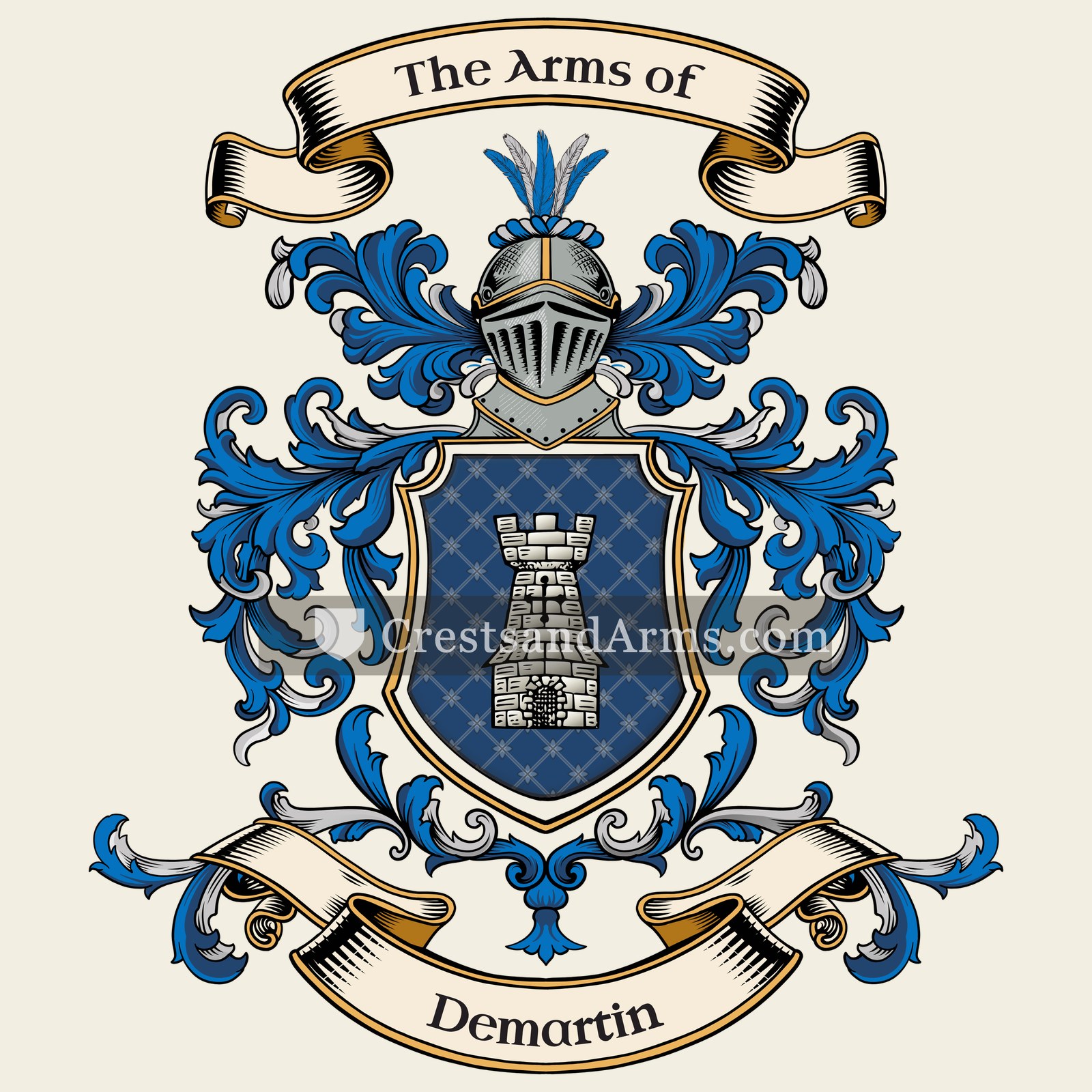
 towerGrandeur and solidity, and a stronghold defended
 towerGrandeur and solidity, and a stronghold defended