A record of documented arms, meaning and origin, researched for the de Meester family lines. Documented in 2 countries.
Reg. 0128 · Dutch, D–F
Meaning of the de Meester family crest colors & symbols
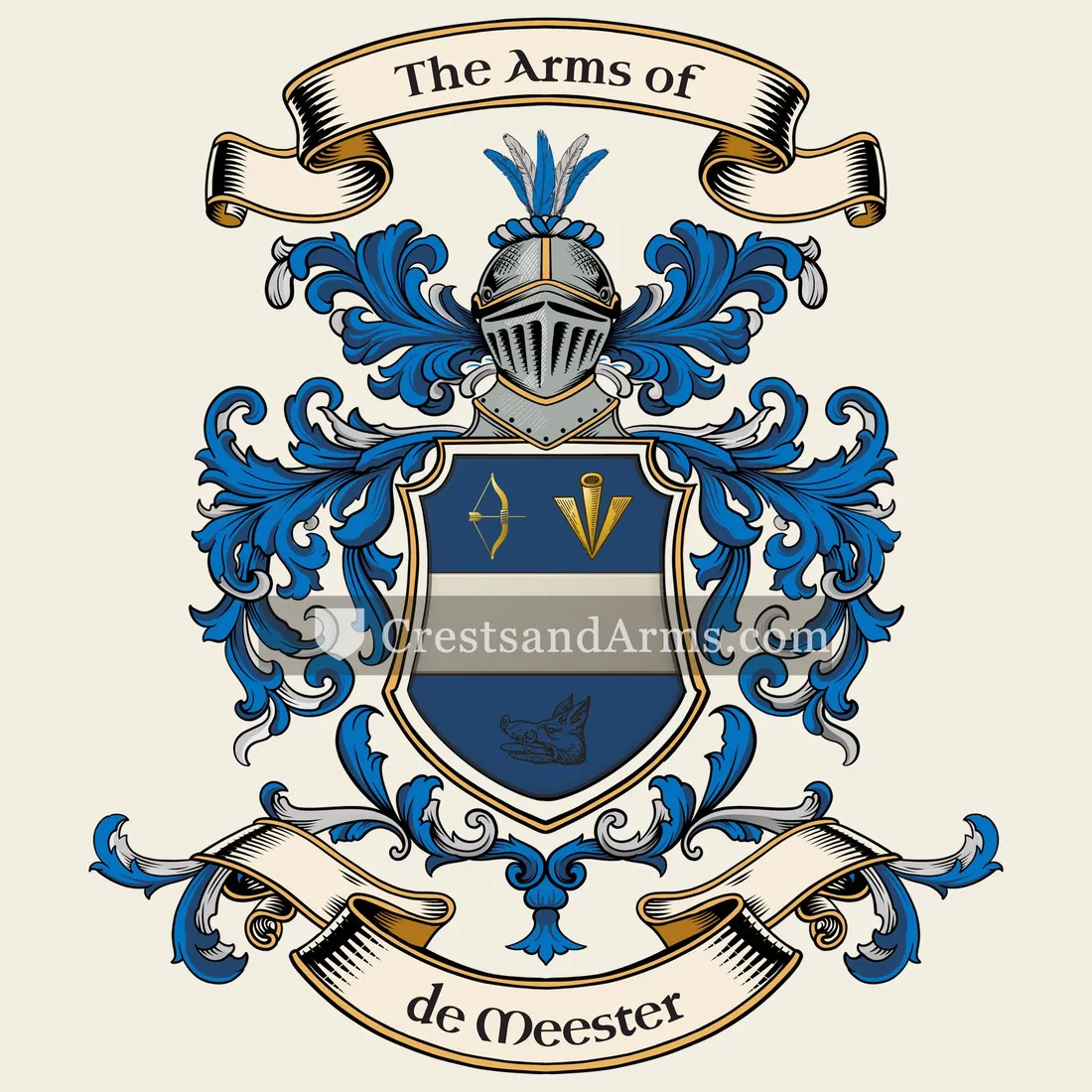
Symbols on this shield
fessThe military belt, and readiness to serve
bowReadiness, and the strength held in reserve
arrowReadiness for battle, and affliction endured
boars headA fierce fighter who battles to the end
Colours
Blue (Azure)Means: Loyalty and truth
Red (Gules)Means: Military strength
Silver (Argent)Means: Peace and sincerity
Gold (Or)Means: Generosity
Black (Sable)Means: Constancy
Historical info
Source
J. B. Rietstap, Armorial Général, Gouda: G. B. van Goor Zonen, 1884–87
Blazon (the actual original written record)
“Coupé d'azur sur gu., à la fasce d'arg., br. sur le coupé; l'azur ch. d'un dextrochère de carn., l'épaule hab. de sa., iss. d'une nuée d'or mouv. du flanc, tenant un arc d'or en pal, senestré d'une flèche ailée du même, en pal; le gu. ch. d'une hure de sanglier de sa., défendue d'arg.”
Netherlandsc. 1815
Digital archive packCoat of arms PNG, gold border print PDF, vector SVG and the certificate of authenticity. Sent to your email in minutes.
Map of Netherlands showing where the de Meester arms are recorded
The de Meester arms were recorded in Netherlands, c. 1815.
Arms such as these were typically recorded in Friesland.
Friesland was low, wet country on the northern coast of the Netherlands, farmed by families who had held the same land for centuries. Free landholders were unusually common there, and a free landholder could carry arms.
This is where the arms were entered in the register. Families often moved to other parts of the country, so the same name can turn up in more than one region.
Region
Friesland
First recorded
1815
Granting Authority for the de Meester Arms
Hoge Raad van Adel
Photograph made by me · CC BY-SA 3.0
The body that granted and recorded arms in Netherlands in this period.
William I of the Netherlands
Sovereign of the period
William I of the Netherlands
1815–1840
Reigning in Netherlands when the de Meester arms are first recorded.
How Arms Worked in Netherlands
In the Netherlands, coats of arms were often used by noble families and those who held specific public offices. These arms were passed down through the generations to legitimate descendants. Younger branches of a family usually kept the original design without needing to add special marks. This system ensured that the family identity remained clear and consistent over many years.
Granting authority
The Hoge Raad van Adel is the official body that regulates and manages noble titles and coats of arms in the Netherlands.
How they got arms
Families typically obtained their coats of arms through official royal grants or by proving their long-standing historical use of the symbols.
Where arms were recorded
Coats of arms are officially recorded in the registers held by the Hoge Raad van Adel, which began its work in 1814.
The family's standing
Recorded among the armigerous families of Netherlands.
Origin & History of the de Meester Family in Netherlands
The surname de Meester is a descriptive name that originates from the Middle Dutch word for master, which often referred to a teacher, a craftsman, or a person of high standing in a local community. While the name appears in various regions across the Low Countries, the family established a notable presence in the northern province of Friesland by the early nineteenth century. During this period, the Netherlands was transitioning into a centralized kingdom following the Napoleonic era, and the formal registration of surnames became strictly enforced by the government. Families like the de Meesters in Friesland were part of this administrative shift, as they transitioned from traditional naming customs to fixed hereditary surnames. This move helped document their lives through birth, marriage, and death records that remain preserved in regional archives today. By settling in Friesland, the family became part of the unique cultural and linguistic landscape of the northern Netherlands, where they contributed to the local economy and social structure during a time of significant national change.
Meaning of the de Meester family crest colors & symbols
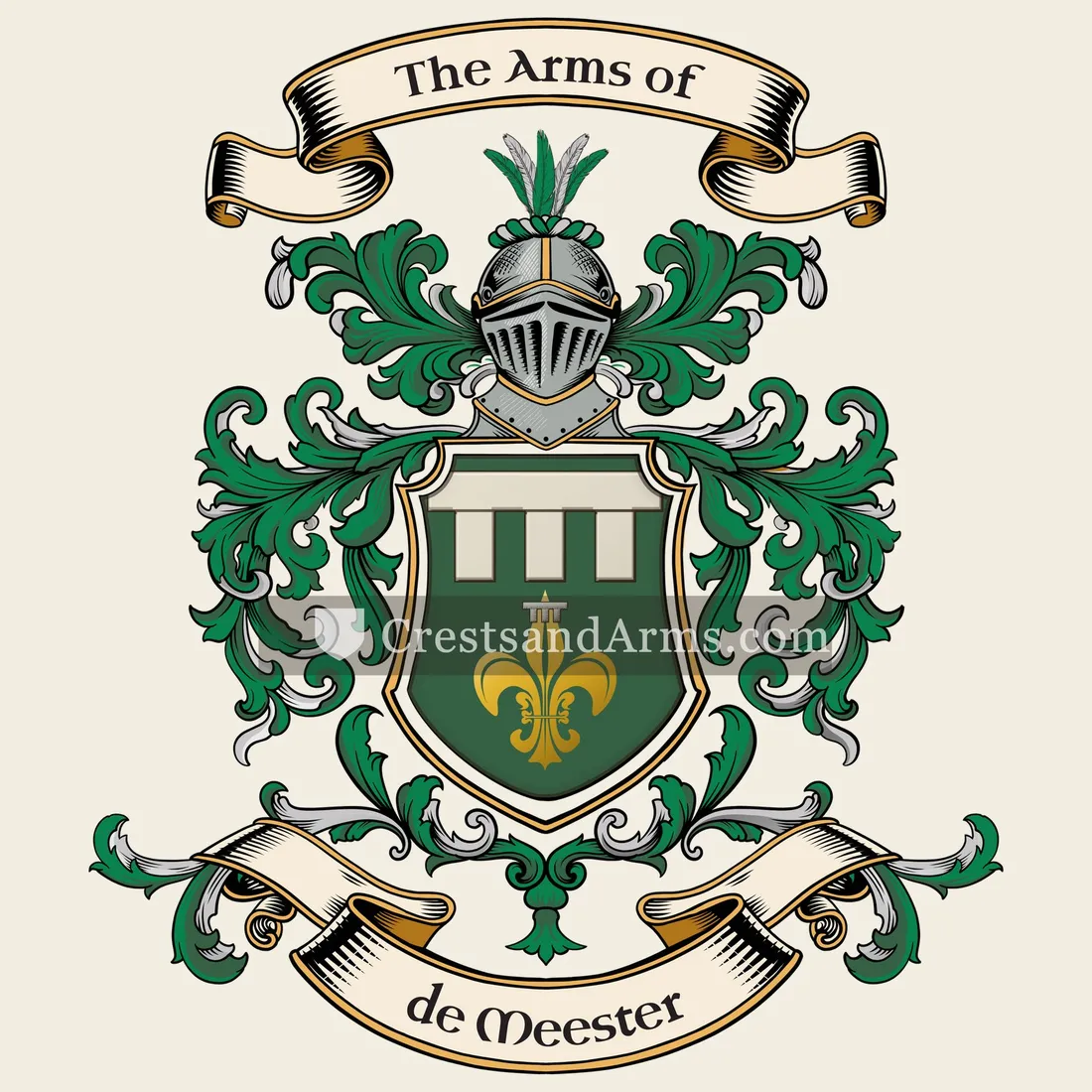
Symbols on this shield
labelThe eldest son, during his father's life
fleur de lisPurity, light, and the sixth son
Colours
Silver (Argent)Means: Peace and sincerity
Gold (Or)Means: Generosity
Historical info
Source
J. B. Rietstap, Armorial Général, Gouda: G. B. van Goor Zonen, 1884–87
Blazon (the actual original written record)
“De sin. à une fleur-de-lis d'or, acc. en chef d'un lambel d'arg.”
BelgiumBruges, c. 1737
Digital archive packCoat of arms PNG, gold border print PDF, vector SVG and the certificate of authenticity. Sent to your email in minutes.
Map of Belgium showing where the de Meester arms are recorded
The de Meester arms were recorded in Bruges, c. 1737.
This is where the arms were entered in the register. Families often moved to other parts of the country, so the same name can turn up in more than one region.
The body that granted and recorded arms in Belgium in this period.
Charles VI, Holy Roman Emperor
Sovereign of the period
Charles VI, Holy Roman Emperor
1711–1740
Reigning in Netherlands when the de Meester arms are first recorded.
How Arms Worked in Belgium
In Belgium, a coat of arms is considered personal property that is passed down through the male line to legitimate descendants. Families often use the same shield design across generations to show their shared heritage. If a branch of the family wants to change the design, they must apply for an official update to their specific version of the arms.
Granting authority
The Conseil héraldique is the official body that regulates and approves all coats of arms in Belgium.
How they got arms
Families obtain their coats of arms through formal royal grants or by confirming their historical right to use existing designs.
Where arms were recorded
All approved coats of arms are officially recorded in the public registers of the Conseil héraldique since 1844.
The family's standing
Recorded among the armigerous families of Belgium.
Origin & History of the de Meester Family in Belgium
The family name de Meester carries a long history in the Flanders region of Belgium, particularly within the city of Bruges. By the early eighteenth century, the family had established a notable presence in this historic urban center. The name itself is derived from the Middle Dutch word for master, which often referred to a skilled craftsman, a teacher, or a person of high standing in a professional guild. During the 1700s, Bruges was a hub of trade and civic organization, and families like the de Meesters were often deeply integrated into the local merchant class or administrative circles. As the family grew, they became part of the social fabric of the city, participating in the economic life that defined the region during the late Enlightenment period. Their presence in 1737 serves as a clear marker of their firm roots in the Belgian landscape, reflecting a lineage that was shaped by the urban development and professional traditions of medieval and early modern Flanders.
de Meester Meaning & Related Branches
Root word
Magister
Latin term for a teacher, master, or person in authority.
This name
de MeesterRefers to a person who held the position of a master, teacher, or overseer.
also spelled
Demester
Related arms
Alexandre de la Londesimilar arms
Monigosimilar arms
Padovasimilar arms
Meester (de) - Bruxellesvariant spelling
Documented Sources
J. B. Rietstap, Armorial Général, Gouda: G. B. van Goor Zonen, 1884–87
Meertens, P.J., De betekenis van Nederlandse familienamen, 1963
Tresoar (Fries Historisch en Letterkundig Centrum), Burgerlijke Stand van Friesland (1811–1950)
Van der Schaar, J., Woordenboek van voornamen, 1964
Digital archive packCoat of arms PNG, gold border print PDF, vector SVG and the certificate of authenticity. Sent to your email in minutes.


 fessThe military belt, and readiness to serve
 bowReadiness, and the strength held in reserve
 arrowReadiness for battle, and affliction endured
 boars headA fierce fighter who battles to the end
 fessThe military belt, and readiness to serve
 bowReadiness, and the strength held in reserve
 arrowReadiness for battle, and affliction endured
 boars headA fierce fighter who battles to the end


 labelThe eldest son, during his father's life
 fleur de lisPurity, light, and the sixth son