Map of France showing where the de Meulenaere arms are recorded
The de Meulenaere arms were recorded in Flandre, c. 1663.
Flandre grew rich on cloth, and its towns were among the busiest in Europe. Merchant families bought land with their profits and took arms to go with it, so trade put as many names in the registers here as land did.
This is where the arms were entered in the register. Families often moved to other parts of the country, so the same name can turn up in more than one region.
The body that granted and recorded arms in France in this period.
Louis XIV of France
Sovereign of the period
Louis XIV of France
1643–1715
Reigning in France when the de Meulenaere arms are first recorded.
How Arms Worked in France
In France, a coat of arms was a mark of honor that passed down through the male line to all legitimate descendants. Families often used the same shield without changes to show their shared heritage. If a branch wanted to stand out, they could add a small mark to their shield to show their specific place in the family tree.
Granting authority
The Juge d'armes de France acted as the official authority that regulated and verified coats of arms across the country.
How they got arms
Families typically inherited their arms from ancestors, though they could also receive them through royal grants or by proving their noble status.
Where arms were recorded
Coats of arms were officially recorded in the Armorial Général de France, which began its main collection in the year 1696.
The family's standing
Recorded among the armigerous families of Flandre.
Origin & History of the de Meulenaere Family in France
The family name de Meulenaere originates from the Dutch language and translates to the miller or the man who works at the mill. While the name is deeply rooted in the history of Flanders, its presence in France grew as the borders of the region shifted during the seventeenth century. By 1663, members of the family were well established in the Flemish territories, which were then undergoing significant political and cultural transitions under French influence. During this era, the name served as a functional identifier for individuals who managed essential grain mills, which were the economic hubs of rural life. As the family moved within these changing borderlands, they integrated into the local administrative and social structures of the time. This transition helped the name persist through generations as the family adapted to the evolving laws and customs of the French kingdom.
Coat of Arms & Family Crest Details
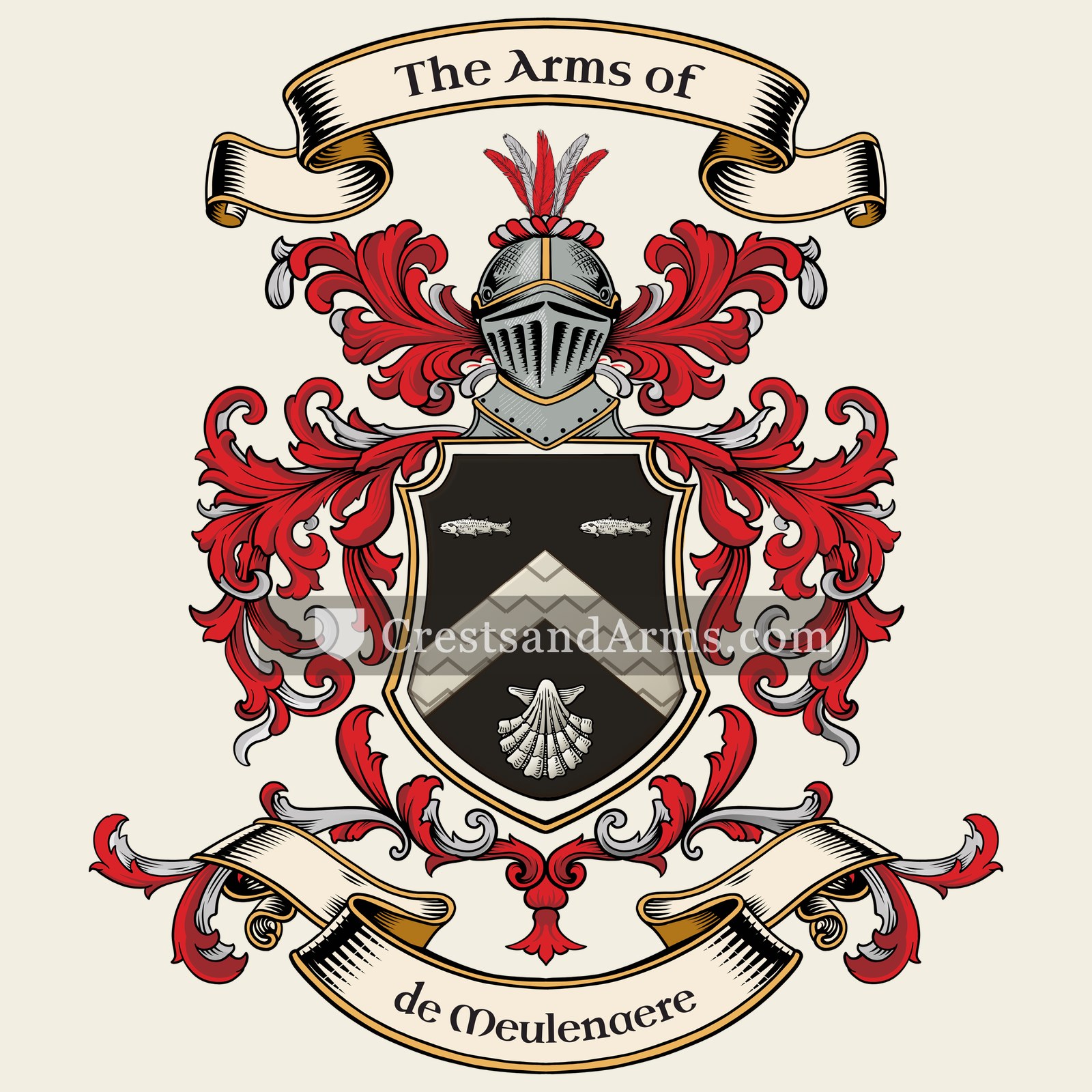
Symbols on this shield
chevronProtection, and faithful service completed
fishA true and generous mind, and Christian faith
escallopThe pilgrim's shell, and a long journey made
Colours
Black (Sable)Means: Constancy
Silver (Argent)Means: Peace and sincerity
Historical info
Source
J. B. Rietstap, Armorial Général, Gouda: G. B. van Goor Zonen, 1884–87
Blazon (the actual original written record)
“De sa. au chev., côtoyé en chef de deux poissons (nommés, en flamand, meulenaers) et acc. en p. d'une coquille, le tout d'arg. Cq. cour. C.: les deux poissons, posés en chev. renv., les têtes en bas. S.: deux griffons d'or, arm. et lamp. de gu. D.: AMANTI NIHIL DIFFICILE.”
BelgiumGand, c. 1810
Digital archive packCoat of arms PNG, gold border print PDF, vector SVG and the certificate of authenticity. Sent to your email in minutes.
Map of Belgium showing where the de Meulenaere arms are recorded
The de Meulenaere arms were recorded in Gand, c. 1810.
This is where the arms were entered in the register. Families often moved to other parts of the country, so the same name can turn up in more than one region.
The body that granted and recorded arms in Belgium in this period.
Napoleon
Sovereign of the period
Napoleon
1804–1814
Reigning in France when the de Meulenaere arms are first recorded.
How Arms Worked in Belgium
In Belgium, a coat of arms is considered personal property that is passed down through the male line to legitimate descendants. Families often use the same shield design across generations to show their shared heritage. If a branch of the family wants to change the design, they must apply for an official update to their specific version of the arms.
Granting authority
The Conseil héraldique is the official body that regulates and approves all coats of arms in Belgium.
How they got arms
Families obtain their coats of arms through formal royal grants or by confirming their historical right to use existing designs.
Where arms were recorded
All approved coats of arms are officially recorded in the public registers of the Conseil héraldique since 1844.
The family's standing
Recorded among the armigerous families of Belgium.
Origin & History of the de Meulenaere Family in Belgium
The family name de Meulenaere is deeply rooted in the history of the Flanders region in Belgium. The name itself is occupational, as it translates from Dutch to mean the miller or the one who works at a windmill. By the early nineteenth century, the family had established a clear presence in the city of Ghent, which was then known as Gand. During this period, Ghent was a major industrial hub undergoing significant changes due to the rise of the textile industry. Families with this name were often integrated into the urban life of the city, contributing to the local economy and social structure. Over time, the name became associated with the industrious spirit of the region as members of the family navigated the shifting political and economic landscapes of nineteenth-century Belgium.
de Meulenaere Meaning & Related Branches
Root word
molinarius
A person who operates a mill for grinding grain.
This name
de MeulenaereOccupational surname referring to a miller or someone who lived near a mill.
also spelled
de Meulenaer
de Meulenaar
de Meulenaare
Demeulenaer
Related arms
de Meulenaervariant spelling
Documented Sources
J. B. Rietstap, Armorial Général, Gouda: G. B. van Goor Zonen, 1884–87
De Flou, Karel. Woordenboek der Toponymie van Westelijk Vlaanderen, Vlaamsch Artesië, het Land van den Hoek, de Fransche Westhoek, Staats-Vlaanderen en het Land van Waas. 1914
Archives Départementales du Nord. Série B: Cours et juridictions. 1663
Fruin, Robert. Geschiedenis der Staatsinstellingen in Nederland tot den val der Republiek. 1901
Digital archive packCoat of arms PNG, gold border print PDF, vector SVG and the certificate of authenticity. Sent to your email in minutes.


 millrind / fer de molineThe mill's iron, and the grinding of grain
 millrind / fer de molineThe mill's iron, and the grinding of grain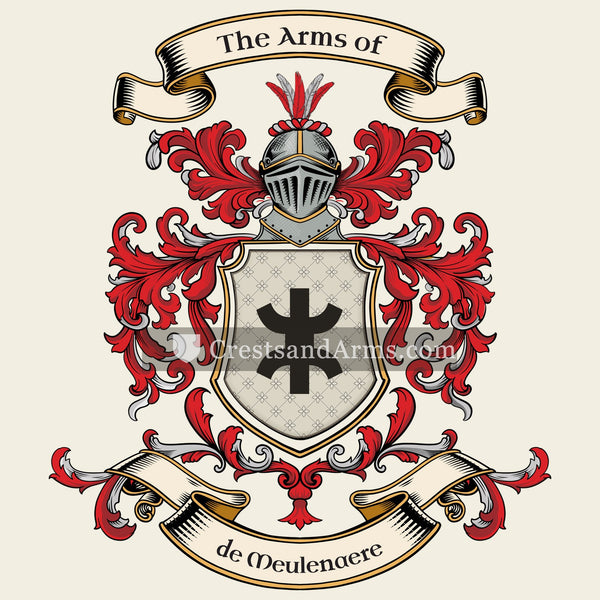


 chevronProtection, and faithful service completed
 fishA true and generous mind, and Christian faith
 escallopThe pilgrim's shell, and a long journey made