Map of Switzerland showing where the Demont arms are recorded
The Demont arms were recorded in Neufchâtel, c. 1745.
This is where the arms were entered in the register. Families often moved to other parts of the country, so the same name can turn up in more than one region.
The body that granted and recorded arms in Switzerland in this period.
How Arms Worked in Switzerland
In Switzerland, coats of arms were not restricted to the nobility and were often adopted by common citizens and families. These symbols were passed down through generations to show family identity. When branches of a family grew, they often changed small details of the design to distinguish their own line from the original group.
Granting authority
Cantonal and civic authorities managed the use of coats of arms within their specific regions and local jurisdictions.
How they got arms
Families typically assumed their own coats of arms based on local custom rather than receiving them from a central monarch.
Where arms were recorded
Arms were recorded in various cantonal and civic registers starting from the fourteenth century throughout the Swiss region.
The family's standing
Recorded among the armigerous families of Switzerland.
Origin & History of the Demont Family in Switzerland
The name Demont carries a distinct history rooted in the mountainous landscapes of Switzerland, particularly within the French-speaking regions. By the mid-eighteenth century, records confirm that families bearing this name were well-established in the canton of Neuchâtel. The name itself is topographical in origin, likely derived from the French phrase "de mont," which translates to "of the mountain." This suggests that the earliest ancestors were identified by their residence in high-altitude settlements or alpine valleys. During the 1700s, these families were often integrated into the local agrarian and artisan communities of the Jura Mountains. As they moved through these regions, they contributed to the unique cultural and linguistic development of the area, maintaining a strong connection to the rugged terrain that originally inspired their name.
Coat of Arms & Family Crest Details
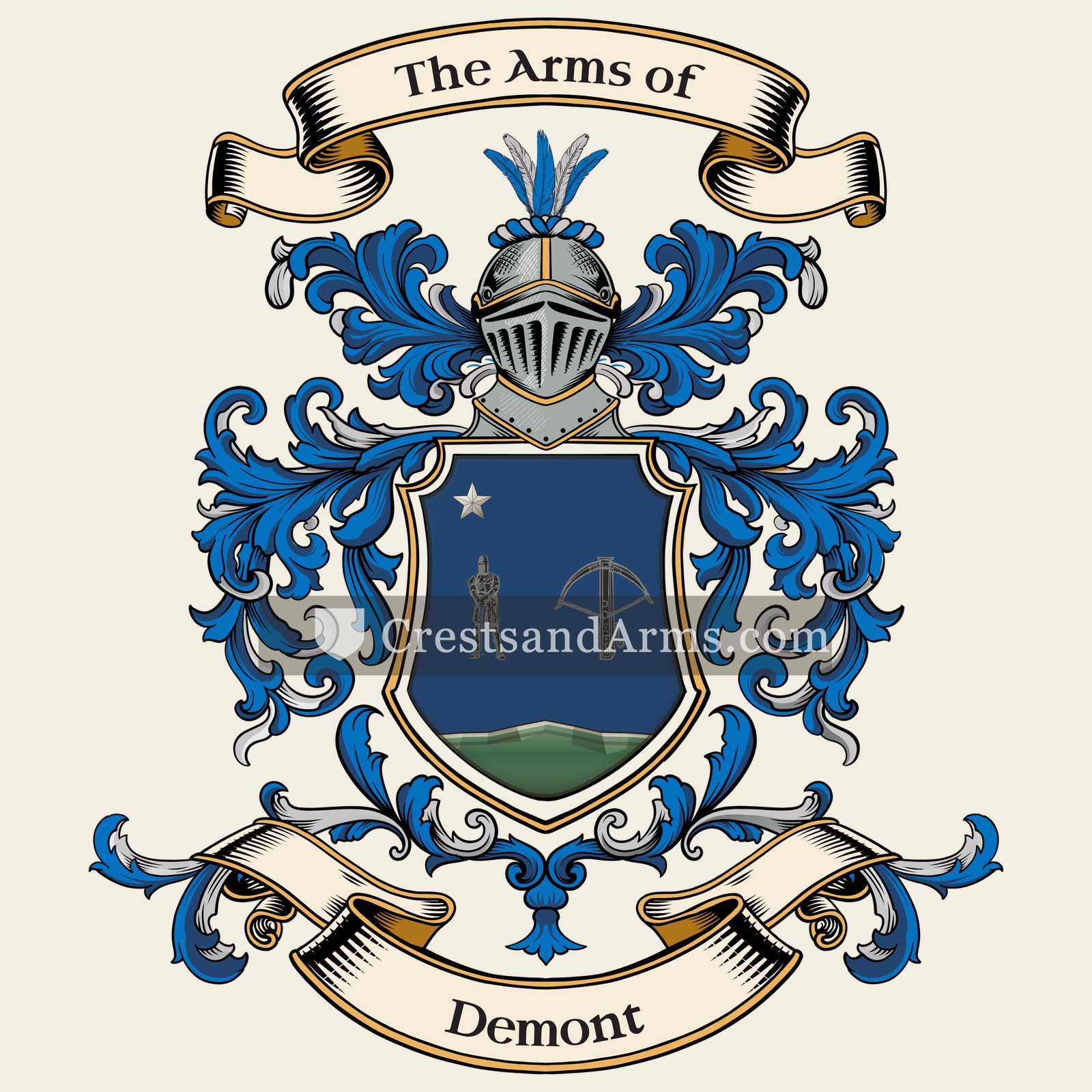
Symbols on this shield
mountThe ground held, and steadfastness upon it
knightChivalry and service in arms
crossbowReadiness for battle and skill at arms
mulletThe third son, and a divine quality from above
Colours
Blue (Azure)Means: Loyalty and truth
Green (Vert)Means: Hope
Silver (Argent)Means: Peace and sincerity
Historical info
Source
J. B. Rietstap, Armorial Général, Gouda: G. B. van Goor Zonen, 1884–87
Blazon (the actual original written record)
“D'azur à un homme de profil, hab. au nat., coiffé d'une casquette, soutenu d'une terrasse de sin., tenant une arbalète tendue et visant une étoile d'arg., posée au canton dextre du chef. C.: une étoile d'arg.”
Belgiumc. 1737
Digital archive packCoat of arms PNG, gold border print PDF, vector SVG and the certificate of authenticity. Sent to your email in minutes.
Map of Belgium showing where the Demont arms are recorded
The Demont arms were recorded in Belgium, c. 1737.
Arms such as these were typically recorded in Brabant.
Brabant lay at the heart of the Low Countries, where the trade routes met. Its towns were wealthy and its landowners many, and both kinds of family kept arms, which is why the region is so heavily represented.
This is where the arms were entered in the register. Families often moved to other parts of the country, so the same name can turn up in more than one region.
The body that granted and recorded arms in Belgium in this period.
Charles VI, Holy Roman Emperor
Sovereign of the period
Charles VI, Holy Roman Emperor
1711–1740
Reigning in Switzerland when the Demont arms are first recorded.
How Arms Worked in Belgium
In Belgium, a coat of arms is considered personal property that is passed down through the male line to legitimate descendants. Families often use the same shield design across generations to show their shared heritage. If a branch of the family wants to change the design, they must apply for an official update to their specific version of the arms.
Granting authority
The Conseil héraldique is the official body that regulates and approves all coats of arms in Belgium.
How they got arms
Families obtain their coats of arms through formal royal grants or by confirming their historical right to use existing designs.
Where arms were recorded
All approved coats of arms are officially recorded in the public registers of the Conseil héraldique since 1844.
The family's standing
Recorded among the armigerous families of Belgium.
Origin & History of the Demont Family in Belgium
The surname Demont finds its roots in the historical landscape of the Low Countries, specifically within the Duchy of Brabant. By the year 1737, records confirm that members of the family were already established in this region, which was then under the rule of the Austrian Habsburgs. The name itself is topographic in origin, meaning it was likely given to people who lived near a mountain or a significant hill. In the flat terrain of the Belgian provinces, such a name often identified families who resided on higher ground or near prominent earthen fortifications. As the family grew throughout the eighteenth century, they became part of the local social fabric, participating in the agricultural and merchant life that defined the Brabant region during a period of relative economic recovery. Their presence in official parish and civil registers from this era highlights their integration into the community long before the modern borders of Belgium were formally established.
Demont Meaning & Related Branches
Root word
de monte
Latin term meaning from the mountain or of the mountain.
This name
DemontA topographic surname identifying individuals who lived on or near a mountain.
also spelled
de Monte
de Montay
de Montai
Demond
Demonte
Documented Sources
J. B. Rietstap, Armorial Général, Gouda: G. B. van Goor Zonen, 1884–87
Archives: Archives de l'État de Neuchâtel, Registres paroissiaux de l'ancien régime
Books: Dictionnaire historique de la Suisse, Dictionnaire historique de la Suisse (DHS), 2002
Books: Montandon, Charles, Histoire de l'ancien comté de Neuchâtel, 1925
Digital archive packCoat of arms PNG, gold border print PDF, vector SVG and the certificate of authenticity. Sent to your email in minutes.


 cross symbolChristian faith and service
 escallopThe pilgrim's shell, and a long journey made
 cross symbolChristian faith and service
 escallopThe pilgrim's shell, and a long journey made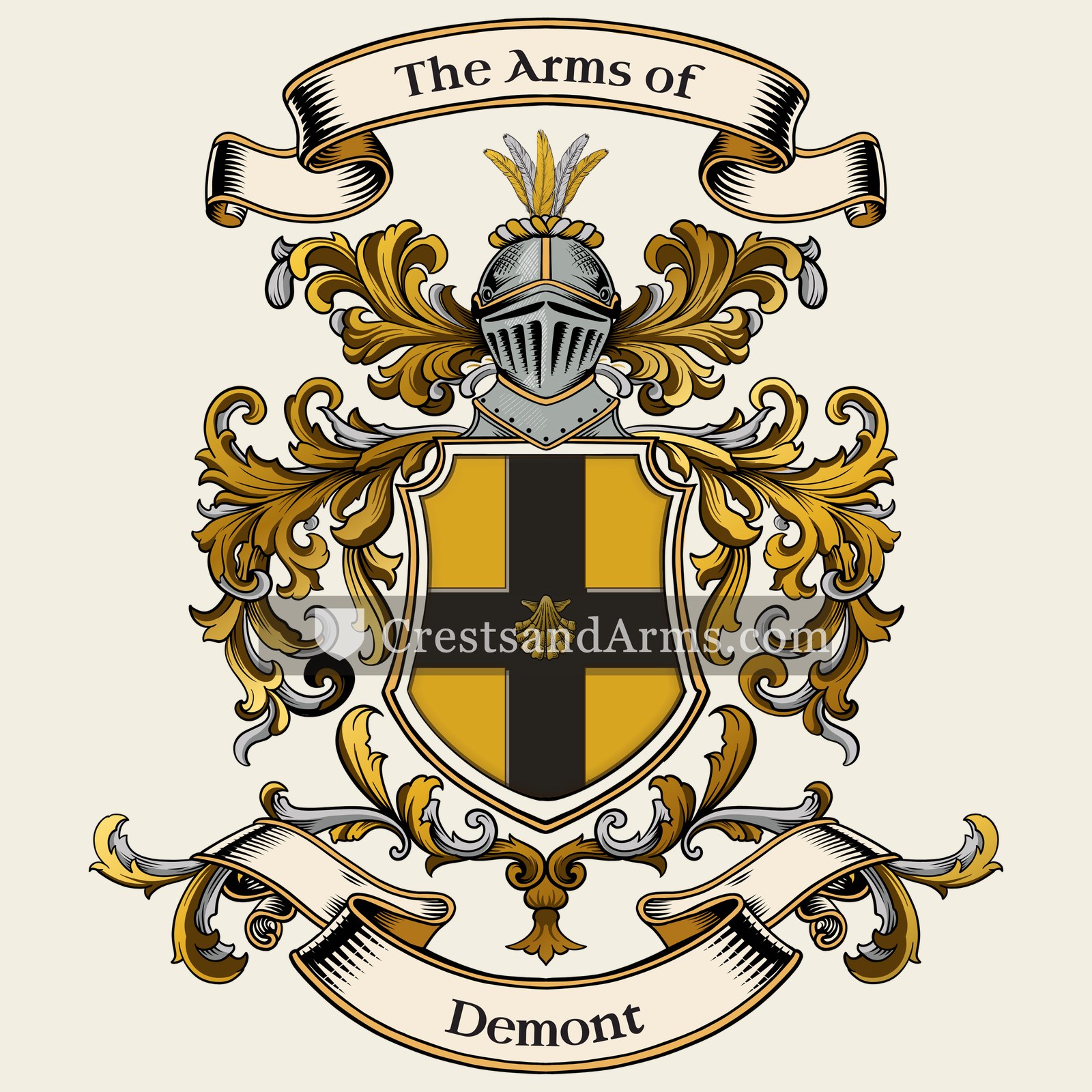

 mountThe ground held, and steadfastness upon it
 knightChivalry and service in arms
 crossbowReadiness for battle and skill at arms
 mulletThe third son, and a divine quality from above