A record of documented arms, meaning and origin, researched for the Demuth family lines. Documented in 2 countries.
Reg. 6704 · German, D–F
Coat of Arms & Family Crest Details
Symbols on this shield
ravenConstancy and divine providence
Colours
Silver (Argent)Means: Peace and sincerity
Red (Gules)Means: Military strength
Black (Sable)Means: Constancy
Historical info
Source
J. B. Rietstap, Armorial Général, Gouda: G. B. van Goor Zonen, 1884–87
Blazon (the actual original written record)
“D'arg. à une barrière de quatre palissades de gu. et de trois poutres transversales, occupant la moitié inférieure de l'écu; au corbeau de sa., perché sur la barrière. C.: un corbeau de sa., entre deux prob. de gu. L. d'arg. et de gu.”
Germanyc. 1765
Digital archive packCoat of arms PNG, gold border print PDF, vector SVG and the certificate of authenticity. Sent to your email in minutes.
Map of Germany showing where the Demuth arms are recorded
The Demuth arms were recorded in Germany, c. 1765.
Arms such as these were typically recorded in Bavaria.
Bavaria was a country of old landed families and walled market towns. Estates passed down the same line for centuries, and both the landowners and the leading townsmen kept arms, which is why so many Bavarian names sit in the registers.
This is where the arms were entered in the register. Families often moved to other parts of the country, so the same name can turn up in more than one region.
The body that granted and recorded arms in Germany in this period.
Francis I, Holy Roman Emperor
Sovereign of the period
Francis I, Holy Roman Emperor
1745–1765
Reigning in Germany when the Demuth arms are first recorded.
How Arms Worked in Germany
In the Holy Roman Empire, coats of arms were often granted to individuals by the Emperor or his representatives. These arms were then passed down through the generations to all legitimate descendants of the original holder. Younger branches of a family usually kept the same shield design without needing to change it, as the arms belonged to the entire lineage.
Granting authority
The Holy Roman Emperor held the sole power to grant new coats of arms throughout his vast imperial territories.
How they got arms
Families typically obtained their coats of arms through a formal imperial grant or by proving their noble status to the authorities.
Where arms were recorded
These grants were officially recorded in the Imperial Chancery registers, which began keeping formal records of such honors during the Middle Ages.
The family's standing
Recorded among the armigerous families of Germany.
Origin & History of the Demuth Family in Germany
The surname Demuth is deeply rooted in the German language and carries a meaning that reflects the values of its early bearers. Derived from the Middle High German word *diemuot*, the name translates to humility or a gentle spirit. By the mid-18th century, families carrying this name were well-established in the region of Bavaria. During this period, Bavaria was a collection of territories where social status was often tied to land ownership and local trade. Families like the Demuths were typically part of the industrious working class, contributing to the agricultural and craft-based economy that defined the Bavarian landscape in 1765. As the name spread through the German states, it remained a testament to the cultural emphasis on modesty and quiet strength that was highly regarded in local village life.
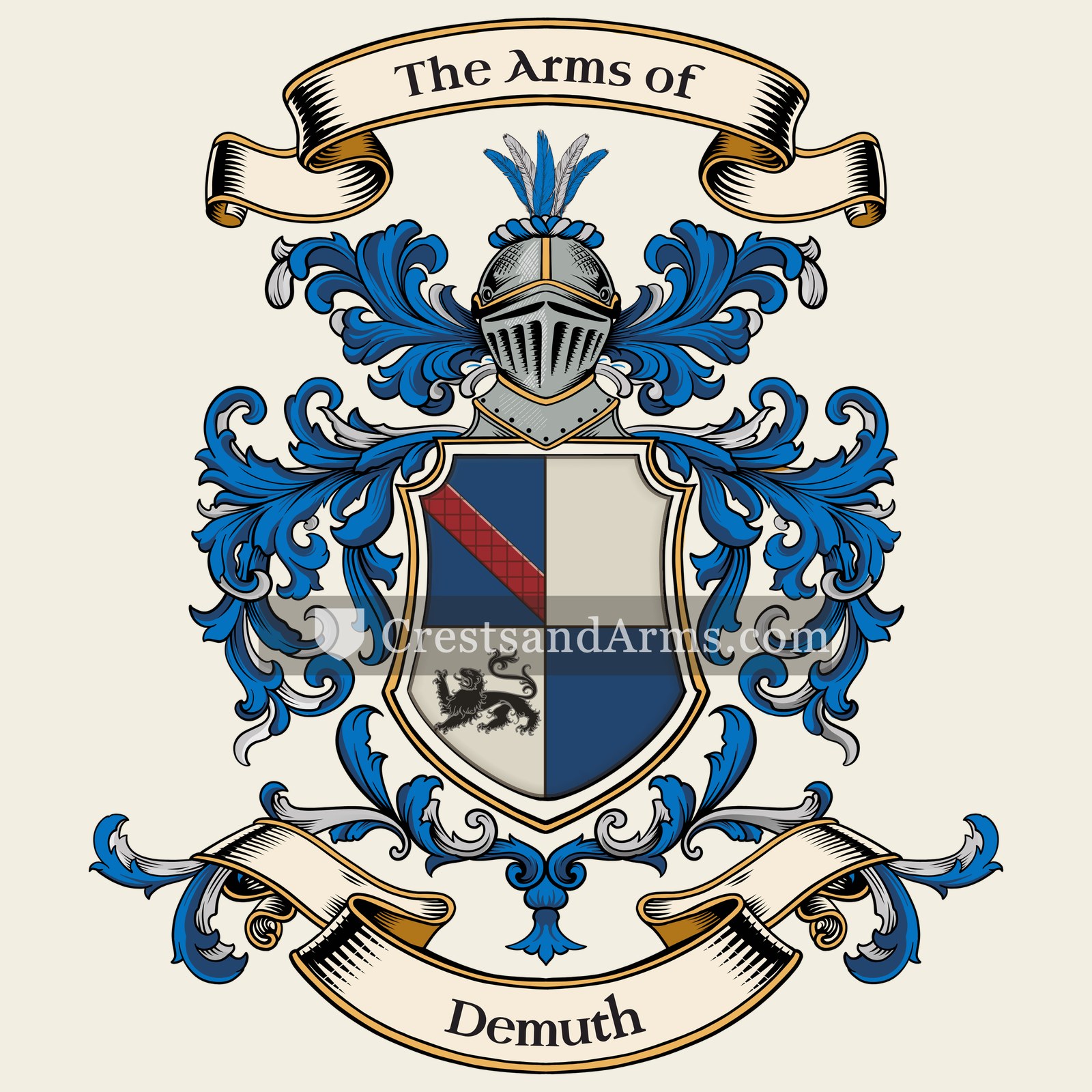
Coat of Arms & Family Crest Details
Symbols on this shield
bendDefence, and the scarf of a commander
lionCourage, strength and royalty
Colours
Blue (Azure)Means: Loyalty and truth
Silver (Argent)Means: Peace and sincerity
Red (Gules)Means: Military strength
Historical info
Source
J. B. Rietstap, Armorial Général, Gouda: G. B. van Goor Zonen, 1884–87
Blazon (the actual original written record)
“Ec.: au 1 d'azur à la demi-aigle échiquetée d'arg. et de gu., mouv. du parti; au 2 d'arg. à la bande de gu., ch. de deux annelets d'or; au 3 d'arg. à un livre fermé, relié d'azur, doré sur tranche, le plat marqué d'un T d'or; au 4 de gu. au lion d'arg., cour. d'or. Cq. cour. C.: un lion iss. d'arg., tenant entre ses pattes le livre du 3. L.: à dextre d'arg. et d'azur, à sen. d'arg. et de gu. D.: LABORE AD METAM.”
Austriac. 1875
Digital archive packCoat of arms PNG, gold border print PDF, vector SVG and the certificate of authenticity. Sent to your email in minutes.
Map of Austria showing where the Demuth arms are recorded
The Demuth arms were recorded in Austria, c. 1875.
Arms such as these were typically recorded in Tyrol.
Tyrol was mountain country in western Austria, where the valleys were held by families who had been there a very long time. Old tenure counted for more than money, and old families carried arms.
This is where the arms were entered in the register. Families often moved to other parts of the country, so the same name can turn up in more than one region.
Region
Tyrol
First recorded
1875
Granting Authority for the Demuth Arms
Imperial and Royal chancery
Sodacan · CC BY-SA 3.0
The body that granted and recorded arms in Austria in this period.
Franz Joseph I of Austria
Sovereign of the period
Franz Joseph I of Austria
1848–1916
Reigning in Germany when the Demuth arms are first recorded.
How Arms Worked in Austria
Austrian coats of arms were often linked directly to noble titles granted by the Emperor. These symbols belonged to the entire family line rather than just one individual. When a family grew, new branches kept the original design without needing to change it. This system allowed all members of a noble house to share the same identity across many generations.
Granting authority
The Imperial and Royal chancery managed all heraldic matters and controlled the official granting of arms throughout the Austrian lands.
How they got arms
Families typically received their arms through a formal imperial decree that often accompanied the elevation of a person to noble status.
Where arms were recorded
Official records of these grants were kept in the Imperial Register of Nobility which began its formal documentation process in 1453.
The family's standing
Recorded among the armigerous families of Austria.
Origin & History of the Demuth Family in Austria
The surname Demuth is deeply rooted in the German language and carries a meaning related to humility or a gentle spirit. While the name appears in various regions, the family established a notable presence in the rugged landscape of Tyrol by the late 19th century. During this era, Tyrol was a vital part of the Austro-Hungarian Empire, serving as a mountainous crossroads for trade and cultural exchange between Central Europe and Italy. Families living in this region often worked in agriculture, forestry, or local crafts, adapting their livelihoods to the challenging alpine environment. By 1875, the Demuth name was already well-integrated into the social fabric of these mountain communities. This period was a time of significant transition for the region, as improved infrastructure began to connect isolated villages to larger urban centers like Innsbruck. The history of the Demuth family in Austria reflects this broader story of resilience and steady growth within the heart of the Alps.
Demuth Meaning & Related Branches
Root word
demuot
Old High German term combining words for gentle and spirit or mind.
This name
DemuthRefers to a person characterized by humility, modesty, or a gentle disposition.
also spelled
Demut
Demoot
Documented Sources
J. B. Rietstap, Armorial Général, Gouda: G. B. van Goor Zonen, 1884–87
Bahlow, Hans, Deutsches Namenlexikon: Familien- und Vornamen nach Ursprung und Sinn erklärt, 1967
Bayerisches Hauptstaatsarchiv, Kurbayern Hofkammer, Steuer- und Revisionsunterlagen, 1765
Heintze, Albert, Die deutschen Familien-Namen: geschichtlich, geographisch, sprachlich, 1903
Digital archive packCoat of arms PNG, gold border print PDF, vector SVG and the certificate of authenticity. Sent to your email in minutes.


 ravenConstancy and divine providence
 ravenConstancy and divine providence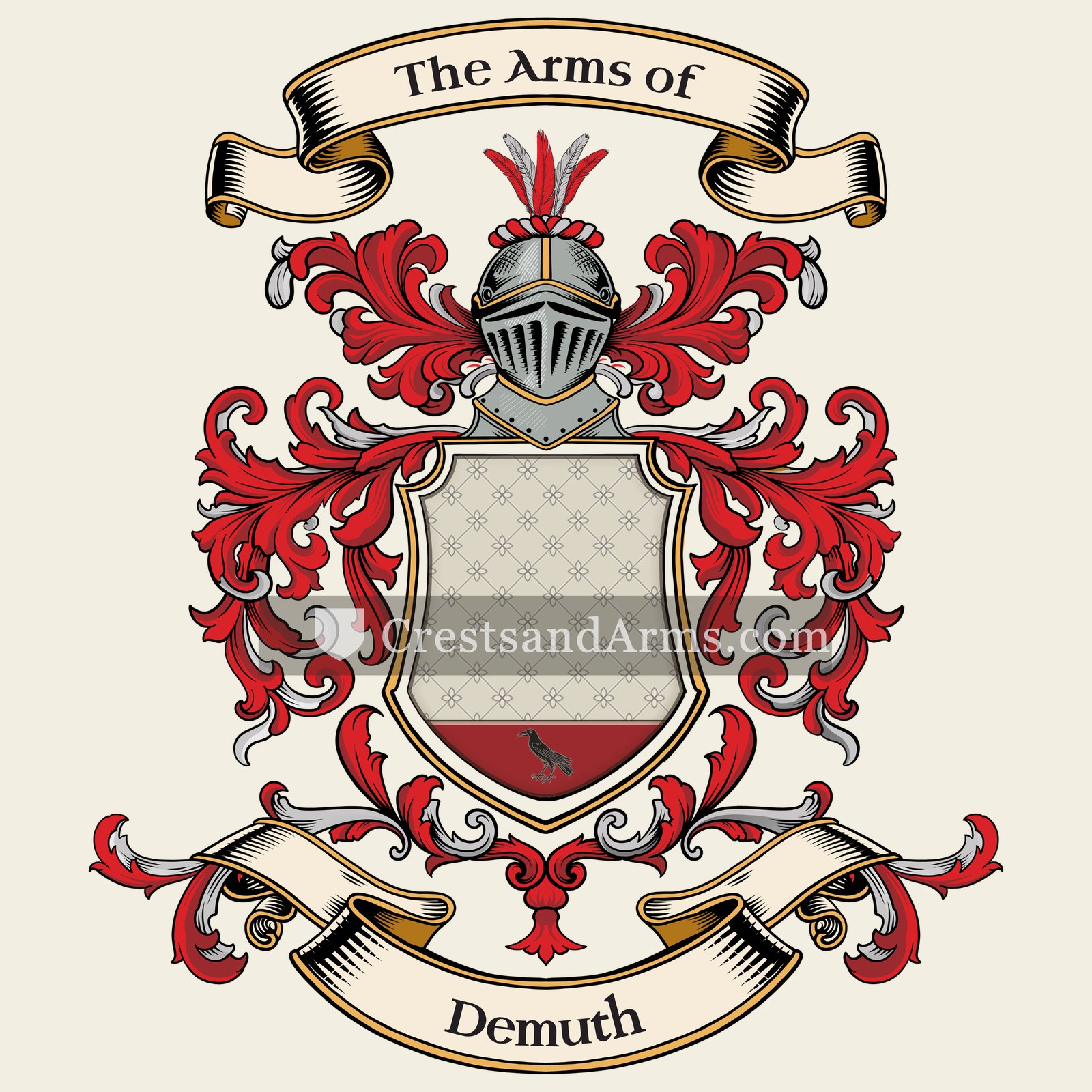


 bendDefence, and the scarf of a commander
 lionCourage, strength and royalty