Map of Britain showing where the Denis arms are recorded
The Denis arms were recorded in Kent, c. 1767.
Kent sits between London and the short crossing to Europe, and the trade passing through made it wealthy. Merchant families bought land with that money, and it was landowners who took coats of arms.
This is where the arms were entered in the register. Families often moved to other parts of the country, so the same name can turn up in more than one region.
The body that granted and recorded arms in Britain in this period.
George III of Great Britain
Sovereign of the period
George III of Great Britain
1760–1801
Reigning in Britain when the Denis arms are first recorded.
How Arms Worked in Britain
English heraldry allowed arms to be shared by all legitimate descendants of the original owner. These symbols were treated as personal property that moved through the generations to all children. While the eldest son kept the original design, other family members could use the same shield without needing to change it or register their own unique versions.
Granting authority
The College of Arms in London has regulated the use of coats of arms throughout England and Wales since 1484.
How they got arms
Families typically obtained their coats of arms through a formal grant from the Crown or by proving their ancient right to them.
Where arms were recorded
All official coats of arms are recorded in the registers kept at the College of Arms, which date back to the fifteenth century.
The family's standing
Recorded among the armigerous families of Kent.
Origin & History of the Denis Family in Britain
The surname Denis is rooted in the ancient name Dionysius, which honors a Greek god and later became associated with Saint Denis, the patron saint of France. While the name has deep continental origins, it became established in Britain through centuries of migration and cultural exchange. By the middle of the eighteenth century, the family had firmly planted roots in the county of Kent. Records from 1767 confirm their presence in this region, where they likely participated in the local agricultural or trade economies that defined life in southeastern England at the time. As the family settled into their community, the name evolved alongside the changing social landscape of the British Isles. Their history reflects the broader movement of families who helped shape the local identity of Kent during the Georgian era.
Coat of Arms & Family Crest Details
Symbols on this shield
savages head affrontyAn enemy overcome
wreathHonour, and a victory crowned
Colours
Red (Gules)Means: Military strength
Gold (Or)Means: Generosity
Historical info
Source
J. B. Rietstap, Armorial Général, Gouda: G. B. van Goor Zonen, 1884–87
Blazon (the actual original written record)
“De gu. à trois têtes de More, tort d'or. (de gu.”
BrabantBrabant, c. 1737
Digital archive packCoat of arms PNG, gold border print PDF, vector SVG and the certificate of authenticity. Sent to your email in minutes.
Map of Belgium showing where the Denis arms are recorded
The Denis arms were recorded in Brabant, c. 1737.
Brabant lay at the heart of the Low Countries, where the trade routes met. Its towns were wealthy and its landowners many, and both kinds of family kept arms, which is why the region is so heavily represented.
This is where the arms were entered in the register. Families often moved to other parts of the country, so the same name can turn up in more than one region.
The body that granted and recorded arms in Belgium in this period.
Charles VI, Holy Roman Emperor
Sovereign of the period
Charles VI, Holy Roman Emperor
1711–1740
Reigning in Britain when the Denis arms are first recorded.
How Arms Worked in Belgium
In Belgium, a coat of arms is considered personal property that is passed down through the male line to legitimate descendants. Families often use the same shield design across generations to show their shared heritage. If a branch of the family wants to change the design, they must apply for an official update to their specific version of the arms.
Granting authority
The Conseil héraldique is the official body that regulates and approves all coats of arms in Belgium.
How they got arms
Families obtain their coats of arms through formal royal grants or by confirming their historical right to use existing designs.
Where arms were recorded
All approved coats of arms are officially recorded in the public registers of the Conseil héraldique since 1844.
The family's standing
Recorded among the armigerous families of Brabant.
Origin & History of the Denis Family in Belgium
The surname Denis has deep roots in the historical region of Brabant, where records confirm the presence of the family as early as 1737. The name itself is a derivative of the ancient Greek name Dionysius, which became popular across Europe due to the influence of Saint Denis, the patron saint of France. In the context of the Low Countries, families bearing this name were often integrated into the local agricultural or artisan communities that defined the social structure of the eighteenth century. As the region transitioned through various political shifts under Austrian and later French rule, the Denis family likely navigated the complex landscape of local parish life and regional trade. These early ancestors were part of a broader demographic movement where surnames became increasingly fixed in official registers, marking a transition from simple given names to established family lineages that persisted across generations in the Belgian provinces.
Coat of Arms & Family Crest Details
Symbols on this shield
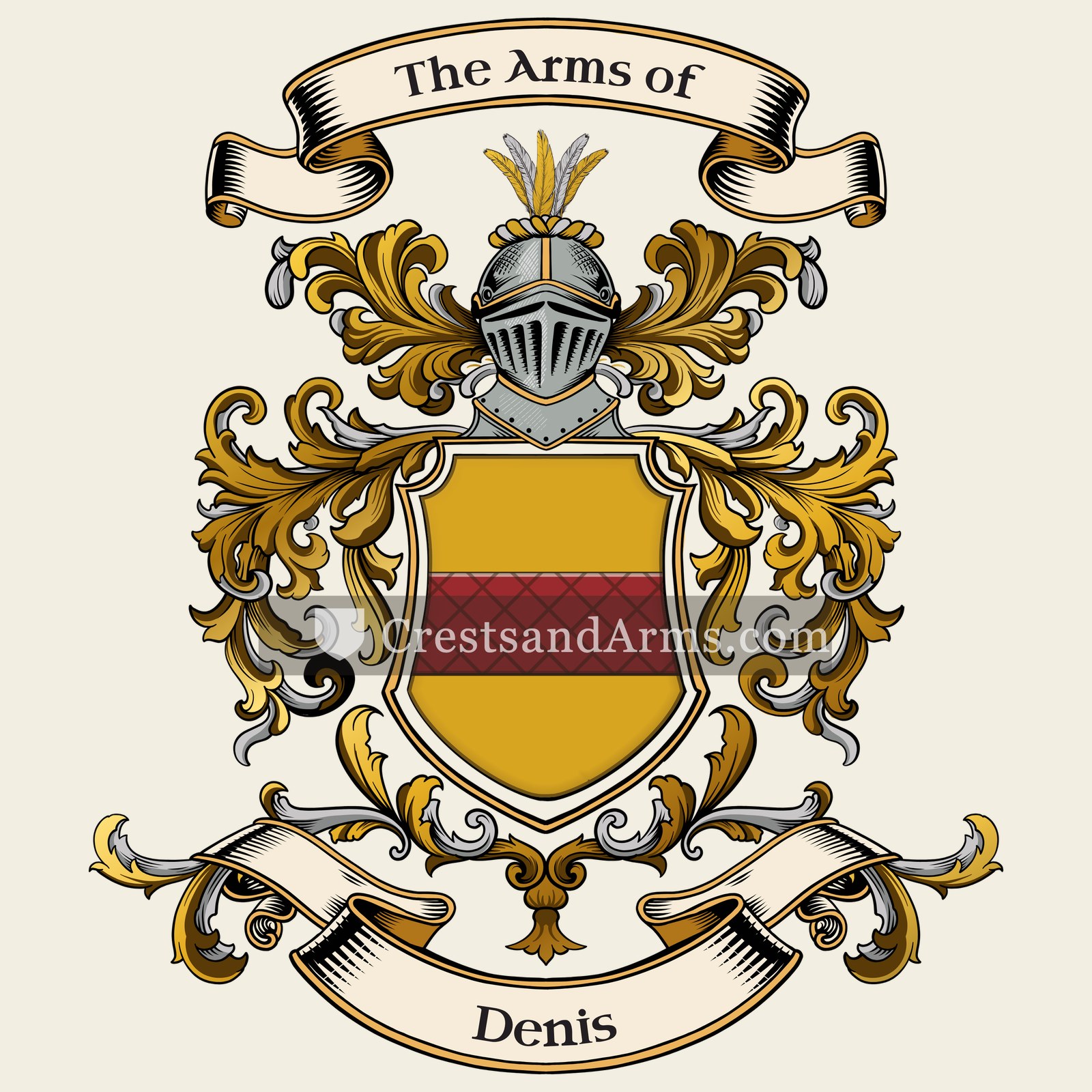
fessThe military belt, and readiness to serve
Colours
Gold (Or)Means: Generosity
Red (Gules)Means: Military strength
Historical info
Source
J. B. Rietstap, Armorial Général, Gouda: G. B. van Goor Zonen, 1884–87
Blazon (the actual original written record)
“D'or à la fasce de gu.”
PicardiePicardie, c. 1663
Digital archive packCoat of arms PNG, gold border print PDF, vector SVG and the certificate of authenticity. Sent to your email in minutes.
Map of France showing where the Denis arms are recorded
The Denis arms were recorded in Picardie, c. 1663.
Picardie lay on the northern road into France and saw armies pass through it repeatedly. Its landowners were soldiers as often as farmers, and a soldier needed a shield he could be recognised by.
This is where the arms were entered in the register. Families often moved to other parts of the country, so the same name can turn up in more than one region.
The body that granted and recorded arms in France in this period.
Louis XIV of France
Sovereign of the period
Louis XIV of France
1643–1715
Reigning in Britain when the Denis arms are first recorded.
How Arms Worked in France
In France, a coat of arms was a mark of honor that passed down through the male line to all legitimate descendants. Families often used the same shield without changes to show their shared heritage. If a branch wanted to stand out, they could add a small mark to their shield to show their specific place in the family tree.
Granting authority
The Juge d'armes de France acted as the official authority that regulated and verified coats of arms across the country.
How they got arms
Families typically inherited their arms from ancestors, though they could also receive them through royal grants or by proving their noble status.
Where arms were recorded
Coats of arms were officially recorded in the Armorial Général de France, which began its main collection in the year 1696.
The family's standing
Recorded among the armigerous families of Picardie.
Origin & History of the Denis Family in France
The family name Denis originates from the ancient Greek name Dionysius, which honors the god of wine and fertility. Over many centuries, this name evolved through Latin and eventually became a popular given name throughout France due to the influence of Saint Denis, the patron saint of the country. By the middle of the seventeenth century, families bearing this name were well-established in the northern region of Picardie. In 1663, records confirm that members of the Denis family were active participants in the local life of this province. During this era, families in Picardie often lived in agricultural communities where they worked the land or practiced skilled trades. Because the name was tied to a significant religious figure, it was common for families to adopt it as a surname to signify their devotion and identity within their local parish. This transition from a first name to a hereditary family name allowed the Denis lineage to maintain a distinct presence in the historical records of northern France.
Denis Meaning & Related Branches
Root word
Dionysius
Derived from Dionysus, the Greek god of wine and fertility.
This name
DenisA medieval English and French form of the name meaning follower of Dionysus.
also spelled
Denys
Deny
Dennis
Denise
Dennes
Related arms
Denysvariant spelling
Dennyvariant spelling
Dennys, or Denisvariant spelling
Documented Sources
J. B. Rietstap, Armorial Général, Gouda: G. B. van Goor Zonen, 1884–87
Reaney, P.H. and Wilson, R.M., A Dictionary of English Surnames, 1997
Hanks, Patrick, Dictionary of American Family Names, 2003
Kent Archives, Parish Registers of Kent, 1767
Digital archive packCoat of arms PNG, gold border print PDF, vector SVG and the certificate of authenticity. Sent to your email in minutes.


 chevronProtection, and faithful service completed
 fleur de lisPurity, light, and the sixth son
 chevronProtection, and faithful service completed
 fleur de lisPurity, light, and the sixth son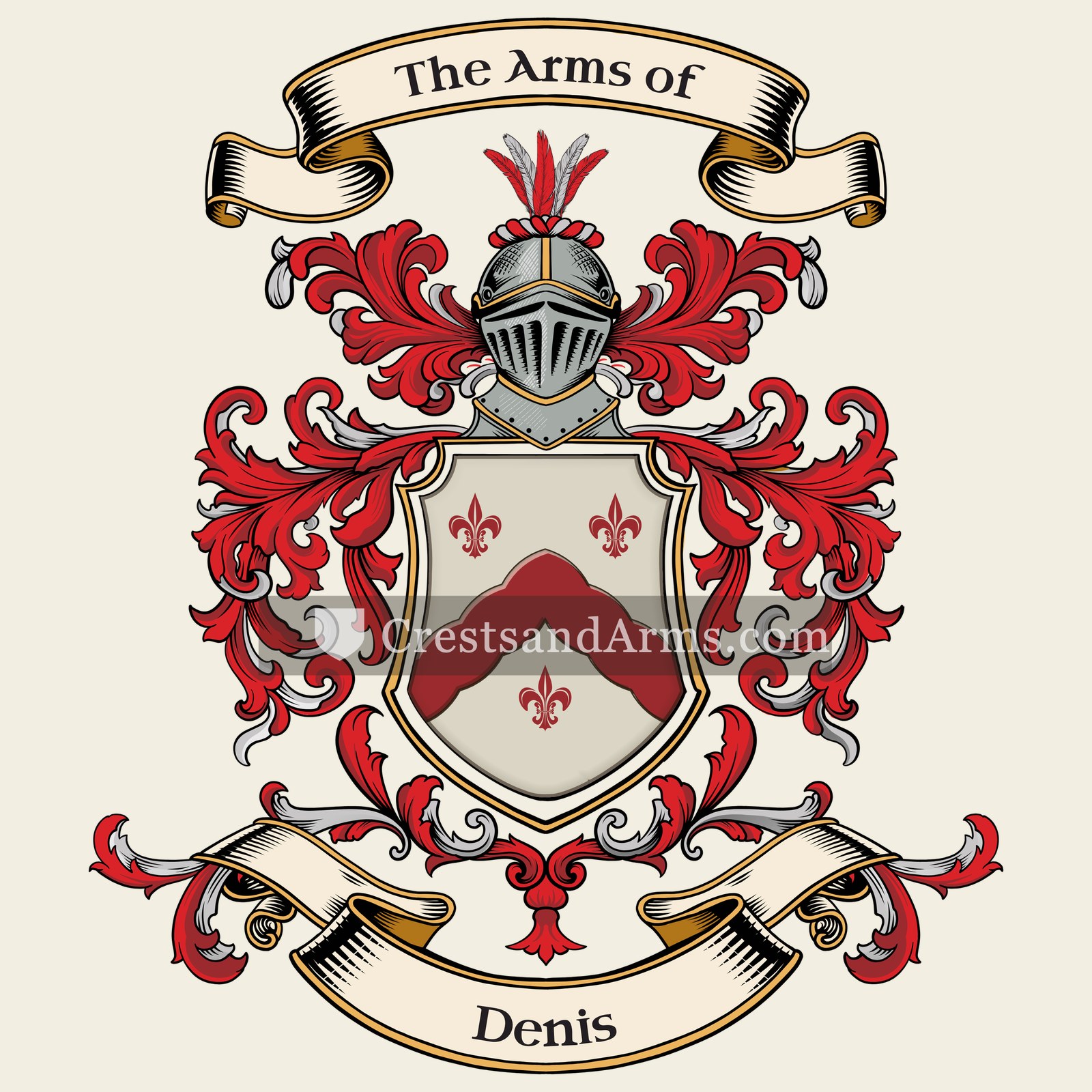


 savages head affrontyAn enemy overcome
 wreathHonour, and a victory crowned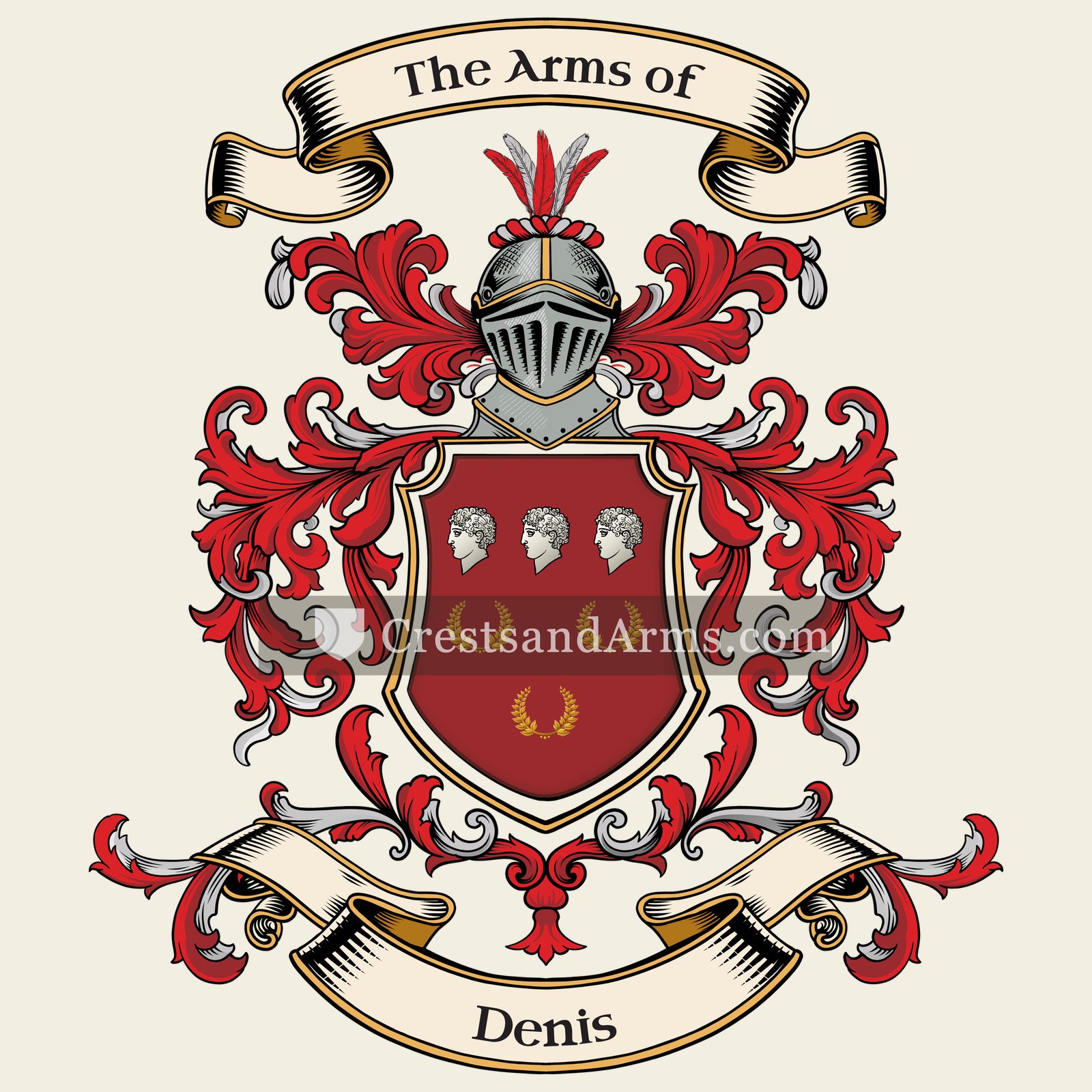


 fessThe military belt, and readiness to serve