Map of France showing where the Dennehy arms are recorded
The Dennehy arms were recorded in Philadelphie, c. 1725.
Arms such as these were typically recorded in Bretagne.
More families held coats of arms in Bretagne than anywhere else in France. The land was divided into many small estates rather than a few large ones, so far more households counted as gentry, and each needed a shield of its own to be told apart.
This is where the arms were entered in the register. Families often moved to other parts of the country, so the same name can turn up in more than one region.
The body that granted and recorded arms in France in this period.
Louis XV of France
Sovereign of the period
Louis XV of France
1715–1774
Reigning in France when the Dennehy arms are first recorded.
How Arms Worked in France
In France, a coat of arms was a mark of honor that passed down through the male line to all legitimate descendants. Families often used the same shield without changes to show their shared heritage. If a branch wanted to stand out, they could add a small mark to their shield to show their specific place in the family tree.
Granting authority
The Juge d'armes de France acted as the official authority that regulated and verified coats of arms across the country.
How they got arms
Families typically inherited their arms from ancestors, though they could also receive them through royal grants or by proving their noble status.
Where arms were recorded
Coats of arms were officially recorded in the Armorial Général de France, which began its main collection in the year 1696.
The family's standing
Recorded among the armigerous families of France.
Origin & History of the Dennehy Family in France
The history of the Dennehy name in France is deeply connected to the movement of families across the sea during the eighteenth century. While the name has strong roots in Ireland, records confirm that members of the family were established in the Brittany region by 1725. During this era, Brittany served as a vital gateway for people traveling between the British Isles and the French mainland. Families like the Dennehys often settled in port cities or coastal towns to maintain trade connections and professional networks. Living in this region allowed them to integrate into the local society while preserving their distinct heritage. By establishing themselves in Brittany, these early family members became part of a unique cultural exchange that defined the coastal communities of western France during the early modern period.
Coat of Arms & Family Crest Details
Symbols on this shield
chevronProtection, and faithful service completed
bordureA difference between branches of one family
Colours
Silver (Argent)Means: Peace and sincerity
Black (Sable)Means: Constancy
Historical info
Source
Sir Bernard Burke, The General Armory of England, Scotland, Ireland and Wales, London: Harrison & Sons, 1884
Blazon (the actual original written record)
“Ar. a chev. within a bordure engr. sa. quartered by ROSCARROCK”
Englandc. 1620
Digital archive packCoat of arms PNG, gold border print PDF, vector SVG and the certificate of authenticity. Sent to your email in minutes.
Map of England showing where the Dennehy arms are recorded
The Dennehy arms were recorded in England, c. 1620.
Arms such as these were typically recorded in York.
Yorkshire is the largest of the English counties, and it held more gentry families than any other. Land there was split among a great many households rather than a few, so a great many of them carried arms.
This is where the arms were entered in the register. Families often moved to other parts of the country, so the same name can turn up in more than one region.
The body that granted and recorded arms in England in this period.
James VI and I
Sovereign of the period
James VI and I
1603–1625
Reigning in France when the Dennehy arms are first recorded.
How Arms Worked in England
English heraldry allowed arms to be shared by all legitimate descendants of the original owner. These symbols were treated as personal property that moved through the generations to all children. While the eldest son kept the original design, other family members could use the same shield without needing to change it or register their own unique versions.
Granting authority
The College of Arms in London has regulated the use of coats of arms throughout England and Wales since 1484.
How they got arms
Families typically obtained their coats of arms through a formal grant from the Crown or by proving their ancient right to them.
Where arms were recorded
All official coats of arms are recorded in the registers kept at the College of Arms, which date back to the fifteenth century.
The family's standing
Recorded among the armigerous families of England.
Origin & History of the Dennehy Family in England
The history of the Dennehy name in England is deeply connected to the movement of people across the British Isles during the seventeenth century. While the name is traditionally rooted in Irish Gaelic origins, records confirm that members of the family were established in the city of York by 1620. During this period, York served as a major northern hub for trade and administration, attracting families who were seeking new economic opportunities or fleeing political instability. These early settlers likely integrated into the local community by working in skilled trades or merchant guilds, which allowed them to maintain a stable presence in the city. By embedding themselves in the urban life of York, these early Dennehys helped transition the family name from its regional origins into the broader social fabric of northern England. This migration pattern reflects a common trend of the era, where families sought to build new lives in growing English cities while preserving their unique cultural identity.
Coat of Arms & Family Crest Details
Symbols on this shield
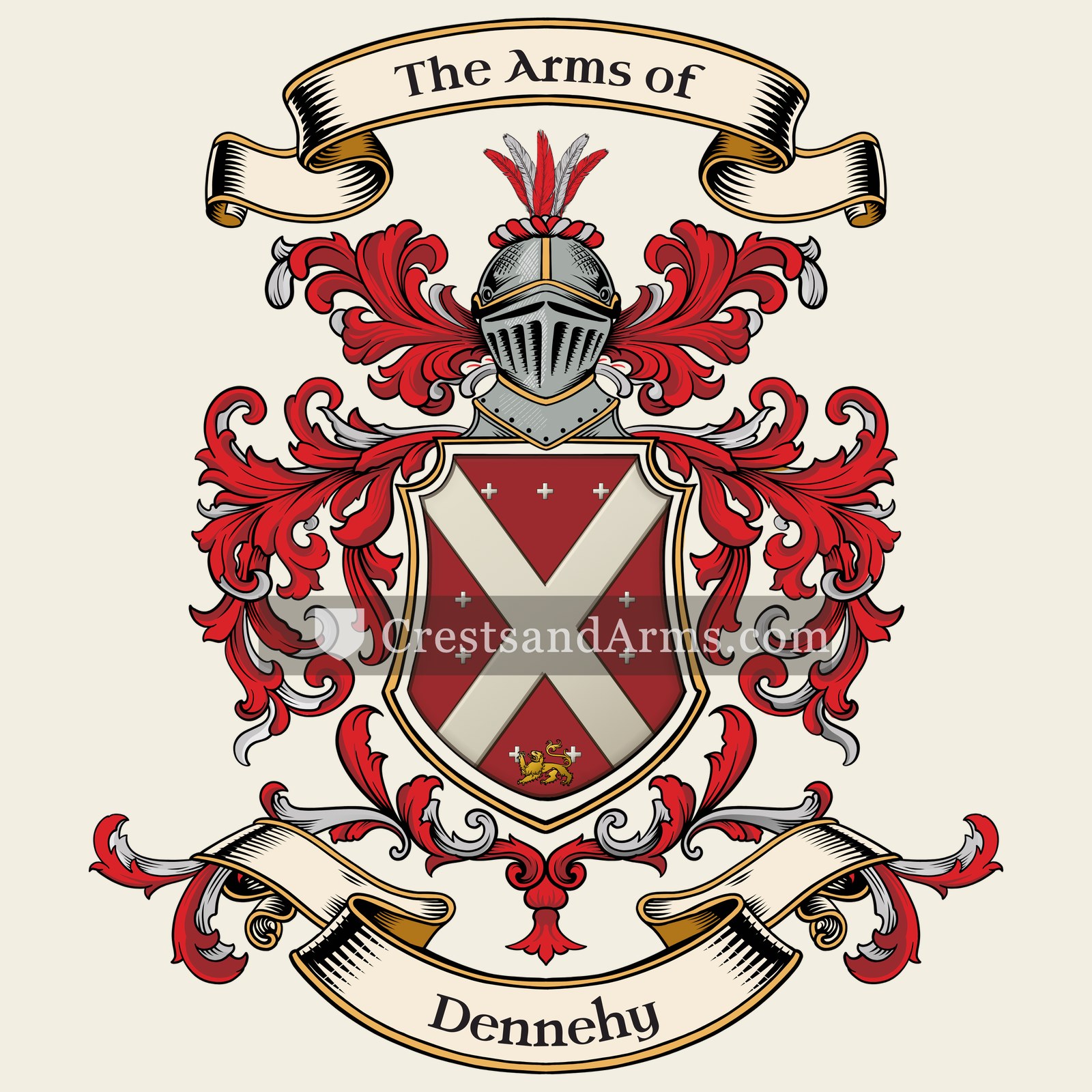
saltireResolution, and St Andrew's cross
cross symbolChristian faith and service
lionCourage, strength and royalty
Colours
Red (Gules)Means: Military strength
Silver (Argent)Means: Peace and sincerity
Gold (Or)Means: Generosity
Historical info
Source
Sir Bernard Burke, The General Armory of England, Scotland, Ireland and Wales, London: Harrison & Sons, 1884
Blazon (the actual original written record)
“Gu. a saltire betw. nine crosses pattée, three in chief and a like number on each side ar. in base a lion pass. guard. or”
IrelandHyde Park, c. 1645
Digital archive packCoat of arms PNG, gold border print PDF, vector SVG and the certificate of authenticity. Sent to your email in minutes.
Map of Ireland showing where the Dennehy arms are recorded
The Dennehy arms were recorded in Hyde Park, c. 1645.
Arms such as these were typically recorded in Dublin.
Dublin was the seat of government in Ireland and the place where grants were sought and recorded. Families with business at the castle or the courts settled nearby, and settling there put their arms on record.
This is where the arms were entered in the register. Families often moved to other parts of the country, so the same name can turn up in more than one region.
The body that granted and recorded arms in Ireland in this period.
Charles I of England
Sovereign of the period
Charles I of England
1625–1649
Reigning in France when the Dennehy arms are first recorded.
How Arms Worked in Ireland
The Ulster King of Arms granted coats of arms to individuals who proved their social standing and good character. These symbols were typically inherited by all legitimate descendants of the original holder. If a family branch wanted a unique look, they could apply for a specific change to their design through the office to ensure their identity remained distinct.
Granting authority
The Ulster King of Arms acted as the official body that regulated and issued all coats of arms throughout Ireland.
How they got arms
Families obtained their arms through formal grants issued by the office after proving their eligibility and paying the required fees.
Where arms were recorded
All official grants were recorded in the registers held by the Ulster King of Arms starting from the year 1552.
The family's standing
Recorded among the armigerous families of Ireland.
Origin & History of the Dennehy Family in Ireland
The family name Dennehy, or Ó Duineacha in its original Irish form, traces its roots back to the southern regions of Ireland, particularly County Cork. While the name is deeply connected to the Gaelic tradition, historical records confirm that members of the family were well-established in Dublin by 1645. During this period, Ireland was undergoing significant political upheaval, and the presence of the family in the capital city suggests they were likely involved in the urban professional or merchant classes of the time. As the seventeenth century progressed, the family navigated the shifting social landscape of Ireland, moving from their traditional rural origins into the administrative and economic life of growing cities. This transition reflects the broader experiences of many Gaelic families who adapted to the changing power structures of the era while maintaining their distinct cultural identity.
Related Branches & Arms
Root word
Donnchadh
A compound of brown and warrior or strong fighter.
This name
DennehyAn anglicized Irish surname meaning descendant of the brown-haired warrior.
also spelled
Denniy
Dennyy
Dennye
Deny
Denney
Documented Sources
J. B. Rietstap, Armorial Général, Gouda: G. B. van Goor Zonen, 1884–87
Archives départementales du Finistère, Série B (Courts and Jurisdictions)
Archives départementales d'Ille-et-Vilaine, Série E (Family and Notarial Records)
O'Hart, John, Irish Pedigrees; or, The Origin and Stem of the Irish Nation, 1892
Digital archive packCoat of arms PNG, gold border print PDF, vector SVG and the certificate of authenticity. Sent to your email in minutes.


 saltireResolution, and St Andrew's cross
 cross symbolChristian faith and service
 saltireResolution, and St Andrew's cross
 cross symbolChristian faith and service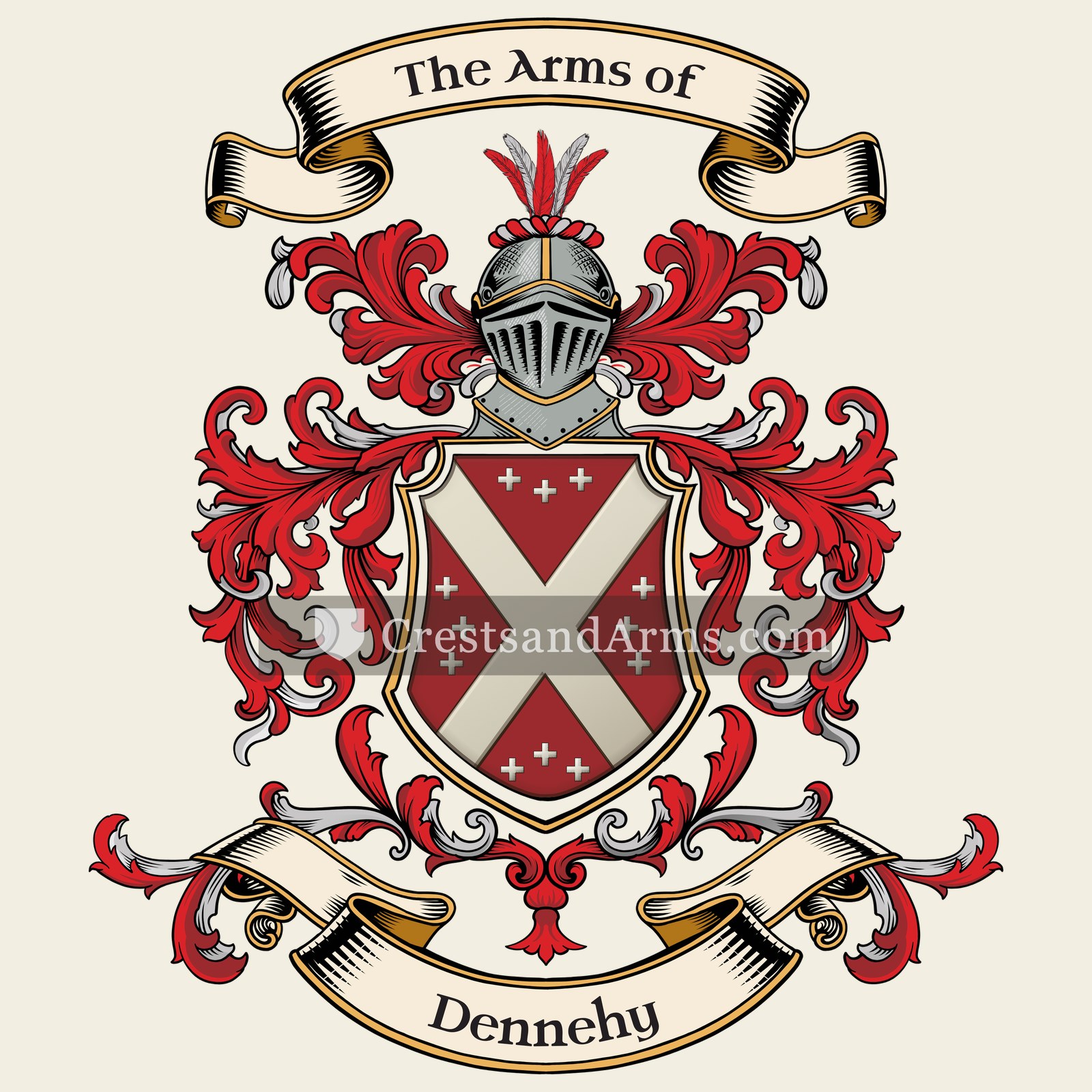


 chevronProtection, and faithful service completed
 bordureA difference between branches of one family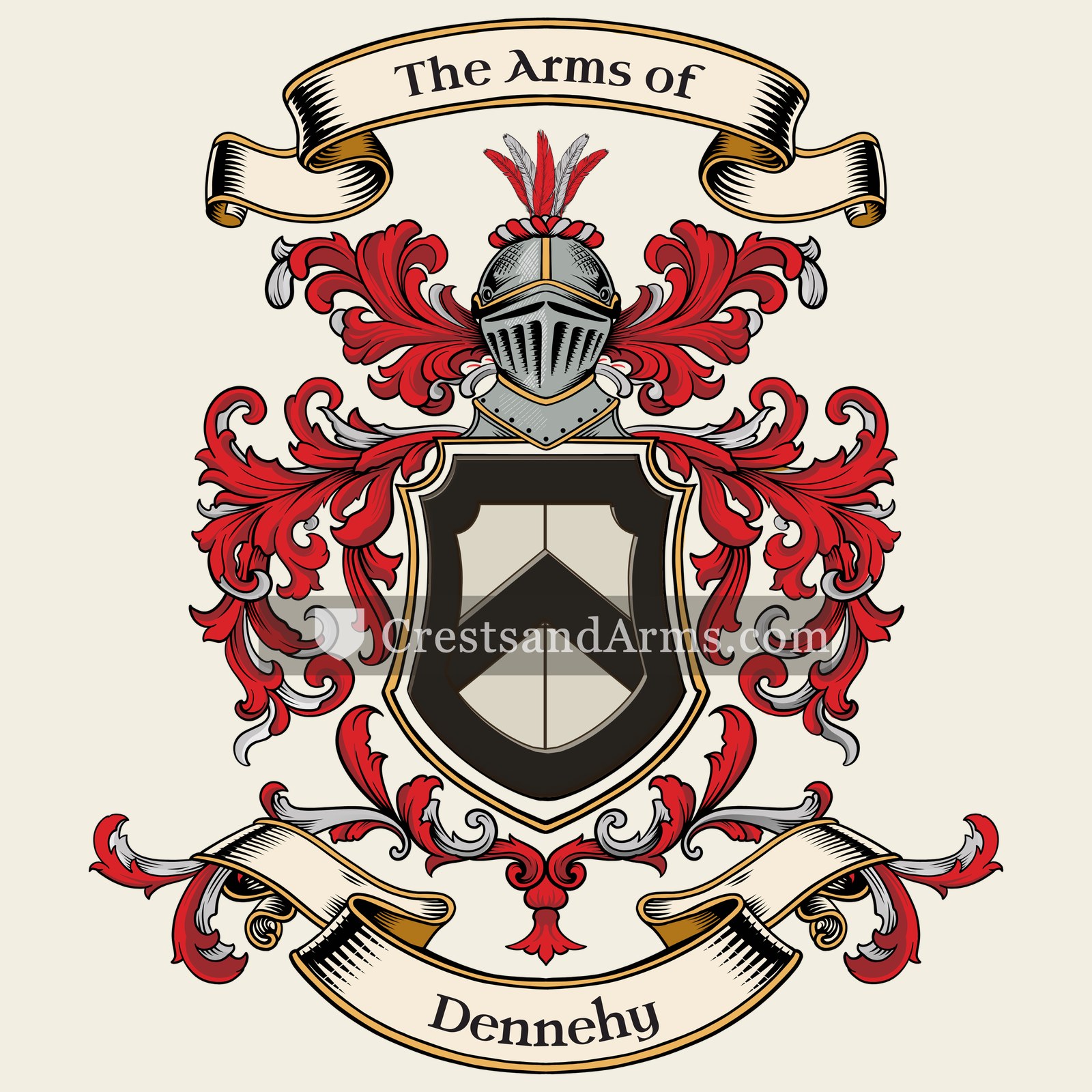


 lionCourage, strength and royalty