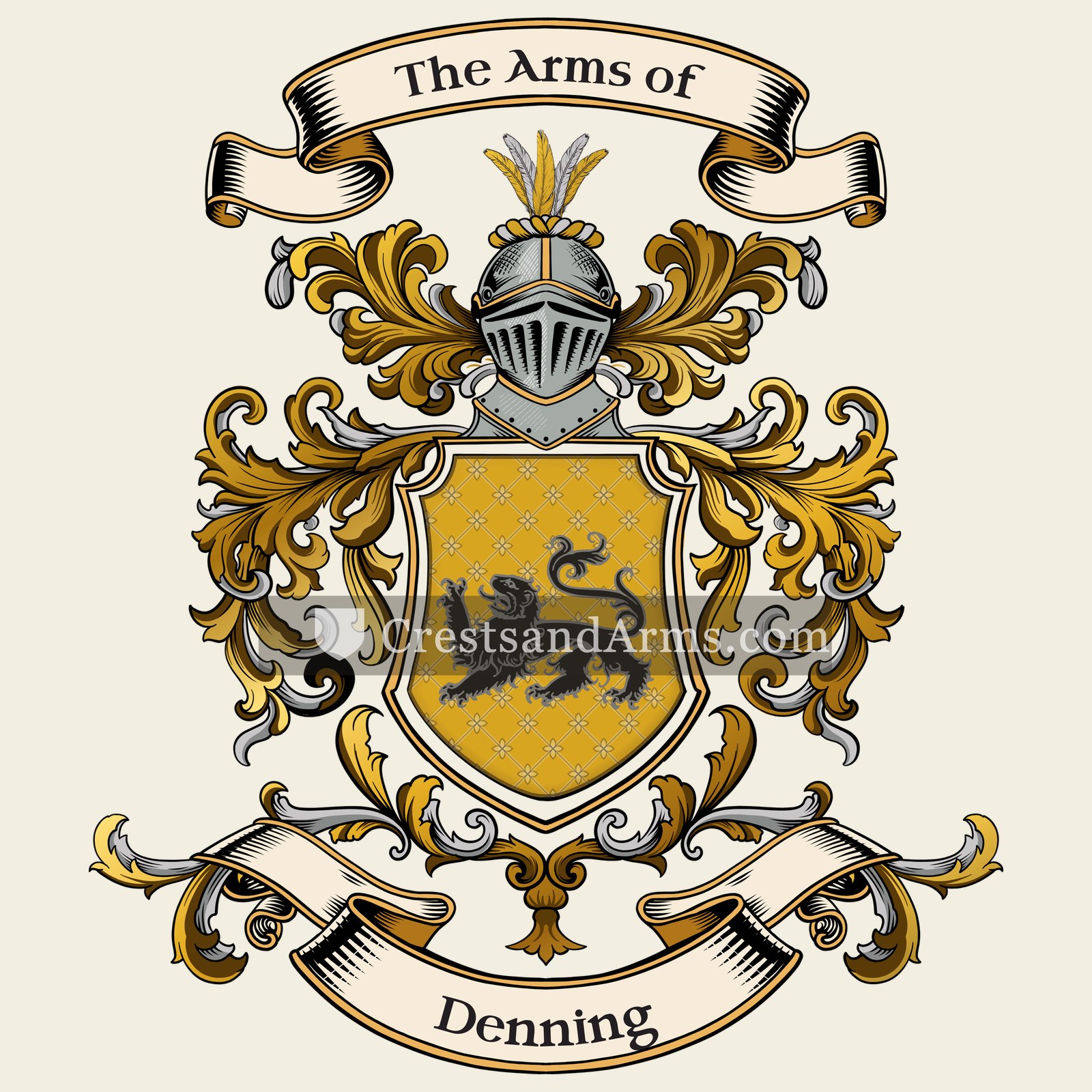
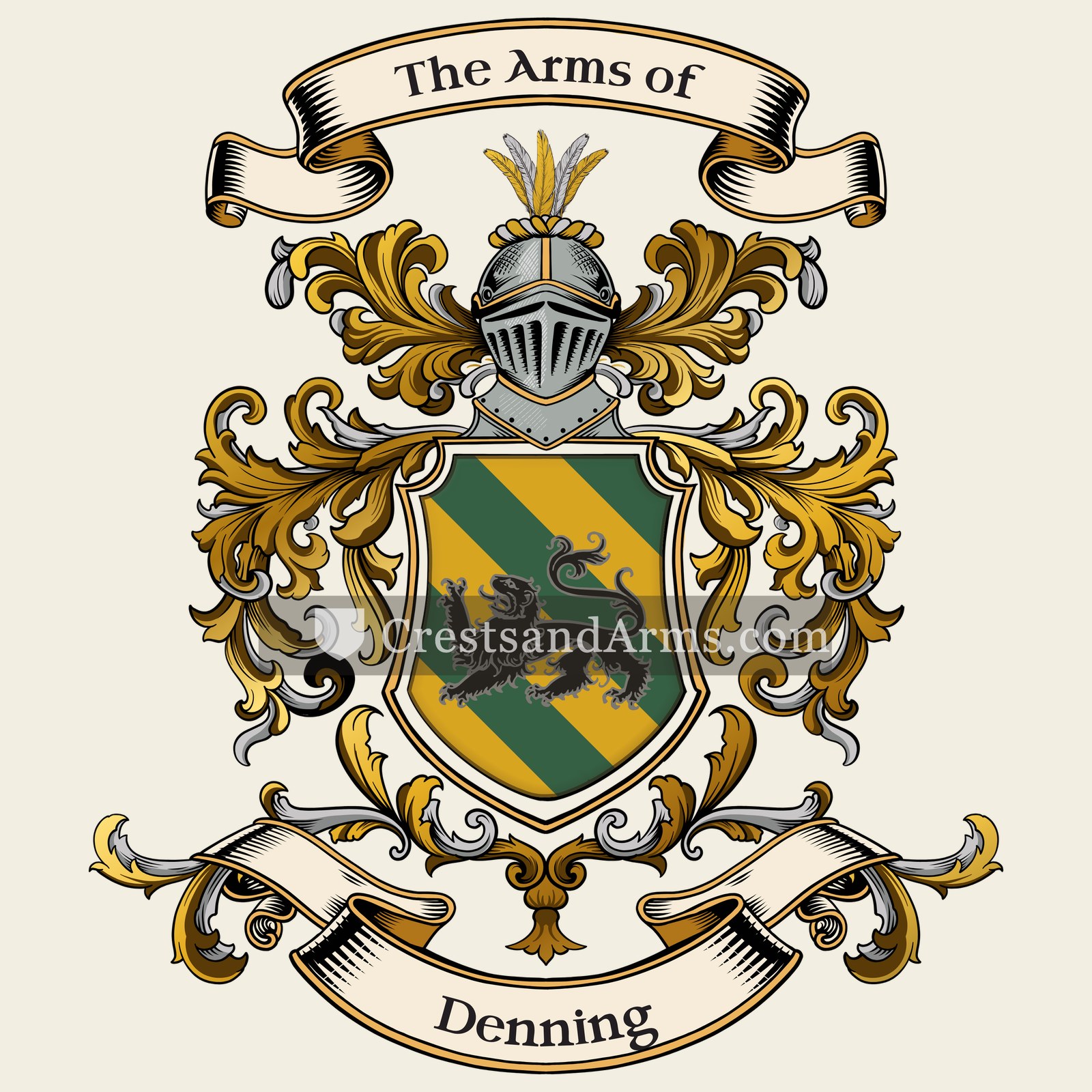
A record of documented arms, meaning and origin, researched for the Denning family lines. Documented in 2 countries.
Reg. 9040 · Britain, D–F
Coat of Arms & Family Crest Details
Symbols on this shield
lionCourage, strength and royalty
Colours
Gold (Or)Means: Generosity
Black (Sable)Means: Constancy
Historical info
Source
J. B. Rietstap, Armorial Général, Gouda: G. B. van Goor Zonen, 1884–87
Blazon (the actual original written record)
“Coticé en barre d'or et de pourpre de quatorze pièces; au lion de sa., br. sur le tout. C.: une tête et col d'antelope d'arg. S.: deux antelopes au nat., coll. d'or. D.: STUDIIS ET REBUS HONESTIS.”
DevonshireDevonshire, c. 1700
Digital archive packCoat of arms PNG, gold border print PDF, vector SVG and the certificate of authenticity. Sent to your email in minutes.
Map of Britain showing where the Denning arms are recorded
The Denning arms were recorded in Devonshire, c. 1700.
This is where the arms were entered in the register. Families often moved to other parts of the country, so the same name can turn up in more than one region.
The body that granted and recorded arms in Britain in this period.
William III of England
Sovereign of the period
William III of England
1694–1702
Reigning in Britain when the Denning arms are first recorded.
How Arms Worked in Britain
English heraldry allowed arms to be shared by all legitimate descendants of the original owner. These symbols were treated as personal property that moved through the generations to all children. While the eldest son kept the original design, other family members could use the same shield without needing to change it or register their own unique versions.
Granting authority
The College of Arms in London has regulated the use of coats of arms throughout England and Wales since 1484.
How they got arms
Families typically obtained their coats of arms through a formal grant from the Crown or by proving their ancient right to them.
Where arms were recorded
All official coats of arms are recorded in the registers kept at the College of Arms, which date back to the fifteenth century.
The family's standing
Recorded among the armigerous families of Devonshire.
Origin & History of the Denning Family in Britain
The surname Denning has deep roots in the rugged landscape of Devonshire, where families bearing this name were well-established by the dawn of the eighteenth century. Linguists believe the name likely originated as a locative surname, meaning it was used to identify people who lived in or near a specific valley, known in Old English as a "denu." As the family grew, they became part of the local fabric of the West Country, often working as skilled farmers or tradespeople in the rural parishes. By the 1700s, the Denning name was already woven into the social history of the region, appearing in parish registers that recorded the baptisms, marriages, and burials of generations. These early records show that the family was deeply connected to the land and the tight-knit village life that defined Devonshire during this period. Through these humble beginnings, the name persisted as a marker of local identity, reflecting the steady and hardworking nature of the families who called the English countryside their home.
Coat of Arms & Family Crest Details
Symbols on this shield
lionCourage, strength and royalty
Colours
Gold (Or)Means: Generosity
Black (Sable)Means: Constancy
Green (Vert)Means: Hope
Historical info
Source
Sir Bernard Burke, The General Armory of England, Scotland, Ireland and Wales, London: Harrison & Sons, 1884
Blazon (the actual original written record)
“Bendy sinister of fourteen or and vert, over all a lion ramp. sa”
Englandc. 1782
Digital archive packCoat of arms PNG, gold border print PDF, vector SVG and the certificate of authenticity. Sent to your email in minutes.
Map of England showing where the Denning arms are recorded
The Denning arms were recorded in England, c. 1782.
Arms such as these were typically recorded in York.
Yorkshire is the largest of the English counties, and it held more gentry families than any other. Land there was split among a great many households rather than a few, so a great many of them carried arms.
This is where the arms were entered in the register. Families often moved to other parts of the country, so the same name can turn up in more than one region.
The body that granted and recorded arms in England in this period.
George III of Great Britain
Sovereign of the period
George III of Great Britain
1760–1801
Reigning in Britain when the Denning arms are first recorded.
How Arms Worked in England
English heraldry allowed arms to be shared by all legitimate descendants of the original owner. These symbols were treated as personal property that moved through the generations to all children. While the eldest son kept the original design, other family members could use the same shield without needing to change it or register their own unique versions.
Granting authority
The College of Arms in London has regulated the use of coats of arms throughout England and Wales since 1484.
How they got arms
Families typically obtained their coats of arms through a formal grant from the Crown or by proving their ancient right to them.
Where arms were recorded
All official coats of arms are recorded in the registers kept at the College of Arms, which date back to the fifteenth century.
The family's standing
Recorded among the armigerous families of England.
Origin & History of the Denning Family in England
The surname Denning is rooted in the Old English language and likely originated as a topographic name for people who lived in a deep, wooded valley, often referred to as a "den." Over many centuries, families bearing this name established themselves across various English counties, gradually moving from rural agricultural settings into growing urban centers. By the late 18th century, the presence of the Denning family in York by 1782 suggests they were part of the steady migration toward northern industrial hubs during the early stages of the Industrial Revolution. During this period, families in cities like York often worked as skilled tradespeople or merchants, contributing to the local economy as the city expanded beyond its ancient Roman and medieval walls. This transition from the countryside to the city reflects the broader movement of English families who sought new opportunities in the thriving markets of the north.
Related Branches & Arms
Root word
Dene
An Old English term for a valley or a wooded hollow.
This name
DenningA habitational name for someone who lived in or near a valley.
also spelled
Duning
Dunnyng
Dunyng
Documented Sources
J. B. Rietstap, Armorial Général, Gouda: G. B. van Goor Zonen, 1884–87
Reaney, P.H., A Dictionary of English Surnames, 1958
Devon Archives, Parish Registers of Devon, 1700–1750
Bardsley, Charles Wareing, A Dictionary of English and Welsh Surnames, 1901
Digital archive packCoat of arms PNG, gold border print PDF, vector SVG and the certificate of authenticity. Sent to your email in minutes.


 lionCourage, strength and royalty
 lionCourage, strength and royalty