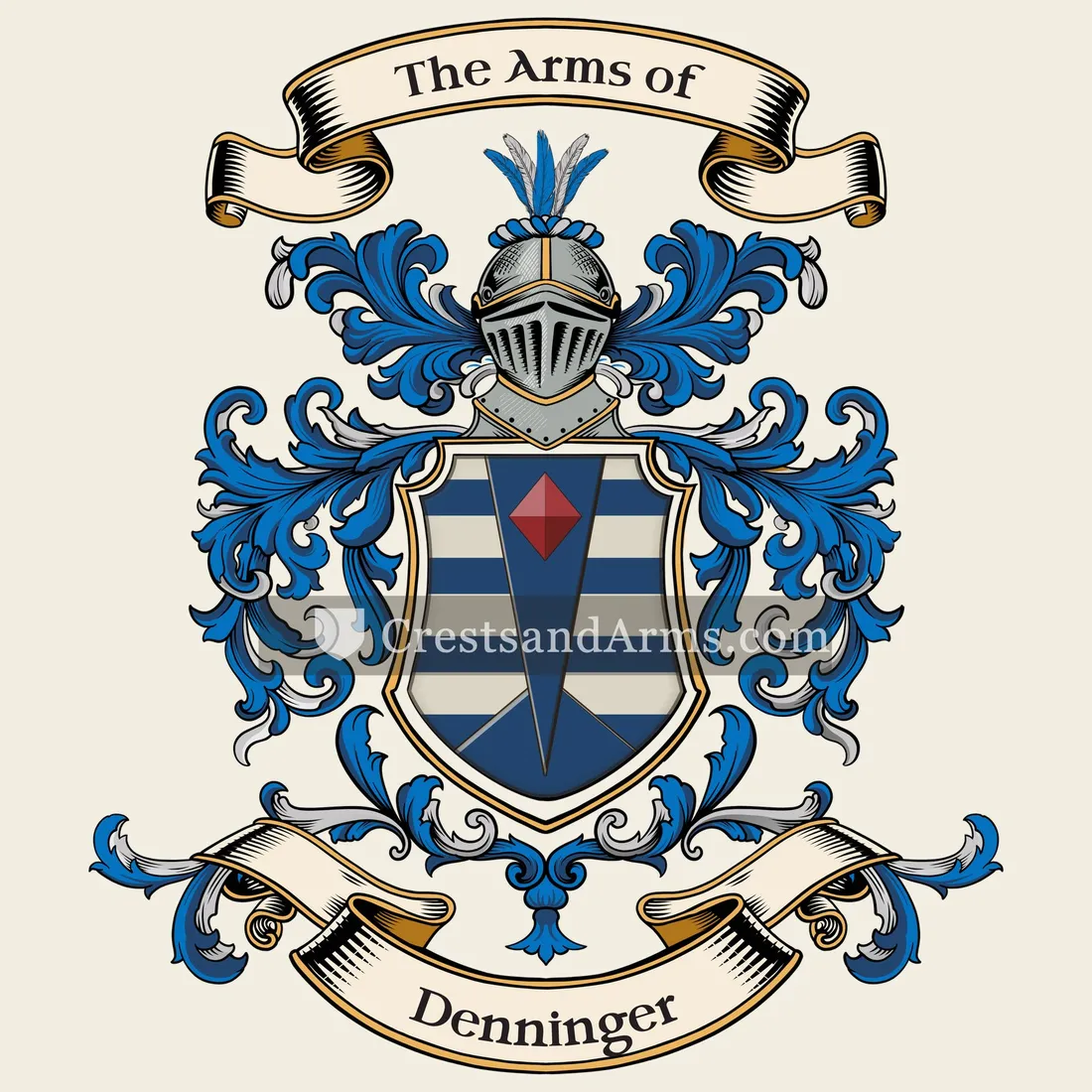
A record of documented arms, meaning and origin, researched for the Denninger family of Austria.
Reg. 6633 · Austrian, D–F
Meaning of the Denninger family crest colors & symbols
Symbols on this shield
fessThe military belt, and readiness to serve
pileWell-doing, and a mark of distinction
lozengeHonour and nobility, and the arms of a woman
Colours
Silver (Argent)Means: Peace and sincerity
Blue (Azure)Means: Loyalty and truth
Red (Gules)Means: Military strength
Historical info
Source
J. B. Rietstap, Armorial Général, Gouda: G. B. van Goor Zonen, 1884–87
Blazon (the actual original written record)
“Coupé: au 1 fascé d'azur et d'arg. de quatre pièces, la seconde fasce d'azur ch. d'une rose de gu.; au 2 d'arg. à une pile et une pointe d'azur, toutes deux ployées et br. l'une sur l'autre, ce qui produit au milieu une espèce de losange qui est de gu. Cq. cour. C.: un vol d'azur, chaque aile ch. de deux fasces d'arg. et d'une rose de gu., entre les fasces. L.: à dextre d'arg. et d'azur, à sen. d'arg. et de gu.”
AustriaVienne, c. 1772
Digital archive packCoat of arms PNG, gold border print PDF, vector SVG and the certificate of authenticity. Sent to your email in minutes.
Map of Austria showing where the Denninger arms are recorded
The Denninger arms were recorded in Vienne, c. 1772.
This is where the arms were entered in the register. Families often moved to other parts of the country, so the same name can turn up in more than one region.
Region
Vienne
Town
Vienne
First recorded
1772
Granting Authority for the Denninger Arms
Imperial and Royal chancery
Sodacan · CC BY-SA 3.0
The body that granted and recorded arms in Austria in this period.
Joseph II, Holy Roman Emperor
Sovereign of the period
Joseph II, Holy Roman Emperor
1765–1790
Reigning in Austria when the Denninger arms are first recorded.
How Arms Worked in Austria
Austrian coats of arms were often linked directly to noble titles granted by the Emperor. These symbols belonged to the entire family line rather than just one individual. When a family grew, new branches kept the original design without needing to change it. This system allowed all members of a noble house to share the same identity across many generations.
Granting authority
The Imperial and Royal chancery managed all heraldic matters and controlled the official granting of arms throughout the Austrian lands.
How they got arms
Families typically received their arms through a formal imperial decree that often accompanied the elevation of a person to noble status.
Where arms were recorded
Official records of these grants were kept in the Imperial Register of Nobility which began its formal documentation process in 1453.
The family's standing
Recorded among the armigerous families of Austria.
Origin & History of the Denninger Family in Austria
The family name Denninger is rooted in the German-speaking regions of Europe, where it likely originated as a topographical or occupational descriptor. The suffix "-er" typically denotes a person who comes from a specific place or practices a certain trade, suggesting that early ancestors may have been associated with a location named Denning or a similar variation. By the late 18th century, the family had established a documented presence in Vienna, which was then the bustling capital of the Holy Roman Empire. Records from 1772 confirm that members of the family were living in this influential city during a time of significant cultural and administrative growth. As residents of Vienna, these early family members were part of a diverse urban society that served as the heart of Central European trade and governance. This historical foothold indicates that the family was integrated into the professional or social fabric of the city during the Enlightenment era.
Denninger Meaning & Related Branches
Root word
Tann
A German term referring to a fir tree or a forest.
This name
DenningerA topographic name for someone who lived near a fir forest or a dweller in the woods.
also spelled
Deyninger
Deiningar
Deyningher
Dininger
Documented Sources
J. B. Rietstap, Armorial Général, Gouda: G. B. van Goor Zonen, 1884–87
Wiener Stadt- und Landesarchiv, Magistrat der Stadt Wien, Untertanenverzeichnisse
Österreichisches Staatsarchiv, Allgemeines Verwaltungsarchiv, Adels- und Bürgerrechtsakten
Bahlow, Hans, Deutsches Namenlexikon: Familien- und Vornamen nach Ursprung und Sinn erklärt, 1967
Heintze, Albert, Die deutschen Familiennamen: geschichtlich, geographisch, sprachlich, 1903
Digital archive packCoat of arms PNG, gold border print PDF, vector SVG and the certificate of authenticity. Sent to your email in minutes.


 fessThe military belt, and readiness to serve
 pileWell-doing, and a mark of distinction
 lozengeHonour and nobility, and the arms of a woman
 fessThe military belt, and readiness to serve
 pileWell-doing, and a mark of distinction
 lozengeHonour and nobility, and the arms of a woman