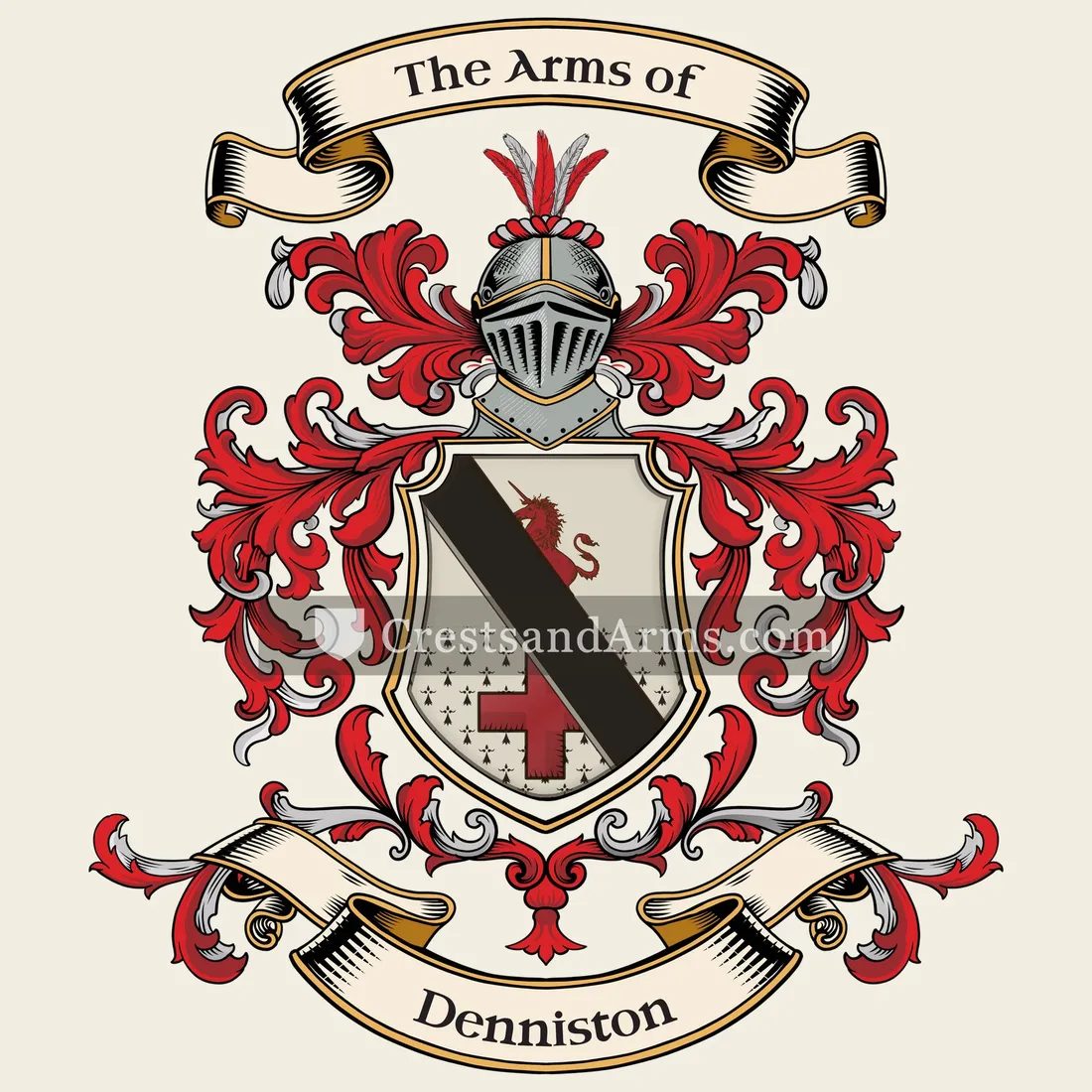
A record of documented arms, meaning and origin, researched for the Denniston family lines. Documented in 2 countries.
Reg. 3574 · Britain, D–F
Meaning of the Denniston family crest colors & symbols
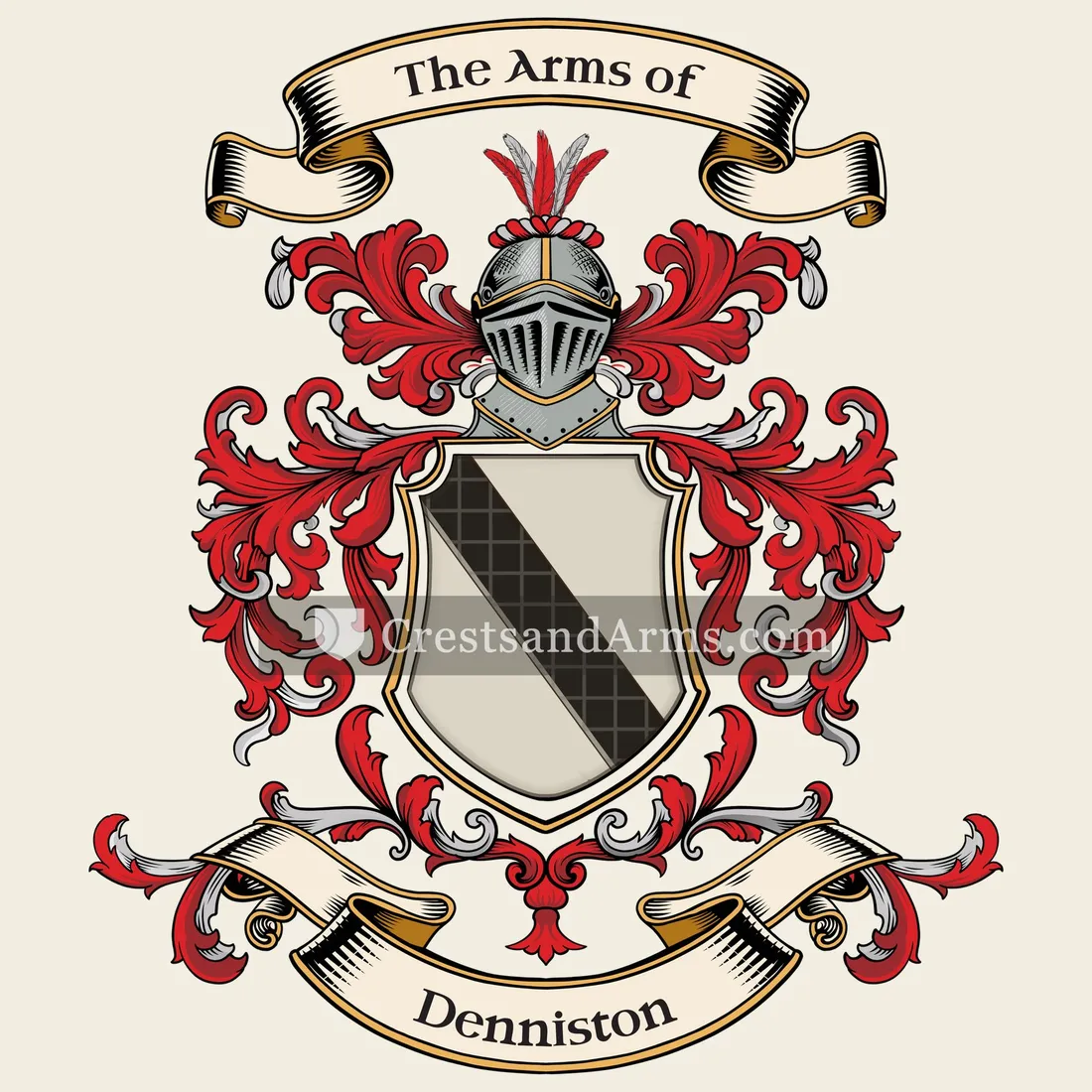
Symbols on this shield
bendDefence, and the scarf of a commander
Colours
Silver (Argent)Means: Peace and sincerity
Black (Sable)Means: Constancy
Historical info
Source
J. B. Rietstap, Armorial Général, Gouda: G. B. van Goor Zonen, 1884–87
Blazon (the actual original written record)
“D'arg. à la bande de sa. C.: un bras, en pal, paré de gu., la main de carn. tenant un écusson à l'antique de sa., ch. d'une étoile d'or. S.: à dextre un lion de gu., arm. et lamp. d'azur; à sen. une antelope d'arg., accornée d'azur, onglée d'or. D.: ADVERSA VIRTUTE REPELLO.”
Britainc. 1700
Digital archive packCoat of arms PNG, gold border print PDF, vector SVG and the certificate of authenticity. Sent to your email in minutes.
Map of Britain showing where the Denniston arms are recorded
The Denniston arms were recorded in Britain, c. 1700.
Arms such as these were typically recorded in Kent.
Kent sits between London and the short crossing to Europe, and the trade passing through made it wealthy. Merchant families bought land with that money, and it was landowners who took coats of arms.
This is where the arms were entered in the register. Families often moved to other parts of the country, so the same name can turn up in more than one region.
The body that granted and recorded arms in Britain in this period.
William III of England
Sovereign of the period
William III of England
1694–1702
Reigning in Britain when the Denniston arms are first recorded.
How Arms Worked in Britain
English heraldry allowed arms to be shared by all legitimate descendants of the original owner. These symbols were treated as personal property that moved through the generations to all children. While the eldest son kept the original design, other family members could use the same shield without needing to change it or register their own unique versions.
Granting authority
The College of Arms in London has regulated the use of coats of arms throughout England and Wales since 1484.
How they got arms
Families typically obtained their coats of arms through a formal grant from the Crown or by proving their ancient right to them.
Where arms were recorded
All official coats of arms are recorded in the registers kept at the College of Arms, which date back to the fifteenth century.
The family's standing
Recorded among the armigerous families of Britain.
Origin & History of the Denniston Family in Britain
The surname Denniston is a topographical name that likely originated from a specific place in Britain, often linked to the Scottish Lowlands before spreading southward. While the name is deeply rooted in Scottish history, by the turn of the 18th century, families bearing the name had established a firm presence in the county of Kent. During this period, England was undergoing significant social and economic shifts, and families often moved to these southern regions to pursue new opportunities in trade or agriculture. Living in Kent in 1700 placed these early Dennistons in a region known for its proximity to London and its bustling maritime connections. This migration reflects the broader movement of people across the British Isles as individuals sought to establish roots in growing communities. By settling in Kent, these early family members became part of the local fabric of the English countryside, contributing to the development of the region through their work and daily lives.
Meaning of the Denniston family crest colors & symbols
Symbols on this shield
bendDefence, and the scarf of a commander
cross symbolChristian faith and service
unicornPurity, and extreme courage in defence of honour
Colours
Silver (Argent)Means: Peace and sincerity
ErmineMeans: Dignity
Black (Sable)Means: Constancy
Red (Gules)Means: Military strength
Historical info
Source
Sir Bernard Burke, The General Armory of England, Scotland, Ireland and Wales, London: Harrison & Sons, 1884
Blazon (the actual original written record)
“Per fess ar. and erm. a bend sa. betw. a unicorn's head erased in chief and a cross crosslet fitchée in base gu”
LanarkGolfhill · Lanark, c. 1748
Digital archive packCoat of arms PNG, gold border print PDF, vector SVG and the certificate of authenticity. Sent to your email in minutes.
Map of Scotland showing where the Denniston arms are recorded
The Denniston arms were recorded in Lanark, c. 1748.
Lanarkshire ran along the upper Clyde, farming country with coal beneath it. Its landed families were long-established, and long establishment is what brought them into the register.
This is where the arms were entered in the register. Families often moved to other parts of the country, so the same name can turn up in more than one region.
The body that granted and recorded arms in Scotland in this period.
George II of Great Britain
Sovereign of the period
George II of Great Britain
1727–1760
Reigning in Britain when the Denniston arms are first recorded.
How Arms Worked in Scotland
Scottish heraldry is unique because it treats a coat of arms as a piece of personal property protected by law. Only one person can own a specific design at any given time. When a family grows, the head keeps the original shield while other relatives must apply for their own distinct version with slight changes to prove their specific identity.
Granting authority
The Court of the Lord Lyon acts as the official body that regulates and controls all heraldic matters throughout Scotland.
How they got arms
Individuals obtain a legal right to their arms through a formal petition process that confirms their identity and family connection.
Where arms were recorded
All valid coats of arms are officially entered into the Public Register of All Arms and Bearings starting from 1672.
The family's standing
Recorded among the armigerous families of Lanark.
Origin & History of the Denniston Family in Scotland
The name Denniston is a topographical surname that originated from the lands of Dennistoun in the parish of Kilbarchan, located in the county of Renfrewshire. The family name is derived from the Old English word "tun," meaning a settlement or enclosure, combined with the name of an early settler named Daniel. By the medieval period, the family had established themselves as significant landowners in the west of Scotland. While the family held deep roots in the Lowlands for centuries, their presence in Lanark by 1748 reflects the common movement of families toward growing market towns during the eighteenth century. This period was a time of transition, as families moved away from rural estates to participate in the expanding trade and administrative roles found in burghs like Lanark. Through these shifts, the Dennistons maintained their identity as a family deeply connected to the social and economic fabric of the Scottish Lowlands.
Denniston Meaning & Related Branches
Root word
Dunn
A Gaelic term referring to a dark-colored or brown hill.
This name
DennistonDerived from a place name meaning town or settlement on the dark hill.
also spelled
Denistoun
Denistun
Denistone
Dennistone
Documented Sources
J. B. Rietstap, Armorial Général, Gouda: G. B. van Goor Zonen, 1884–87
Black, George Fraser, The Surnames of Scotland: Their Origin, Meaning, and History, 1946
Reaney, Percy Hide and Wilson, Richard Middlewood, A Dictionary of English Surnames, 1991
The National Archives, Parish registers for the county of Kent, 1700
Digital archive packCoat of arms PNG, gold border print PDF, vector SVG and the certificate of authenticity. Sent to your email in minutes.


 bendDefence, and the scarf of a commander
 bendDefence, and the scarf of a commander


 cross symbolChristian faith and service
 unicornPurity, and extreme courage in defence of honour