Map of France showing where the Denson arms are recorded
The Denson arms were recorded in Ile-de-France, c. 1663.
Ile-de-France is the country around Paris, and proximity to the court mattered. Families who served the crown were rewarded with land near it, and land near the capital carried arms almost as a matter of course.
This is where the arms were entered in the register. Families often moved to other parts of the country, so the same name can turn up in more than one region.
The body that granted and recorded arms in France in this period.
Louis XIV of France
Sovereign of the period
Louis XIV of France
1643–1715
Reigning in France when the Denson arms are first recorded.
How Arms Worked in France
In France, a coat of arms was a mark of honor that passed down through the male line to all legitimate descendants. Families often used the same shield without changes to show their shared heritage. If a branch wanted to stand out, they could add a small mark to their shield to show their specific place in the family tree.
Granting authority
The Juge d'armes de France acted as the official authority that regulated and verified coats of arms across the country.
How they got arms
Families typically inherited their arms from ancestors, though they could also receive them through royal grants or by proving their noble status.
Where arms were recorded
Coats of arms were officially recorded in the Armorial Général de France, which began its main collection in the year 1696.
The family's standing
Recorded among the armigerous families of Ile-de-France.
Origin & History of the Denson Family in France
The Denson family name traces its roots to the historical region of Île-de-France, where members of the lineage were firmly established by 1663. During this period, the area surrounding Paris served as the political and cultural heart of the kingdom, drawing families into a complex network of trade, agriculture, and service to the crown. The name likely evolved as a patronymic or a locative identifier, reflecting the specific social ties and geographic origins of those living in the fertile plains of the Seine basin. As residents of this central province, the early Densons lived through a transformative era of French history marked by the consolidation of royal power and the expansion of administrative record-keeping. By maintaining a presence in this influential region, the family became part of the enduring social fabric that defined the transition from the feudal era to the centralized state of the seventeenth century.
Meaning of the Denson family crest colors & symbols
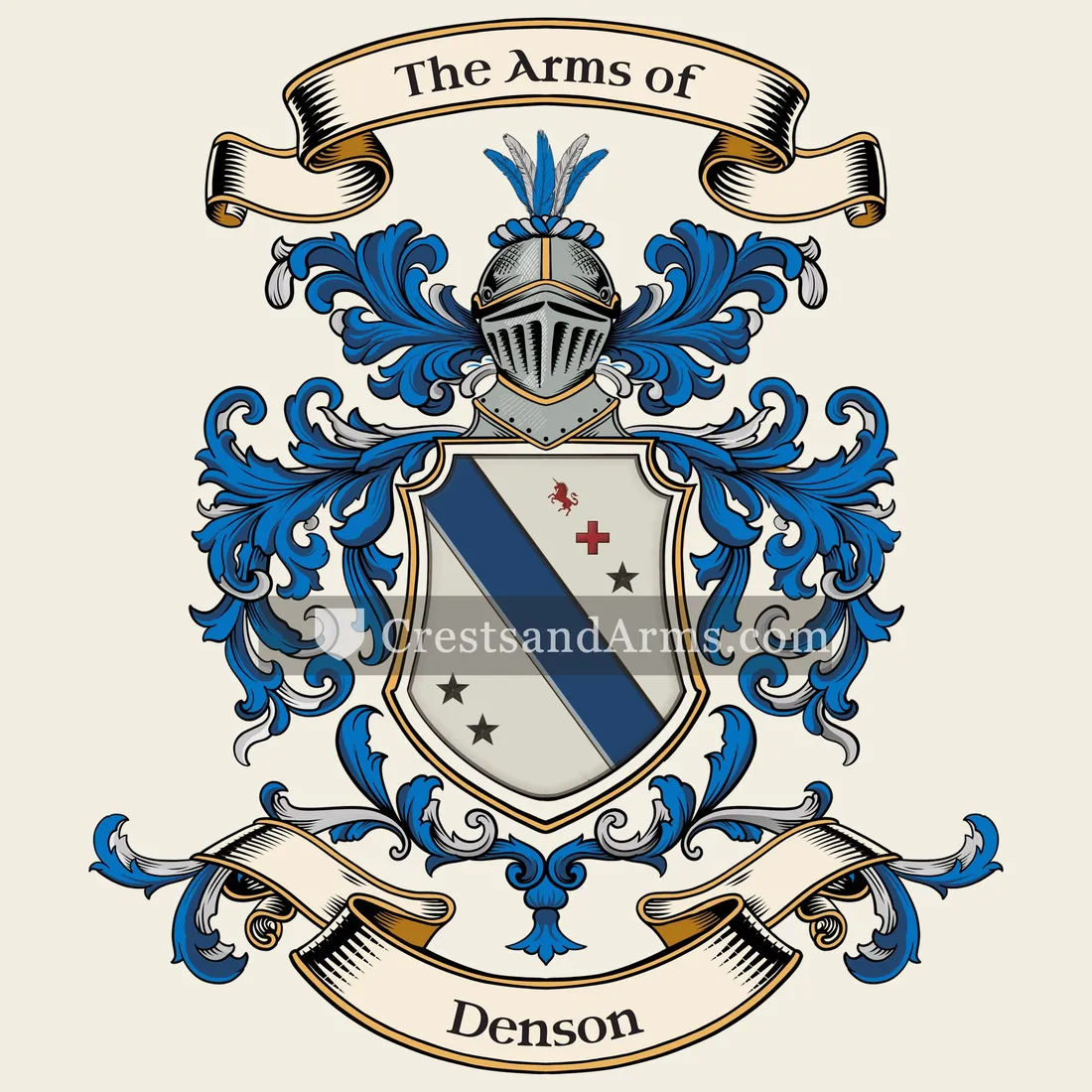
Symbols on this shield
bendDefence, and the scarf of a commander
cross symbolChristian faith and service
unicornPurity, and extreme courage in defence of honour
mulletThe third son, and a divine quality from above
Colours
ErmineMeans: Dignity
Blue (Azure)Means: Loyalty and truth
Red (Gules)Means: Military strength
Black (Sable)Means: Constancy
Historical info
Source
Sir Bernard Burke, The General Armory of England, Scotland, Ireland and Wales, London: Harrison & Sons, 1884
Blazon (the actual original written record)
“Quarterly, 1st and 4th, erm. a bend az. cottised sa. betw. in chief a unicorn's head erased and in base a cross crosslet fitchée gu., for DENISON; 2nd and 3rd, ar. a shake-fork betw. three mullets sa. one in chief and two in base, for CONYNGHAM”
Englandc. 1620
Digital archive packCoat of arms PNG, gold border print PDF, vector SVG and the certificate of authenticity. Sent to your email in minutes.
Map of England showing where the Denson arms are recorded
The Denson arms were recorded in England, c. 1620.
Arms such as these were typically recorded in York.
Yorkshire is the largest of the English counties, and it held more gentry families than any other. Land there was split among a great many households rather than a few, so a great many of them carried arms.
This is where the arms were entered in the register. Families often moved to other parts of the country, so the same name can turn up in more than one region.
The body that granted and recorded arms in England in this period.
James VI and I
Sovereign of the period
James VI and I
1603–1625
Reigning in France when the Denson arms are first recorded.
How Arms Worked in England
English heraldry allowed arms to be shared by all legitimate descendants of the original owner. These symbols were treated as personal property that moved through the generations to all children. While the eldest son kept the original design, other family members could use the same shield without needing to change it or register their own unique versions.
Granting authority
The College of Arms in London has regulated the use of coats of arms throughout England and Wales since 1484.
How they got arms
Families typically obtained their coats of arms through a formal grant from the Crown or by proving their ancient right to them.
Where arms were recorded
All official coats of arms are recorded in the registers kept at the College of Arms, which date back to the fifteenth century.
The family's standing
Recorded among the armigerous families of England.
Origin & History of the Denson Family in England
The surname Denson is a patronymic name, which means it originated as a way to identify a person as the son of someone named Denis or Den. By the early 17th century, the name had established a firm presence in the historic city of York, England. During this period, York served as a vital northern hub for trade and administration, providing a stable environment for families to settle and grow. Records from 1620 indicate that members of the Denson family were active participants in the local community life of the region. As the name spread through the northern counties, it became part of the social fabric of England, reflecting the common naming traditions of the time where surnames were often derived from the given names of fathers. This transition from a simple description to a permanent family name helped define the identity of these early residents as they navigated the changing landscape of 17th-century England.
Meaning of the Denson family crest colors & symbols
Symbols on this shield
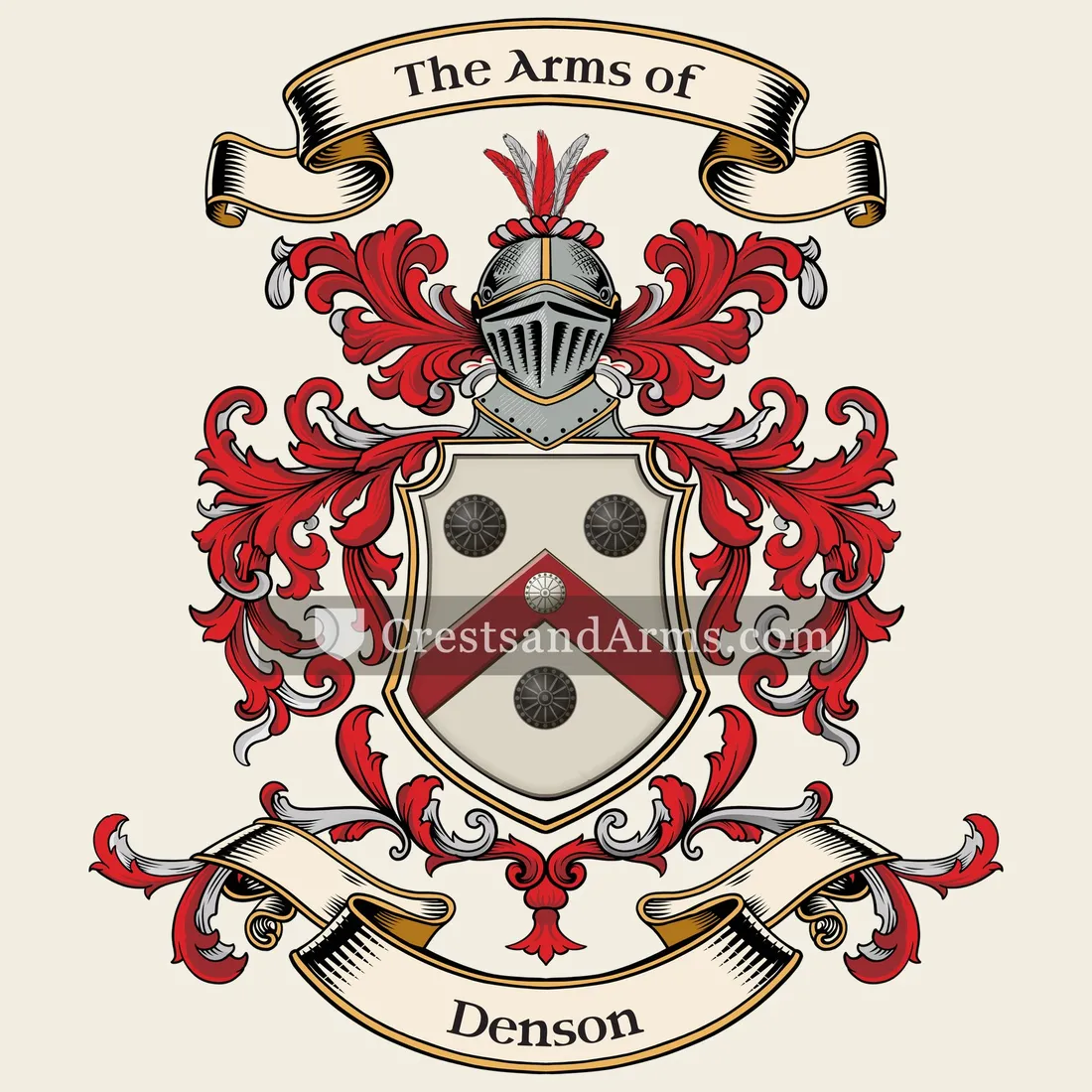
chevronProtection, and faithful service completed
roundelA coin, and one who has been to the crusades
Colours
Silver (Argent)Means: Peace and sincerity
Red (Gules)Means: Military strength
Black (Sable)Means: Constancy
Historical info
Source
Sir Bernard Burke, The General Armory of England, Scotland, Ireland and Wales, London: Harrison & Sons, 1884
Blazon (the actual original written record)
“Ar. on a chev. gu. betw. three pellets a torteau”
Irelandc. 1645
Digital archive packCoat of arms PNG, gold border print PDF, vector SVG and the certificate of authenticity. Sent to your email in minutes.
Map of Ireland showing where the Denson arms are recorded
The Denson arms were recorded in Ireland, c. 1645.
Arms such as these were typically recorded in Dublin.
Dublin was the seat of government in Ireland and the place where grants were sought and recorded. Families with business at the castle or the courts settled nearby, and settling there put their arms on record.
This is where the arms were entered in the register. Families often moved to other parts of the country, so the same name can turn up in more than one region.
The body that granted and recorded arms in Ireland in this period.
Charles I of England
Sovereign of the period
Charles I of England
1625–1649
Reigning in France when the Denson arms are first recorded.
How Arms Worked in Ireland
The Ulster King of Arms granted coats of arms to individuals who proved their social standing and good character. These symbols were typically inherited by all legitimate descendants of the original holder. If a family branch wanted a unique look, they could apply for a specific change to their design through the office to ensure their identity remained distinct.
Granting authority
The Ulster King of Arms acted as the official body that regulated and issued all coats of arms throughout Ireland.
How they got arms
Families obtained their arms through formal grants issued by the office after proving their eligibility and paying the required fees.
Where arms were recorded
All official grants were recorded in the registers held by the Ulster King of Arms starting from the year 1552.
The family's standing
Recorded among the armigerous families of Ireland.
Origin & History of the Denson Family in Ireland
The name Denson is primarily recognized as a patronymic surname, meaning it originated as a way to identify a person as the son of Dennis or Den. While the name has deep roots in England, historical records confirm that members of the Denson family were established in Dublin by 1645. During the seventeenth century, Ireland experienced significant social and political upheaval, which often led to the movement of families across the Irish Sea for trade, military service, or land administration. Families like the Densons who settled in Dublin during this period often integrated into the urban merchant or administrative classes of the city. As the family became more rooted in Irish society, they participated in the shifting economic landscape of the capital, contributing to the local community while maintaining the name that linked them to their ancestral origins.
Denson Meaning & Related Branches
Root word
Denis
Derived from Dionysius, the Greek god of wine and fertility.
This name
DensonA patronymic surname meaning son of Denis or son of the follower of Dionysius.
also spelled
Dennison
Denyson
Deneson
Documented Sources
J. B. Rietstap, Armorial Général, Gouda: G. B. van Goor Zonen, 1884–87
Archives Nationales, Minutier central des notaires de Paris, Series Y
Favier, Jean, Paris au XVe siècle, 1997
Foisil, Madeleine, Le journal de Jean Héroard, 1989
Digital archive packCoat of arms PNG, gold border print PDF, vector SVG and the certificate of authenticity. Sent to your email in minutes.


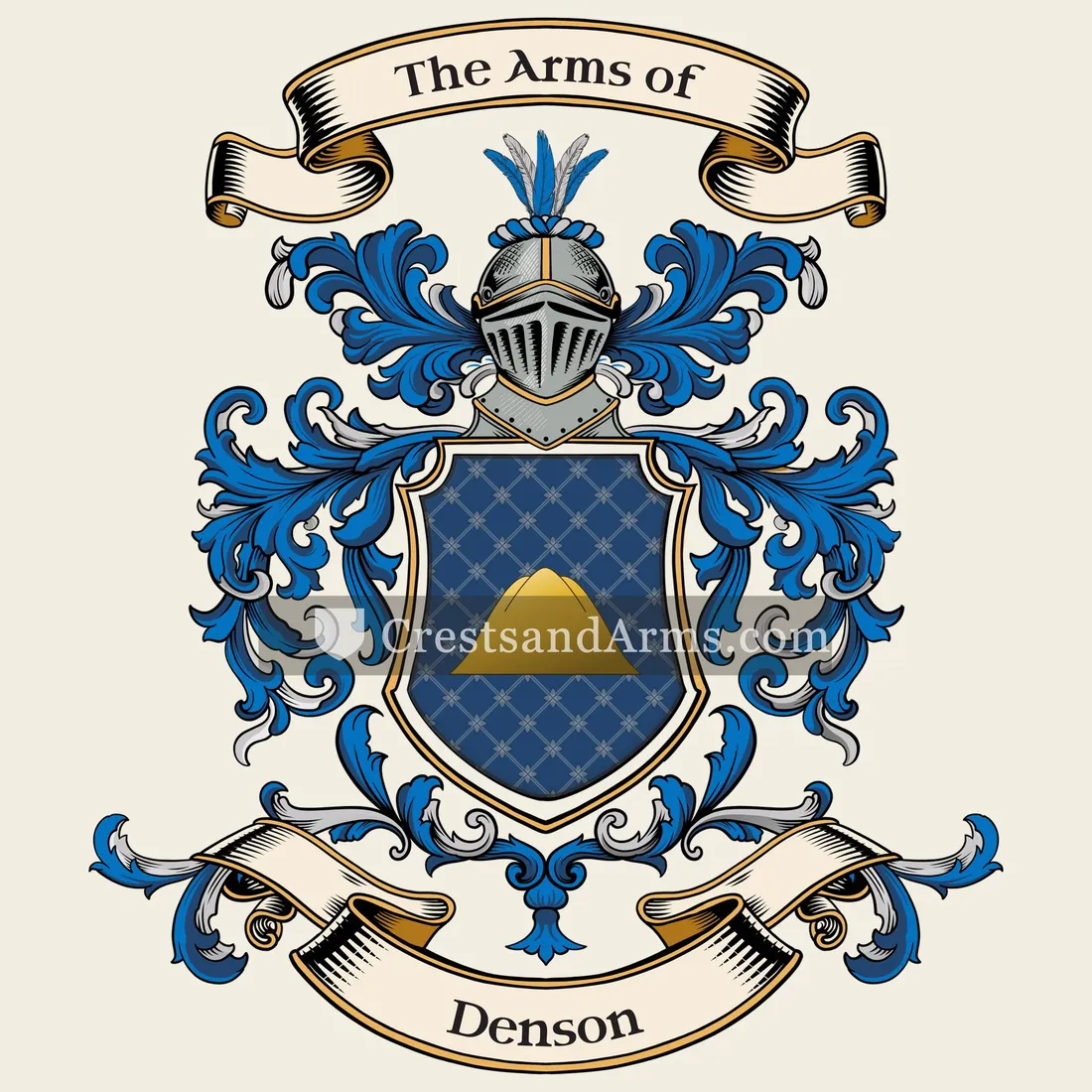
 mountThe ground held, and steadfastness upon it
 mountThe ground held, and steadfastness upon it


 bendDefence, and the scarf of a commander
 cross symbolChristian faith and service
 unicornPurity, and extreme courage in defence of honour
 mulletThe third son, and a divine quality from above


 chevronProtection, and faithful service completed
 roundelA coin, and one who has been to the crusades