Map of Poland showing where the Derusha arms are recorded
The Derusha arms were recorded in Courland, c. 1772.
Courland was Baltic coast country held in large estates by a small number of families. They kept their land for generations and served as officers abroad, and both landholding and service brought arms with them.
This is where the arms were entered in the register. Families often moved to other parts of the country, so the same name can turn up in more than one region.
Region
Courland
First recorded
1772
Granting Authority for the Derusha Arms
Ennoblement by the Sejm
Author: Olek Remesz · CC BY-SA 3.0
The body that granted and recorded arms in Poland in this period.
Stanisław August Poniatowski
Sovereign of the period
Stanisław August Poniatowski
1764–1795
Reigning in Poland when the Derusha arms are first recorded.
How Arms Worked in Poland
Polish noble families shared a single coat of arms across many different surnames, creating large clans rather than individual designs. These symbols were held collectively by all members of the clan regardless of their specific family name. When a new family joined the nobility, they were adopted into an existing clan and began using that group's established shield.
Granting authority
The Sejm, which was the Polish parliament, held the power to grant noble status and the right to bear arms.
How they got arms
Families typically received their coat of arms through a formal act of ennoblement granted by the Sejm for distinguished service.
Where arms were recorded
These grants were officially recorded in the Crown Metrica, which served as the central archive for state documents starting in the sixteenth century.
The family's standing
Recorded among the armigerous families of Courland.
Origin & History of the Derusha Family in Poland
The history of the Derusha family name is deeply connected to the shifting borders and complex cultural landscape of the Polish-Lithuanian Commonwealth. By 1772, records confirm that members of the family were established in the region of Courland, which was a duchy under the influence of the Polish crown at that time. The name likely evolved from local linguistic roots as families moved through the diverse territories of the Baltic and Polish regions. During this period, the area experienced significant political upheaval, including the first partition of Poland, which forced many families to adapt to new administrative systems and changing social structures. As the family lived in this crossroads of European history, they navigated the transition between different regional identities while maintaining their presence in the Baltic lands. This early era defined the family as part of a resilient group that survived the collapse of old borders and the rise of new imperial powers.
Coat of Arms & Family Crest Details
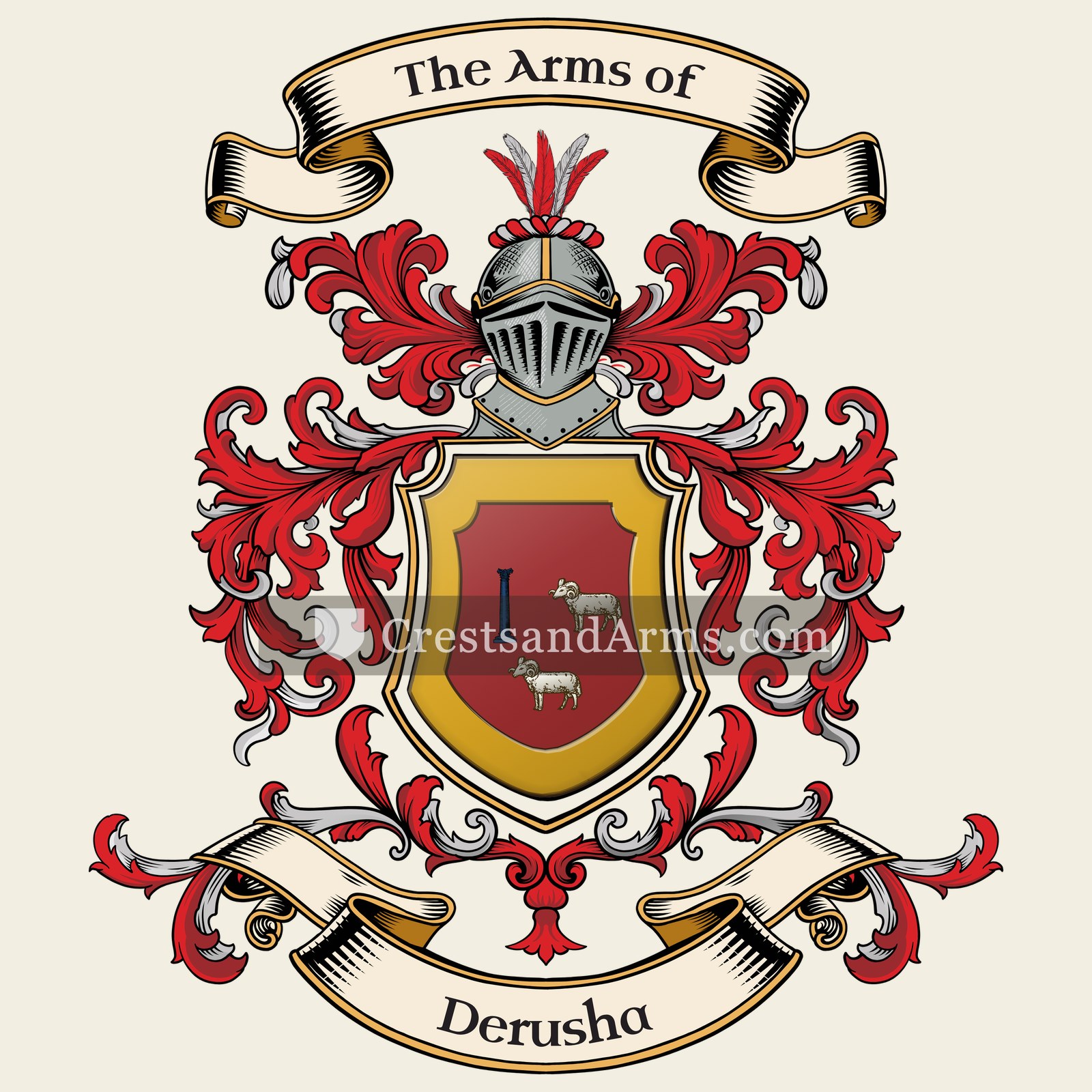
Symbols on this shield
columnFortitude and constancy
ramLeadership and authority
Colours
Red (Gules)Means: Military strength
Gold (Or)Means: Generosity
Blue (Azure)Means: Loyalty and truth
Historical info
Source
J. B. Rietstap, Armorial Général, Gouda: G. B. van Goor Zonen, 1884–87
Blazon (the actual original written record)
“De gu. à une colonne d'azur, sommée d'une boule du même, et une couronne de laurier de sin. suspendue au fût; la colonne accostée de deux têtes de bélier affr. au nat. L'écu bordé d'or. C.: une tête et col de bélier au nat., posée de front. L. d'or et de gu.”
Germanyc. 1765
Digital archive packCoat of arms PNG, gold border print PDF, vector SVG and the certificate of authenticity. Sent to your email in minutes.
Map of Germany showing where the Derusha arms are recorded
The Derusha arms were recorded in Germany, c. 1765.
Arms such as these were typically recorded in Bavaria.
Bavaria was a country of old landed families and walled market towns. Estates passed down the same line for centuries, and both the landowners and the leading townsmen kept arms, which is why so many Bavarian names sit in the registers.
This is where the arms were entered in the register. Families often moved to other parts of the country, so the same name can turn up in more than one region.
The body that granted and recorded arms in Germany in this period.
Francis I, Holy Roman Emperor
Sovereign of the period
Francis I, Holy Roman Emperor
1745–1765
Reigning in Poland when the Derusha arms are first recorded.
How Arms Worked in Germany
In the Holy Roman Empire, coats of arms were often granted to individuals by the Emperor or his representatives. These arms were then passed down through the generations to all legitimate descendants of the original holder. Younger branches of a family usually kept the same shield design without needing to change it, as the arms belonged to the entire lineage.
Granting authority
The Holy Roman Emperor held the sole power to grant new coats of arms throughout his vast imperial territories.
How they got arms
Families typically obtained their coats of arms through a formal imperial grant or by proving their noble status to the authorities.
Where arms were recorded
These grants were officially recorded in the Imperial Chancery registers, which began keeping formal records of such honors during the Middle Ages.
The family's standing
Recorded among the armigerous families of Germany.
Origin & History of the Derusha Family in Germany
The family name Derusha carries a history deeply rooted in the cultural landscape of eighteenth-century Bavaria. By 1765, records indicate that members of the family were established within this region, which was then a prominent territory of the Holy Roman Empire. During this period, Bavaria was undergoing significant social and agricultural changes as it transitioned toward a more centralized administrative system. Families like the Derushas often lived in rural communities where their daily lives were shaped by the local traditions of the Bavarian Alps and the surrounding fertile plains. While the name itself reflects the linguistic evolution of the German language, it also serves as a marker of the family’s long-standing connection to the traditions and regional identity of southern Germany. Their presence in the area during the mid-1700s suggests they were part of the hardworking population that sustained the local economy through farming and skilled craftsmanship before the major migrations of the following century.
Related Branches & Arms
Root word
Derus
Derived from the Latin word durus meaning hard or enduring.
This name
DerushaA locational or descriptive surname likely referring to a person of resilient character.
also spelled
Dershow
Documented Sources
J. B. Rietstap, Armorial Général, Gouda: G. B. van Goor Zonen, 1884–87
Dunsdorfs, Edgars. Der Grüne Stammbaum: Die Geschichte der Familie von der Recke. 1964
Latvian State Historical Archives (Latvijas Valsts vēstures arhīvs), Kurzemes un Zemgales hercogistes arhīvs. 1772
Seraphim, Ernst. Geschichte Liv-, Est- und Kurlands. 1895
Digital archive packCoat of arms PNG, gold border print PDF, vector SVG and the certificate of authenticity. Sent to your email in minutes.


 ramLeadership and authority
 ramLeadership and authority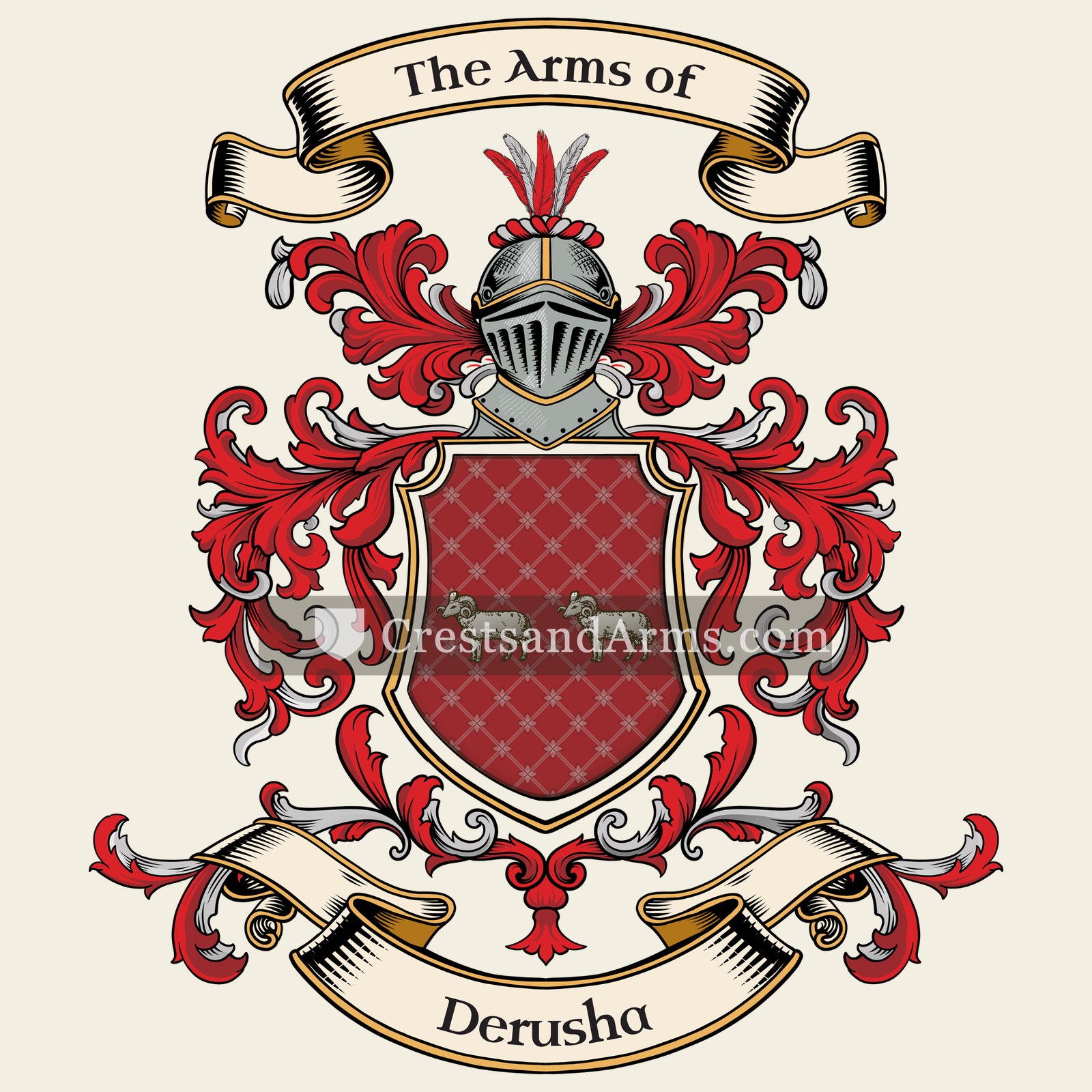


 columnFortitude and constancy