Map of France showing where the Désiré arms are recorded
The Désiré arms were recorded in Paris, c. 1663.
This is where the arms were entered in the register. Families often moved to other parts of the country, so the same name can turn up in more than one region.
The body that granted and recorded arms in France in this period.
Louis XIV of France
Sovereign of the period
Louis XIV of France
1643–1715
Reigning in France when the Désiré arms are first recorded.
How Arms Worked in France
In France, a coat of arms was a mark of honor that passed down through the male line to all legitimate descendants. Families often used the same shield without changes to show their shared heritage. If a branch wanted to stand out, they could add a small mark to their shield to show their specific place in the family tree.
Granting authority
The Juge d'armes de France acted as the official authority that regulated and verified coats of arms across the country.
How they got arms
Families typically inherited their arms from ancestors, though they could also receive them through royal grants or by proving their noble status.
Where arms were recorded
Coats of arms were officially recorded in the Armorial Général de France, which began its main collection in the year 1696.
The family's standing
Recorded among the armigerous families of France.
Origin & History of the Désiré Family in France
The history of the name Désiré in France is deeply rooted in the cultural and religious traditions of the seventeenth century. Derived from the Latin word *desideratus*, meaning desired or wished for, the name was often bestowed upon children as a sign of gratitude or as a reflection of their status as a long-awaited blessing. By 1663, records confirm that members of the Désiré family were well-established in Paris, a city that served as the vibrant center of French intellectual and social life during the reign of King Louis XIV. At this time, families living in the capital were often part of the growing merchant or artisan classes, contributing to the bustling economy of the city. As the name became more common, it evolved from a simple expression of parental affection into a formal surname that helped define the identity of these early Parisians. Through their presence in the capital, the family became part of the complex social fabric of old France, living through an era of significant architectural and political change.
Coat of Arms & Family Crest Details
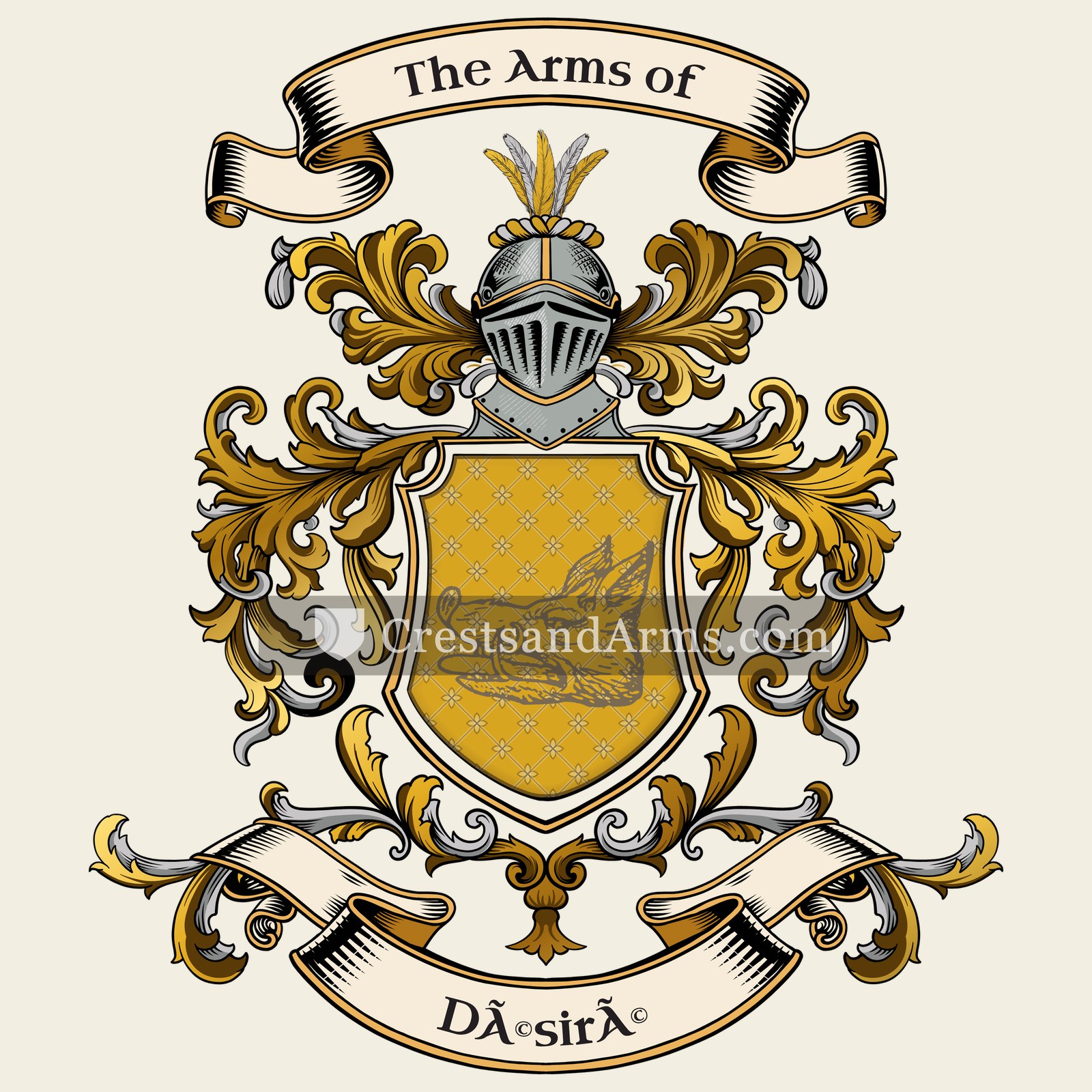
Symbols on this shield
boars headA fierce fighter who battles to the end
Colours
Gold (Or)Means: Generosity
Historical info
Source
J. B. Rietstap, Armorial Général, Gouda: G. B. van Goor Zonen, 1884–87
Blazon (the actual original written record)
“D'or à une hure de sanglier au nat. C.: un bras arm., brandissant une épée.”
Belgiumc. 1737
Digital archive packCoat of arms PNG, gold border print PDF, vector SVG and the certificate of authenticity. Sent to your email in minutes.
Map of Belgium showing where the Désiré arms are recorded
The Désiré arms were recorded in Belgium, c. 1737.
Arms such as these were typically recorded in Brabant.
Brabant lay at the heart of the Low Countries, where the trade routes met. Its towns were wealthy and its landowners many, and both kinds of family kept arms, which is why the region is so heavily represented.
This is where the arms were entered in the register. Families often moved to other parts of the country, so the same name can turn up in more than one region.
The body that granted and recorded arms in Belgium in this period.
Charles VI, Holy Roman Emperor
Sovereign of the period
Charles VI, Holy Roman Emperor
1711–1740
Reigning in France when the Désiré arms are first recorded.
How Arms Worked in Belgium
In Belgium, a coat of arms is considered personal property that is passed down through the male line to legitimate descendants. Families often use the same shield design across generations to show their shared heritage. If a branch of the family wants to change the design, they must apply for an official update to their specific version of the arms.
Granting authority
The Conseil héraldique is the official body that regulates and approves all coats of arms in Belgium.
How they got arms
Families obtain their coats of arms through formal royal grants or by confirming their historical right to use existing designs.
Where arms were recorded
All approved coats of arms are officially recorded in the public registers of the Conseil héraldique since 1844.
The family's standing
Recorded among the armigerous families of Belgium.
Origin & History of the Désiré Family in Belgium
The family name Désiré traces its roots in Belgium back to the historic Duchy of Brabant, where records confirm members of the family were established by 1737. During this era, the name functioned primarily as a given name derived from the French word for desired or wished for, often reflecting the religious sentiment of a child being a long-awaited blessing to their parents. As the family settled into the Brabant region, they became part of the local social fabric during a time of significant agricultural and economic transition under the Austrian Netherlands. Over the following decades, the name gradually transitioned from a personal identifier into a stable hereditary surname as record-keeping practices became more formal across Belgian parishes. This evolution allowed the family to maintain a distinct identity while navigating the complex linguistic and cultural shifts that defined the region throughout the eighteenth century.
Désiré Meaning & Related Branches
Root word
Desiderium
Latin term meaning longing, desire, or a wish for something.
This name
DésiréDerived from the French word for desired or wished for, often implying a long-awaited child.
also spelled
de Sires
de Sir
de Seer
Documented Sources
J. B. Rietstap, Armorial Général, Gouda: G. B. van Goor Zonen, 1884–87
Dauzat, Albert. Dictionnaire étymologique des noms et prénoms de France. 1951
Morlet, Marie-Thérèse. Dictionnaire étymologique des noms de famille. 1991
Archives Nationales de France, Minutier central des notaires de Paris
Archives de Paris, Registres paroissiaux et d'état civil
Digital archive packCoat of arms PNG, gold border print PDF, vector SVG and the certificate of authenticity. Sent to your email in minutes.


 chevronProtection, and faithful service completed
 starThe celestial goddess, and nobility
 chevronProtection, and faithful service completed
 starThe celestial goddess, and nobility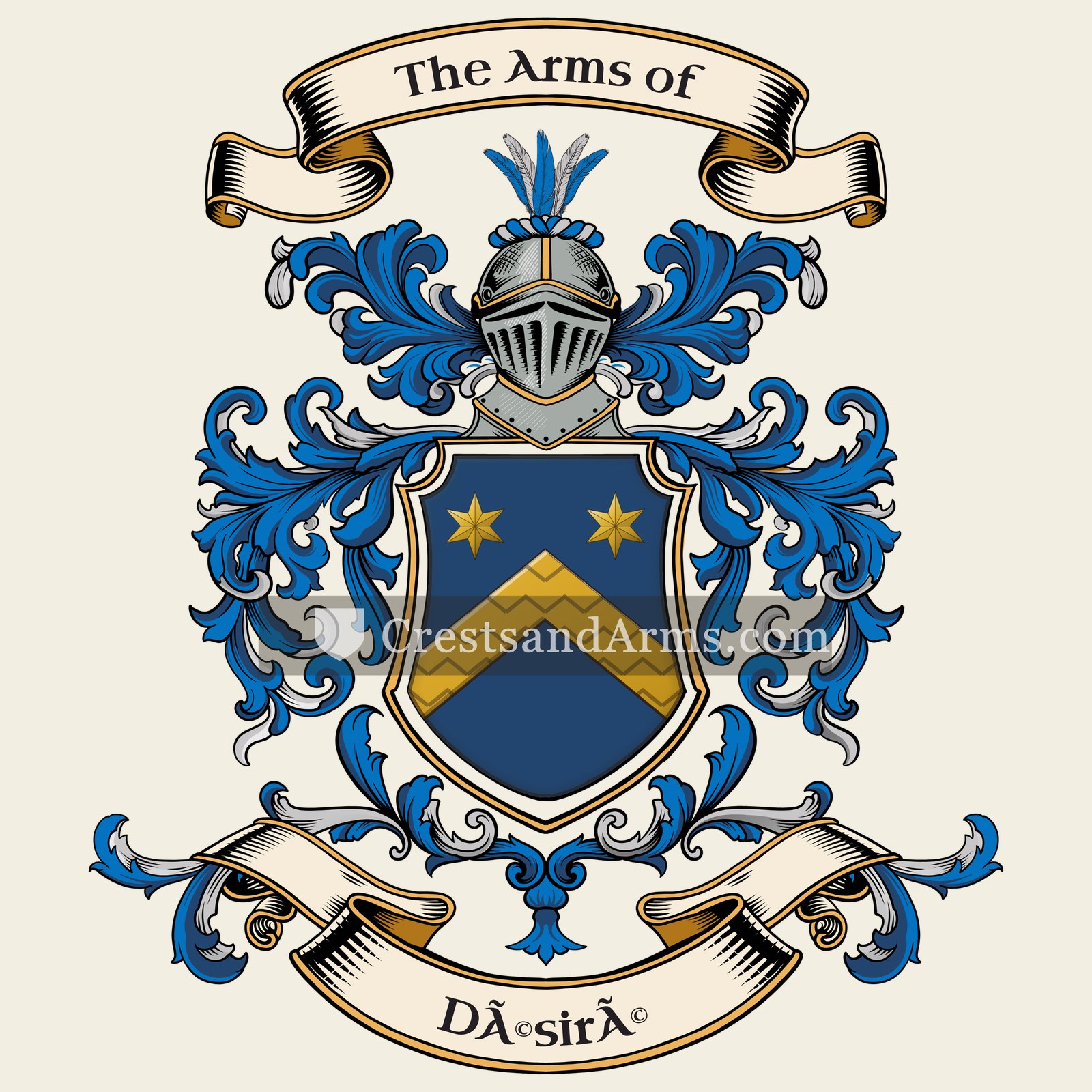


 boars headA fierce fighter who battles to the end