Map of Germany showing where the Deuchar arms are recorded
The Deuchar arms were recorded in Franconia, c. 1765.
Franconia was a patchwork of small territories in central Germany, full of minor landowners and prosperous market towns. So many separate households held land there that the region produced a great many coats of arms.
This is where the arms were entered in the register. Families often moved to other parts of the country, so the same name can turn up in more than one region.
The body that granted and recorded arms in Germany in this period.
Francis I, Holy Roman Emperor
Sovereign of the period
Francis I, Holy Roman Emperor
1745–1765
Reigning in Germany when the Deuchar arms are first recorded.
How Arms Worked in Germany
In the Holy Roman Empire, coats of arms were often granted to individuals by the Emperor or his representatives. These arms were then passed down through the generations to all legitimate descendants of the original holder. Younger branches of a family usually kept the same shield design without needing to change it, as the arms belonged to the entire lineage.
Granting authority
The Holy Roman Emperor held the sole power to grant new coats of arms throughout his vast imperial territories.
How they got arms
Families typically obtained their coats of arms through a formal imperial grant or by proving their noble status to the authorities.
Where arms were recorded
These grants were officially recorded in the Imperial Chancery registers, which began keeping formal records of such honors during the Middle Ages.
The family's standing
Recorded among the armigerous families of Franconia.
Origin & History of the Deuchar Family in Germany
The family name Deuchar finds its early roots in the historical region of Franconia, where members of the family were firmly established by 1765. During this period, Franconia was a patchwork of territories within the Holy Roman Empire, characterized by a strong tradition of craftsmanship and agricultural development. Families like the Deuchars often lived in small, tight-knit communities where local identity was tied closely to the land and the specific trade practiced by their ancestors. As the eighteenth century progressed, the region faced significant social and economic shifts, prompting many families to adapt their livelihoods to changing market demands. The presence of the Deuchar name in these German records highlights a history of resilience and integration into the local social fabric of the time, long before the name spread to other parts of the world.
Meaning of the Deuchar family crest colors & symbols
Symbols on this shield
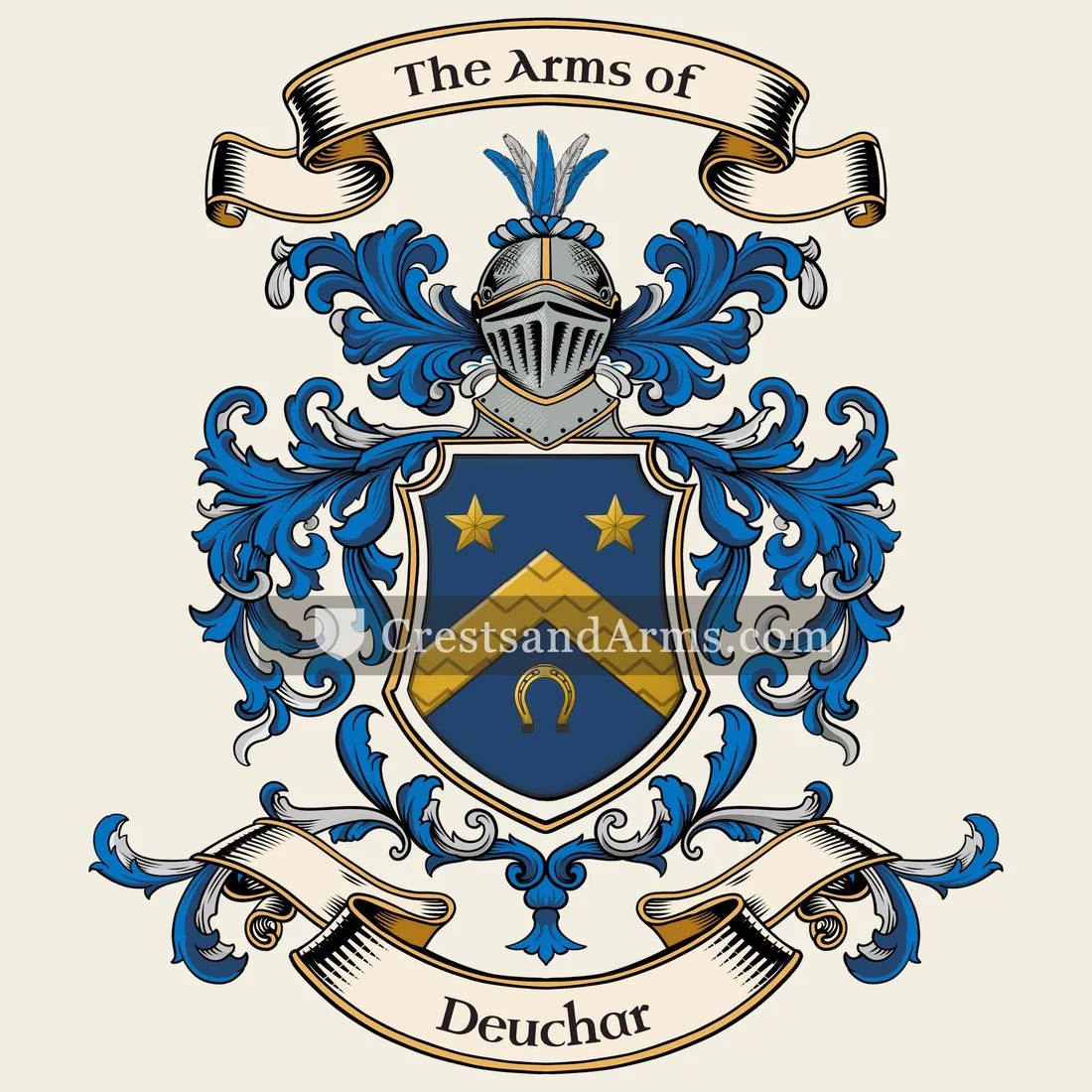
chevronProtection, and faithful service completed
mulletThe third son, and a divine quality from above
horseshoeGood fortune and protection from harm
Colours
Blue (Azure)Means: Loyalty and truth
Gold (Or)Means: Generosity
Historical info
Source
J. B. Rietstap, Armorial Général, Gouda: G. B. van Goor Zonen, 1884–87
Blazon (the actual original written record)
“D'azur au chev., acc. en chef de deux étoiles et en p. d'un fer-à-cheval, les bouts en bas, le tout d'or, le fer-à-cheval sommé d'une croisette pattée d'arg. C.: un vol d'azur, chaque aile ch. d'un chev. d'or, acc. de trois étoiles du même.”
SwitzerlandBâle, c. 1745
Digital archive packCoat of arms PNG, gold border print PDF, vector SVG and the certificate of authenticity. Sent to your email in minutes.
Map of Switzerland showing where the Deuchar arms are recorded
The Deuchar arms were recorded in Bâle, c. 1745.
This is where the arms were entered in the register. Families often moved to other parts of the country, so the same name can turn up in more than one region.
The body that granted and recorded arms in Switzerland in this period.
How Arms Worked in Switzerland
In Switzerland, coats of arms were not restricted to the nobility and were often adopted by common citizens and families. These symbols were passed down through generations to show family identity. When branches of a family grew, they often changed small details of the design to distinguish their own line from the original group.
Granting authority
Cantonal and civic authorities managed the use of coats of arms within their specific regions and local jurisdictions.
How they got arms
Families typically assumed their own coats of arms based on local custom rather than receiving them from a central monarch.
Where arms were recorded
Arms were recorded in various cantonal and civic registers starting from the fourteenth century throughout the Swiss region.
The family's standing
Recorded among the armigerous families of Switzerland.
Origin & History of the Deuchar Family in Switzerland
The family name Deuchar has deep roots in the city of Basel, Switzerland, where records confirm members of the family were established by the year 1745. During this period, Basel was a thriving center for trade and intellectual growth, situated at the crossroads of European commerce along the Rhine River. Families like the Deuchars often integrated into the local urban structure by participating in the city's guild system, which governed professional life and social status for residents. While the name itself carries linguistic connections to regions further north, the Basel branch became firmly embedded in the local administrative and social fabric of the eighteenth century. By living in such a prominent Swiss city, these early ancestors were part of a dynamic environment that valued craftsmanship, education, and civic duty. Their presence in the city archives during this era suggests they were active participants in the daily life of a community that was rapidly modernizing during the Enlightenment.
Deuchar Meaning & Related Branches
Root word
Teut
Derived from the Germanic word for people or folk.
This name
DeucharRefers to a person belonging to the Germanic people or tribe.
also spelled
Deuchert
Doyker
Documented Sources
J. B. Rietstap, Armorial Général, Gouda: G. B. van Goor Zonen, 1884–87
Staatsarchiv Bamberg, Kirchenbücher der Pfarrei (Parish Registers), 1765


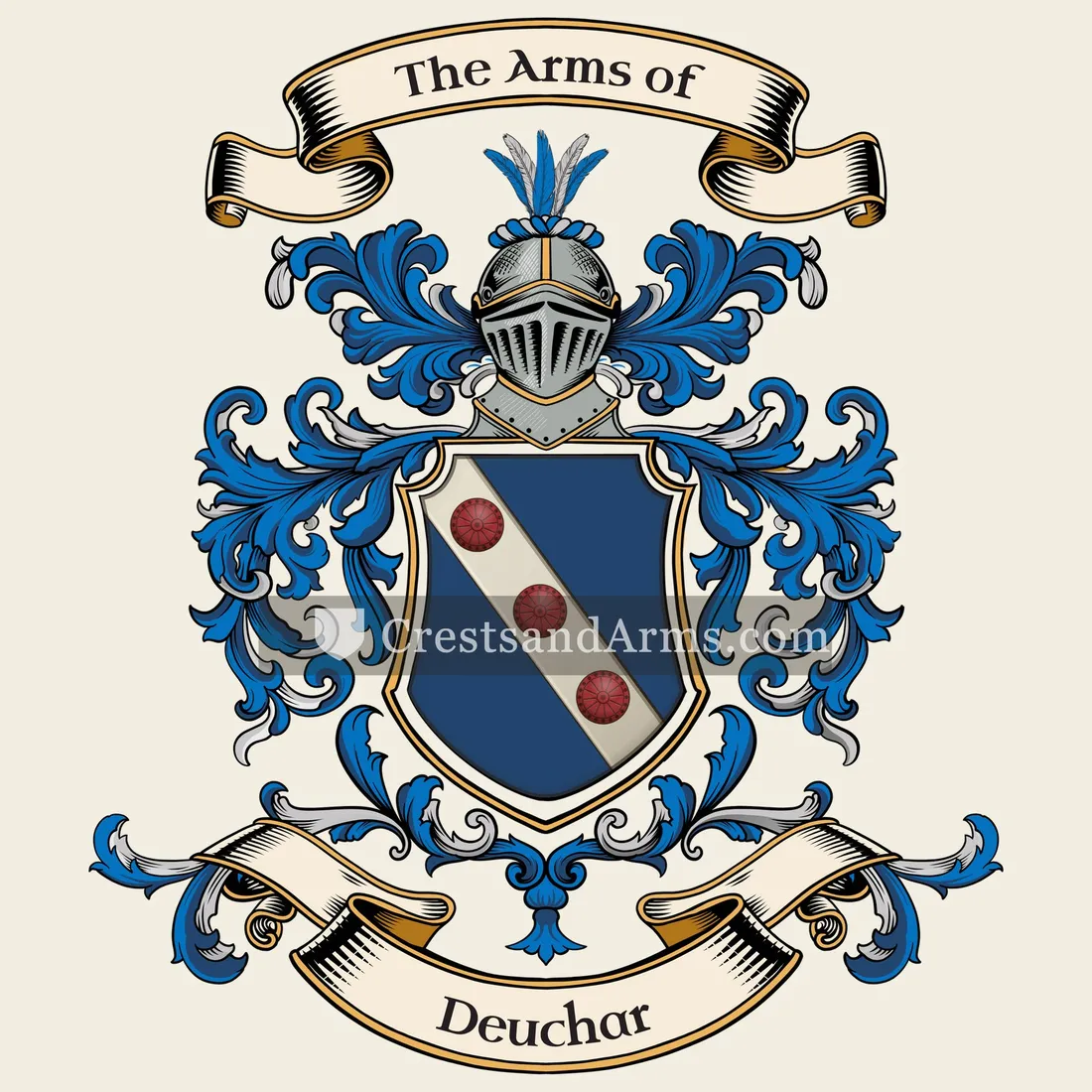
 bendDefence, and the scarf of a commander
 roundelA coin, and one who has been to the crusades
 bendDefence, and the scarf of a commander
 roundelA coin, and one who has been to the crusades


 chevronProtection, and faithful service completed
 mulletThe third son, and a divine quality from above
 horseshoeGood fortune and protection from harm