Map of Netherlands showing where the Devor arms are recorded
The Devor arms were recorded in Amsterdam, c. 1815.
This is where the arms were entered in the register. Families often moved to other parts of the country, so the same name can turn up in more than one region.
Region
Amsterdam
Town
Amsterdam
First recorded
1815
Granting Authority for the Devor Arms
Hoge Raad van Adel
Photograph made by me · CC BY-SA 3.0
The body that granted and recorded arms in Netherlands in this period.
William I of the Netherlands
Sovereign of the period
William I of the Netherlands
1815–1840
Reigning in Netherlands when the Devor arms are first recorded.
How Arms Worked in Netherlands
In the Netherlands, coats of arms were often used by noble families and those who held specific public offices. These arms were passed down through the generations to legitimate descendants. Younger branches of a family usually kept the original design without needing to add special marks. This system ensured that the family identity remained clear and consistent over many years.
Granting authority
The Hoge Raad van Adel is the official body that regulates and manages noble titles and coats of arms in the Netherlands.
How they got arms
Families typically obtained their coats of arms through official royal grants or by proving their long-standing historical use of the symbols.
Where arms were recorded
Coats of arms are officially recorded in the registers held by the Hoge Raad van Adel, which began its work in 1814.
The family's standing
Recorded among the armigerous families of Netherlands.
Origin & History of the Devor Family in Netherlands
The surname Devor is often linked to the historical movement of families across Northern Europe during the nineteenth century. By 1815, records confirm that members of the family were established in Amsterdam, which was a bustling center of trade and cultural exchange at the time. The name likely evolved as a variation of regional surnames found in the Low Countries or nearby areas in France and Germany. During this period, families often moved to major cities like Amsterdam to find work in the growing shipping and mercantile industries. As the family settled into urban life, they became part of the diverse social fabric of the Netherlands. Their presence in city records from this era suggests they were active participants in the economic life of the city as it transitioned into a new century of independence.
Devor Meaning & Related Branches
Root word
de vore
Old French term for a ditch, trench, or watercourse.
This name
DevorA topographic surname referring to someone who lived near a ditch or canal.
also spelled
Devri
Devrye
Documented Sources
J. B. Rietstap, Armorial Général, Gouda: G. B. van Goor Zonen, 1884–87


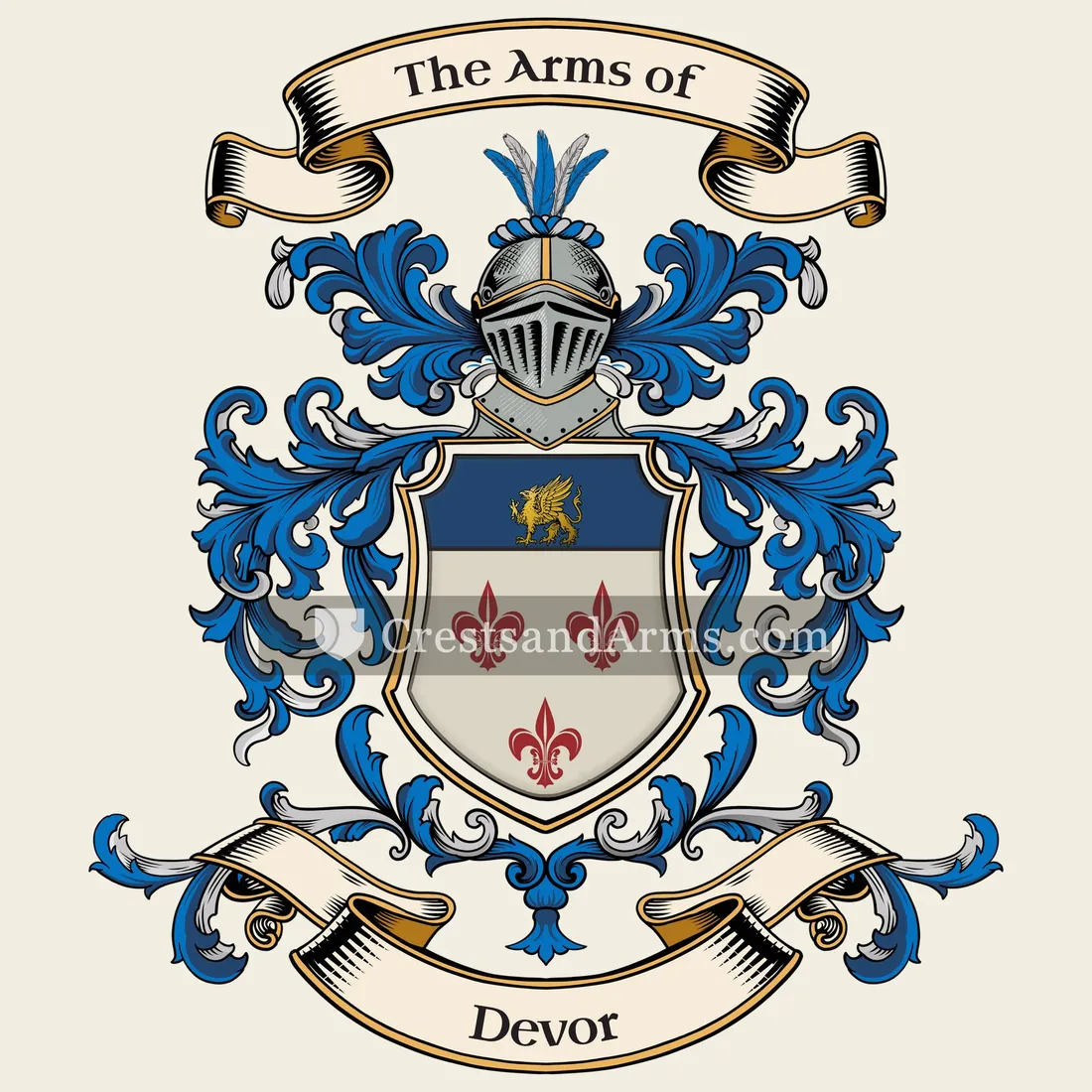
 chiefAuthority, wisdom and dominion
 fleur de lisPurity, light, and the sixth son
 griffinValour and vigilance, guarding great treasure
 chiefAuthority, wisdom and dominion
 fleur de lisPurity, light, and the sixth son
 griffinValour and vigilance, guarding great treasure