Map of Switzerland showing where the de Vy arms are recorded
The de Vy arms were recorded in Neufchâtel, c. 1745.
This is where the arms were entered in the register. Families often moved to other parts of the country, so the same name can turn up in more than one region.
The body that granted and recorded arms in Switzerland in this period.
How Arms Worked in Switzerland
In Switzerland, coats of arms were not restricted to the nobility and were often adopted by common citizens and families. These symbols were passed down through generations to show family identity. When branches of a family grew, they often changed small details of the design to distinguish their own line from the original group.
Granting authority
Cantonal and civic authorities managed the use of coats of arms within their specific regions and local jurisdictions.
How they got arms
Families typically assumed their own coats of arms based on local custom rather than receiving them from a central monarch.
Where arms were recorded
Arms were recorded in various cantonal and civic registers starting from the fourteenth century throughout the Swiss region.
The family's standing
Recorded among the armigerous families of Switzerland.
Origin & History of the de Vy Family in Switzerland
The family name de Vy traces its early roots to the region of Neufchâtel, where members of the family were firmly established by the year 1745. During the eighteenth century, this area was part of the Principality of Neuchâtel, a territory that maintained a unique political status while being closely linked to the Prussian monarchy. Families living in this region often played vital roles in the local economy, which relied heavily on viticulture, watchmaking, and small-scale trade. The name itself follows a common naming pattern from the era, as the prefix "de" suggests a connection to a specific place or a geographic feature near their ancestral home. By settling in this mountainous landscape, the early de Vy family became part of a resilient community that navigated the complex social and political changes occurring throughout the Enlightenment period in Europe.
de Vy Meaning & Related Branches
Root word
Vicus
Latin term referring to a village, district, or dwelling place.
This name
de VyA locative surname indicating someone who originated from a specific village or settlement.
also spelled
Devie
de Vee
Documented Sources
J. B. Rietstap, Armorial Général, Gouda: G. B. van Goor Zonen, 1884–87
Baud, Jean-Pierre, Le droit de Neuchâtel, 1988
Archives de l'État de Neuchâtel, Fonds de la Chancellerie, 1745
Henry, Philippe, Histoire du canton de Neuchâtel, 2011
Digital archive packCoat of arms PNG, gold border print PDF, vector SVG and the certificate of authenticity. Sent to your email in minutes.


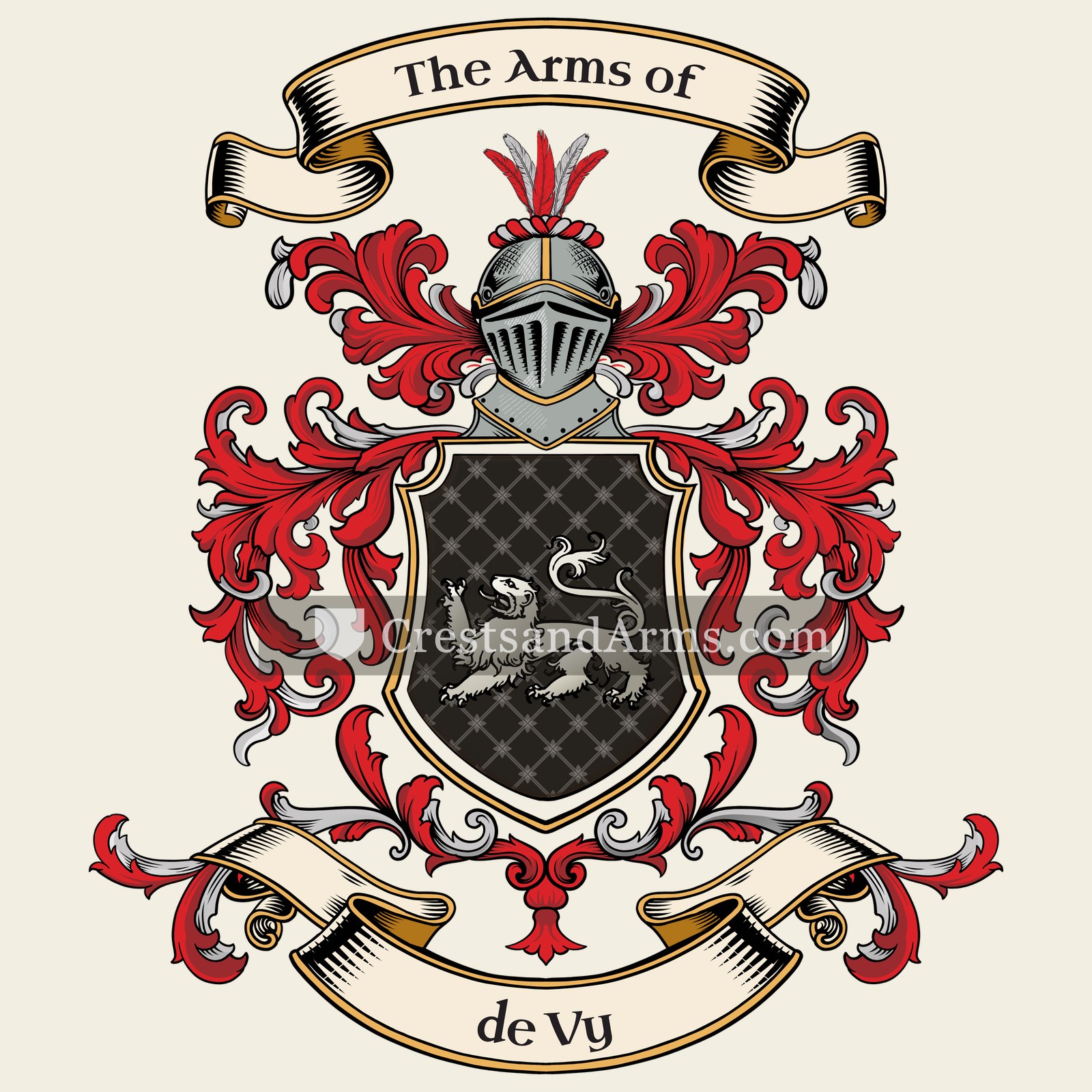
 lionCourage, strength and royalty
 lionCourage, strength and royalty