Map of Belgium showing where the de Windt arms are recorded
The de Windt arms were recorded in Gand, c. 1737.
This is where the arms were entered in the register. Families often moved to other parts of the country, so the same name can turn up in more than one region.
The body that granted and recorded arms in Belgium in this period.
Charles VI, Holy Roman Emperor
Sovereign of the period
Charles VI, Holy Roman Emperor
1711–1740
Reigning in Belgium when the de Windt arms are first recorded.
How Arms Worked in Belgium
In Belgium, a coat of arms is considered personal property that is passed down through the male line to legitimate descendants. Families often use the same shield design across generations to show their shared heritage. If a branch of the family wants to change the design, they must apply for an official update to their specific version of the arms.
Granting authority
The Conseil héraldique is the official body that regulates and approves all coats of arms in Belgium.
How they got arms
Families obtain their coats of arms through formal royal grants or by confirming their historical right to use existing designs.
Where arms were recorded
All approved coats of arms are officially recorded in the public registers of the Conseil héraldique since 1844.
The family's standing
Recorded among the armigerous families of Belgium.
Origin & History of the de Windt Family in Belgium
The history of the de Windt family in Belgium is deeply rooted in the vibrant urban landscape of Ghent, known locally as Gand. By 1737, the family was already established within this influential city, which served as a major center for trade and textile production during the eighteenth century. The name itself suggests a historical connection to the landscape or the occupation of its early bearers, as it translates to "of the wind." This often indicated that the family lived near a windmill or worked in the milling industry, which was a vital part of the local economy. As residents of Ghent, the de Windt family likely participated in the city’s complex social and commercial life, navigating the shifts in power and industry that defined the Austrian Netherlands during this era. Their presence in the city records from this time highlights their integration into the middle-class fabric of Flemish society, where they contributed to the steady growth of the region.
Coat of Arms & Family Crest Details
Symbols on this shield
fessThe military belt, and readiness to serve
chiefAuthority, wisdom and dominion
sunGlory, splendour and the source of life
Colours
Red (Gules)Means: Military strength
Silver (Argent)Means: Peace and sincerity
Gold (Or)Means: Generosity
Historical info
Source
J. B. Rietstap, Armorial Général, Gouda: G. B. van Goor Zonen, 1884–87
Blazon (the actual original written record)
“De gu. à la fasce ondée d'arg.; au chef de ..., ch. d'un soleil (ou d'une étoile) d'or.”
FlandreFlandre, c. 1663
Digital archive packCoat of arms PNG, gold border print PDF, vector SVG and the certificate of authenticity. Sent to your email in minutes.
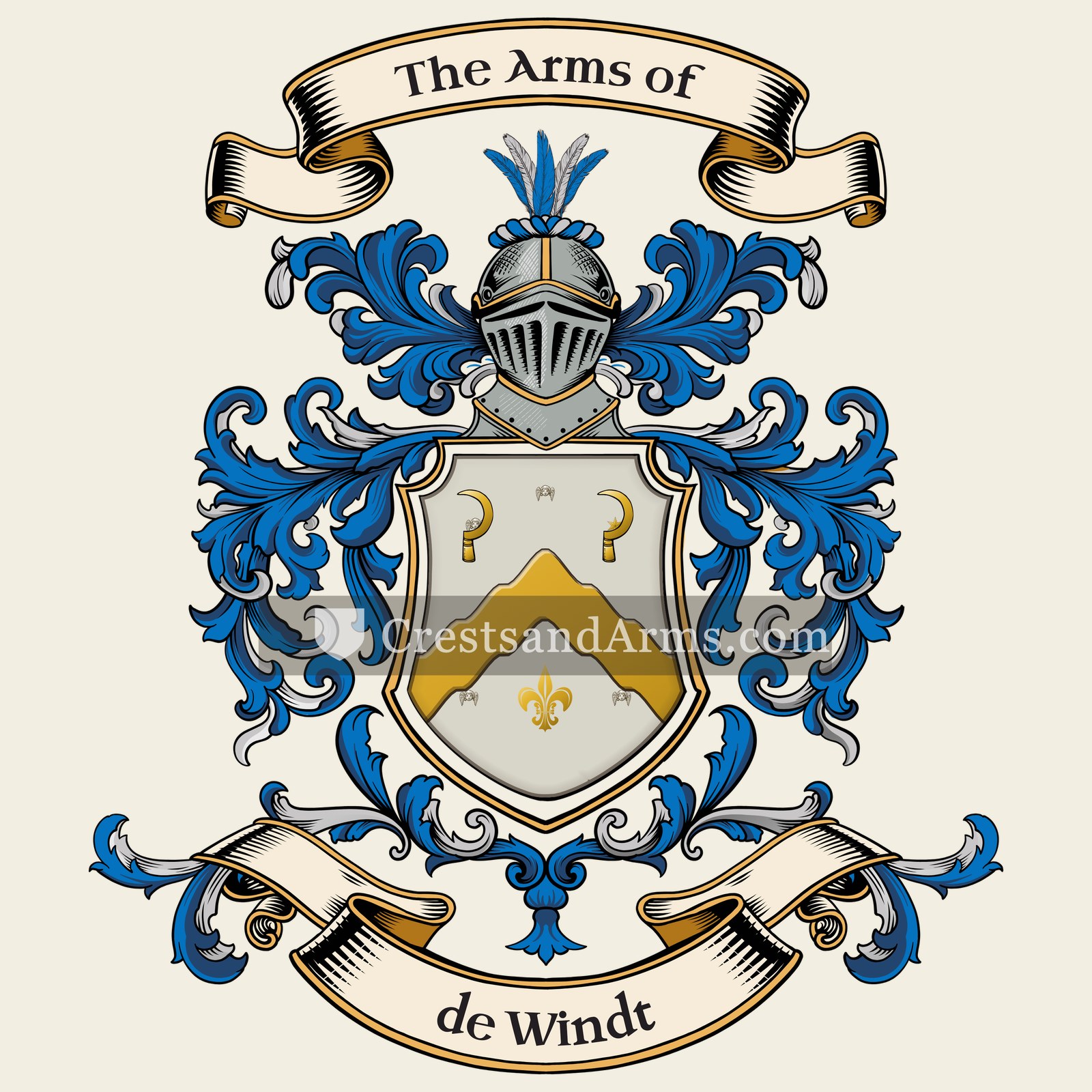
Map of France showing where the de Windt arms are recorded
The de Windt arms were recorded in Flandre, c. 1663.
Flandre grew rich on cloth, and its towns were among the busiest in Europe. Merchant families bought land with their profits and took arms to go with it, so trade put as many names in the registers here as land did.
This is where the arms were entered in the register. Families often moved to other parts of the country, so the same name can turn up in more than one region.
The body that granted and recorded arms in France in this period.
Louis XIV of France
Sovereign of the period
Louis XIV of France
1643–1715
Reigning in Belgium when the de Windt arms are first recorded.
How Arms Worked in France
In France, a coat of arms was a mark of honor that passed down through the male line to all legitimate descendants. Families often used the same shield without changes to show their shared heritage. If a branch wanted to stand out, they could add a small mark to their shield to show their specific place in the family tree.
Granting authority
The Juge d'armes de France acted as the official authority that regulated and verified coats of arms across the country.
How they got arms
Families typically inherited their arms from ancestors, though they could also receive them through royal grants or by proving their noble status.
Where arms were recorded
Coats of arms were officially recorded in the Armorial Général de France, which began its main collection in the year 1696.
The family's standing
Recorded among the armigerous families of Flandre.
Origin & History of the de Windt Family in France
The history of the de Windt family in France is deeply tied to the shifting borders and cultural exchanges of the seventeenth century, particularly within the region of Flandre. By 1663, the family was already well-established in this area, which was a crossroads for trade and political influence between the French crown and the neighboring Low Countries. The name itself reflects a linguistic connection to the landscape and the maritime environment of the North Sea coast. During this period, families in Flandre often navigated complex loyalties as the territory transitioned under French administration. The de Windts were part of a local social fabric that valued commerce and land ownership, allowing them to maintain a stable presence during a time of frequent military conflict. Their early history illustrates how families in border regions adapted to changing national identities while preserving their own heritage through generations of local residency.
Coat of Arms & Family Crest Details
Symbols on this shield
chevronProtection, and faithful service completed
starThe celestial goddess, and nobility
cherubDivine protection over the innocent
sickleThe harvest, and the reaping of what was sown
fleur de lisPurity, light, and the sixth son
Colours
Blue (Azure)Means: Loyalty and truth
Gold (Or)Means: Generosity
Silver (Argent)Means: Peace and sincerity
Historical info
Source
Sir Bernard Burke, The General Armory of England, Scotland, Ireland and Wales, London: Harrison & Sons, 1884
Blazon (the actual original written record)
“1st and 4th, az. an estoile or, betw. four cherubims winged in saltire, each looking to the centre ar., for De Windt; 2nd and 3rd, gu. a chev. nebulée betw. two plummets in chief and a fleur-de-lis in base or, for Jennyns”
EnglandLondon, c. 1620
Digital archive packCoat of arms PNG, gold border print PDF, vector SVG and the certificate of authenticity. Sent to your email in minutes.
Map of England showing where the de Windt arms are recorded
The de Windt arms were recorded in London, c. 1620.
This is where the arms were entered in the register. Families often moved to other parts of the country, so the same name can turn up in more than one region.
The body that granted and recorded arms in England in this period.
James VI and I
Sovereign of the period
James VI and I
1603–1625
Reigning in Belgium when the de Windt arms are first recorded.
How Arms Worked in England
English heraldry allowed arms to be shared by all legitimate descendants of the original owner. These symbols were treated as personal property that moved through the generations to all children. While the eldest son kept the original design, other family members could use the same shield without needing to change it or register their own unique versions.
Granting authority
The College of Arms in London has regulated the use of coats of arms throughout England and Wales since 1484.
How they got arms
Families typically obtained their coats of arms through a formal grant from the Crown or by proving their ancient right to them.
Where arms were recorded
All official coats of arms are recorded in the registers kept at the College of Arms, which date back to the fifteenth century.
The family's standing
Recorded among the armigerous families of England.
Origin & History of the de Windt Family in England
The family name de Windt carries a history deeply connected to the movement of people across the North Sea during the seventeenth century. By 1620, records confirm that members of the family were already established in London, placing them among the vibrant community of merchants and immigrants who shaped the city during the reign of King James I. The name itself reflects a Dutch or Low German origin, likely serving as a descriptive label for ancestors who lived near a prominent windmill or worked in a trade related to wind power. As these individuals settled in England, they integrated into the bustling commercial life of the capital, likely participating in the maritime trade networks that linked London to the ports of the Netherlands. Their presence in the city during this era suggests they were part of a broader wave of European migration that brought new skills, cultural influences, and economic energy to the English landscape.
de Windt Meaning & Related Branches
Root word
Wind
A Germanic term referring to the movement of air.
This name
de WindtRefers to a person who lived in a windy location or was notably swift.
also spelled
Windt
Wind
Wyndt
de Wint
Dewint
Related arms
Windvariant spelling
Documented Sources
J. B. Rietstap, Armorial Général, Gouda: G. B. van Goor Zonen, 1884–87
Archives: State Archives in Ghent (Rijksarchief te Gent), Parochieregisters van Gent (Parish registers of Ghent)
Archives: City Archives of Ghent (Stadsarchief Gent), Registers van de Poorters van Gent (Registers of the Citizens of Ghent)
Book: Blockmans, W., Gent: Een stad van alle tijden (2007)
Digital archive packCoat of arms PNG, gold border print PDF, vector SVG and the certificate of authenticity. Sent to your email in minutes.


 greyhoundCourage, vigilance and loyalty
 swordJustice, and military honour
 martletA younger son, who must win his own land
 greyhoundCourage, vigilance and loyalty
 swordJustice, and military honour
 martletA younger son, who must win his own land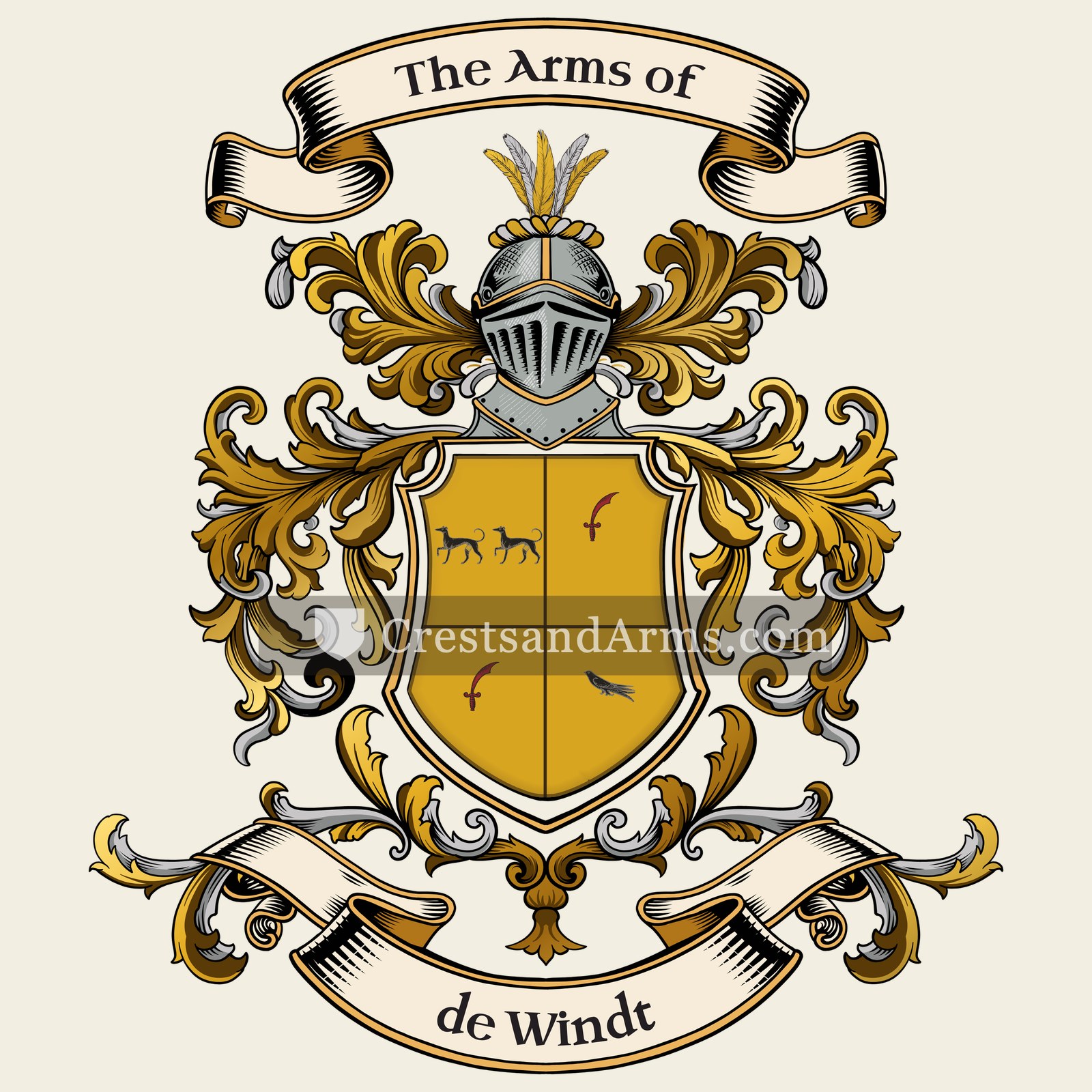


 fessThe military belt, and readiness to serve
 chiefAuthority, wisdom and dominion
 sunGlory, splendour and the source of life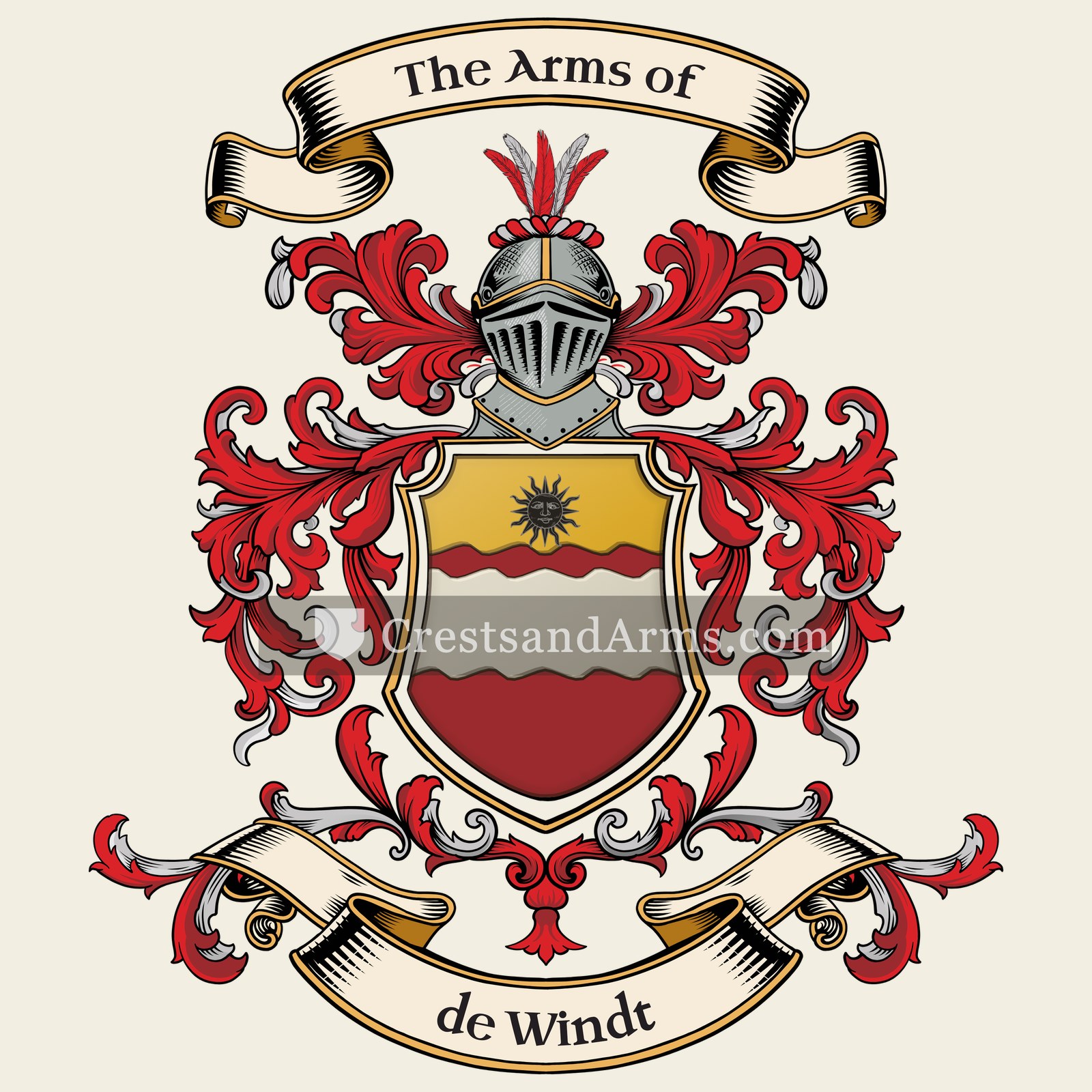


 chevronProtection, and faithful service completed
 starThe celestial goddess, and nobility
 cherubDivine protection over the innocent
 sickleThe harvest, and the reaping of what was sown
 fleur de lisPurity, light, and the sixth son