A record of documented arms, meaning and origin, researched for the Dey family lines. Documented in 2 countries.
Reg. 3777 · Dutch, D–F
Coat of Arms & Family Crest Details
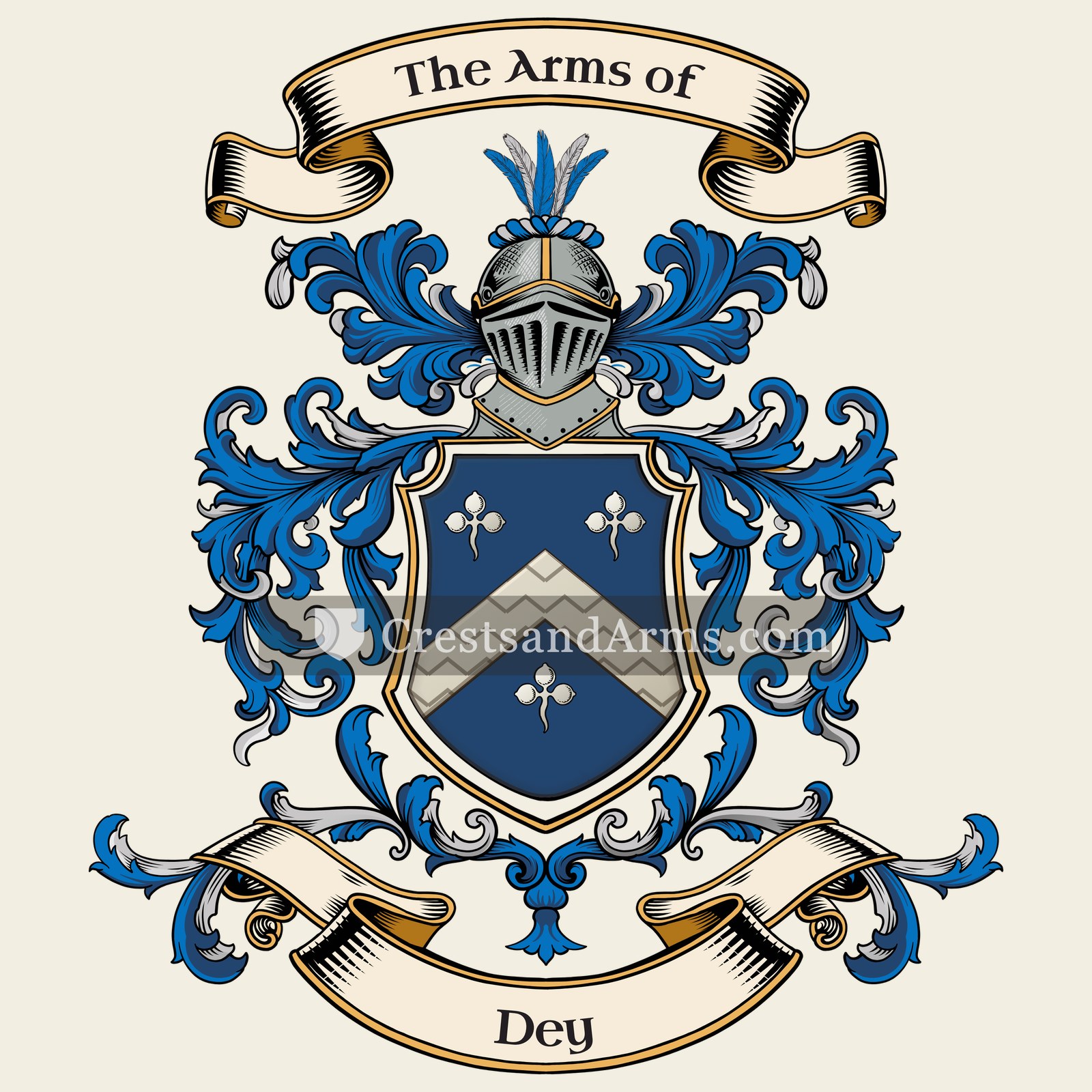
Symbols on this shield
chevronProtection, and faithful service completed
trefoilPerpetuity, and the Trinity
Colours
Blue (Azure)Means: Loyalty and truth
Silver (Argent)Means: Peace and sincerity
Historical info
Source
J. B. Rietstap, Armorial Général, Gouda: G. B. van Goor Zonen, 1884–87
Blazon (the actual original written record)
“D'azur au chev. d'arg., acc. de trois trèfles du même.”
NetherlandsAmsterdam, c. 1815
Where the Dey Arms Were Recorded
Amsterdam
Map of Netherlands showing where the Dey arms are recorded
The Dey arms were recorded in Amsterdam, c. 1815.
This is where the arms were entered in the register. Families often moved to other parts of the country, so the same name can turn up in more than one region.
Region
Amsterdam
Town
Amsterdam
First recorded
1815
Granting Authority for the Dey Arms
Hoge Raad van Adel
Photograph made by me · CC BY-SA 3.0
The body that granted and recorded arms in Netherlands in this period.
William I of the Netherlands
Sovereign of the period
William I of the Netherlands
1815–1840
Reigning in Netherlands when the Dey arms are first recorded.
How Arms Worked in Netherlands
In the Netherlands, coats of arms were often used by noble families and those who held specific public offices. These arms were passed down through the generations to legitimate descendants. Younger branches of a family usually kept the original design without needing to add special marks. This system ensured that the family identity remained clear and consistent over many years.
Granting authority
The Hoge Raad van Adel is the official body that regulates and manages noble titles and coats of arms in the Netherlands.
How they got arms
Families typically obtained their coats of arms through official royal grants or by proving their long-standing historical use of the symbols.
Where arms were recorded
Coats of arms are officially recorded in the registers held by the Hoge Raad van Adel, which began its work in 1814.
The family's standing
Recorded among the armigerous families of Netherlands.
Origin & History of the Dey Family in Netherlands
The surname Dey, often appearing in Dutch records as Deij or Deije, has deep roots in the urban landscape of the Netherlands. By the early 19th century, members of the family were well-established residents of Amsterdam, a city that served as a bustling center for trade and social mobility during the transition from the Napoleonic era to the formation of the United Kingdom of the Netherlands. In this period, the name was typically associated with families living in the dense canal districts where citizens were required to register births, marriages, and deaths with local civil authorities. These early records suggest that the family was part of the growing middle class, likely involved in the city's vibrant mercantile economy. As the Netherlands modernized its administrative systems after 1815, the documentation of the Dey name became more consistent, providing a clear window into the lives of individuals who helped shape the city's identity during a time of significant national change.
Coat of Arms & Family Crest Details
Symbols on this shield
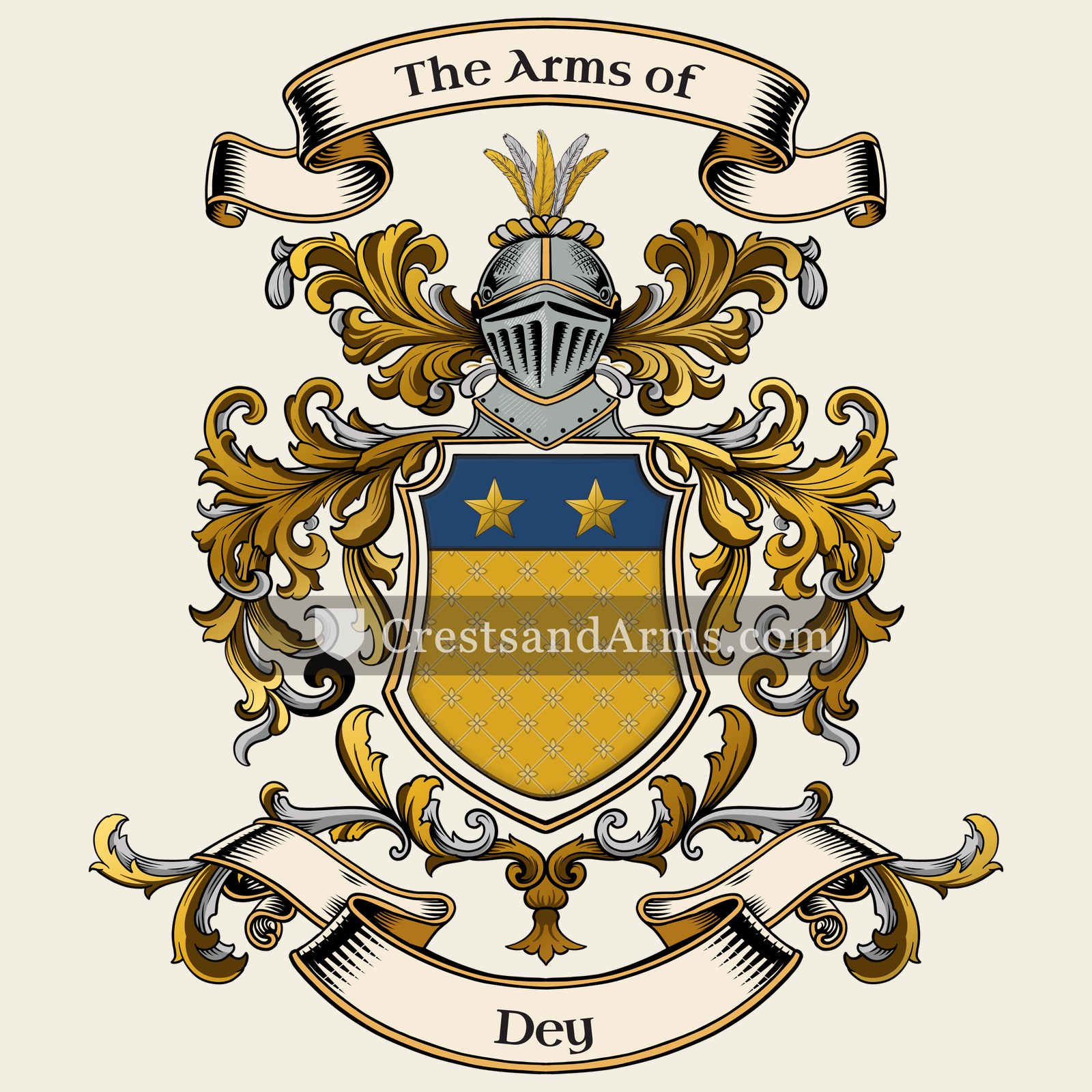
chiefAuthority, wisdom and dominion
mulletThe third son, and a divine quality from above
Colours
Gold (Or)Means: Generosity
Blue (Azure)Means: Loyalty and truth
Historical info
Source
Sir Bernard Burke, The General Armory of England, Scotland, Ireland and Wales, London: Harrison & Sons, 1884
Blazon (the actual original written record)
“Or, on a chief indented az. two mullets of the field”
NorfolkNorfolk, c. 1597
Where the Dey Arms Were Recorded
Norfolk
Map of England showing where the Dey arms are recorded
The Dey arms were recorded in Norfolk, c. 1597.
Norfolk grew rich on wool and grain, and its wealth was spread among many middling families rather than a few great ones. Households of that kind bought land and took arms, and the county holds a large share of English names.
This is where the arms were entered in the register. Families often moved to other parts of the country, so the same name can turn up in more than one region.
The body that granted and recorded arms in England in this period.
Elizabeth I of England
Sovereign of the period
Elizabeth I of England
1558–1603
Reigning in Netherlands when the Dey arms are first recorded.
How Arms Worked in England
English heraldry allowed arms to be shared by all legitimate descendants of the original owner. These symbols were treated as personal property that moved through the generations to all children. While the eldest son kept the original design, other family members could use the same shield without needing to change it or register their own unique versions.
Granting authority
The College of Arms in London has regulated the use of coats of arms throughout England and Wales since 1484.
How they got arms
Families typically obtained their coats of arms through a formal grant from the Crown or by proving their ancient right to them.
Where arms were recorded
All official coats of arms are recorded in the registers kept at the College of Arms, which date back to the fifteenth century.
The family's standing
Recorded among the armigerous families of Norfolk.
Origin & History of the Dey Family in England
The family name Dey has deep roots in the English county of Norfolk, where records confirm members of the family were living as early as 1597. The name itself is often linked to the Middle English word "dey," which was a term used to describe a dairy worker or a servant who managed the milk and butter production on a medieval farm. During this period, surnames were frequently adopted based on a person’s specific trade or occupation to help distinguish them within growing village communities. As these individuals settled into the rural landscape of East Anglia, the name became firmly established through generations of agricultural labor and local trade. By the late sixteenth century, families bearing this name were already well-integrated into the social and economic fabric of Norfolk, reflecting the common practice of turning professional titles into lasting family identities.
Related Branches & Arms
Root word
Deye
Middle Dutch term for a dairy farmer or milkman.
This name
DeyAn occupational surname referring to a person who worked in dairy production.
also spelled
Day
Deye
Daye
Deyis
Deyse
Related arms
Dayvariant spelling
Deevariant spelling
Dyevariant spelling
Documented Sources
J. B. Rietstap, Armorial Général, Gouda: G. B. van Goor Zonen, 1884–87


 chevronProtection, and faithful service completed
 trefoilPerpetuity, and the Trinity
 chevronProtection, and faithful service completed
 trefoilPerpetuity, and the Trinity

 chiefAuthority, wisdom and dominion
 mulletThe third son, and a divine quality from above