Map of Spain showing where the Dez arms are recorded
The Dez arms were recorded in Spain, c. 1722.
Arms such as these were typically recorded in Castile.
Castile was the heart of Spain and the source of most of its noble families. Land won in the long wars against the Moors was granted out to fighting men, and a man granted land was granted arms along with it.
This is where the arms were entered in the register. Families often moved to other parts of the country, so the same name can turn up in more than one region.
The body that granted and recorded arms in Spain in this period.
Philip V of Spain
Sovereign of the period
Philip V of Spain
1714–1724
Reigning in Spain when the Dez arms are first recorded.
How Arms Worked in Spain
In Spain, a coat of arms was considered a form of property that belonged to the entire family line. These arms were passed down from a father to all his children equally. Younger branches of the family usually kept the original design without needing to add any special marks to distinguish their specific line.
Granting authority
The Cronista Rey de Armas was the official body that regulated and granted coats of arms throughout Spain.
How they got arms
Families often obtained their arms through royal grants or by proving their noble status to the official heraldic authority.
Where arms were recorded
Coats of arms were officially recorded in the registers of the Cronista Rey de Armas starting in 1496.
The family's standing
Recorded among the armigerous families of Spain.
Origin & History of the Dez Family in Spain
The family name Dez carries a distinct history rooted in the rugged landscapes of the Castile region during the early eighteenth century. By 1722, records indicate that members of the family were already established within the social and administrative fabric of this central Spanish territory. During this era, Castile served as the heart of the Spanish monarchy, and families living there were often deeply connected to the local agricultural economy or the expanding bureaucratic systems of the crown. The name itself reflects the linguistic shifts common in the Iberian Peninsula, where surnames were often shaped by regional dialects and the movement of people between rural villages and growing urban centers. As the family navigated the challenges of the 1700s, they participated in the daily life of a society transitioning through significant political changes. Their presence in the historical record of 1722 suggests a family that was well-integrated into the local community, contributing to the cultural and economic development of the Castilian heartland.
Meaning of the Dez family crest colors & symbols
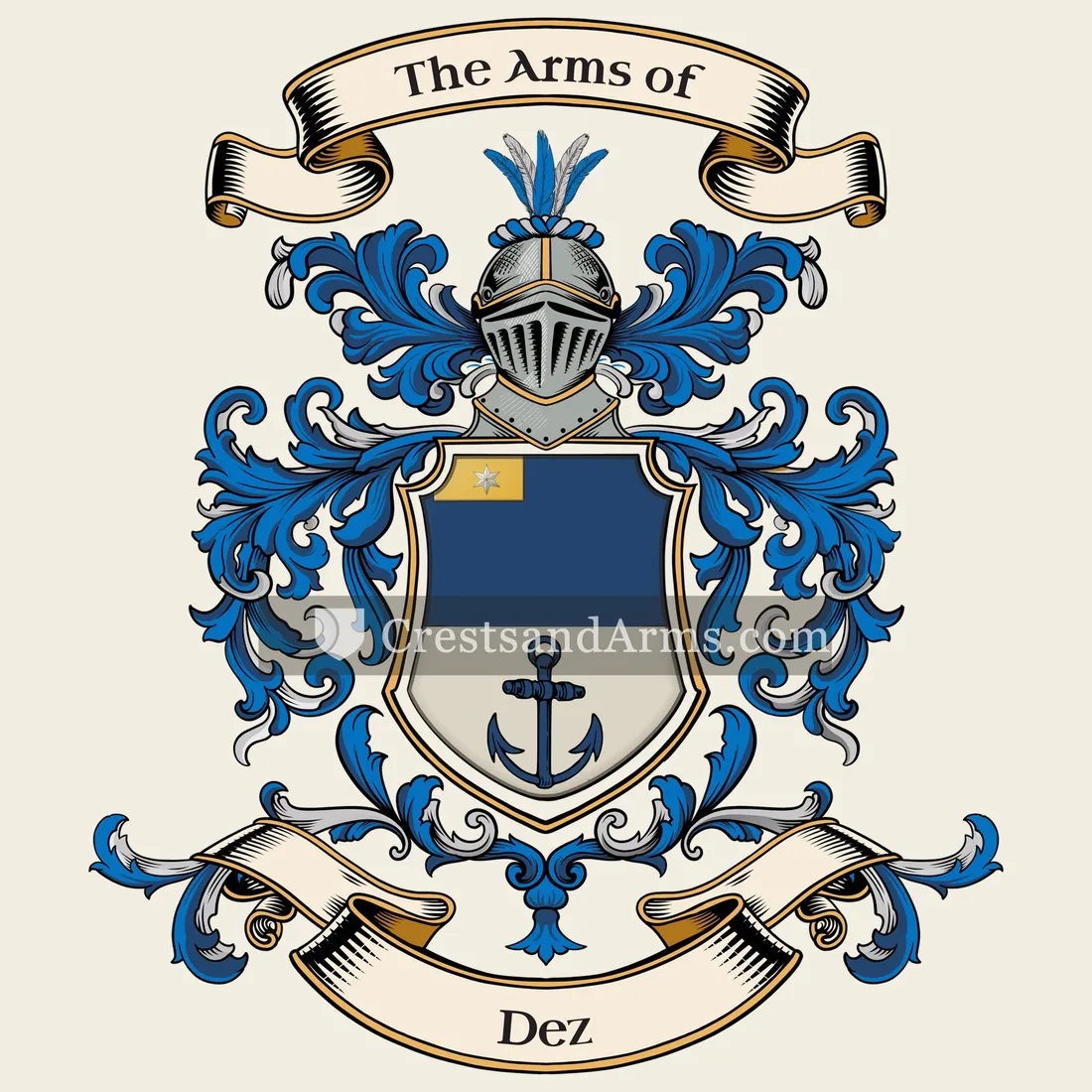
Symbols on this shield
cantonA mark of honour granted by the sovereign
starThe celestial goddess, and nobility
anchorHope, and steadfastness in trouble
Colours
Blue (Azure)Means: Loyalty and truth
Silver (Argent)Means: Peace and sincerity
Gold (Or)Means: Generosity
Historical info
Source
J. B. Rietstap, Armorial Général, Gouda: G. B. van Goor Zonen, 1884–87
Blazon (the actual original written record)
“Coupé: au 1 d'azur à une boussole d'or, acc. d'une étoile d'arg., posée au canton dextre du chef; au 2 d'arg. à une ancre d'azur.”
LorraineLorraine, c. 1641
Digital archive packCoat of arms PNG, gold border print PDF, vector SVG and the certificate of authenticity. Sent to your email in minutes.
Map of France showing where the Dez arms are recorded
The Dez arms were recorded in Lorraine, c. 1641.
Lorraine sat on the border between France and the German lands, and border country bred soldiers. Families here held small estates and served in arms, and a fighting man was exactly the sort who carried a shield of his own.
This is where the arms were entered in the register. Families often moved to other parts of the country, so the same name can turn up in more than one region.
The body that granted and recorded arms in France in this period.
Louis XIII of France
Sovereign of the period
Louis XIII of France
1617–1643
Reigning in Spain when the Dez arms are first recorded.
How Arms Worked in France
In France, a coat of arms was a mark of honor that passed down through the male line to all legitimate descendants. Families often used the same shield without changes to show their shared heritage. If a branch wanted to stand out, they could add a small mark to their shield to show their specific place in the family tree.
Granting authority
The Juge d'armes de France acted as the official authority that regulated and verified coats of arms across the country.
How they got arms
Families typically inherited their arms from ancestors, though they could also receive them through royal grants or by proving their noble status.
Where arms were recorded
Coats of arms were officially recorded in the Armorial Général de France, which began its main collection in the year 1696.
The family's standing
Recorded among the armigerous families of Lorraine.
Origin & History of the Dez Family in France
The family name Dez finds its roots in the historical region of Lorraine, where records confirm the presence of family members as early as 1641. During the 17th century, Lorraine was a territory caught between the cultural influences of France and the Holy Roman Empire, often serving as a crossroads for families moving across borders. The name itself likely functioned as a locative or descriptive identifier during a time when surnames were becoming more standardized in French parish registers. Because Lorraine was frequently impacted by the Thirty Years' War, families in this area were often resilient and deeply connected to their local agricultural or trade communities. By settling in this specific region, the early bearers of the name Dez became part of a complex social landscape defined by shifting political loyalties and the gradual integration of the province into the French kingdom.
Dez Meaning & Related Branches
Root word
Decimus
Latin term meaning the tenth child or tenth born.
This name
DezA patronymic surname indicating descent from an ancestor named Decimus or a tenth-born individual.
also spelled
Dieze
Dyez
Diezz
Deets
Documented Sources
J. B. Rietstap, Armorial Général, Gouda: G. B. van Goor Zonen, 1884–87
Archivo de la Real Chancillería de Valladolid, Registro de Ejecutorias
Archivo Histórico Nacional, Sección Nobleza
Morgado García, Arturo, La vida cotidiana en la España del siglo XVIII, 2006
Pérez-Bustamante, Rogelio, El gobierno y la administración de los reinos de la Corona de Castilla, 1976
Digital archive packCoat of arms PNG, gold border print PDF, vector SVG and the certificate of authenticity. Sent to your email in minutes.


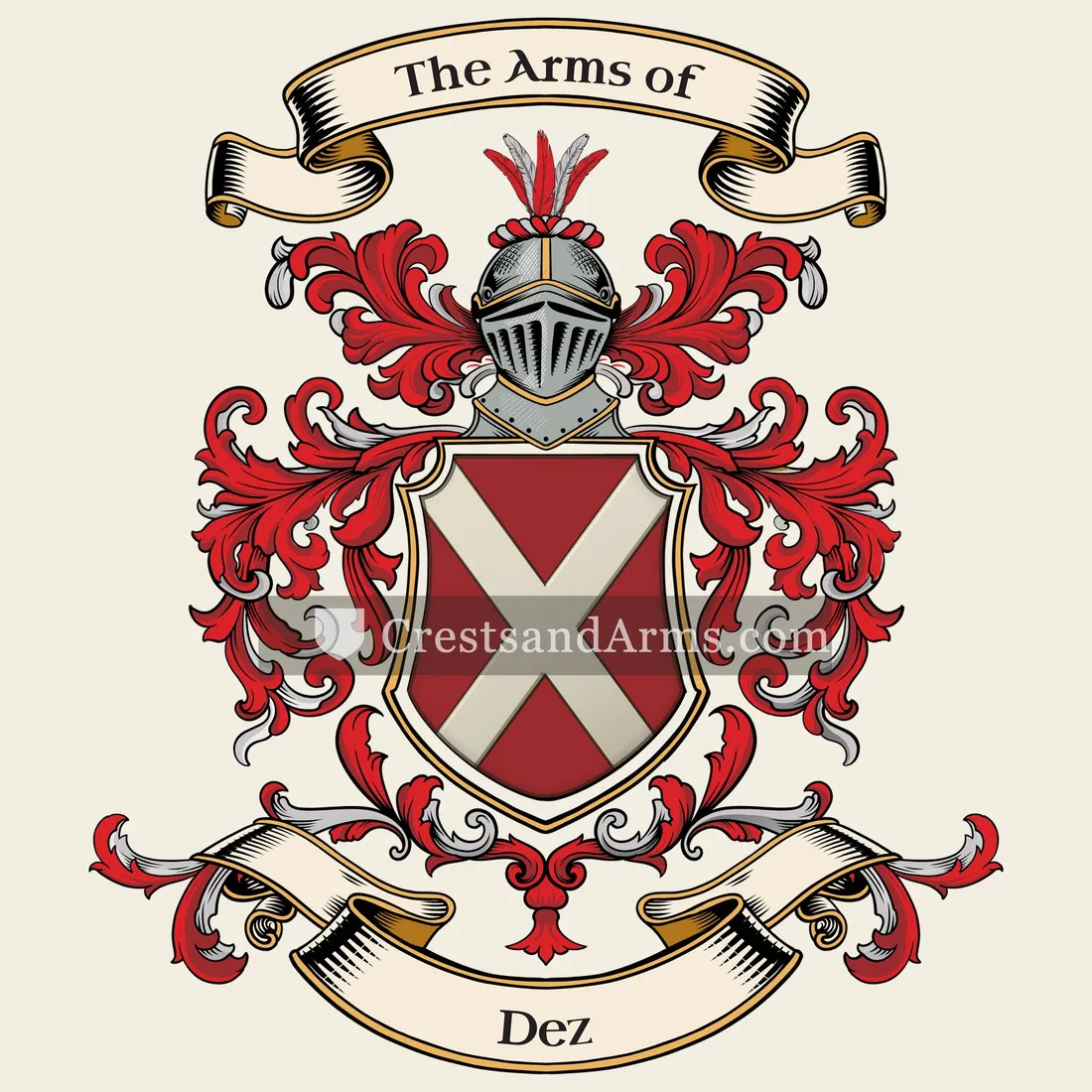


 cantonA mark of honour granted by the sovereign
 starThe celestial goddess, and nobility
 anchorHope, and steadfastness in trouble