Map of Netherlands showing where the Dhillon arms are recorded
The Dhillon arms were recorded in Netherlands, c. 1815.
Arms such as these were typically recorded in Friesland.
Friesland was low, wet country on the northern coast of the Netherlands, farmed by families who had held the same land for centuries. Free landholders were unusually common there, and a free landholder could carry arms.
This is where the arms were entered in the register. Families often moved to other parts of the country, so the same name can turn up in more than one region.
Region
Friesland
First recorded
1815
Granting Authority for the Dhillon Arms
Hoge Raad van Adel
Photograph made by me · CC BY-SA 3.0
The body that granted and recorded arms in Netherlands in this period.
William I of the Netherlands
Sovereign of the period
William I of the Netherlands
1815–1840
Reigning in Netherlands when the Dhillon arms are first recorded.
How Arms Worked in Netherlands
In the Netherlands, coats of arms were often used by noble families and those who held specific public offices. These arms were passed down through the generations to legitimate descendants. Younger branches of a family usually kept the original design without needing to add special marks. This system ensured that the family identity remained clear and consistent over many years.
Granting authority
The Hoge Raad van Adel is the official body that regulates and manages noble titles and coats of arms in the Netherlands.
How they got arms
Families typically obtained their coats of arms through official royal grants or by proving their long-standing historical use of the symbols.
Where arms were recorded
Coats of arms are officially recorded in the registers held by the Hoge Raad van Adel, which began its work in 1814.
The family's standing
Recorded among the armigerous families of Netherlands.
Origin & History of the Dhillon Family in Netherlands
The history of the Dhillon name in the Netherlands begins with the arrival of early family members in the province of Friesland around 1815. During this period, the Napoleonic era had recently concluded, and the Dutch government was actively standardizing civil registration to better track its growing population. Families settling in northern regions like Friesland often integrated into local agricultural or maritime communities, adapting their surnames to fit the phonetic patterns of the Dutch language. While the name itself carries deep roots in South Asian history, its appearance in Dutch records during the early nineteenth century suggests a unique migration story involving trade or military service during the colonial era. These early settlers navigated a society that was transitioning into the modern Kingdom of the Netherlands, leaving behind official documents that provide a rare glimpse into their integration within the Frisian landscape.
Coat of Arms & Family Crest Details
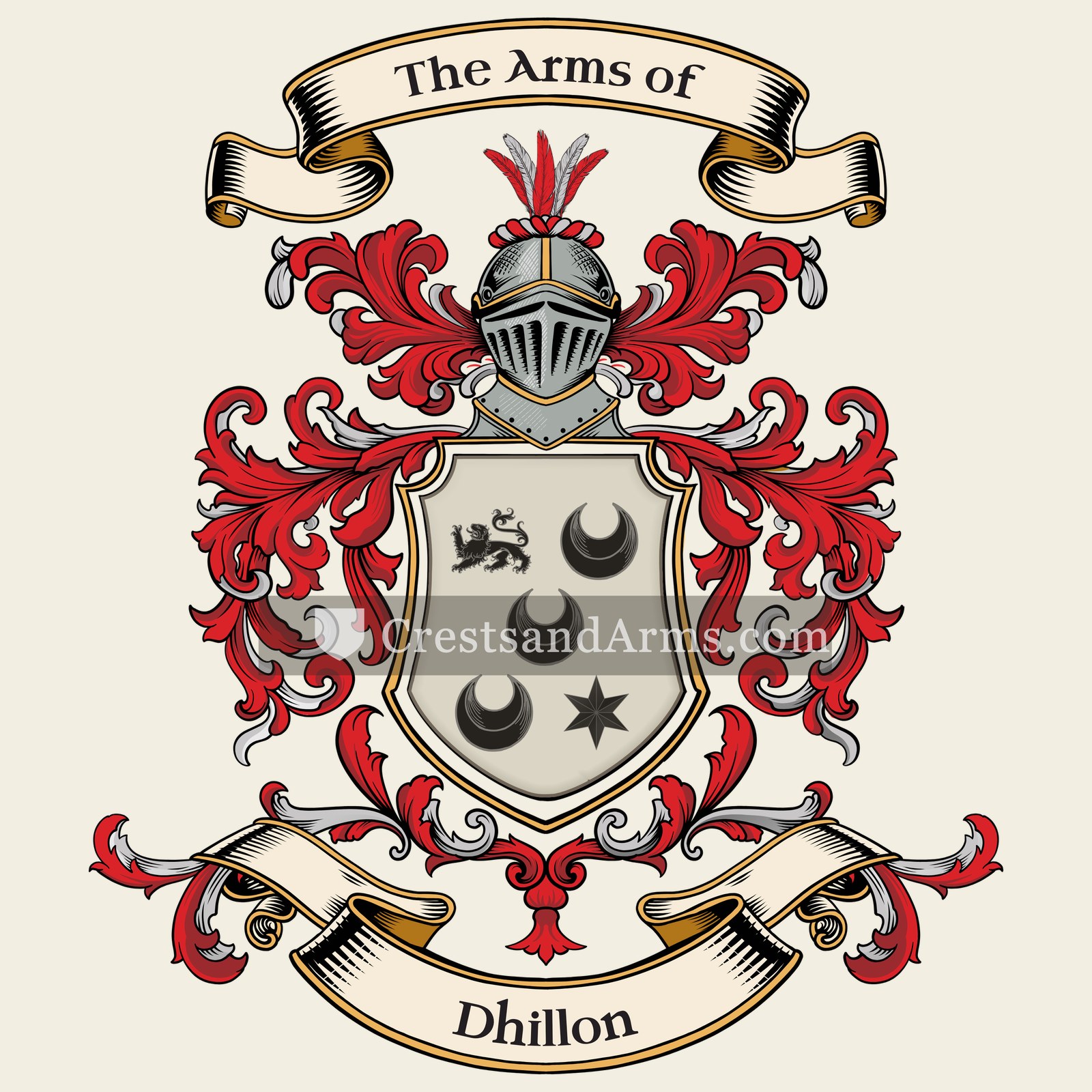
Symbols on this shield
fessThe military belt, and readiness to serve
lionCourage, strength and royalty
crescentHonour by the sovereign, and the second son
Colours
Silver (Argent)Means: Peace and sincerity
Blue (Azure)Means: Loyalty and truth
Red (Gules)Means: Military strength
Historical info
Source
J. B. Rietstap, Armorial Général, Gouda: G. B. van Goor Zonen, 1884–87
Blazon (the actual original written record)
“D'arg. au lion, acc. de trois croiss., surm. chacun d'une étoile rayonnante, le tout de gu.; à la fasce d'azur, br. sur le tout. C.: un faucon ess., au nat., soutenu d'un chapeau de tournoi de gu., retr. d'herm. S.: à dextre un griffon de sin., langué d'or; à sen. un faucon de gu., bq., m. et grilleté d'or. D.: AUXILIUM AB ALTO.”
Francec. 1619
Digital archive packCoat of arms PNG, gold border print PDF, vector SVG and the certificate of authenticity. Sent to your email in minutes.
Map of France showing where the Dhillon arms are recorded
The Dhillon arms were recorded in France, c. 1619.
Arms such as these were typically recorded in Bretagne.
More families held coats of arms in Bretagne than anywhere else in France. The land was divided into many small estates rather than a few large ones, so far more households counted as gentry, and each needed a shield of its own to be told apart.
This is where the arms were entered in the register. Families often moved to other parts of the country, so the same name can turn up in more than one region.
The body that granted and recorded arms in France in this period.
Louis XIII of France
Sovereign of the period
Louis XIII of France
1617–1643
Reigning in Netherlands when the Dhillon arms are first recorded.
How Arms Worked in France
In France, a coat of arms was a mark of honor that passed down through the male line to all legitimate descendants. Families often used the same shield without changes to show their shared heritage. If a branch wanted to stand out, they could add a small mark to their shield to show their specific place in the family tree.
Granting authority
The Juge d'armes de France acted as the official authority that regulated and verified coats of arms across the country.
How they got arms
Families typically inherited their arms from ancestors, though they could also receive them through royal grants or by proving their noble status.
Where arms were recorded
Coats of arms were officially recorded in the Armorial Général de France, which began its main collection in the year 1696.
The family's standing
Recorded among the armigerous families of France.
Origin & History of the Dhillon Family in France
The history of the Dhillon name in France begins with the arrival of early family members in the region of Bretagne during the early seventeenth century. Records confirm their presence in this coastal area as early as 1619, suggesting that the family established roots in a society defined by maritime trade and regional autonomy. During this period, the name likely adapted to the local linguistic patterns of the Breton people while maintaining its distinct identity. These early settlers were part of a broader movement of families navigating the social and economic shifts of pre-revolutionary France. By settling in Bretagne, the Dhillon family became integrated into the local community, participating in the agricultural and social life of the province. This early chapter in their history highlights the family's ability to adapt to new environments while preserving their heritage across generations.
Coat of Arms & Family Crest Details
Symbols on this shield
lionCourage, strength and royalty
crescentHonour by the sovereign, and the second son
starThe celestial goddess, and nobility
Colours
Silver (Argent)Means: Peace and sincerity
Historical info
Source
Sir Bernard Burke, The General Armory of England, Scotland, Ireland and Wales, London: Harrison & Sons, 1884
Blazon (the actual original written record)
“Ar. a lion ramp. betw. three crescents an estoile issuant [?]”
MeathMeath, c. 1622
Digital archive packCoat of arms PNG, gold border print PDF, vector SVG and the certificate of authenticity. Sent to your email in minutes.
Map of Ireland showing where the Dhillon arms are recorded
The Dhillon arms were recorded in Meath, c. 1622.
Meath was the best farmland in Ireland and the old seat of its high kings. Norman families took it early and held it, and land of that quality kept the same families on it for centuries.
This is where the arms were entered in the register. Families often moved to other parts of the country, so the same name can turn up in more than one region.
The body that granted and recorded arms in Ireland in this period.
James VI and I
Sovereign of the period
James VI and I
1603–1625
Reigning in Netherlands when the Dhillon arms are first recorded.
How Arms Worked in Ireland
The Ulster King of Arms granted coats of arms to individuals who proved their social standing and good character. These symbols were typically inherited by all legitimate descendants of the original holder. If a family branch wanted a unique look, they could apply for a specific change to their design through the office to ensure their identity remained distinct.
Granting authority
The Ulster King of Arms acted as the official body that regulated and issued all coats of arms throughout Ireland.
How they got arms
Families obtained their arms through formal grants issued by the office after proving their eligibility and paying the required fees.
Where arms were recorded
All official grants were recorded in the registers held by the Ulster King of Arms starting from the year 1552.
The family's standing
Recorded among the armigerous families of Meath.
Origin & History of the Dhillon Family in Ireland
The history of the Dhillon family in Ireland is deeply rooted in the landscape of County Meath, where records confirm their presence as early as 1622. During this period, the family became established as part of the landowning class in the region, navigating the complex social and political shifts of the seventeenth century. While the name is often associated with South Asian origins, its Irish branch represents a distinct historical chapter where the family integrated into the local administrative and agricultural life of the Pale. By settling in Meath, the Dhillons became part of the long-standing tradition of families who managed estates and participated in the local governance of the area. Their early presence in these official documents highlights their role as active members of Irish society during a time of significant transition.
Related Branches & Arms
Root word
Dhill
A term derived from the Sanskrit word for a hill or mound.
This name
DhillonRefers to a person who originates from a hilly region or high ground.
also spelled
Dillone
Dyllon
Dillonh
Dilon
Documented Sources
J. B. Rietstap, Armorial Général, Gouda: G. B. van Goor Zonen, 1884–87
Tresoar (Fries Historisch en Letterkundig Centrum), Burgerlijke Stand van Friesland
Nationaal Archief, Registers van de Burgerlijke Stand
Digital archive packCoat of arms PNG, gold border print PDF, vector SVG and the certificate of authenticity. Sent to your email in minutes.


 swordJustice, and military honour
 swordJustice, and military honour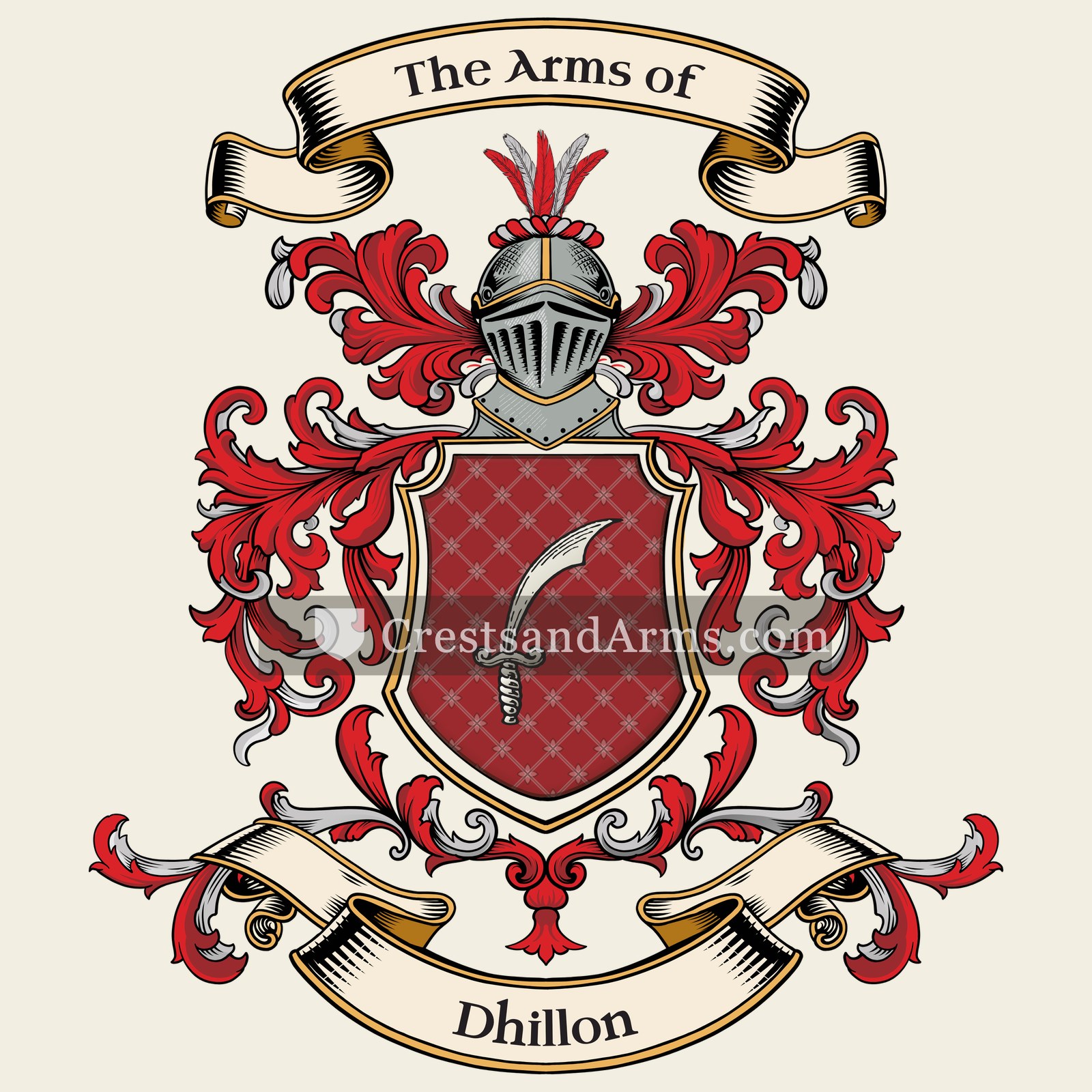


 fessThe military belt, and readiness to serve
 lionCourage, strength and royalty
 crescentHonour by the sovereign, and the second son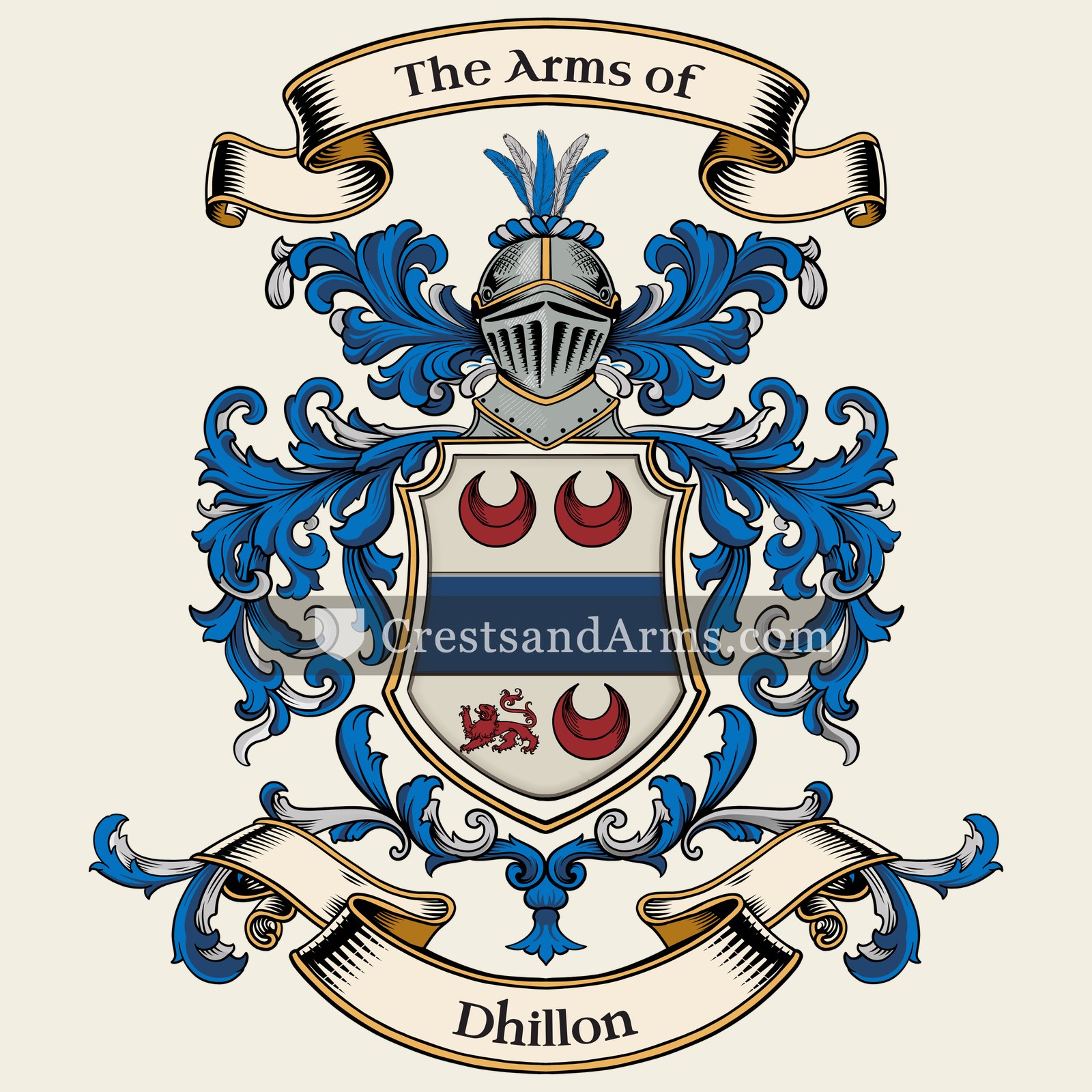


 starThe celestial goddess, and nobility