Map of France showing where the Dhondt arms are recorded
The Dhondt arms were recorded in France, c. 1663.
Arms such as these were typically recorded in Bretagne.
More families held coats of arms in Bretagne than anywhere else in France. The land was divided into many small estates rather than a few large ones, so far more households counted as gentry, and each needed a shield of its own to be told apart.
This is where the arms were entered in the register. Families often moved to other parts of the country, so the same name can turn up in more than one region.
The body that granted and recorded arms in France in this period.
Louis XIV of France
Sovereign of the period
Louis XIV of France
1643–1715
Reigning in France when the Dhondt arms are first recorded.
How Arms Worked in France
In France, a coat of arms was a mark of honor that passed down through the male line to all legitimate descendants. Families often used the same shield without changes to show their shared heritage. If a branch wanted to stand out, they could add a small mark to their shield to show their specific place in the family tree.
Granting authority
The Juge d'armes de France acted as the official authority that regulated and verified coats of arms across the country.
How they got arms
Families typically inherited their arms from ancestors, though they could also receive them through royal grants or by proving their noble status.
Where arms were recorded
Coats of arms were officially recorded in the Armorial Général de France, which began its main collection in the year 1696.
The family's standing
Recorded among the armigerous families of France.
Origin & History of the Dhondt Family in France
The family name Dhondt carries a deep history rooted in the cultural landscape of northwestern France, particularly within the region of Brittany. While the name is often associated with Flemish origins, historical records confirm that members of the family were firmly established in the Breton territory by 1663. During this era, families with this name were often integrated into the local agricultural and artisanal communities that defined the rural economy of the seventeenth century. The name itself is thought to be a descriptive reference, likely derived from the Middle Dutch word for "dog," which may have originally functioned as a nickname for a loyal or watchful ancestor. As these individuals settled in France, they adapted to the local customs and social structures of the time, contributing to the demographic shifts occurring in the coastal provinces. Over the decades, the family became a part of the regional fabric, moving through the social changes that characterized the period leading up to the French Revolution.
Coat of Arms & Family Crest Details
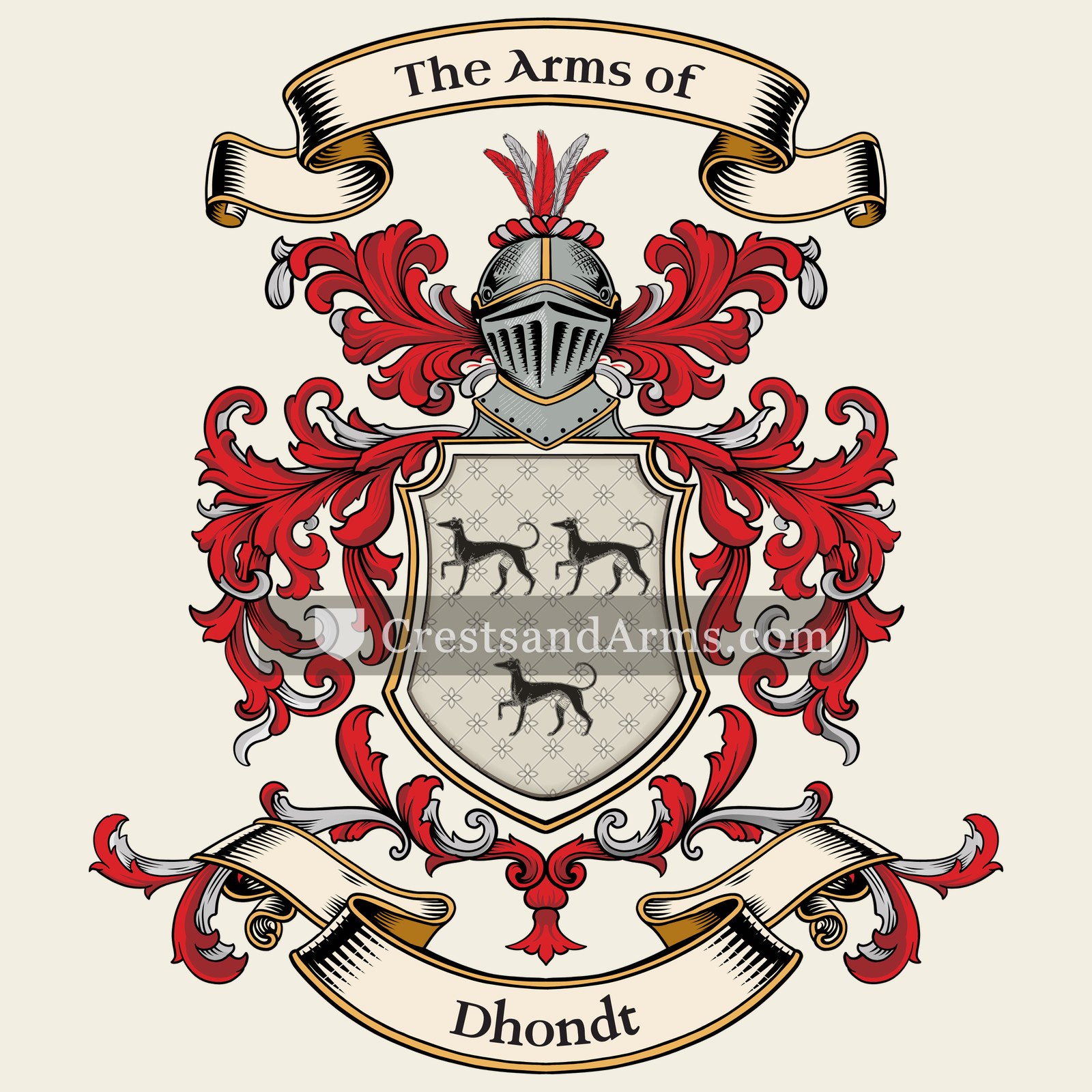
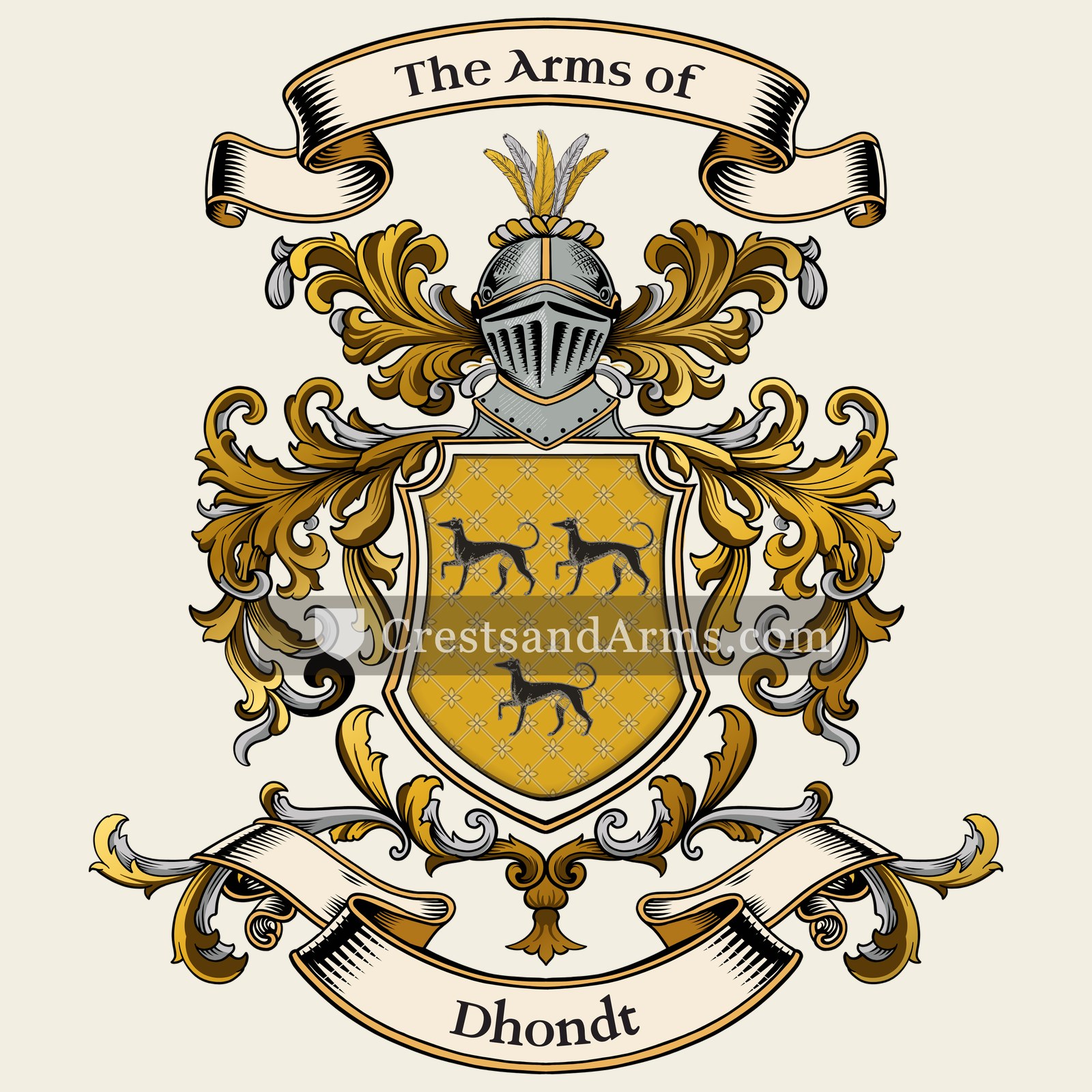
Symbols on this shield
greyhoundCourage, vigilance and loyalty
Colours
Gold (Or)Means: Generosity
Black (Sable)Means: Constancy
Historical info
Source
J. B. Rietstap, Armorial Général, Gouda: G. B. van Goor Zonen, 1884–87
Blazon (the actual original written record)
“D'or à trois lévriers courants de sa., coll. d'or. C.: un lévrier de l'écu, iss.”
BelgiumBruges, c. 1737
Digital archive packCoat of arms PNG, gold border print PDF, vector SVG and the certificate of authenticity. Sent to your email in minutes.
Map of Belgium showing where the Dhondt arms are recorded
The Dhondt arms were recorded in Bruges, c. 1737.
This is where the arms were entered in the register. Families often moved to other parts of the country, so the same name can turn up in more than one region.
The body that granted and recorded arms in Belgium in this period.
Charles VI, Holy Roman Emperor
Sovereign of the period
Charles VI, Holy Roman Emperor
1711–1740
Reigning in France when the Dhondt arms are first recorded.
How Arms Worked in Belgium
In Belgium, a coat of arms is considered personal property that is passed down through the male line to legitimate descendants. Families often use the same shield design across generations to show their shared heritage. If a branch of the family wants to change the design, they must apply for an official update to their specific version of the arms.
Granting authority
The Conseil héraldique is the official body that regulates and approves all coats of arms in Belgium.
How they got arms
Families obtain their coats of arms through formal royal grants or by confirming their historical right to use existing designs.
Where arms were recorded
All approved coats of arms are officially recorded in the public registers of the Conseil héraldique since 1844.
The family's standing
Recorded among the armigerous families of Belgium.
Origin & History of the Dhondt Family in Belgium
The surname Dhondt is deeply rooted in the historical landscape of Flanders, particularly within the bustling city of Bruges. By the early 18th century, the family was already well-established in this region, as evidenced by records confirming their presence in Bruges by 1737. The name itself is a variation of the Dutch word "hond," which means dog. In medieval times, such names were often used as descriptive nicknames for individuals who displayed traits associated with the animal, such as loyalty or keen watchfulness. As the family grew, they became part of the social fabric of West Flanders, living through a period when Bruges was transitioning from its medieval golden age into a center of trade and craftsmanship. Because the name was tied to common language rather than a specific noble title, it reflects the lives of ordinary citizens who contributed to the local economy and community life for generations.
Related Branches & Arms
Root word
Hond
A Germanic term referring to a canine or hound.
This name
DhondtA topographic or occupational surname denoting a person who kept or hunted with hounds.
also spelled
Hond
Dhondt
Hont
Documented Sources
J. B. Rietstap, Armorial Général, Gouda: G. B. van Goor Zonen, 1884–87
Archives départementales du Finistère, Série B, Fonds de l'Amirauté de Brest
Dauzat, Albert, Dictionnaire étymologique des noms et prénoms de France, 1951
Morlet, Marie-Thérèse, Dictionnaire étymologique des noms de famille, 1991
Digital archive packCoat of arms PNG, gold border print PDF, vector SVG and the certificate of authenticity. Sent to your email in minutes.


 greyhoundCourage, vigilance and loyalty
 greyhoundCourage, vigilance and loyalty