Map of England showing where the Dicey arms are recorded
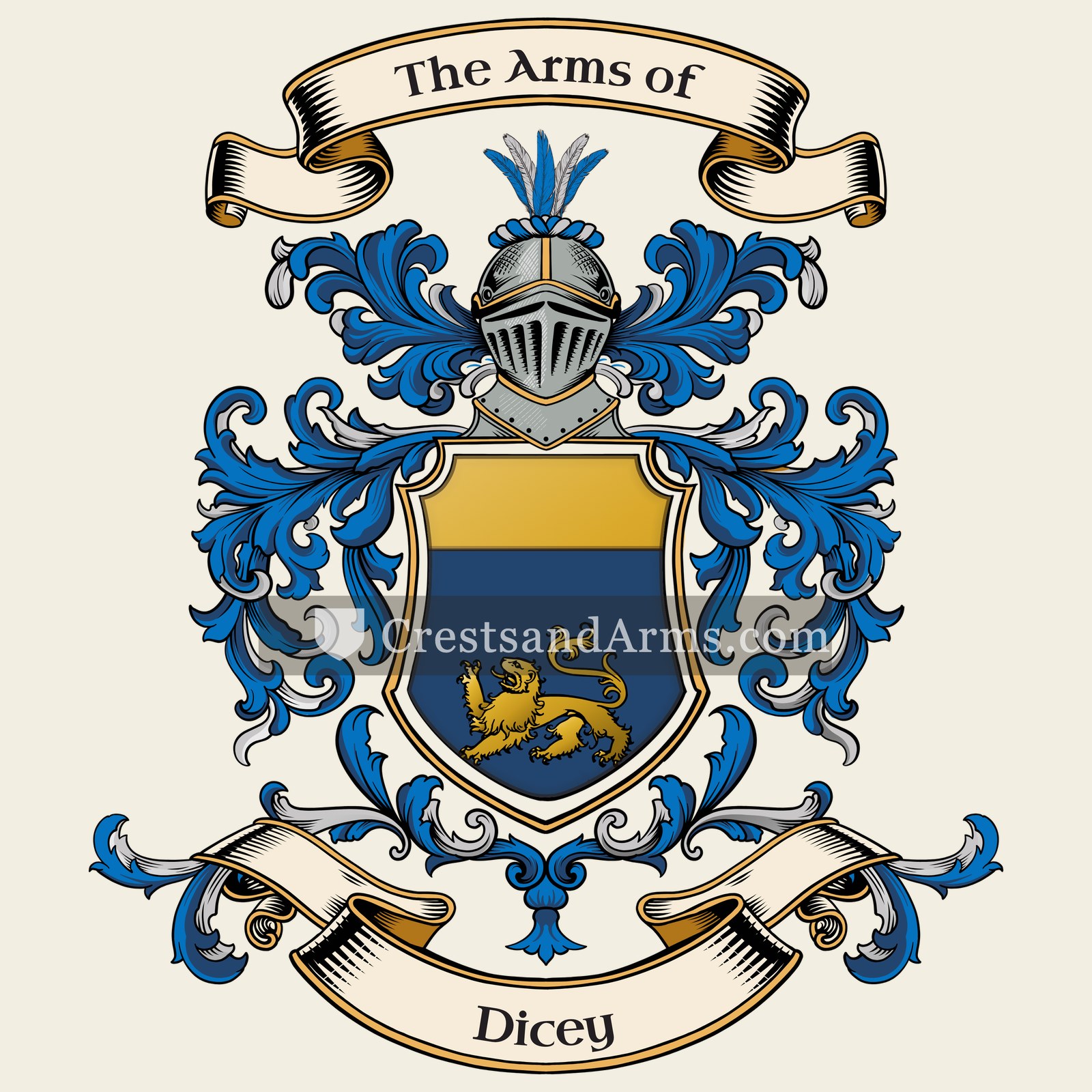
The Dicey arms were recorded in Leicester, c. 1620.
Leicestershire was grazing country, and wool and cattle made steady money rather than spectacular fortunes. Steady money bought manors, and manors are what brought families into the registers.
This is where the arms were entered in the register. Families often moved to other parts of the country, so the same name can turn up in more than one region.
The body that granted and recorded arms in England in this period.
James VI and I
Sovereign of the period
James VI and I
1603–1625
Reigning in England when the Dicey arms are first recorded.
How Arms Worked in England
English heraldry allowed arms to be shared by all legitimate descendants of the original owner. These symbols were treated as personal property that moved through the generations to all children. While the eldest son kept the original design, other family members could use the same shield without needing to change it or register their own unique versions.
Granting authority
The College of Arms in London has regulated the use of coats of arms throughout England and Wales since 1484.
How they got arms
Families typically obtained their coats of arms through a formal grant from the Crown or by proving their ancient right to them.
Where arms were recorded
All official coats of arms are recorded in the registers kept at the College of Arms, which date back to the fifteenth century.
The family's standing
Recorded among the armigerous families of Leicester.
Origin & History of the Dicey Family in England
The Dicey family name has deep roots in the English Midlands, with historical records confirming their presence in Leicester as early as 1620. The name is generally considered a patronymic, meaning it likely evolved from a nickname or a shortened form of a given name like Richard. During the seventeenth century, the family established themselves as prominent members of the local community, eventually becoming well-known for their contributions to the printing and publishing industry. By the eighteenth century, the Dicey name became synonymous with the production of popular literature, including broadsides and chapbooks that were distributed throughout the country. This transition from local Leicester residents to influential figures in the early British book trade highlights the family’s ambition and their ability to adapt to the changing commercial landscape of the era.
Dicey Meaning & Related Branches
Root word
Dica
A medieval pet form of the name Richard.
This name
DiceyA patronymic surname meaning son of the one named Dica or Richard.
also spelled
Diceie
Dicy
Dicie
Documented Sources
Sir Bernard Burke, The General Armory of England, Scotland, Ireland and Wales, London: Harrison & Sons, 1884
Clifford, Anne. The Printed Image and the Transformation of Popular Culture, 1790–1860. 2002
Neuburg, Victor E. The Penny Histories: A Study of Chapbooks for Young Readers over Two Centuries. 1968
Leicestershire, Leicester and Rutland Record Office. Records of the Borough of Leicester
Digital archive packCoat of arms PNG, gold border print PDF, vector SVG and the certificate of authenticity. Sent to your email in minutes.


 chiefAuthority, wisdom and dominion
 lionCourage, strength and royalty
 chiefAuthority, wisdom and dominion
 lionCourage, strength and royalty