A record of documented arms, meaning and origin, researched for the Dickau family lines. Documented in 3 countries.
Reg. 9354 · German, D–F
Coat of Arms & Family Crest Details
Symbols on this shield
lionCourage, strength and royalty
griffinValour and vigilance, guarding great treasure
Colours
Gold (Or)Means: Generosity
Black (Sable)Means: Constancy
Historical info
Source
J. B. Rietstap, Armorial Général, Gouda: G. B. van Goor Zonen, 1884–87
Blazon (the actual original written record)
“D'or au lion de sa., ayant deux têtes de griffon adossées du même, bq. et languées de gu., coll. d'une couronne renv. d'or. C.: le lion de l'écu, iss. (d'or.”
GermanySpire, c. 1532
Digital archive packCoat of arms PNG, gold border print PDF, vector SVG and the certificate of authenticity. Sent to your email in minutes.
Map of Germany showing where the Dickau arms are recorded
The Dickau arms were recorded in Spire, c. 1532.
This is where the arms were entered in the register. Families often moved to other parts of the country, so the same name can turn up in more than one region.
The body that granted and recorded arms in Germany in this period.
Charles V
Sovereign of the period
Charles V
1519–1556
Reigning in Germany when the Dickau arms are first recorded.
How Arms Worked in Germany
In the Holy Roman Empire, coats of arms were often granted to individuals by the Emperor or his representatives. These arms were then passed down through the generations to all legitimate descendants of the original holder. Younger branches of a family usually kept the same shield design without needing to change it, as the arms belonged to the entire lineage.
Granting authority
The Holy Roman Emperor held the sole power to grant new coats of arms throughout his vast imperial territories.
How they got arms
Families typically obtained their coats of arms through a formal imperial grant or by proving their noble status to the authorities.
Where arms were recorded
These grants were officially recorded in the Imperial Chancery registers, which began keeping formal records of such honors during the Middle Ages.
The family's standing
Recorded among the armigerous families of Germany.
Origin & History of the Dickau Family in Germany
The family name Dickau finds its roots in the historical landscape of Germany, with documented evidence placing early members in the city of Speyer by 1532. During the sixteenth century, Speyer served as a vital center for the Holy Roman Empire, frequently hosting the Imperial Diet where significant political and religious decisions were made. Families living in this region during this era were often caught in the middle of the shifting tides of the Reformation and the complex social hierarchies of the German states. The name itself likely evolved from regional dialects or geographic markers common to the Rhineland area, reflecting the way surnames were formed as populations became more mobile and urban centers grew. By establishing a presence in a city as prominent as Speyer, the early Dickau family was situated within a hub of trade, law, and intellectual exchange, which likely influenced their development and movement throughout the German territories in the centuries that followed.
Coat of Arms & Family Crest Details
Symbols on this shield
mulletThe third son, and a divine quality from above
stagPeace and harmony, and one who will not fight unprovoked
Colours
ErmineMeans: Dignity
Red (Gules)Means: Military strength
Historical info
Source
Sir Bernard Burke, The General Armory of England, Scotland, Ireland and Wales, London: Harrison & Sons, 1884
Blazon (the actual original written record)
“Erm. a fesse az. betw. two mullets in chief and a hart's head erased with ten tynes in base gu”
EdinburghPrestonfield · Edinburgh, c. 1677
Digital archive packCoat of arms PNG, gold border print PDF, vector SVG and the certificate of authenticity. Sent to your email in minutes.
Map of Scotland showing where the Dickau arms are recorded
The Dickau arms were recorded in Edinburgh, c. 1677.
Edinburgh was the seat of Scotland's government, its courts and its heralds. Families with business there settled nearby, and being close to where arms were recorded is exactly why so many of them appear.
This is where the arms were entered in the register. Families often moved to other parts of the country, so the same name can turn up in more than one region.
The body that granted and recorded arms in Scotland in this period.
Charles II of England
Sovereign of the period
Charles II of England
1660–1685
Reigning in Germany when the Dickau arms are first recorded.
How Arms Worked in Scotland
Scottish heraldry is unique because it treats a coat of arms as a piece of personal property protected by law. Only one person can own a specific design at any given time. When a family grows, the head keeps the original shield while other relatives must apply for their own distinct version with slight changes to prove their specific identity.
Granting authority
The Court of the Lord Lyon acts as the official body that regulates and controls all heraldic matters throughout Scotland.
How they got arms
Individuals obtain a legal right to their arms through a formal petition process that confirms their identity and family connection.
Where arms were recorded
All valid coats of arms are officially entered into the Public Register of All Arms and Bearings starting from 1672.
The family's standing
Recorded among the armigerous families of Edinburgh.
Origin & History of the Dickau Family in Scotland
The history of the Dickau family in Scotland begins with documented records of individuals living in Edinburgh as early as 1677. During this period, Edinburgh was a bustling center of trade and intellectual growth, serving as the heart of Scottish social life. Families with this name were likely part of the growing urban population that navigated the complex religious and political shifts of the late seventeenth century, including the transition toward the Acts of Union. Because the name appears in city registers during this era, it suggests that the family was integrated into the local merchant or professional classes of the capital. These early residents lived through a time of significant modernization in Scotland, witnessing the expansion of the city beyond its ancient medieval walls. By establishing roots in Edinburgh, the early members of the family became part of the long-standing demographic history of one of Europe's most historic cities.
Coat of Arms & Family Crest Details
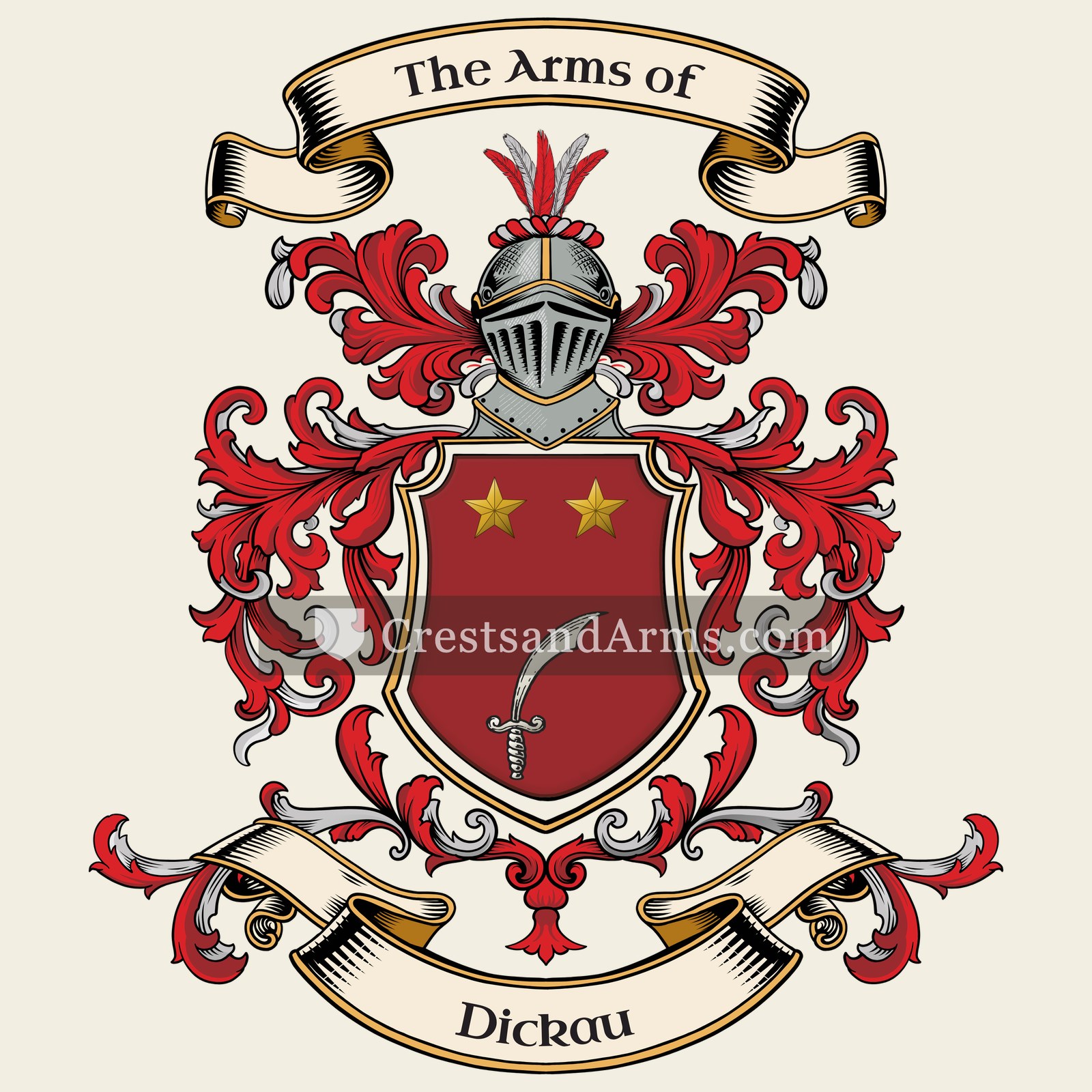
Symbols on this shield
swordJustice, and military honour
mulletThe third son, and a divine quality from above
Colours
Red (Gules)Means: Military strength
Silver (Argent)Means: Peace and sincerity
Gold (Or)Means: Generosity
Historical info
Source
Sir Bernard Burke, The General Armory of England, Scotland, Ireland and Wales, London: Harrison & Sons, 1884
Blazon (the actual original written record)
“Gu. a sword in pale ar. pommel and hilt or, in chief two mullets of the last”
DerryDerry, c. 1812
Digital archive packCoat of arms PNG, gold border print PDF, vector SVG and the certificate of authenticity. Sent to your email in minutes.
Map of Ireland showing where the Dickau arms are recorded
The Dickau arms were recorded in Derry, c. 1812.
This is where the arms were entered in the register. Families often moved to other parts of the country, so the same name can turn up in more than one region.
The body that granted and recorded arms in Ireland in this period.
George III of Great Britain
Sovereign of the period
George III of Great Britain
1801–1820
Reigning in Germany when the Dickau arms are first recorded.
How Arms Worked in Ireland
The Ulster King of Arms granted coats of arms to individuals who proved their social standing and good character. These symbols were typically inherited by all legitimate descendants of the original holder. If a family branch wanted a unique look, they could apply for a specific change to their design through the office to ensure their identity remained distinct.
Granting authority
The Ulster King of Arms acted as the official body that regulated and issued all coats of arms throughout Ireland.
How they got arms
Families obtained their arms through formal grants issued by the office after proving their eligibility and paying the required fees.
Where arms were recorded
All official grants were recorded in the registers held by the Ulster King of Arms starting from the year 1552.
The family's standing
Recorded among the armigerous families of Derry.
Origin & History of the Dickau Family in Ireland
The history of the Dickau family in Ireland begins in the early nineteenth century, specifically within the bustling port city of Derry. By 1812, records confirm that members of the family were established in this region, which served as a major hub for trade and movement between Ireland and the wider world. During this period, Derry was a center of significant social and economic change, and families like the Dickaus were often part of the merchant or artisan classes that kept the city running. While the name itself suggests roots that likely extend to continental Europe, the presence of the family in Derry highlights their integration into the local community during a time of great transition. These early settlers lived through the challenges of the Napoleonic era and the subsequent shifts in Irish society, helping to shape the local landscape before many families of that era began to look toward new opportunities across the Atlantic.
Related Branches & Arms
Root word
Dieck
A low-lying area of land or a dike.
This name
DickauA topographic name for someone who lived near a dike or embankment.
also spelled
Dyk
Dik
Dyke
Documented Sources
J. B. Rietstap, Armorial Général, Gouda: G. B. van Goor Zonen, 1884–87
Stadtarchiv Speyer, Reichskammergerichtsakten
Landesarchiv Speyer, Bestand A 1 (Reichskammergericht)
Bremm, Klaus, Die Stadt Speyer im 16. Jahrhundert, 1998
Kohl, Wilhelm, Die Geschichte der Stadt Speyer, 1982
Digital archive packCoat of arms PNG, gold border print PDF, vector SVG and the certificate of authenticity. Sent to your email in minutes.


 lionCourage, strength and royalty
 griffinValour and vigilance, guarding great treasure
 lionCourage, strength and royalty
 griffinValour and vigilance, guarding great treasure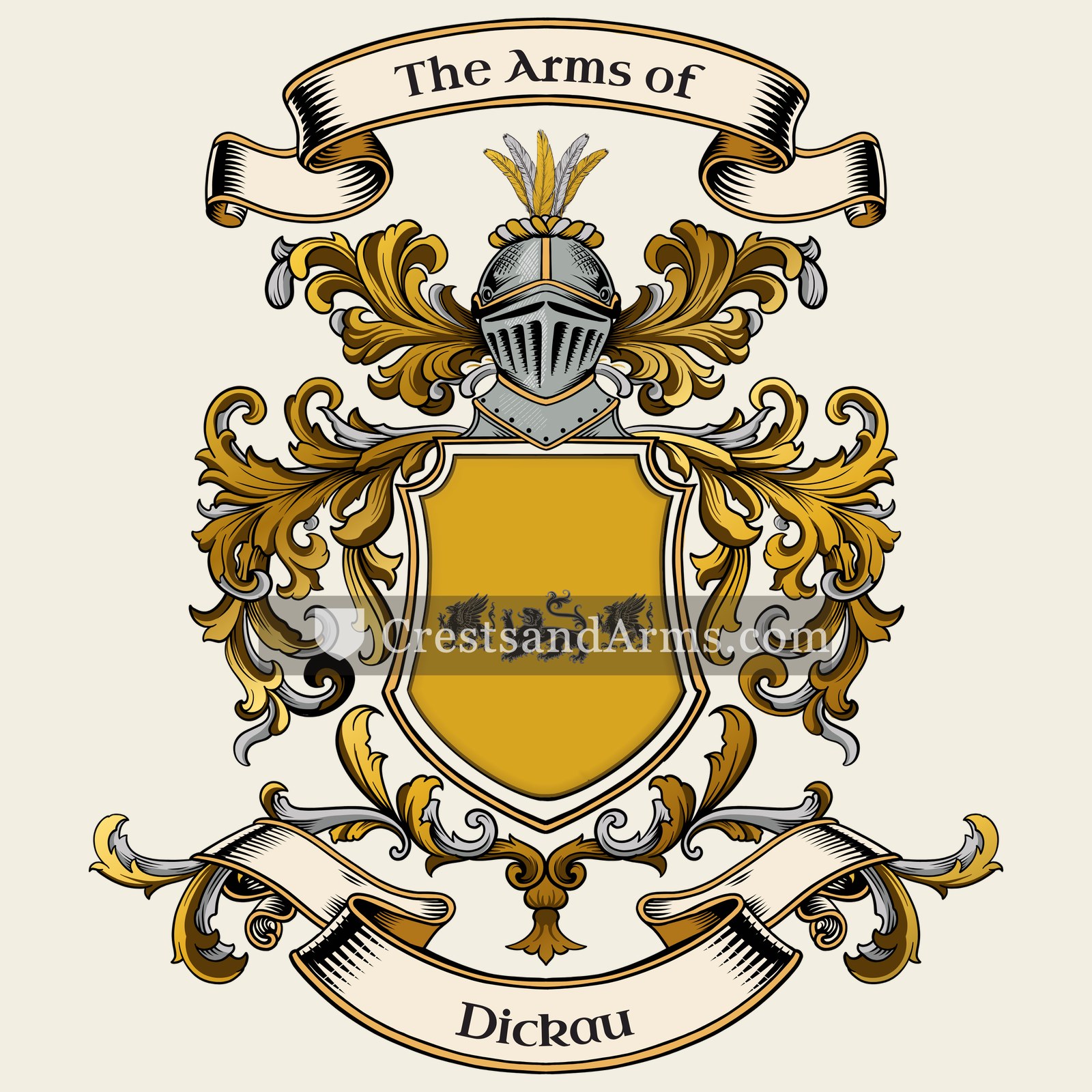


 mulletThe third son, and a divine quality from above
 stagPeace and harmony, and one who will not fight unprovoked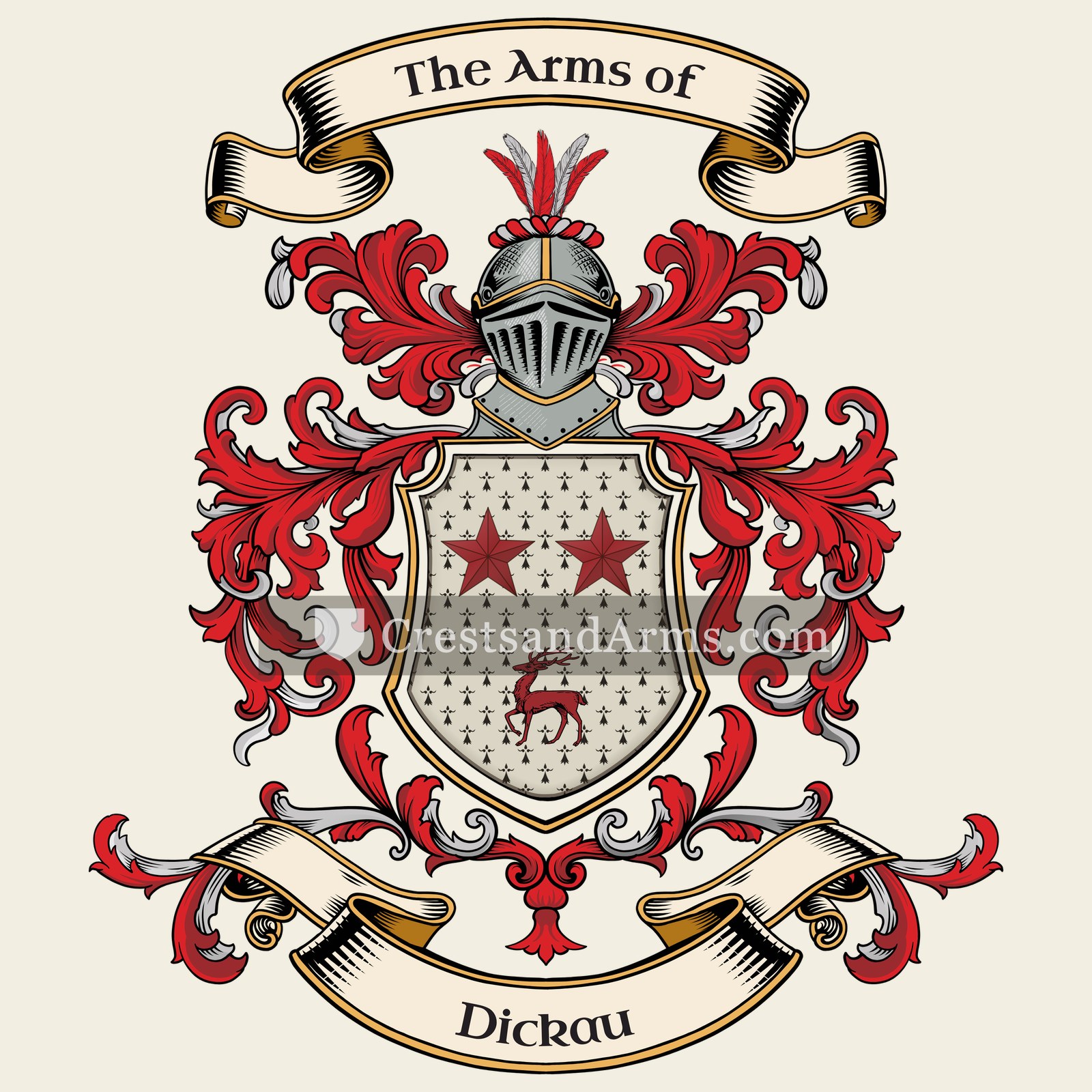


 swordJustice, and military honour