A record of documented arms, meaning and origin, researched for the Dickow family lines. Documented in 3 countries.
Reg. 0377 · German, D–F
Meaning of the Dickow family crest colors & symbols
Symbols on this shield
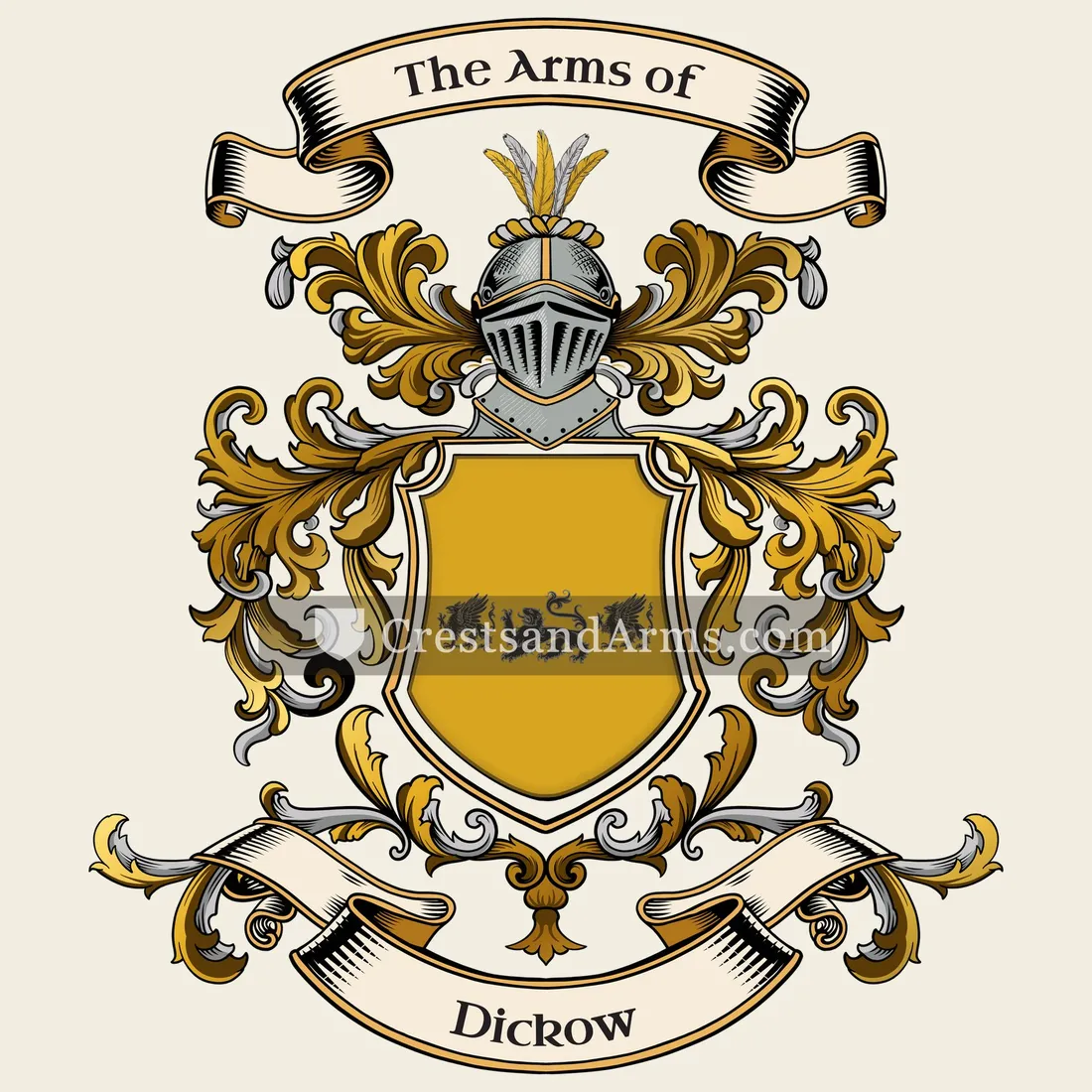
lionCourage, strength and royalty
griffinValour and vigilance, guarding great treasure
Colours
Gold (Or)Means: Generosity
Black (Sable)Means: Constancy
Historical info
Source
J. B. Rietstap, Armorial Général, Gouda: G. B. van Goor Zonen, 1884–87
Blazon (the actual original written record)
“D'or au lion de sa., ayant deux têtes de griffon adossées du même, bq. et languées de gu., coll. d'une couronne renv. d'or. C.: le lion de l'écu, iss. (d'or.”
GermanySpire, c. 1532
Digital archive packCoat of arms PNG, gold border print PDF, vector SVG and the certificate of authenticity. Sent to your email in minutes.
Map of Germany showing where the Dickow arms are recorded
The Dickow arms were recorded in Spire, c. 1532.
This is where the arms were entered in the register. Families often moved to other parts of the country, so the same name can turn up in more than one region.
The body that granted and recorded arms in Germany in this period.
Charles V
Sovereign of the period
Charles V
1519–1556
Reigning in Germany when the Dickow arms are first recorded.
How Arms Worked in Germany
In the Holy Roman Empire, coats of arms were often granted to individuals by the Emperor or his representatives. These arms were then passed down through the generations to all legitimate descendants of the original holder. Younger branches of a family usually kept the same shield design without needing to change it, as the arms belonged to the entire lineage.
Granting authority
The Holy Roman Emperor held the sole power to grant new coats of arms throughout his vast imperial territories.
How they got arms
Families typically obtained their coats of arms through a formal imperial grant or by proving their noble status to the authorities.
Where arms were recorded
These grants were officially recorded in the Imperial Chancery registers, which began keeping formal records of such honors during the Middle Ages.
The family's standing
Recorded among the armigerous families of Germany.
Origin & History of the Dickow Family in Germany
The surname Dickow traces its historical roots to the region of the Upper Rhine, with documented evidence placing family members in the city of Speyer as early as 1532. During the sixteenth century, Speyer served as a vital center of political and religious activity within the Holy Roman Empire, acting as the site for the Imperial Chamber Court. Families living in this area were often influenced by the shifting social landscape of the Reformation and the economic changes brought about by the city's status as a hub for trade and law. The name likely developed as a descriptive identifier, reflecting the linguistic patterns of the German-speaking territories at the time. By establishing a presence in such a prominent urban center, the early Dickow family was positioned within a society that valued civic participation and record-keeping, which allowed their history to be preserved in regional administrative documents.
Meaning of the Dickow family crest colors & symbols
Symbols on this shield
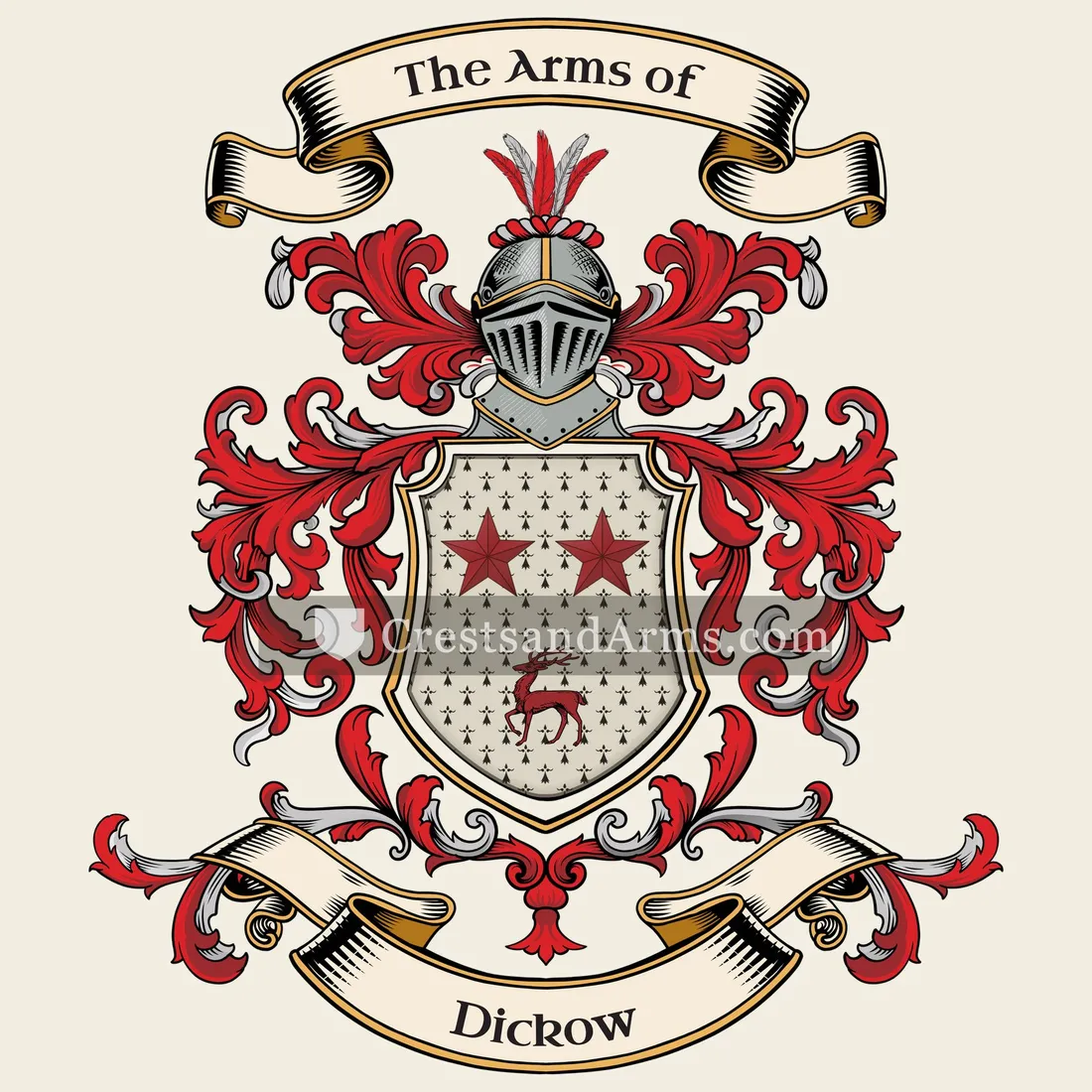
mulletThe third son, and a divine quality from above
stagPeace and harmony, and one who will not fight unprovoked
Colours
ErmineMeans: Dignity
Red (Gules)Means: Military strength
Historical info
Source
Sir Bernard Burke, The General Armory of England, Scotland, Ireland and Wales, London: Harrison & Sons, 1884
Blazon (the actual original written record)
“Erm. a fesse az. betw. two mullets in chief and a hart's head erased with ten tynes in base gu”
EdinburghPrestonfield · Edinburgh, c. 1677
Digital archive packCoat of arms PNG, gold border print PDF, vector SVG and the certificate of authenticity. Sent to your email in minutes.
Map of Scotland showing where the Dickow arms are recorded
The Dickow arms were recorded in Edinburgh, c. 1677.
Edinburgh was the seat of Scotland's government, its courts and its heralds. Families with business there settled nearby, and being close to where arms were recorded is exactly why so many of them appear.
This is where the arms were entered in the register. Families often moved to other parts of the country, so the same name can turn up in more than one region.
The body that granted and recorded arms in Scotland in this period.
Charles II of England
Sovereign of the period
Charles II of England
1660–1685
Reigning in Germany when the Dickow arms are first recorded.
How Arms Worked in Scotland
Scottish heraldry is unique because it treats a coat of arms as a piece of personal property protected by law. Only one person can own a specific design at any given time. When a family grows, the head keeps the original shield while other relatives must apply for their own distinct version with slight changes to prove their specific identity.
Granting authority
The Court of the Lord Lyon acts as the official body that regulates and controls all heraldic matters throughout Scotland.
How they got arms
Individuals obtain a legal right to their arms through a formal petition process that confirms their identity and family connection.
Where arms were recorded
All valid coats of arms are officially entered into the Public Register of All Arms and Bearings starting from 1672.
The family's standing
Recorded among the armigerous families of Edinburgh.
Origin & History of the Dickow Family in Scotland
The family name Dickow has roots that trace back to the bustling streets of seventeenth-century Edinburgh. By the year 1677, records confirm that members of the family were already established residents within the city. During this period, Edinburgh was a center of rapid social and economic change as the Scottish capital transitioned into a hub for trade and administration. Families like the Dickows often lived in the dense, multi-story tenements of the Old Town, where they would have been active participants in the local merchant guilds or the growing professional classes. While the name is rare, its presence in the historical registers of the city suggests that the family was part of the urban fabric that helped shape the Scottish capital during the late Stuart era. Their early life in Edinburgh would have been defined by the daily rhythms of a city navigating the complex political and religious shifts of the late 1600s.
Meaning of the Dickow family crest colors & symbols
Symbols on this shield
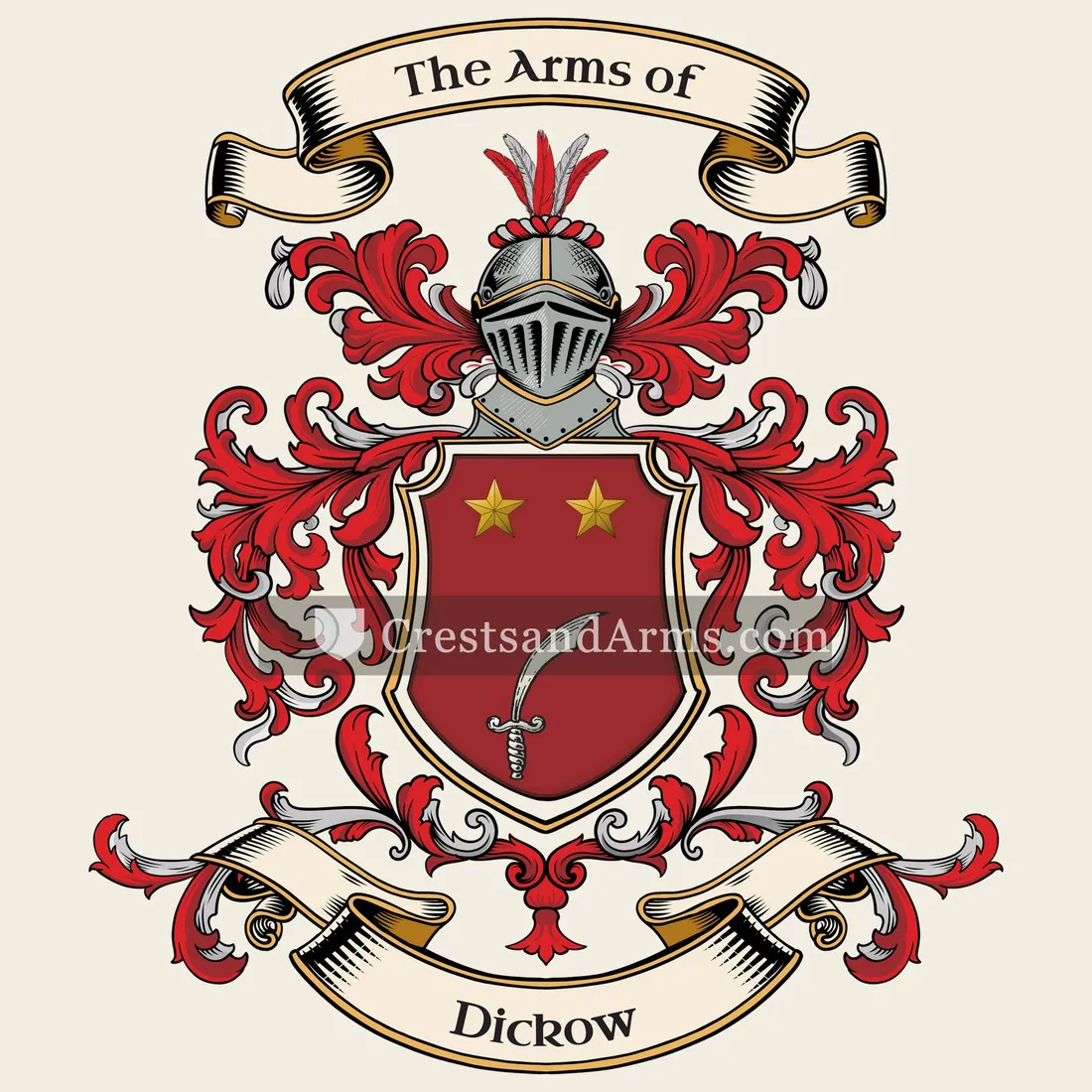
swordJustice, and military honour
mulletThe third son, and a divine quality from above
Colours
Red (Gules)Means: Military strength
Silver (Argent)Means: Peace and sincerity
Gold (Or)Means: Generosity
Historical info
Source
Sir Bernard Burke, The General Armory of England, Scotland, Ireland and Wales, London: Harrison & Sons, 1884
Blazon (the actual original written record)
“Gu. a sword in pale ar. pommel and hilt or, in chief two mullets of the last”
DerryDerry, c. 1812
Digital archive packCoat of arms PNG, gold border print PDF, vector SVG and the certificate of authenticity. Sent to your email in minutes.
Map of Ireland showing where the Dickow arms are recorded
The Dickow arms were recorded in Derry, c. 1812.
This is where the arms were entered in the register. Families often moved to other parts of the country, so the same name can turn up in more than one region.
The body that granted and recorded arms in Ireland in this period.
George III of Great Britain
Sovereign of the period
George III of Great Britain
1801–1820
Reigning in Germany when the Dickow arms are first recorded.
How Arms Worked in Ireland
The Ulster King of Arms granted coats of arms to individuals who proved their social standing and good character. These symbols were typically inherited by all legitimate descendants of the original holder. If a family branch wanted a unique look, they could apply for a specific change to their design through the office to ensure their identity remained distinct.
Granting authority
The Ulster King of Arms acted as the official body that regulated and issued all coats of arms throughout Ireland.
How they got arms
Families obtained their arms through formal grants issued by the office after proving their eligibility and paying the required fees.
Where arms were recorded
All official grants were recorded in the registers held by the Ulster King of Arms starting from the year 1552.
The family's standing
Recorded among the armigerous families of Derry.
Origin & History of the Dickow Family in Ireland
The family name Dickow is not traditionally Irish in its linguistic roots, yet the presence of the family in Derry by 1812 suggests a fascinating story of migration and integration. During the early 19th century, Derry served as a bustling port city that attracted various settlers from across Europe, often due to shifting trade routes or religious movements. While the name likely originated in Germanic or Slavic regions, those who carried it to Ireland became part of the unique social fabric of Ulster. By establishing themselves in Derry, the early Dickow family members lived through a time of significant industrial growth and urban change. They likely integrated into the local community by participating in the city's maritime trade or the linen industry, which were the primary economic drivers of the region at that time. Their presence in the city records from 1812 marks them as part of the diverse population that helped shape the modern history of Northern Ireland.
Dickow Meaning & Related Branches
Root word
Diedrich
Derived from the Germanic elements for people and ruler.
This name
DickowA patronymic surname indicating descent from a person named Dietrich or a variant of Richard.
also spelled
Dyk
Dik
Dyke
Documented Sources
J. B. Rietstap, Armorial Général, Gouda: G. B. van Goor Zonen, 1884–87


 lionCourage, strength and royalty
 griffinValour and vigilance, guarding great treasure
 lionCourage, strength and royalty
 griffinValour and vigilance, guarding great treasure


 mulletThe third son, and a divine quality from above
 stagPeace and harmony, and one who will not fight unprovoked


 swordJustice, and military honour