A record of documented arms, meaning and origin, researched for the Dieck family lines. Documented in 3 countries.
Reg. 6202 · German, D–F
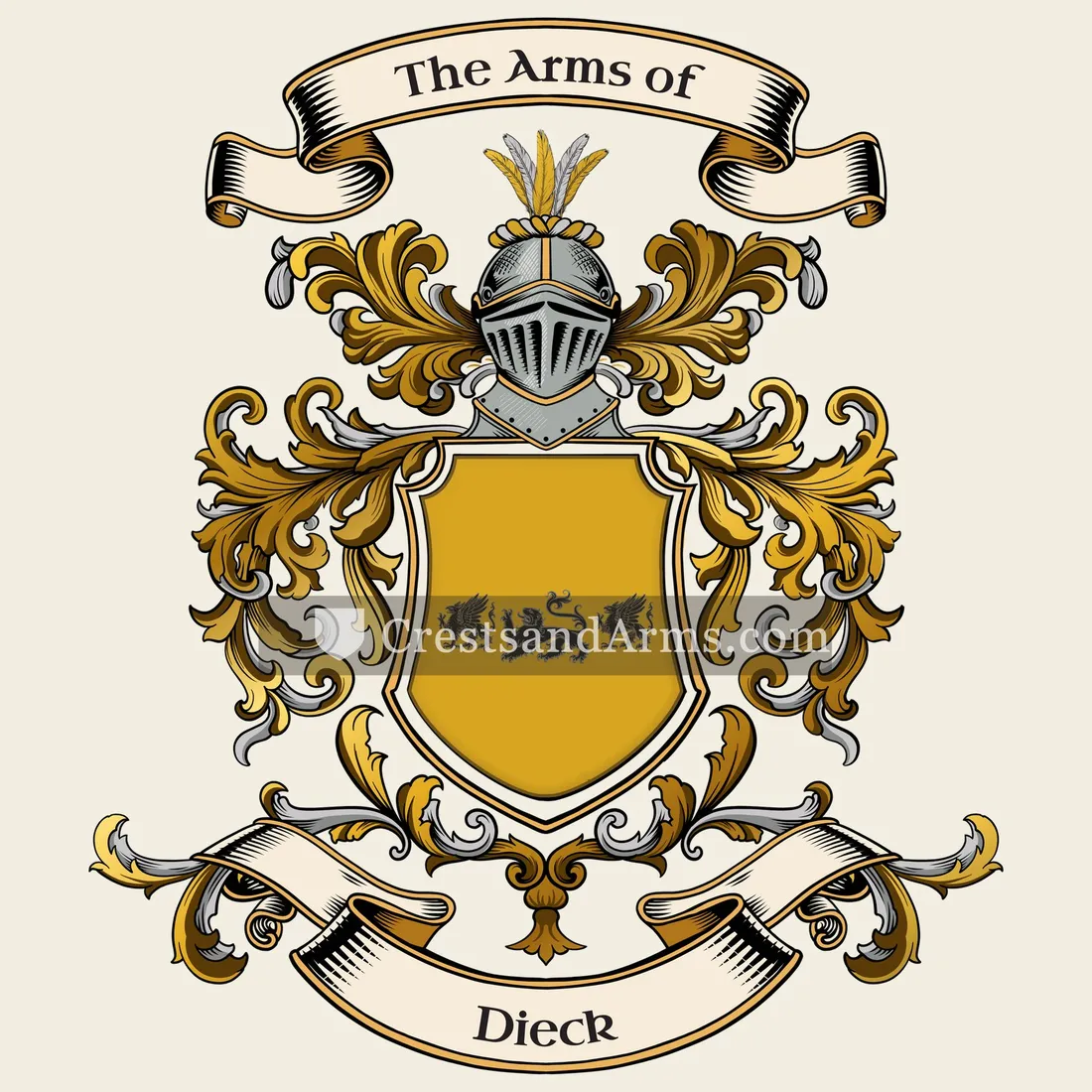
Meaning of the Dieck family crest colors & symbols
Symbols on this shield
lionCourage, strength and royalty
griffinValour and vigilance, guarding great treasure
Colours
Gold (Or)Means: Generosity
Black (Sable)Means: Constancy
Historical info
Source
J. B. Rietstap, Armorial Général, Gouda: G. B. van Goor Zonen, 1884–87
Blazon (the actual original written record)
“D'or au lion de sa., ayant deux têtes de griffon adossées du même, bq. et languées de gu., coll. d'une couronne renv. d'or. C.: le lion de l'écu, iss. (d'or.”
GermanySpire, c. 1532
Digital archive packCoat of arms PNG, gold border print PDF, vector SVG and the certificate of authenticity. Sent to your email in minutes.
Map of Germany showing where the Dieck arms are recorded
The Dieck arms were recorded in Spire, c. 1532.
This is where the arms were entered in the register. Families often moved to other parts of the country, so the same name can turn up in more than one region.
The body that granted and recorded arms in Germany in this period.
Charles V
Sovereign of the period
Charles V
1519–1556
Reigning in Germany when the Dieck arms are first recorded.
How Arms Worked in Germany
In the Holy Roman Empire, coats of arms were often granted to individuals by the Emperor or his representatives. These arms were then passed down through the generations to all legitimate descendants of the original holder. Younger branches of a family usually kept the same shield design without needing to change it, as the arms belonged to the entire lineage.
Granting authority
The Holy Roman Emperor held the sole power to grant new coats of arms throughout his vast imperial territories.
How they got arms
Families typically obtained their coats of arms through a formal imperial grant or by proving their noble status to the authorities.
Where arms were recorded
These grants were officially recorded in the Imperial Chancery registers, which began keeping formal records of such honors during the Middle Ages.
The family's standing
Recorded among the armigerous families of Germany.
Origin & History of the Dieck Family in Germany
The surname Dieck finds its roots in the linguistic landscape of Northern and Central Germany, where it likely originated as a topographic name for people living near a dike or a water barrier. By the early 16th century, the family had established a notable presence in the city of Speyer, a major center of the Holy Roman Empire. Records from 1532 confirm that members of the Dieck family were active in this region during a time of significant religious and political transition. Because Speyer served as a frequent meeting place for the Imperial Diet, the family lived in a hub of European governance and trade. This location suggests that early ancestors were likely integrated into the urban middle class, participating in the civic life of a city that was central to the history of the Reformation. Their presence in such a prominent location indicates that the family was well-settled and connected to the administrative developments of the era.
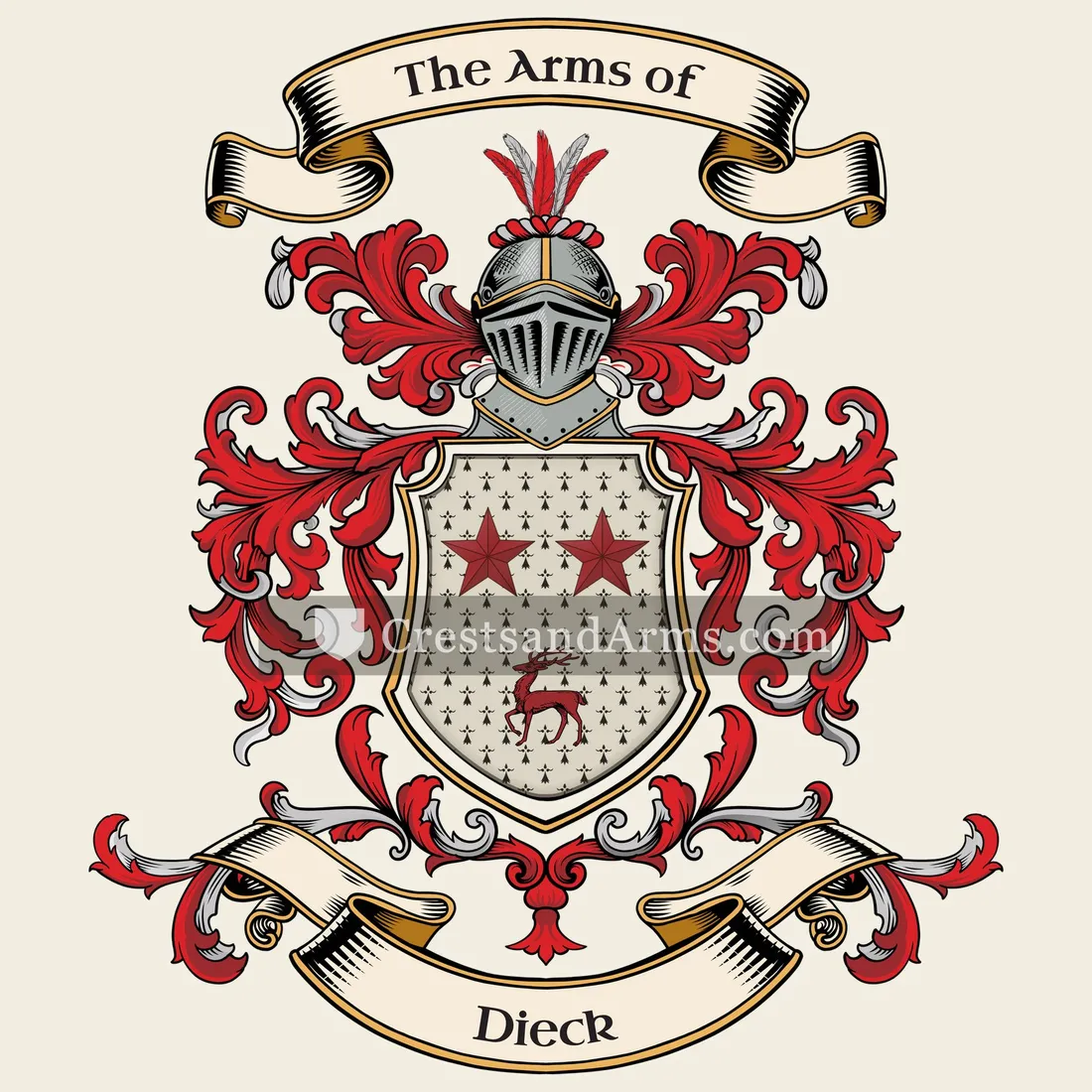
Meaning of the Dieck family crest colors & symbols
Symbols on this shield
mulletThe third son, and a divine quality from above
stagPeace and harmony, and one who will not fight unprovoked
Colours
ErmineMeans: Dignity
Red (Gules)Means: Military strength
Historical info
Source
Sir Bernard Burke, The General Armory of England, Scotland, Ireland and Wales, London: Harrison & Sons, 1884
Blazon (the actual original written record)
“Erm. a fesse az. betw. two mullets in chief and a hart's head erased with ten tynes in base gu”
EdinburghPrestonfield · Edinburgh, c. 1677
Digital archive packCoat of arms PNG, gold border print PDF, vector SVG and the certificate of authenticity. Sent to your email in minutes.
Map of Scotland showing where the Dieck arms are recorded
The Dieck arms were recorded in Edinburgh, c. 1677.
Edinburgh was the seat of Scotland's government, its courts and its heralds. Families with business there settled nearby, and being close to where arms were recorded is exactly why so many of them appear.
This is where the arms were entered in the register. Families often moved to other parts of the country, so the same name can turn up in more than one region.
The body that granted and recorded arms in Scotland in this period.
Charles II of England
Sovereign of the period
Charles II of England
1660–1685
Reigning in Germany when the Dieck arms are first recorded.
How Arms Worked in Scotland
Scottish heraldry is unique because it treats a coat of arms as a piece of personal property protected by law. Only one person can own a specific design at any given time. When a family grows, the head keeps the original shield while other relatives must apply for their own distinct version with slight changes to prove their specific identity.
Granting authority
The Court of the Lord Lyon acts as the official body that regulates and controls all heraldic matters throughout Scotland.
How they got arms
Individuals obtain a legal right to their arms through a formal petition process that confirms their identity and family connection.
Where arms were recorded
All valid coats of arms are officially entered into the Public Register of All Arms and Bearings starting from 1672.
The family's standing
Recorded among the armigerous families of Edinburgh.
Origin & History of the Dieck Family in Scotland
The surname Dieck is a rare and intriguing name within the historical records of Scotland. While the name is often associated with Germanic roots, its presence in Edinburgh by 1677 suggests that early bearers were part of the growing urban population during a time of significant social change. During the late 17th century, Edinburgh was a bustling center for trade and craftsmanship, attracting individuals from across Europe who sought new opportunities in the capital. Families with this name likely integrated into the local community by working in specialized trades or professional guilds that defined the city’s economy. Because the name appears in official registers during this period, it indicates that these early ancestors were recognized members of society who participated in the legal and civic life of the city. Their presence highlights the diverse origins of the people who helped shape the cultural fabric of Scotland during the Restoration era.
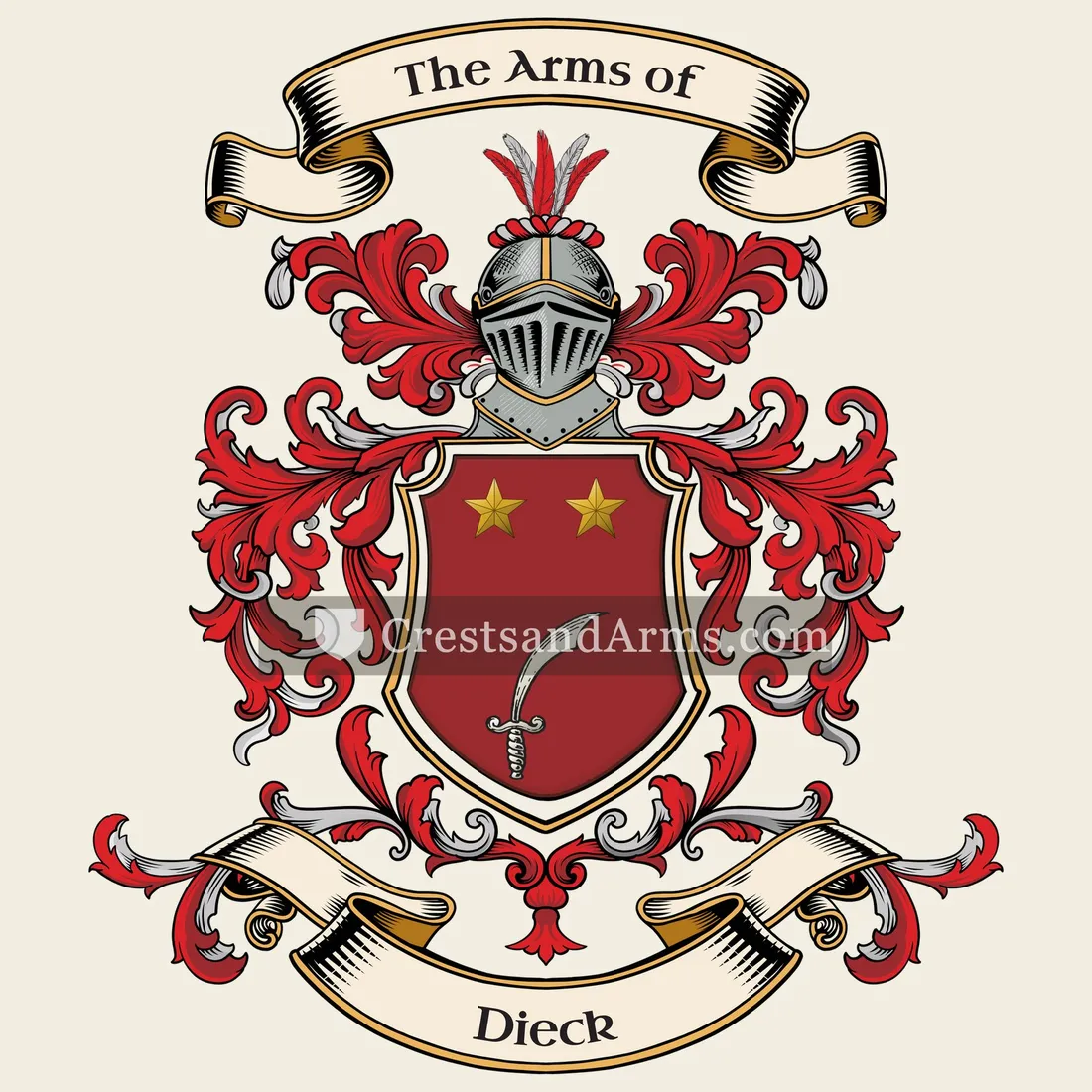
Meaning of the Dieck family crest colors & symbols
Symbols on this shield
swordJustice, and military honour
mulletThe third son, and a divine quality from above
Colours
Red (Gules)Means: Military strength
Silver (Argent)Means: Peace and sincerity
Gold (Or)Means: Generosity
Historical info
Source
Sir Bernard Burke, The General Armory of England, Scotland, Ireland and Wales, London: Harrison & Sons, 1884
Blazon (the actual original written record)
“Gu. a sword in pale ar. pommel and hilt or, in chief two mullets of the last”
DerryDerry, c. 1812
Digital archive packCoat of arms PNG, gold border print PDF, vector SVG and the certificate of authenticity. Sent to your email in minutes.
Map of Ireland showing where the Dieck arms are recorded
The Dieck arms were recorded in Derry, c. 1812.
This is where the arms were entered in the register. Families often moved to other parts of the country, so the same name can turn up in more than one region.
The body that granted and recorded arms in Ireland in this period.
George III of Great Britain
Sovereign of the period
George III of Great Britain
1801–1820
Reigning in Germany when the Dieck arms are first recorded.
How Arms Worked in Ireland
The Ulster King of Arms granted coats of arms to individuals who proved their social standing and good character. These symbols were typically inherited by all legitimate descendants of the original holder. If a family branch wanted a unique look, they could apply for a specific change to their design through the office to ensure their identity remained distinct.
Granting authority
The Ulster King of Arms acted as the official body that regulated and issued all coats of arms throughout Ireland.
How they got arms
Families obtained their arms through formal grants issued by the office after proving their eligibility and paying the required fees.
Where arms were recorded
All official grants were recorded in the registers held by the Ulster King of Arms starting from the year 1552.
The family's standing
Recorded among the armigerous families of Derry.
Origin & History of the Dieck Family in Ireland
The family name Dieck is not traditionally Irish in origin, as it is widely recognized as a German surname derived from the Low German word for a dike or a ditch. Its presence in Ireland is a fascinating example of migration during the early nineteenth century. By 1812, records confirm that members of the Dieck family had established a presence in the city of Derry. During this period, Derry served as a bustling port and a gateway for trade and movement between Northern Europe and the British Isles. It is likely that these early settlers arrived as part of the small but steady stream of continental European merchants or skilled tradesmen who moved to Irish urban centers to pursue new economic opportunities. Once in Derry, the family integrated into the local community, living through a time of significant social and industrial change in the region. Their history reflects the broader story of how individual families from abroad contributed to the diverse cultural fabric of Irish port cities during the nineteenth century.
Dieck Meaning & Related Branches
Root word
Diederik
Derived from Germanic elements meaning people and ruler.
This name
DieckA patronymic form indicating a descendant of a ruler of the people.
also spelled
Dyk
Dik
Dyke
Documented Sources
J. B. Rietstap, Armorial Général, Gouda: G. B. van Goor Zonen, 1884–87
Bremmer, Rolf H., Germanic Onomastics: The Study of Names, 2010


 lionCourage, strength and royalty
 griffinValour and vigilance, guarding great treasure
 lionCourage, strength and royalty
 griffinValour and vigilance, guarding great treasure


 mulletThe third son, and a divine quality from above
 stagPeace and harmony, and one who will not fight unprovoked


 swordJustice, and military honour