A record of documented arms, meaning and origin, researched for the Dieterich family lines. Documented in 2 countries.
Reg. 2285 · German, D–F
Coat of Arms & Family Crest Details
Symbols on this shield
fessThe military belt, and readiness to serve
knightChivalry and service in arms
keyGuardianship, and the office of a steward
mulletThe third son, and a divine quality from above
Colours
Red (Gules)Means: Military strength
Blue (Azure)Means: Loyalty and truth
Gold (Or)Means: Generosity
Black (Sable)Means: Constancy
Historical info
Source
J. B. Rietstap, Armorial Général, Gouda: G. B. van Goor Zonen, 1884–87
Blazon (the actual original written record)
“Coupé de gu. sur azur; à la fasce d'or, br. sur le coupé; le gu. ch. d'un homme iss., hab. d'un parti d'arg. et d'azur, coiffé d'un bonnet du même, tenant de sa main dextre une clé de sa.; l'azur ch. de trois étoiles d'or. C.: l'homme. L. d'arg. et d'azur.”
BavariaBavaria, c. 1765
Digital archive packCoat of arms PNG, gold border print PDF, vector SVG and the certificate of authenticity. Sent to your email in minutes.
Map of Germany showing where the Dieterich arms are recorded
The Dieterich arms were recorded in Bavaria, c. 1765.
Bavaria was a country of old landed families and walled market towns. Estates passed down the same line for centuries, and both the landowners and the leading townsmen kept arms, which is why so many Bavarian names sit in the registers.
This is where the arms were entered in the register. Families often moved to other parts of the country, so the same name can turn up in more than one region.
The body that granted and recorded arms in Germany in this period.
Francis I, Holy Roman Emperor
Sovereign of the period
Francis I, Holy Roman Emperor
1745–1765
Reigning in Germany when the Dieterich arms are first recorded.
How Arms Worked in Germany
In the Holy Roman Empire, coats of arms were often granted to individuals by the Emperor or his representatives. These arms were then passed down through the generations to all legitimate descendants of the original holder. Younger branches of a family usually kept the same shield design without needing to change it, as the arms belonged to the entire lineage.
Granting authority
The Holy Roman Emperor held the sole power to grant new coats of arms throughout his vast imperial territories.
How they got arms
Families typically obtained their coats of arms through a formal imperial grant or by proving their noble status to the authorities.
Where arms were recorded
These grants were officially recorded in the Imperial Chancery registers, which began keeping formal records of such honors during the Middle Ages.
The family's standing
Recorded among the armigerous families of Bavaria.
Origin & History of the Dieterich Family in Germany
The surname Dieterich traces its roots back to the Old High German name Theodoric, which combines the words for people and ruler. This name was popular among Germanic tribes and was often associated with leadership and strength. By the time the family was established in Bavaria in 1765, the name had evolved from a given name into a hereditary surname used to identify specific family lineages. During this period in southern Germany, families often lived in small rural communities where they worked as farmers or skilled tradespeople. As the region underwent social and economic changes in the eighteenth century, the Dieterich name became firmly rooted in the local records of Bavarian parishes. These early records show that the family was part of a stable society that relied on church documentation to track births, marriages, and deaths. Over time, the name spread across the German states, reflecting the movement of people within the Holy Roman Empire and later the German Confederation.
Coat of Arms & Family Crest Details
Symbols on this shield
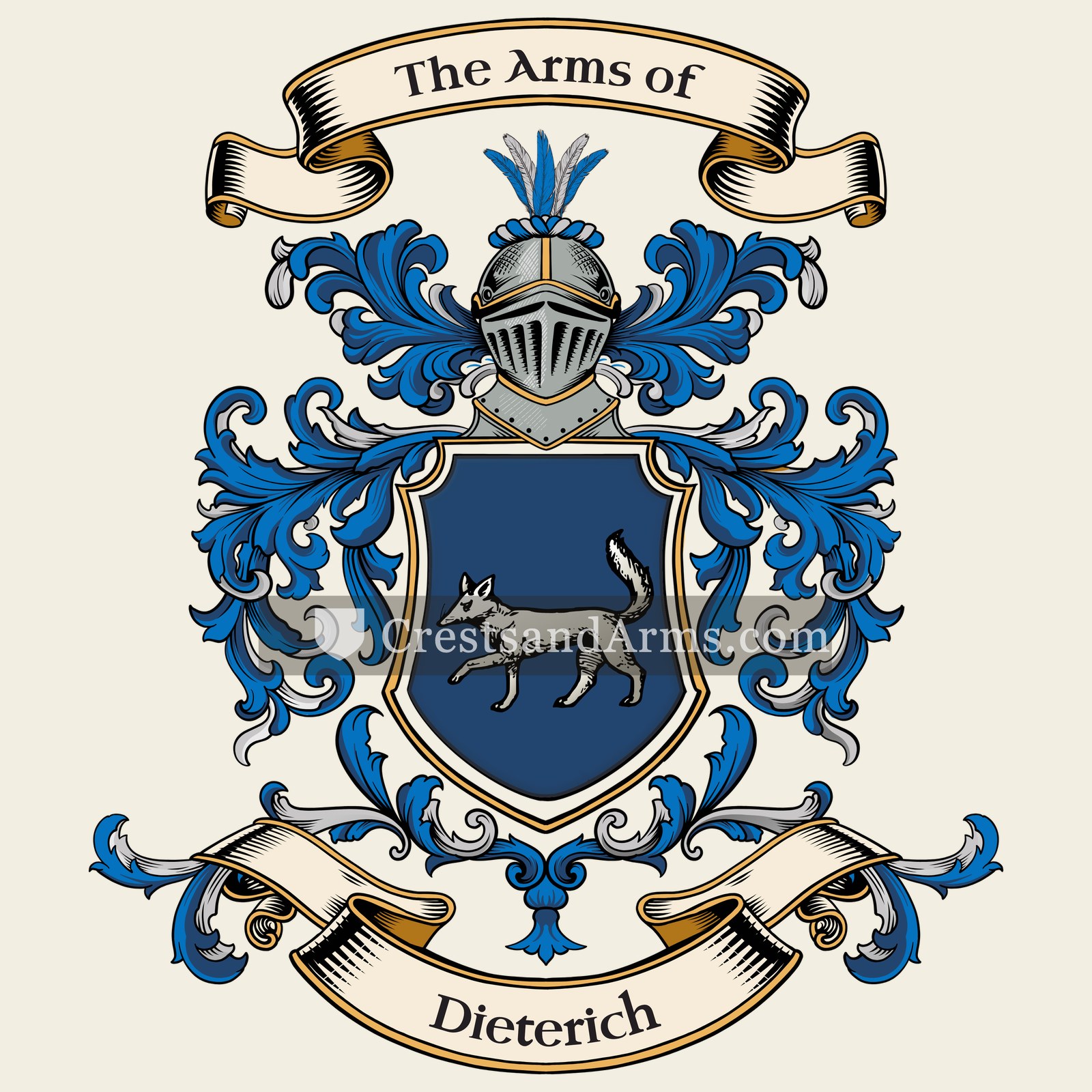
foxWit and wisdom in defence
Colours
Blue (Azure)Means: Loyalty and truth
Gold (Or)Means: Generosity
Historical info
Source
J. B. Rietstap, Armorial Général, Gouda: G. B. van Goor Zonen, 1884–87
Blazon (the actual original written record)
“Tranché d'azur sur or; à un renard ramp. au nat., br. sur le tout. C.: le renard iss., donnant dans un huchet qu'il supporte de sa patte dextre, et tenant de sa sen. une oie d'arg.”
Austriac. 1772
Digital archive packCoat of arms PNG, gold border print PDF, vector SVG and the certificate of authenticity. Sent to your email in minutes.
Map of Austria showing where the Dieterich arms are recorded
The Dieterich arms were recorded in Austria, c. 1772.
Arms such as these were typically recorded in Tyrol.
Tyrol was mountain country in western Austria, where the valleys were held by families who had been there a very long time. Old tenure counted for more than money, and old families carried arms.
This is where the arms were entered in the register. Families often moved to other parts of the country, so the same name can turn up in more than one region.
Region
Tyrol
First recorded
1772
Granting Authority for the Dieterich Arms
Imperial and Royal chancery
Sodacan · CC BY-SA 3.0
The body that granted and recorded arms in Austria in this period.
Joseph II, Holy Roman Emperor
Sovereign of the period
Joseph II, Holy Roman Emperor
1765–1790
Reigning in Germany when the Dieterich arms are first recorded.
How Arms Worked in Austria
Austrian coats of arms were often linked directly to noble titles granted by the Emperor. These symbols belonged to the entire family line rather than just one individual. When a family grew, new branches kept the original design without needing to change it. This system allowed all members of a noble house to share the same identity across many generations.
Granting authority
The Imperial and Royal chancery managed all heraldic matters and controlled the official granting of arms throughout the Austrian lands.
How they got arms
Families typically received their arms through a formal imperial decree that often accompanied the elevation of a person to noble status.
Where arms were recorded
Official records of these grants were kept in the Imperial Register of Nobility which began its formal documentation process in 1453.
The family's standing
Recorded among the armigerous families of Austria.
Origin & History of the Dieterich Family in Austria
The family name Dieterich is rooted in the ancient Germanic name Theodoric, which translates to ruler of the people. By the time members of the family were documented in the Tyrol region of Austria in 1772, the name had evolved through centuries of linguistic shifts across Central Europe. During this era, the Tyrol was a rugged and mountainous territory where families often settled in specific valleys to work as farmers, craftsmen, or local administrators. The presence of the Dieterich name in these records suggests that the family was well-established within the local community, likely participating in the traditional alpine economy that defined life in the Habsburg lands. As the family moved through these high-altitude landscapes, they contributed to the social fabric of the region, leaving behind a legacy tied to the growth and development of the Austrian countryside.
Dieterich Meaning & Related Branches
Root word
Theodoricus
Derived from Germanic elements meaning people and ruler.
This name
DieterichA ruler of the people or leader of the folk.
also spelled
Dietrich
Deeterik
Related arms
Klezl-Norbergsimilar arms
Lipstorpsimilar arms
Dietrichvariant spelling
Documented Sources
J. B. Rietstap, Armorial Général, Gouda: G. B. van Goor Zonen, 1884–87
Bahlow, Hans, Deutsches Namenlexikon: Familien- und Vornamen nach Ursprung und Sinn erklärt, 1967
Heintze, Albert, Die deutschen Familiennamen: geschichtlich, geographisch, sprachlich, 1903
Bayerisches Hauptstaatsarchiv, Kirchenbücher der Pfarreien in Bayern, 1765
Digital archive packCoat of arms PNG, gold border print PDF, vector SVG and the certificate of authenticity. Sent to your email in minutes.


 fessThe military belt, and readiness to serve
 knightChivalry and service in arms
 keyGuardianship, and the office of a steward
 mulletThe third son, and a divine quality from above
 fessThe military belt, and readiness to serve
 knightChivalry and service in arms
 keyGuardianship, and the office of a steward
 mulletThe third son, and a divine quality from above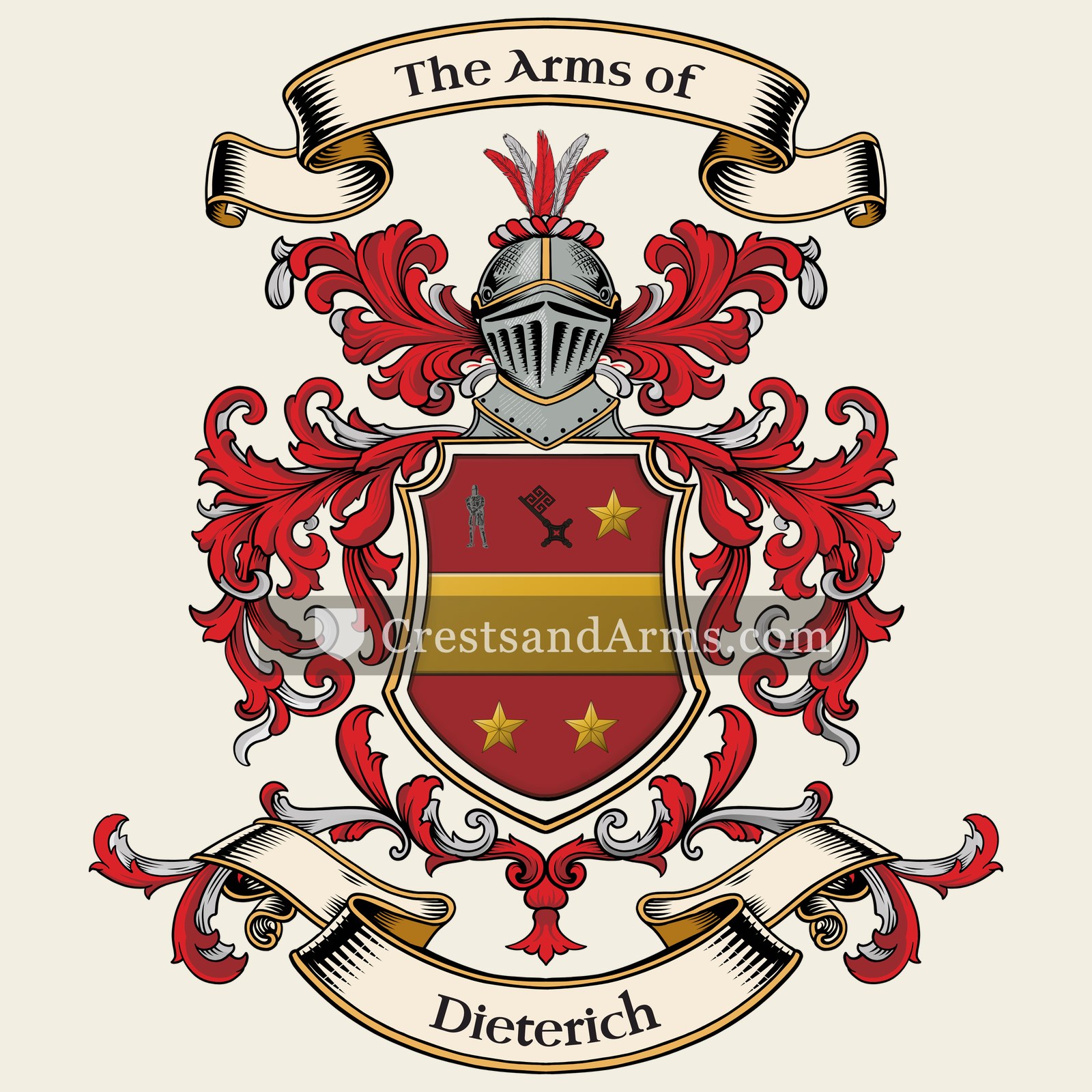


 foxWit and wisdom in defence