A record of documented arms, meaning and origin, researched for the Dietz family lines. Documented in 3 countries.
Reg. 7035 · German, D–F
Coat of Arms & Family Crest Details
Symbols on this shield
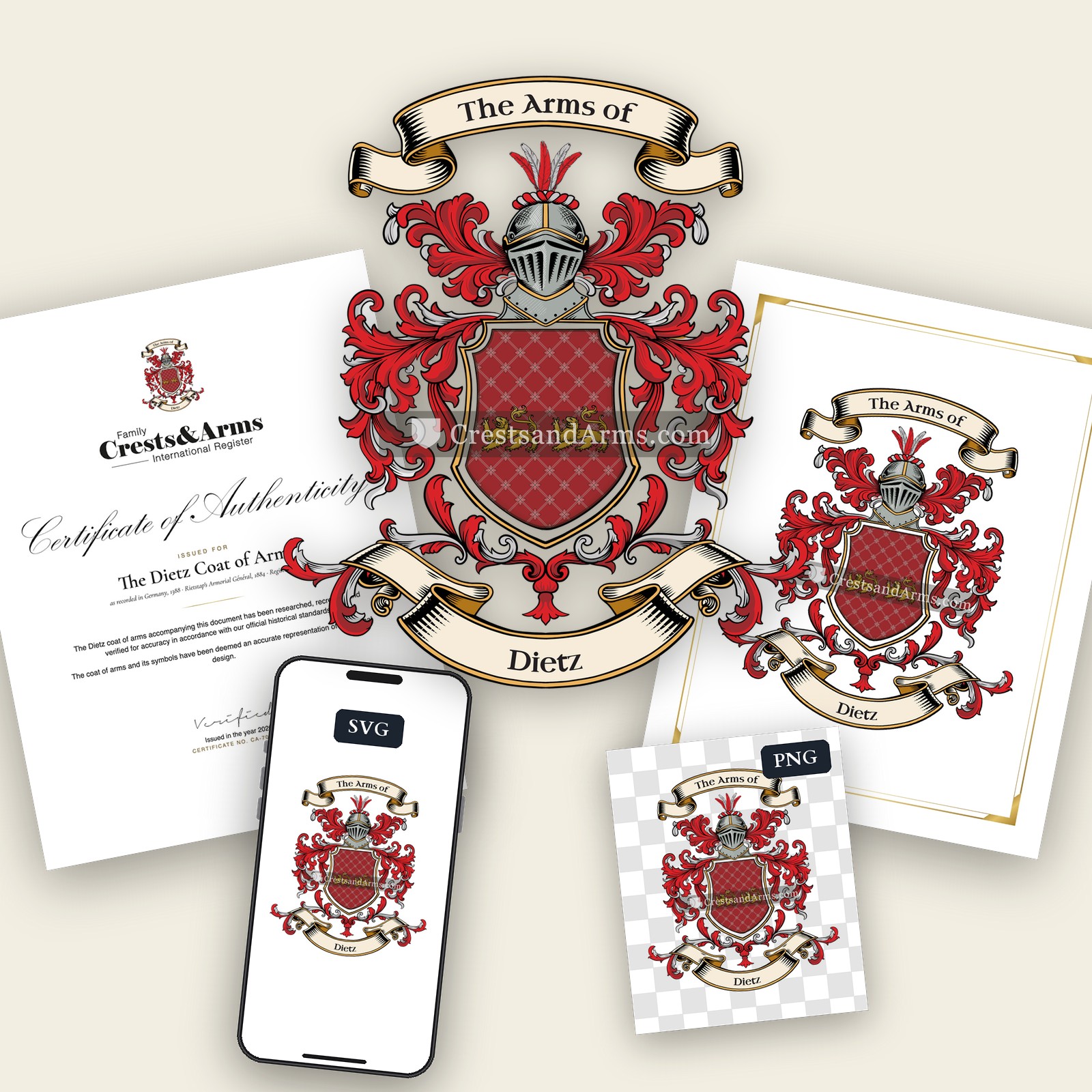
lionCourage, strength and royalty
Colours
Red (Gules)Means: Military strength
Gold (Or)Means: Generosity
Historical info
Source
J. B. Rietstap, Armorial Général, Gouda: G. B. van Goor Zonen, 1884–87
Blazon (the actual original written record)
“De gu. à deux léopards d'or, l'un sur l'autre. C.: un vol à l'antique de sa., ch. d'un tourteau aux armes de l'écu; ou, un chapeau pyramidal palé de gu. et d'or de quatre pièces et sommé de cinq pl. d'aut., alt. de gu. et d'or [Comp. Nassau-Dietz.]”
GermanyNassau, c. 1388
Digital archive packCoat of arms PNG, gold border print PDF, vector SVG and the certificate of authenticity. Sent to your email in minutes.
Map of Germany showing where the Dietz arms are recorded
The Dietz arms were recorded in Nassau, c. 1388.
This is where the arms were entered in the register. Families often moved to other parts of the country, so the same name can turn up in more than one region.
The body that granted and recorded arms in Germany in this period.
How Arms Worked in Germany
In the Holy Roman Empire, coats of arms were often granted to individuals by the Emperor or his representatives. These arms were then passed down through the generations to all legitimate descendants of the original holder. Younger branches of a family usually kept the same shield design without needing to change it, as the arms belonged to the entire lineage.
Granting authority
The Holy Roman Emperor held the sole power to grant new coats of arms throughout his vast imperial territories.
How they got arms
Families typically obtained their coats of arms through a formal imperial grant or by proving their noble status to the authorities.
Where arms were recorded
These grants were officially recorded in the Imperial Chancery registers, which began keeping formal records of such honors during the Middle Ages.
The family's standing
Recorded among the armigerous families of Germany.
Origin & History of the Dietz Family in Germany
The surname Dietz originated as a short form of the Germanic name Dietrich, which combines the words for people and ruler. By the late Middle Ages, this name became a common way to identify individuals within the German-speaking lands. Historical records confirm the presence of the Dietz family in the region of Nassau as early as 1388. During this era, families in Nassau often lived in small agricultural communities or served local lords in the feudal system. As the name spread across the landscape, it evolved from a personal identifier into a hereditary surname passed down through generations. The family likely played a role in the local development of the Nassau territory, which was a significant political power in the Holy Roman Empire. Over time, the name became firmly established throughout central Germany as the family members moved between towns and villages for work and trade.
Coat of Arms & Family Crest Details
Symbols on this shield
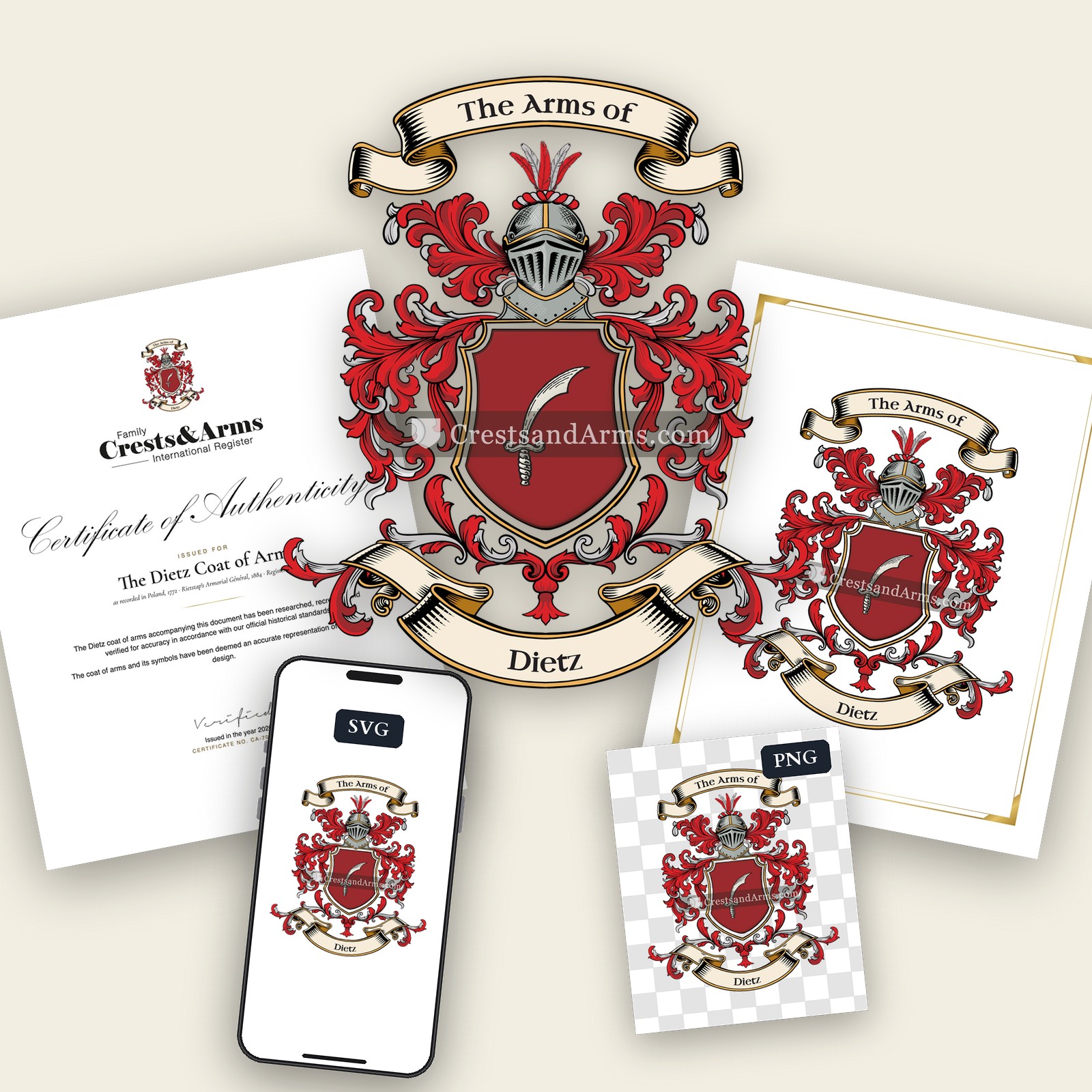
swordJustice, and military honour
Colours
Red (Gules)Means: Military strength
Blue (Azure)Means: Loyalty and truth
Silver (Argent)Means: Peace and sincerity
Historical info
Source
J. B. Rietstap, Armorial Général, Gouda: G. B. van Goor Zonen, 1884–87
Blazon (the actual original written record)
“Coupé de gu. sur azur; à une serpette d'arg., emm. d'or, posée en pal, br. sur le coupé. C.: un demi-vol, aux armes de l'écu.”
PolandThorn Prusse, c. 1772
Digital archive packCoat of arms PNG, gold border print PDF, vector SVG and the certificate of authenticity. Sent to your email in minutes.
Map of Poland showing where the Dietz arms are recorded
The Dietz arms were recorded in Thorn Prusse, c. 1772.
This is where the arms were entered in the register. Families often moved to other parts of the country, so the same name can turn up in more than one region.
Region
Thorn
Town
Thorn Prusse
First recorded
1772
Granting Authority for the Dietz Arms
Ennoblement by the Sejm
Author: Olek Remesz · CC BY-SA 3.0
The body that granted and recorded arms in Poland in this period.
Stanisław August Poniatowski
Sovereign of the period
Stanisław August Poniatowski
1764–1795
Reigning in Germany when the Dietz arms are first recorded.
How Arms Worked in Poland
Polish noble families shared a single coat of arms across many different surnames, creating large clans rather than individual designs. These symbols were held collectively by all members of the clan regardless of their specific family name. When a new family joined the nobility, they were adopted into an existing clan and began using that group's established shield.
Granting authority
The Sejm, which was the Polish parliament, held the power to grant noble status and the right to bear arms.
How they got arms
Families typically received their coat of arms through a formal act of ennoblement granted by the Sejm for distinguished service.
Where arms were recorded
These grants were officially recorded in the Crown Metrica, which served as the central archive for state documents starting in the sixteenth century.
The family's standing
Recorded among the armigerous families of Poland.
Origin & History of the Dietz Family in Poland
The surname Dietz is a shortened form of the old German name Dietrich, which translates to a ruler of the people. While the name has deep roots in Germanic regions, families carrying this name were well-established in the city of Thorn by 1772. At that time, Thorn was a significant center of trade and culture located along the Vistula River. Families like the Dietz clan often moved into these urban areas to work as skilled craftsmen, merchants, or administrators during a period of major political change in the region. Because Thorn served as a bridge between different cultures, the Dietz family likely played a role in the local economy and civic life of the city. Their presence in the 1772 tax and census records shows that they were integrated into the community long before the modern borders of Poland were defined. By maintaining their household in such a strategic location, these early ancestors helped shape the diverse history of the region through their daily work and community involvement.
Coat of Arms & Family Crest Details
Symbols on this shield
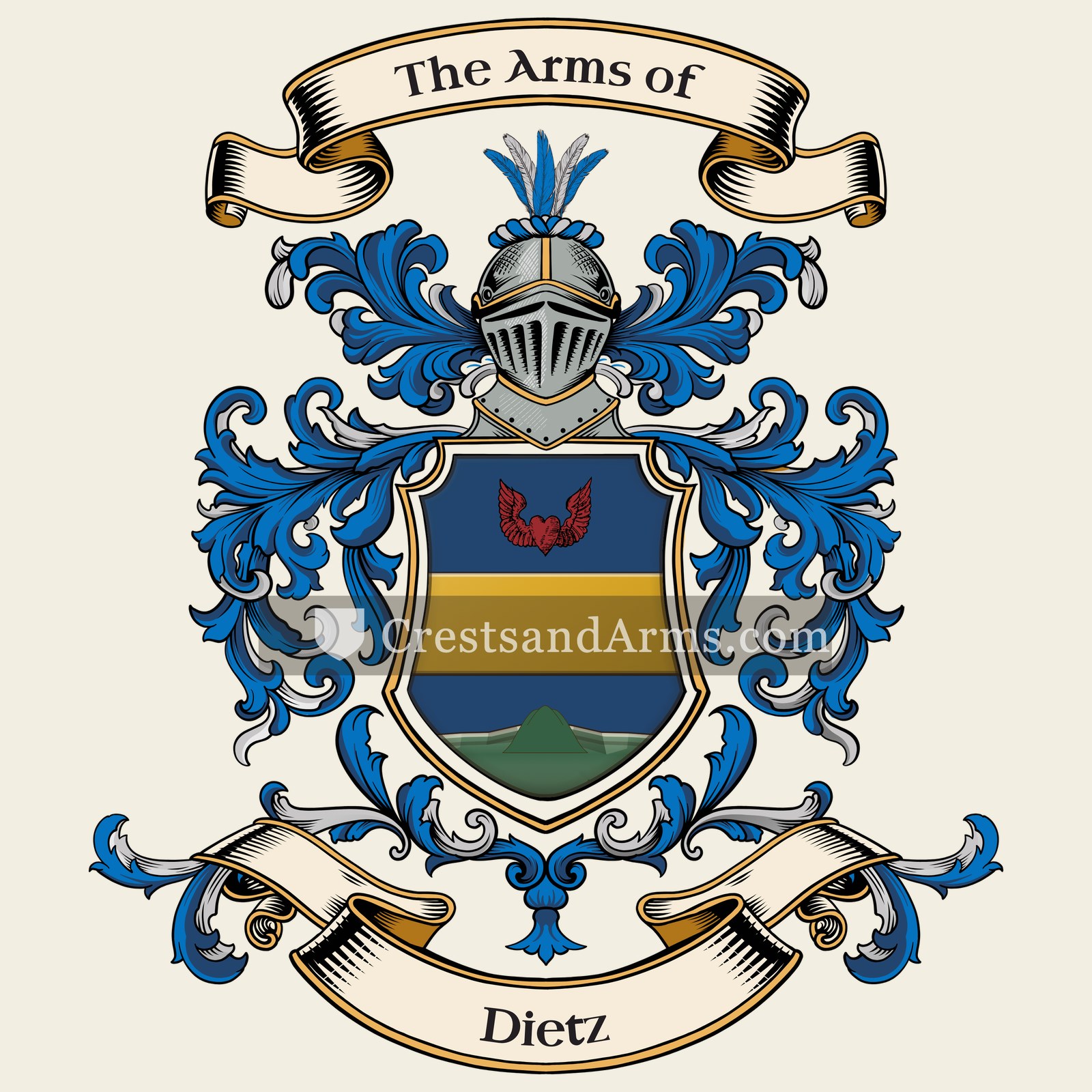
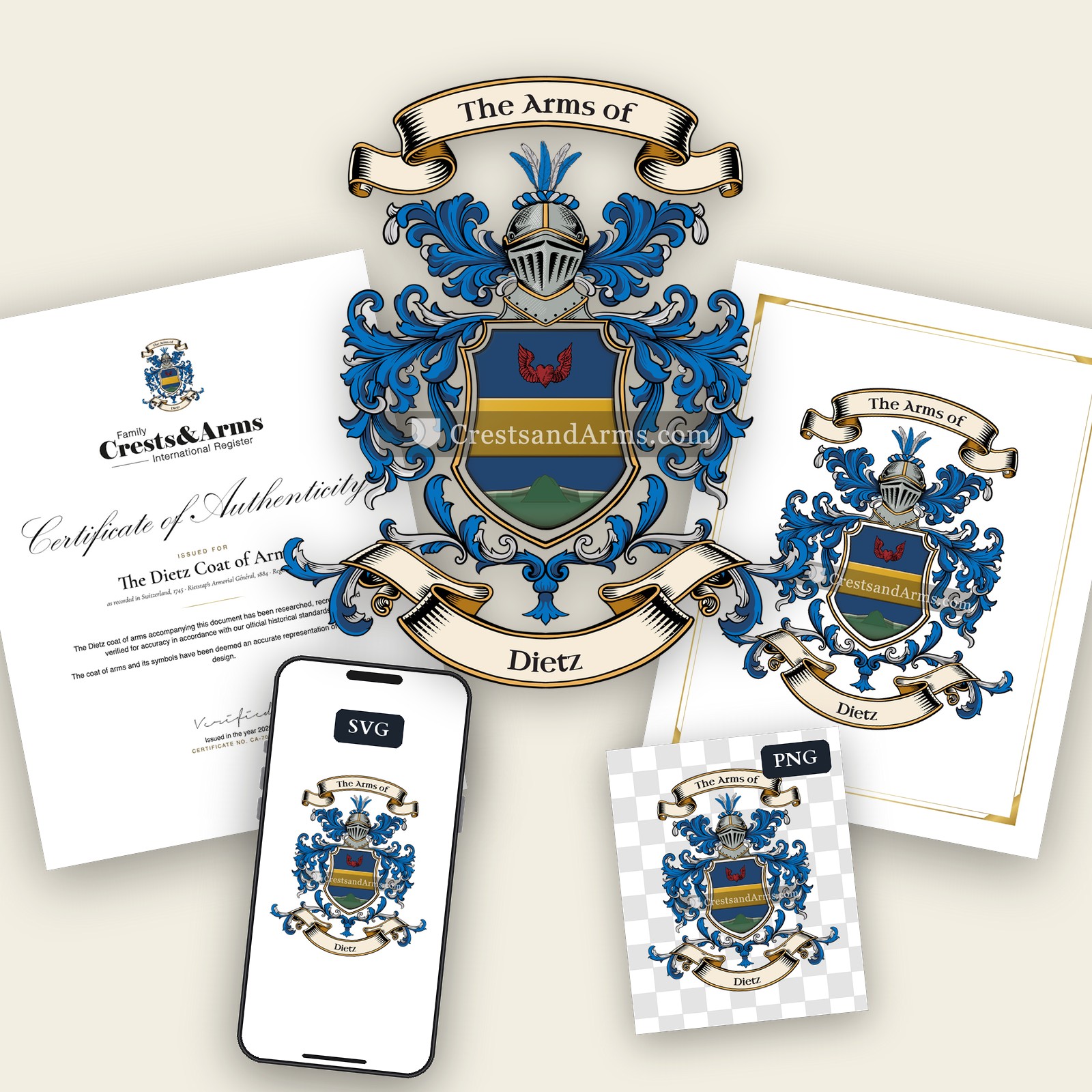
fessThe military belt, and readiness to serve
mountThe ground held, and steadfastness upon it
heartSincerity, charity and true affection
Colours
Blue (Azure)Means: Loyalty and truth
Gold (Or)Means: Generosity
Green (Vert)Means: Hope
Red (Gules)Means: Military strength
Historical info
Source
J. B. Rietstap, Armorial Général, Gouda: G. B. van Goor Zonen, 1884–87
Blazon (the actual original written record)
“D'azur à la fasce d'or, acc. en p. d'un coeur de gu., soutenu d'un tertre de trois coupeaux de sin. et sommé de trois roses d'azur, bout. d'or, tigées et feuillées de sin., les roses et les tiges br. sur la fasce. C.: une balance d'or, posée en bande, br. sur un livre ouv. au nat.; le tout br. sur une épée en barre, la pointe en bas, et surm. d'un oeil humain au nat. L. d'or et d'azur.”
SwitzerlandBâle, c. 1745
Digital archive packCoat of arms PNG, gold border print PDF, vector SVG and the certificate of authenticity. Sent to your email in minutes.
Map of Switzerland showing where the Dietz arms are recorded
The Dietz arms were recorded in Bâle, c. 1745.
This is where the arms were entered in the register. Families often moved to other parts of the country, so the same name can turn up in more than one region.
The body that granted and recorded arms in Switzerland in this period.
How Arms Worked in Switzerland
In Switzerland, coats of arms were not restricted to the nobility and were often adopted by common citizens and families. These symbols were passed down through generations to show family identity. When branches of a family grew, they often changed small details of the design to distinguish their own line from the original group.
Granting authority
Cantonal and civic authorities managed the use of coats of arms within their specific regions and local jurisdictions.
How they got arms
Families typically assumed their own coats of arms based on local custom rather than receiving them from a central monarch.
Where arms were recorded
Arms were recorded in various cantonal and civic registers starting from the fourteenth century throughout the Swiss region.
The family's standing
Recorded among the armigerous families of Switzerland.
Origin & History of the Dietz Family in Switzerland
The surname Dietz has deep roots in the Germanic regions of Europe, functioning originally as a short form of the ancient name Dietrich, which translates to ruler of the people. By the mid-eighteenth century, the name was well established within the city of Basel, Switzerland. Records confirm that members of the Dietz family were active residents of the city by 1745, participating in the local urban economy during a period of significant trade and cultural growth. Because Basel served as a vital crossroads between Switzerland, France, and Germany, families like the Dietz often navigated a blend of cultural influences while maintaining their status as established citizens. These early ancestors were part of the hardworking middle class that helped sustain the city’s reputation for craftsmanship and commerce. Their presence in the historical registers of Basel highlights how the family integrated into the Swiss social fabric long before the modern era.
Dietz Meaning & Related Branches
Root word
Dietrich
Derived from Germanic elements meaning people and ruler.
This name
DietzA diminutive form of names starting with the element meaning people or tribe.
also spelled
Dietze
Ditz
Dietzs
Deets
Related arms
Dollingersame arms
Eisenlohrsimilar arms
Schmidsimilar arms
Straussimilar arms
Documented Sources
J. B. Rietstap, Armorial Général, Gouda: G. B. van Goor Zonen, 1884–87
Bahlow, Hans, Deutsches Namenlexikon: Familien- und Vornamen nach Ursprung und Sinn erklärt, 1967
Heß, Hellmuth, Die Matrikel der Universität Heidelberg, 1884
Hessisches Hauptstaatsarchiv, Bestand 171: Nassauische Urkunden, 1388
Digital archive packCoat of arms PNG, gold border print PDF, vector SVG and the certificate of authenticity. Sent to your email in minutes.


 lionCourage, strength and royalty
 lionCourage, strength and royalty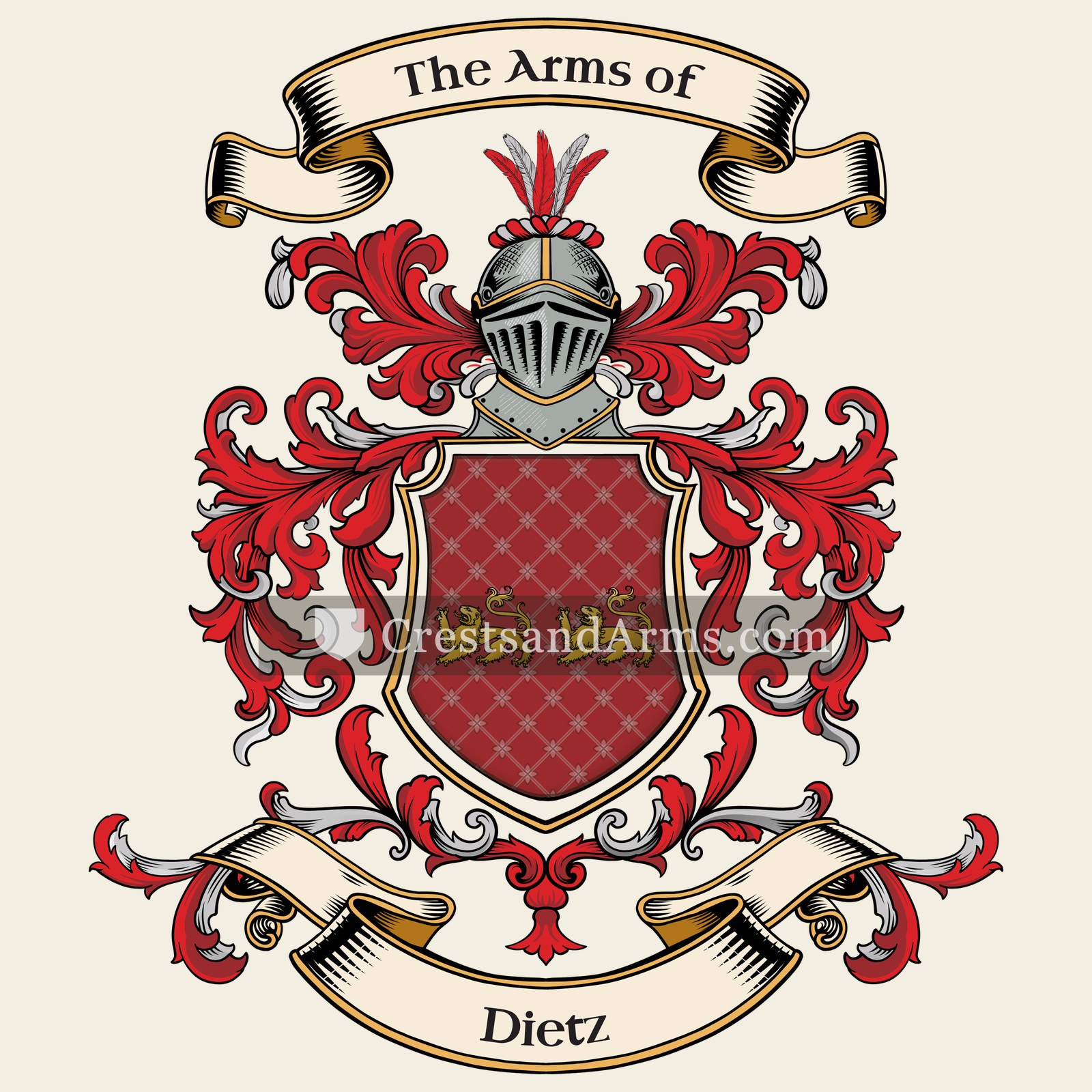

 swordJustice, and military honour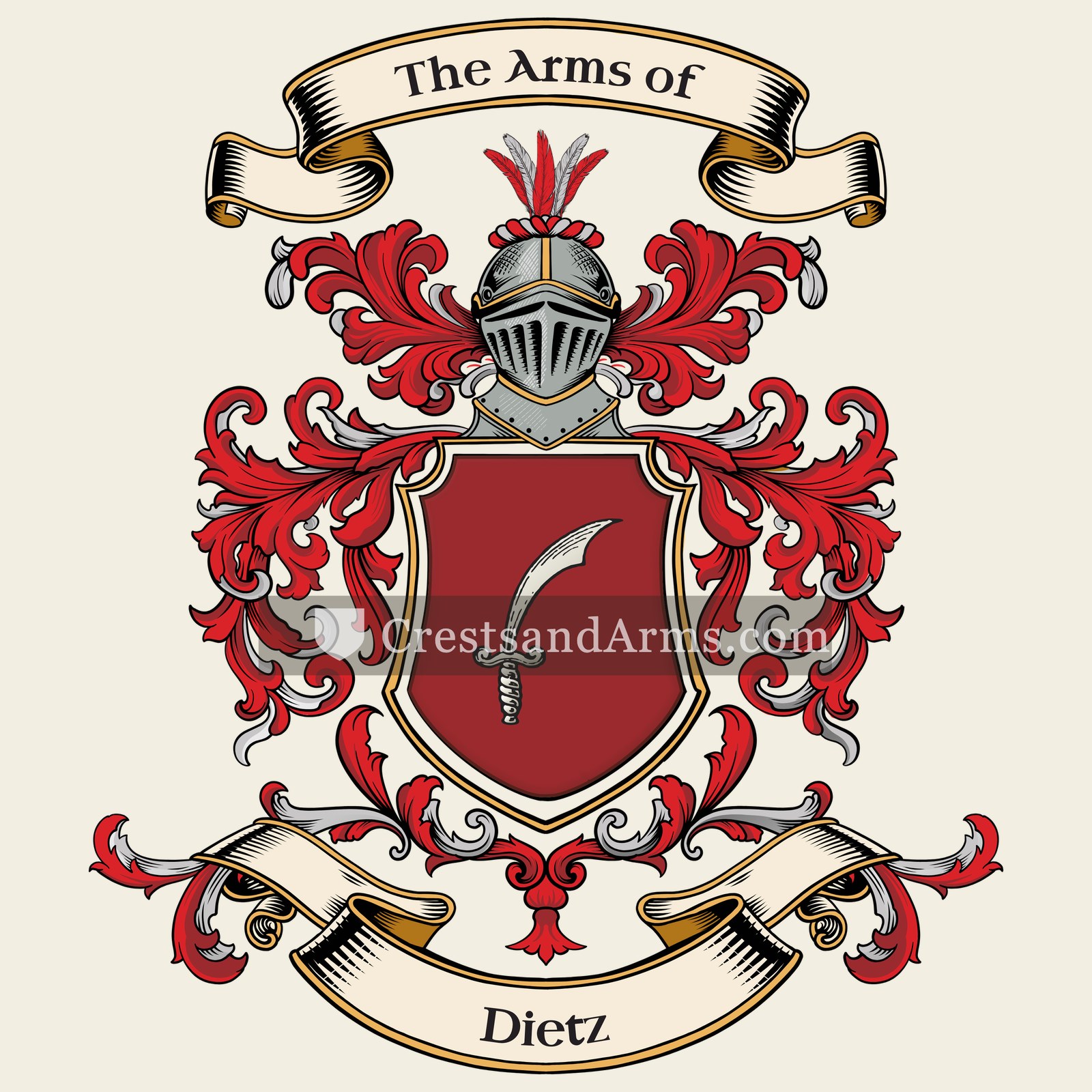


 fessThe military belt, and readiness to serve
 mountThe ground held, and steadfastness upon it
 heartSincerity, charity and true affection