Map of Britain showing where the Dilke arms are recorded
The Dilke arms were recorded in Londres, c. 1862.
Arms such as these were typically recorded in Kent.
Kent sits between London and the short crossing to Europe, and the trade passing through made it wealthy. Merchant families bought land with that money, and it was landowners who took coats of arms.
This is where the arms were entered in the register. Families often moved to other parts of the country, so the same name can turn up in more than one region.
The body that granted and recorded arms in Britain in this period.
Victoria
Sovereign of the period
Victoria
1837–1901
Reigning in Britain when the Dilke arms are first recorded.
How Arms Worked in Britain
English heraldry allowed arms to be shared by all legitimate descendants of the original owner. These symbols were treated as personal property that moved through the generations to all children. While the eldest son kept the original design, other family members could use the same shield without needing to change it or register their own unique versions.
Granting authority
The College of Arms in London has regulated the use of coats of arms throughout England and Wales since 1484.
How they got arms
Families typically obtained their coats of arms through a formal grant from the Crown or by proving their ancient right to them.
Where arms were recorded
All official coats of arms are recorded in the registers kept at the College of Arms, which date back to the fifteenth century.
The family's standing
Recorded among the armigerous families of Britain.
Origin & History of the Dilke Family in Britain
The surname Dilke is rooted in the linguistic landscape of medieval England, likely emerging as a diminutive form of the Old English name Dillo. While the family established a notable presence in Kent by the mid-19th century, the name itself traces back much further to the Midlands, particularly Warwickshire, where early records place the family as landed gentry. The name evolved through various spellings in parish registers and tax documents over several centuries before settling into its modern form. By the time the family became prominent in Kent during the 1860s, they were already part of a long tradition of English public life. This history reflects the broader movement of families across the British Isles as they transitioned from local landowners to figures involved in the national political and social spheres of the Victorian era.
Coat of Arms & Family Crest Details
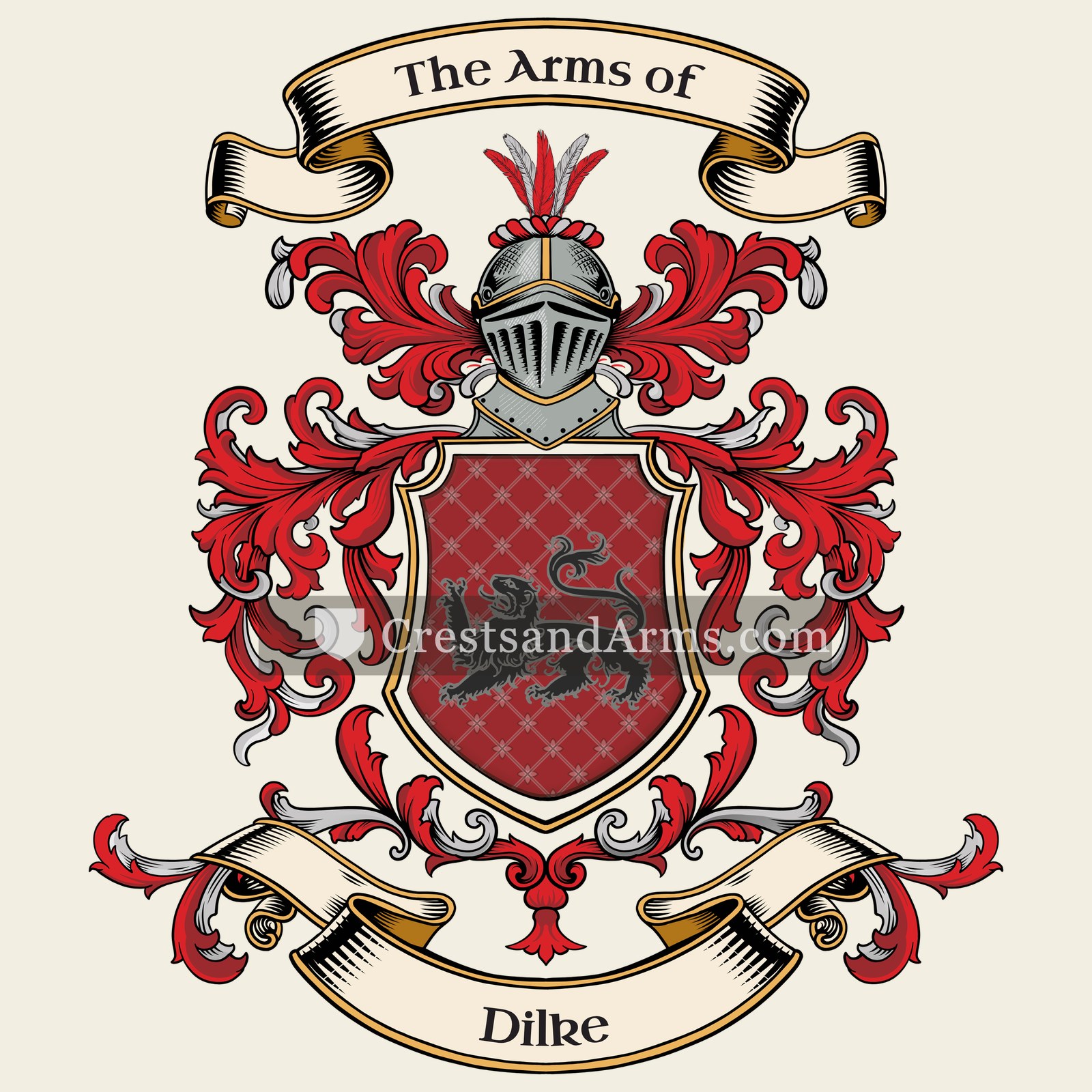
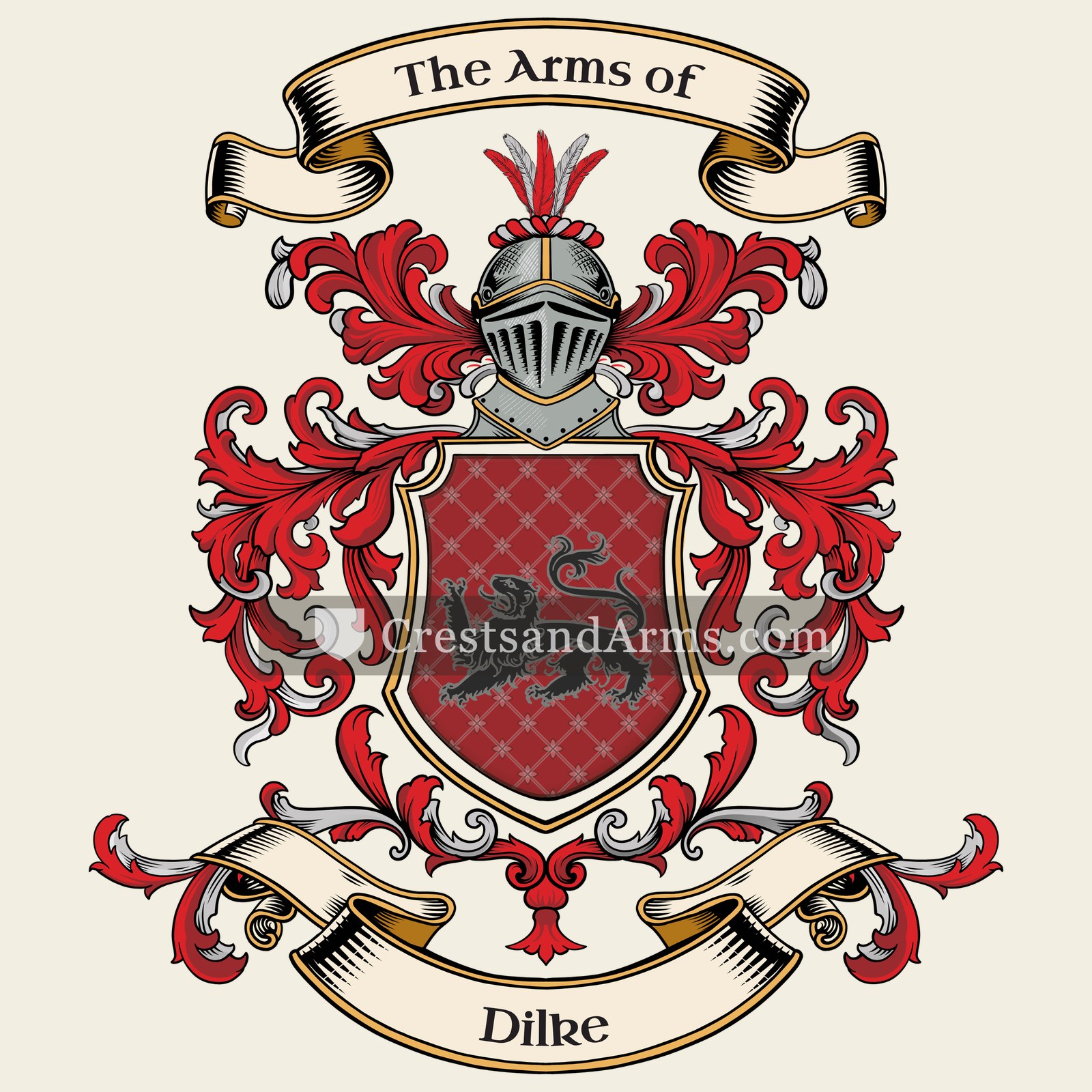
Symbols on this shield
lionCourage, strength and royalty
Colours
Red (Gules)Means: Military strength
Historical info
Source
Sir Bernard Burke, The General Armory of England, Scotland, Ireland and Wales, London: Harrison & Sons, 1884
Blazon (the actual original written record)
“Gu. a lion ramp. per pale ar. and or”
LeicesterKirkby Mallory · Leicester, c. 1574
Digital archive packCoat of arms PNG, gold border print PDF, vector SVG and the certificate of authenticity. Sent to your email in minutes.
Map of England showing where the Dilke arms are recorded
The Dilke arms were recorded in Leicester, c. 1574.
Leicestershire was grazing country, and wool and cattle made steady money rather than spectacular fortunes. Steady money bought manors, and manors are what brought families into the registers.
This is where the arms were entered in the register. Families often moved to other parts of the country, so the same name can turn up in more than one region.
The body that granted and recorded arms in England in this period.
Elizabeth I of England
Sovereign of the period
Elizabeth I of England
1558–1603
Reigning in Britain when the Dilke arms are first recorded.
How Arms Worked in England
English heraldry allowed arms to be shared by all legitimate descendants of the original owner. These symbols were treated as personal property that moved through the generations to all children. While the eldest son kept the original design, other family members could use the same shield without needing to change it or register their own unique versions.
Granting authority
The College of Arms in London has regulated the use of coats of arms throughout England and Wales since 1484.
How they got arms
Families typically obtained their coats of arms through a formal grant from the Crown or by proving their ancient right to them.
Where arms were recorded
All official coats of arms are recorded in the registers kept at the College of Arms, which date back to the fifteenth century.
The family's standing
Recorded among the armigerous families of Leicester.
Origin & History of the Dilke Family in England
The surname Dilke is rooted in the English Midlands, where it emerged as a distinct family name during the late sixteenth century. Historical records confirm that members of the Dilke family were established in Leicester by 1574, suggesting they were part of the growing merchant and landowning classes of the era. The name itself is believed to be a diminutive form of the Old English name Dilk, which likely functioned as a nickname or a shortened version of a longer personal name common in the region. As the family grew in prominence, they became deeply integrated into the local government and social life of Leicestershire. Their presence in the area during the Elizabethan period reflects a time when many families were solidifying their surnames and expanding their influence through local trade and property ownership. By settling in this specific part of England, the early Dilkes helped establish a legacy that remained tied to the Leicestershire landscape for many generations.
Dilke Meaning & Related Branches
Root word
Matilda
Derived from Germanic elements meaning strength in battle.
This name
DilkeA patronymic surname originating as a diminutive form of the name Matilda.
also spelled
Dilk
Dilkee
Dilkey
Dylke
Dylkes
Related arms
Dylkesvariant spelling
Documented Sources
J. B. Rietstap, Armorial Général, Gouda: G. B. van Goor Zonen, 1884–87
Bardsley, Charles Wareing, A Dictionary of English and Welsh Surnames, 1901
Reaney, Percy Hide, A Dictionary of British Surnames, 1958
The National Archives, Probate Records of the Prerogative Court of Canterbury, 1384–1858
Kent History and Library Centre, Parish Registers of Kent, 1862
Digital archive packCoat of arms PNG, gold border print PDF, vector SVG and the certificate of authenticity. Sent to your email in minutes.


 lionCourage, strength and royalty
 lionCourage, strength and royalty