Map of Belgium showing where the Dillehay arms are recorded
The Dillehay arms were recorded in Louvain, c. 1737.
This is where the arms were entered in the register. Families often moved to other parts of the country, so the same name can turn up in more than one region.
The body that granted and recorded arms in Belgium in this period.
Charles VI, Holy Roman Emperor
Sovereign of the period
Charles VI, Holy Roman Emperor
1711–1740
Reigning in Belgium when the Dillehay arms are first recorded.
How Arms Worked in Belgium
In Belgium, a coat of arms is considered personal property that is passed down through the male line to legitimate descendants. Families often use the same shield design across generations to show their shared heritage. If a branch of the family wants to change the design, they must apply for an official update to their specific version of the arms.
Granting authority
The Conseil héraldique is the official body that regulates and approves all coats of arms in Belgium.
How they got arms
Families obtain their coats of arms through formal royal grants or by confirming their historical right to use existing designs.
Where arms were recorded
All approved coats of arms are officially recorded in the public registers of the Conseil héraldique since 1844.
The family's standing
Recorded among the armigerous families of Belgium.
Origin & History of the Dillehay Family in Belgium
The family name Dillehay is believed to have roots in the Low Countries, specifically within the region of present-day Belgium. Historical records confirm that members of the family were established in the city of Louvain by 1737. During this era, Louvain was a prominent center for trade and academic life, which suggests that the family likely held a stable position within the urban community. As the name moved across borders, it underwent various spelling changes to adapt to the phonetic patterns of different languages. These early ancestors were part of a period of significant social transition in Europe, where families often moved between growing cities to pursue new opportunities in commerce or craftsmanship. By tracing these early residents of Louvain, we gain a glimpse into a lineage that was already well-integrated into the fabric of European society during the eighteenth century.
Related Branches & Arms
Root word
Dille
A diminutive form of the Germanic name Diederik meaning people ruler.
This name
DillehayA topographic or habitational name referring to someone from a valley or meadow.
also spelled
Dyle
Dila
Dill
Documented Sources
J. B. Rietstap, Armorial Général, Gouda: G. B. van Goor Zonen, 1884–87
Stadsarchief Leuven, Registers van de Burgerlijke Stand van Leuven, 1737
Van Even, Edward, Louvain dans le passé et dans le présent, 1895
Digital archive packCoat of arms PNG, gold border print PDF, vector SVG and the certificate of authenticity. Sent to your email in minutes.


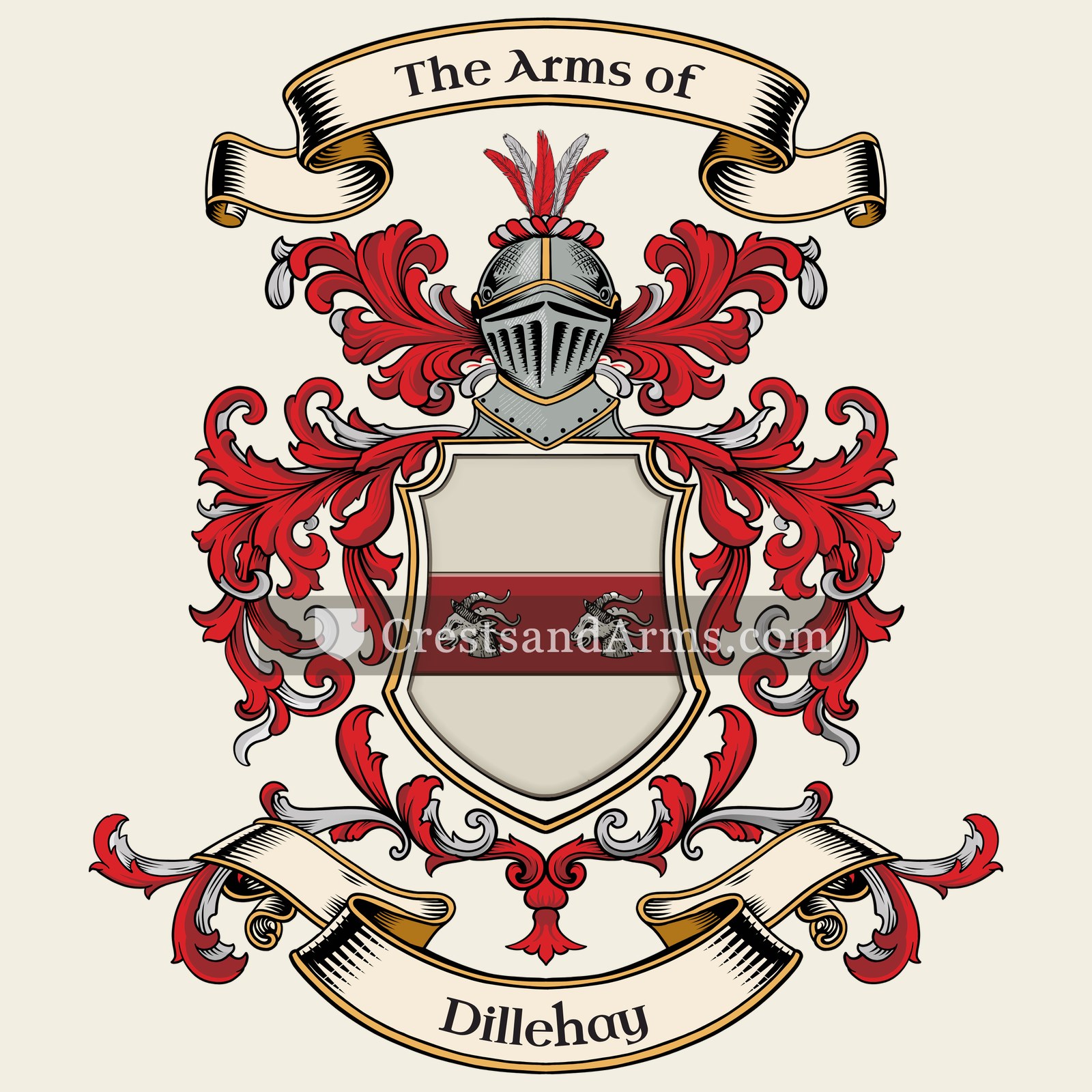
 fessThe military belt, and readiness to serve
 goats headWisdom, and one who wins by policy rather than force
 fessThe military belt, and readiness to serve
 goats headWisdom, and one who wins by policy rather than force