Map of Germany showing where the Diller arms are recorded
The Diller arms were recorded in Francfort s, c. 1765.
This is where the arms were entered in the register. Families often moved to other parts of the country, so the same name can turn up in more than one region.
The body that granted and recorded arms in Germany in this period.
Francis I, Holy Roman Emperor
Sovereign of the period
Francis I, Holy Roman Emperor
1745–1765
Reigning in Germany when the Diller arms are first recorded.
How Arms Worked in Germany
In the Holy Roman Empire, coats of arms were often granted to individuals by the Emperor or his representatives. These arms were then passed down through the generations to all legitimate descendants of the original holder. Younger branches of a family usually kept the same shield design without needing to change it, as the arms belonged to the entire lineage.
Granting authority
The Holy Roman Emperor held the sole power to grant new coats of arms throughout his vast imperial territories.
How they got arms
Families typically obtained their coats of arms through a formal imperial grant or by proving their noble status to the authorities.
Where arms were recorded
These grants were officially recorded in the Imperial Chancery registers, which began keeping formal records of such honors during the Middle Ages.
The family's standing
Recorded among the armigerous families of Germany.
Origin & History of the Diller Family in Germany
The surname Diller originated in the German-speaking regions of Europe, where it likely functioned as a descriptive occupational or locational name. Linguistic experts suggest that the name is linked to the Middle High German word *dille*, which referred to a board or a plank used in flooring. This implies that early ancestors may have been skilled carpenters, woodworkers, or individuals who lived near a specific wooden structure. By the mid-eighteenth century, the family had established a notable presence in the bustling trade hub of Frankfurt. Records from 1765 confirm that members of the Diller family were active participants in the social and economic life of this city. During this era, Frankfurt served as a vital center for commerce and migration, providing a stable environment for families to grow and transition into various professional roles within the urban landscape.
Coat of Arms & Family Crest Details
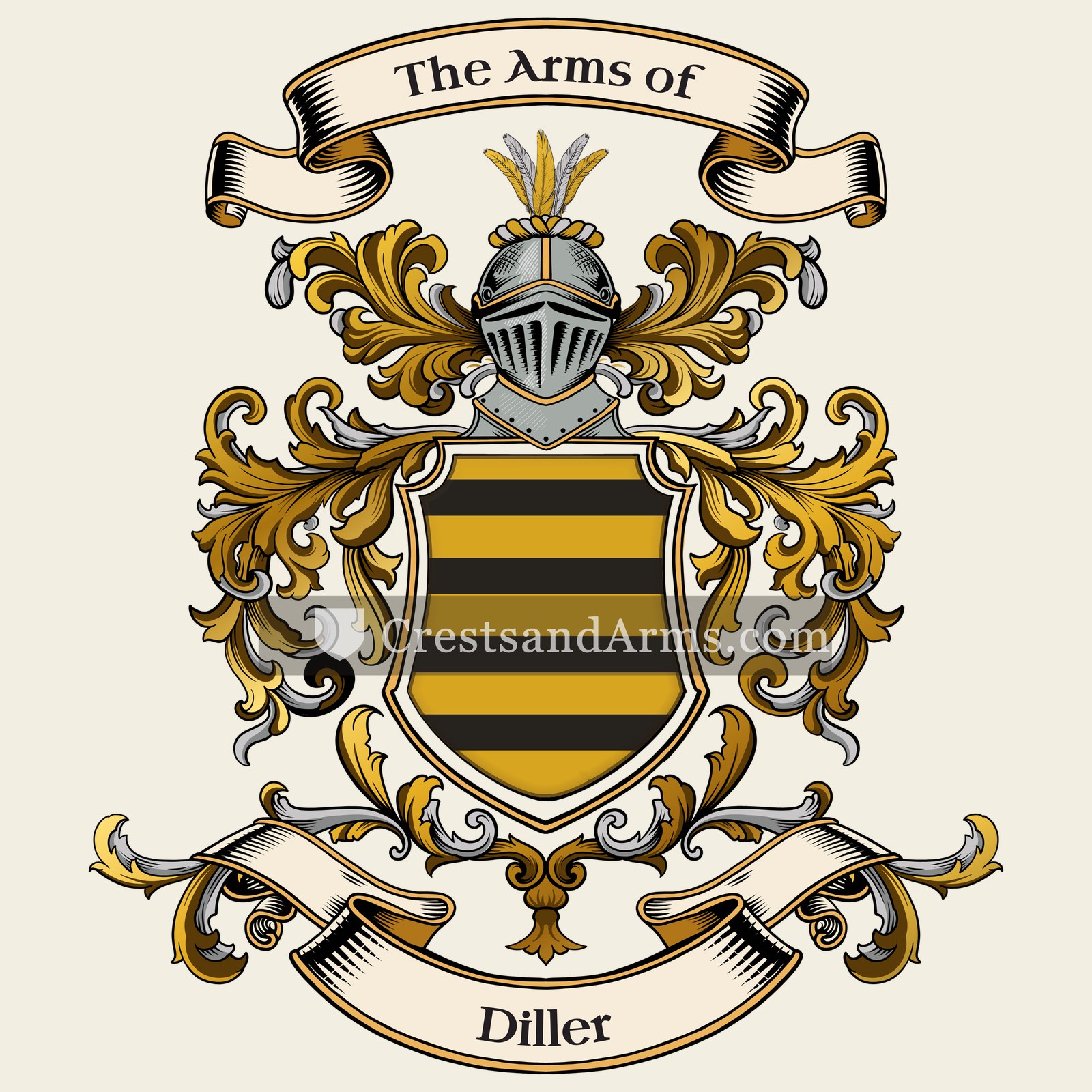
Symbols on this shield
fessThe military belt, and readiness to serve
Colours
Gold (Or)Means: Generosity
Black (Sable)Means: Constancy
Historical info
Source
J. B. Rietstap, Armorial Général, Gouda: G. B. van Goor Zonen, 1884–87
Blazon (the actual original written record)
“D'or à quatre fasces de sa. Cq. cour. C.: un senestrochère, arm. au nat., posé sur le coude; entre un vol de sa., tenant une hailebarde en barre. S.: deux griffons de sa., le bec et les pattes de devant d'or. [Comp. Hess-Diller.]”
Austriac. 1806
Digital archive packCoat of arms PNG, gold border print PDF, vector SVG and the certificate of authenticity. Sent to your email in minutes.
Map of Austria showing where the Diller arms are recorded
The Diller arms were recorded in Austria, c. 1806.
Arms such as these were typically recorded in Tyrol.
Tyrol was mountain country in western Austria, where the valleys were held by families who had been there a very long time. Old tenure counted for more than money, and old families carried arms.
This is where the arms were entered in the register. Families often moved to other parts of the country, so the same name can turn up in more than one region.
Region
Tyrol
First recorded
1806
Granting Authority for the Diller Arms
Imperial and Royal chancery
Sodacan · CC BY-SA 3.0
The body that granted and recorded arms in Austria in this period.
Francis II, Holy Roman Emperor
Sovereign of the period
Francis II, Holy Roman Emperor
1792–1806
Reigning in Germany when the Diller arms are first recorded.
How Arms Worked in Austria
Austrian coats of arms were often linked directly to noble titles granted by the Emperor. These symbols belonged to the entire family line rather than just one individual. When a family grew, new branches kept the original design without needing to change it. This system allowed all members of a noble house to share the same identity across many generations.
Granting authority
The Imperial and Royal chancery managed all heraldic matters and controlled the official granting of arms throughout the Austrian lands.
How they got arms
Families typically received their arms through a formal imperial decree that often accompanied the elevation of a person to noble status.
Where arms were recorded
Official records of these grants were kept in the Imperial Register of Nobility which began its formal documentation process in 1453.
The family's standing
Recorded among the armigerous families of Austria.
Origin & History of the Diller Family in Austria
The Diller family name has deep roots in the mountainous landscape of the Austrian Tyrol, where records confirm their presence as early as 1806. The name is generally considered a topographic or occupational surname, likely originating from the Middle High German word "dille," which referred to a wooden floor or a plank. This suggests that the earliest ancestors bearing this name were likely skilled carpenters or woodworkers who played an essential role in constructing the traditional timber-framed houses common in the Alpine region. Living in the rugged terrain of Tyrol, these families were often tied to the local forestry and agricultural trades that defined the economy of the nineteenth-century Austrian Empire. As they moved through the valleys, the Diller family became part of the steady rhythm of mountain life, contributing to the development of small, tight-knit communities that relied on craftsmanship and trade to survive the harsh winters.
Diller Meaning & Related Branches
Root word
Dill
A Germanic personal name derived from the word for the dill plant.
This name
DillerA topographic or occupational name for someone who grew or dealt in dill herbs.
also spelled
Dillerh
Dillerre
Dyller
Diler
Documented Sources
J. B. Rietstap, Armorial Général, Gouda: G. B. van Goor Zonen, 1884–87
Bahlow, Hans, Deutsches Namenlexikon: Familien- und Vornamen nach Ursprung und Sinn erklärt, 1967
Heintze, Albert, Die deutschen Familiennamen: geschichtlich, geographisch, sprachlich, 1903
Institut für Stadtgeschichte Frankfurt am Main, Bürgerbücher der Stadt Frankfurt am Main
Digital archive packCoat of arms PNG, gold border print PDF, vector SVG and the certificate of authenticity. Sent to your email in minutes.


 horseReadiness to serve king and country
 horseReadiness to serve king and country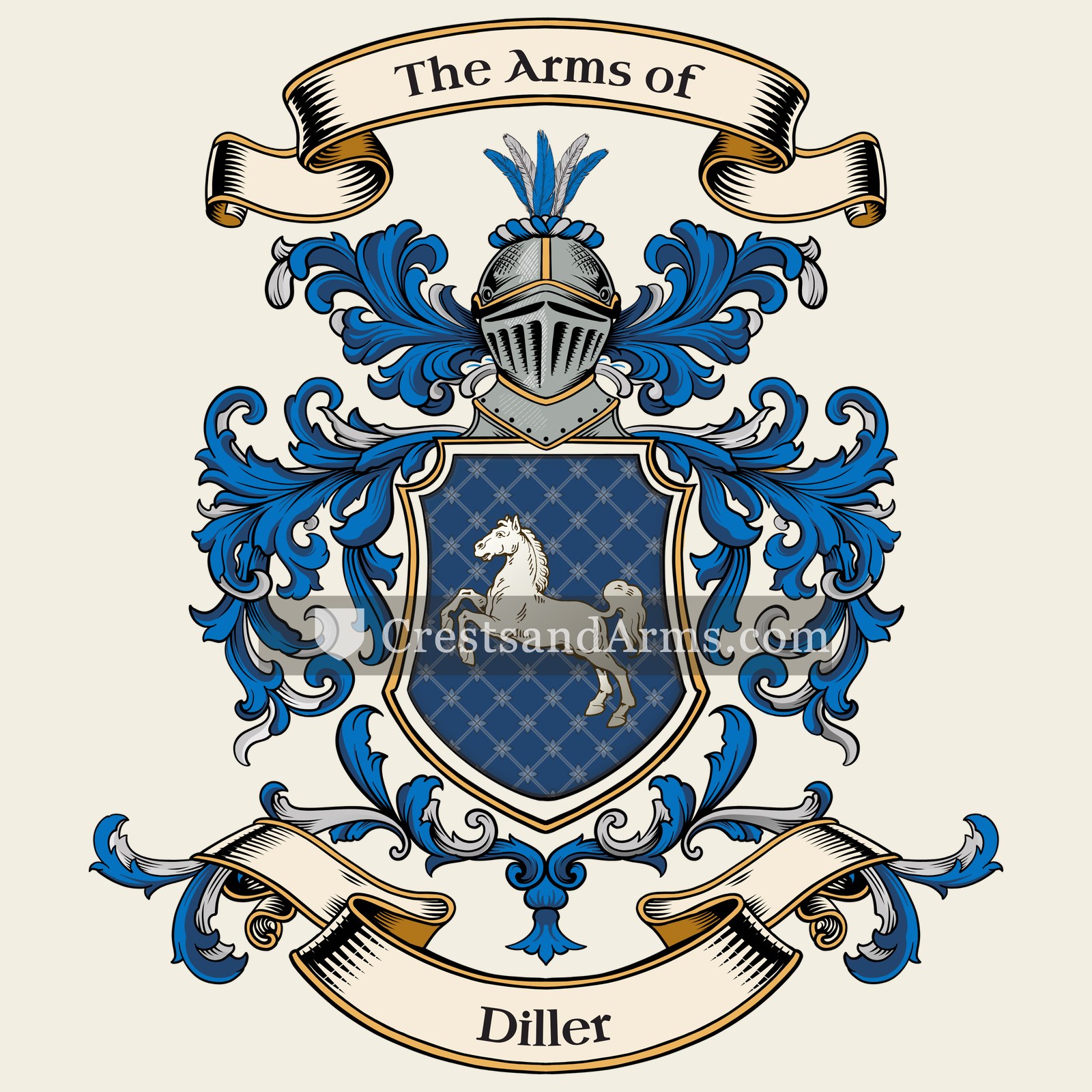


 fessThe military belt, and readiness to serve