Map of France showing where the Dimas arms are recorded
The Dimas arms were recorded in Paris, c. 1663.
This is where the arms were entered in the register. Families often moved to other parts of the country, so the same name can turn up in more than one region.
The body that granted and recorded arms in France in this period.
Louis XIV of France
Sovereign of the period
Louis XIV of France
1643–1715
Reigning in France when the Dimas arms are first recorded.
How Arms Worked in France
In France, a coat of arms was a mark of honor that passed down through the male line to all legitimate descendants. Families often used the same shield without changes to show their shared heritage. If a branch wanted to stand out, they could add a small mark to their shield to show their specific place in the family tree.
Granting authority
The Juge d'armes de France acted as the official authority that regulated and verified coats of arms across the country.
How they got arms
Families typically inherited their arms from ancestors, though they could also receive them through royal grants or by proving their noble status.
Where arms were recorded
Coats of arms were officially recorded in the Armorial Général de France, which began its main collection in the year 1696.
The family's standing
Recorded among the armigerous families of France.
Origin & History of the Dimas Family in France
The surname Dimas carries a rich history that traces back to the vibrant streets of seventeenth-century Paris. By 1663, records confirm that members of the family were already established within the capital, living during a time when the city was undergoing a massive transformation under the reign of King Louis XIV. During this era, families with the name Dimas were often integrated into the urban fabric of France, likely working in the skilled trades or administrative roles that supported the growing bureaucracy of the French state. As the family navigated the social shifts of the 1600s, they became part of the dense population of Paris, contributing to the cultural and economic life of a city that was quickly becoming the center of European power. While the name has roots that reach into various linguistic traditions, its presence in the French capital during this period highlights a long-standing connection to the history of one of the world’s most influential cities.
Meaning of the Dimas family crest colors & symbols
Symbols on this shield
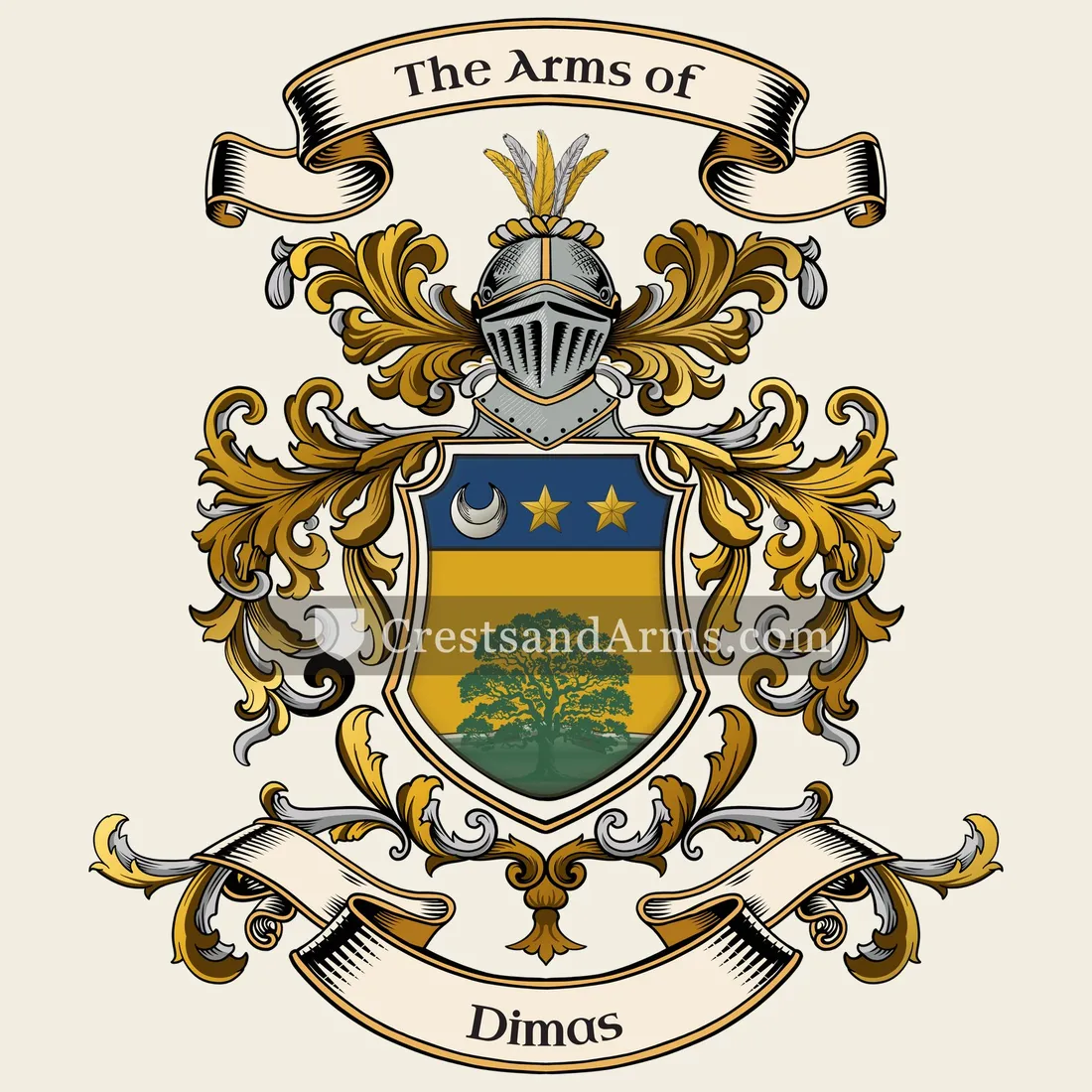
mountThe ground held, and steadfastness upon it
chiefAuthority, wisdom and dominion
treeLife, endurance and deep roots
crescentHonour by the sovereign, and the second son
mulletThe third son, and a divine quality from above
Colours
Gold (Or)Means: Generosity
Blue (Azure)Means: Loyalty and truth
Green (Vert)Means: Hope
Silver (Argent)Means: Peace and sincerity
Historical info
Source
J. B. Rietstap, Armorial Général, Gouda: G. B. van Goor Zonen, 1884–87
Blazon (the actual original written record)
“D'or à un arbre terrassé de sin.; au chef d'azur, ch. d'un croiss. d'arg. entre deux étoiles (5) du champ. Brl. d'azur et d'or. C.: un lion iss., au nat., supp. une étoile d'or. L. d'or et d'azur.”
BavariaBavaria, c. 1736
Digital archive packCoat of arms PNG, gold border print PDF, vector SVG and the certificate of authenticity. Sent to your email in minutes.
Map of Germany showing where the Dimas arms are recorded
The Dimas arms were recorded in Bavaria, c. 1736.
Bavaria was a country of old landed families and walled market towns. Estates passed down the same line for centuries, and both the landowners and the leading townsmen kept arms, which is why so many Bavarian names sit in the registers.
This is where the arms were entered in the register. Families often moved to other parts of the country, so the same name can turn up in more than one region.
The body that granted and recorded arms in Germany in this period.
Charles VI, Holy Roman Emperor
Sovereign of the period
Charles VI, Holy Roman Emperor
1711–1740
Reigning in France when the Dimas arms are first recorded.
How Arms Worked in Germany
In the Holy Roman Empire, coats of arms were often granted to individuals by the Emperor or his representatives. These arms were then passed down through the generations to all legitimate descendants of the original holder. Younger branches of a family usually kept the same shield design without needing to change it, as the arms belonged to the entire lineage.
Granting authority
The Holy Roman Emperor held the sole power to grant new coats of arms throughout his vast imperial territories.
How they got arms
Families typically obtained their coats of arms through a formal imperial grant or by proving their noble status to the authorities.
Where arms were recorded
These grants were officially recorded in the Imperial Chancery registers, which began keeping formal records of such honors during the Middle Ages.
The family's standing
Recorded among the armigerous families of Bavaria.
Origin & History of the Dimas Family in Germany
The family name Dimas has deep roots in the historical landscape of Bavaria, where records confirm the presence of family members as early as 1736. During the eighteenth century, Bavaria was a region defined by its strong agricultural traditions and a complex social structure governed by the Electorate. Families with this name likely lived in small, tight-knit rural communities where life revolved around the seasonal rhythms of farming and the local parish church. Because the name Dimas is linked to the Greek name Dismas, it often carried a sense of religious significance, suggesting that early ancestors may have been deeply integrated into the cultural and spiritual life of the Bavarian countryside. As these families navigated the challenges of the era, including shifting political borders and the demands of local lords, they helped shape the identity of their villages through their labor and their participation in regional customs. This early history reflects a life of stability and endurance, placing the family firmly within the fabric of southern German society long before the modern era.
Meaning of the Dimas family crest colors & symbols
Symbols on this shield
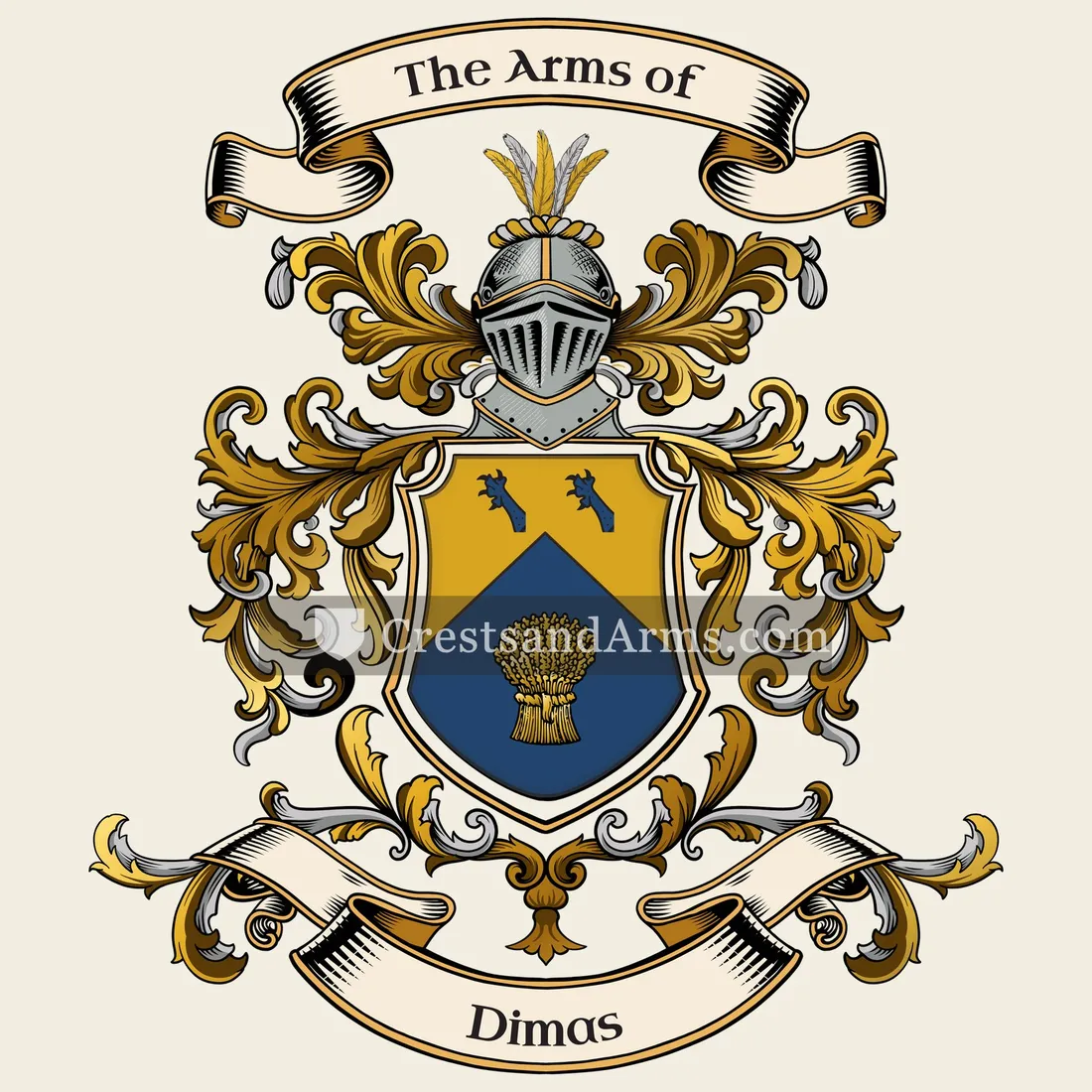
pawStrength held ready, the beast's power in a single limb
wheatsheafPlenty, and the harvest of one's own labour
Colours
Gold (Or)Means: Generosity
Blue (Azure)Means: Loyalty and truth
Historical info
Source
Sir Bernard Burke, The General Armory of England, Scotland, Ireland and Wales, London: Harrison & Sons, 1884
Blazon (the actual original written record)
“Per chev. flory counterflory or and az. in chief two lions' gambs erased and in base a garb counterchanged”
SurreyClapham · Surrey, c. 1620
Digital archive packCoat of arms PNG, gold border print PDF, vector SVG and the certificate of authenticity. Sent to your email in minutes.
Map of England showing where the Dimas arms are recorded
The Dimas arms were recorded in Surrey, c. 1620.
Surrey sat just south of London and filled up with families who had made money in the City. Buying an estate there was the usual next step, and an estate was the usual reason to take arms.
This is where the arms were entered in the register. Families often moved to other parts of the country, so the same name can turn up in more than one region.
The body that granted and recorded arms in England in this period.
James VI and I
Sovereign of the period
James VI and I
1603–1625
Reigning in France when the Dimas arms are first recorded.
How Arms Worked in England
English heraldry allowed arms to be shared by all legitimate descendants of the original owner. These symbols were treated as personal property that moved through the generations to all children. While the eldest son kept the original design, other family members could use the same shield without needing to change it or register their own unique versions.
Granting authority
The College of Arms in London has regulated the use of coats of arms throughout England and Wales since 1484.
How they got arms
Families typically obtained their coats of arms through a formal grant from the Crown or by proving their ancient right to them.
Where arms were recorded
All official coats of arms are recorded in the registers kept at the College of Arms, which date back to the fifteenth century.
The family's standing
Recorded among the armigerous families of Surrey.
Origin & History of the Dimas Family in England
The family name Dimas possesses a quiet but distinct history within the English landscape, with documented roots reaching back to the early seventeenth century. By 1620, records confirm that members of the family were established in the county of Surrey, a region known for its mix of bustling market towns and rural agricultural life. During this period, England was undergoing significant social changes, and families like the Dimas clan often integrated into local parish life through farming, trade, or skilled craftsmanship. Because the name is relatively rare in early English registers, it suggests that the family likely maintained a localized presence, contributing to the development of their specific community over several generations. Their early residence in Surrey places them in a pivotal area near London, which allowed them to witness the shifting political and economic tides of the Stuart era while building a foundation for their descendants.
Dimas Meaning & Related Branches
Root word
Dismas
Derived from the Greek word for sunset or to set.
This name
DimasA French surname associated with the legendary name of the repentant thief crucified alongside Jesus.
also spelled
de Mas
du Mass
de Mass
Du Ma
Mas
Documented Sources
J. B. Rietstap, Armorial Général, Gouda: G. B. van Goor Zonen, 1884–87
Archives nationales de France, Minutier central des notaires de Paris
Archives de Paris, Registres paroissiaux et d'état civil
Boudon, Françoise, Sauval et l'histoire de Paris, 1989
Foisil, Madeleine, Le journal de Jean Héroard: médecin de Louis XIII, 1989
Digital archive packCoat of arms PNG, gold border print PDF, vector SVG and the certificate of authenticity. Sent to your email in minutes.


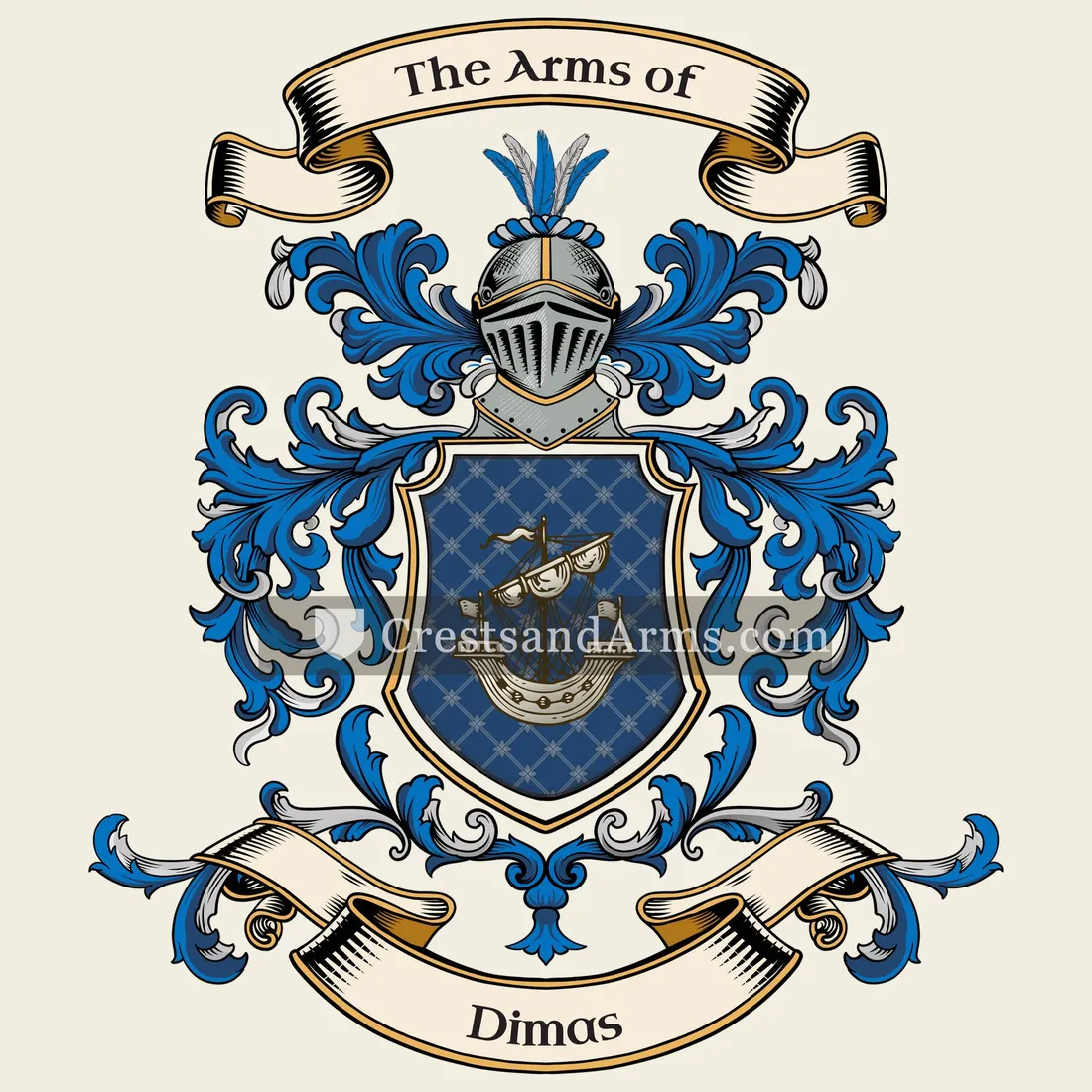
 shipEnterprise, and a great voyage undertaken
 shipEnterprise, and a great voyage undertaken


 mountThe ground held, and steadfastness upon it
 chiefAuthority, wisdom and dominion
 treeLife, endurance and deep roots
 crescentHonour by the sovereign, and the second son
 mulletThe third son, and a divine quality from above


 pawStrength held ready, the beast's power in a single limb
 wheatsheafPlenty, and the harvest of one's own labour