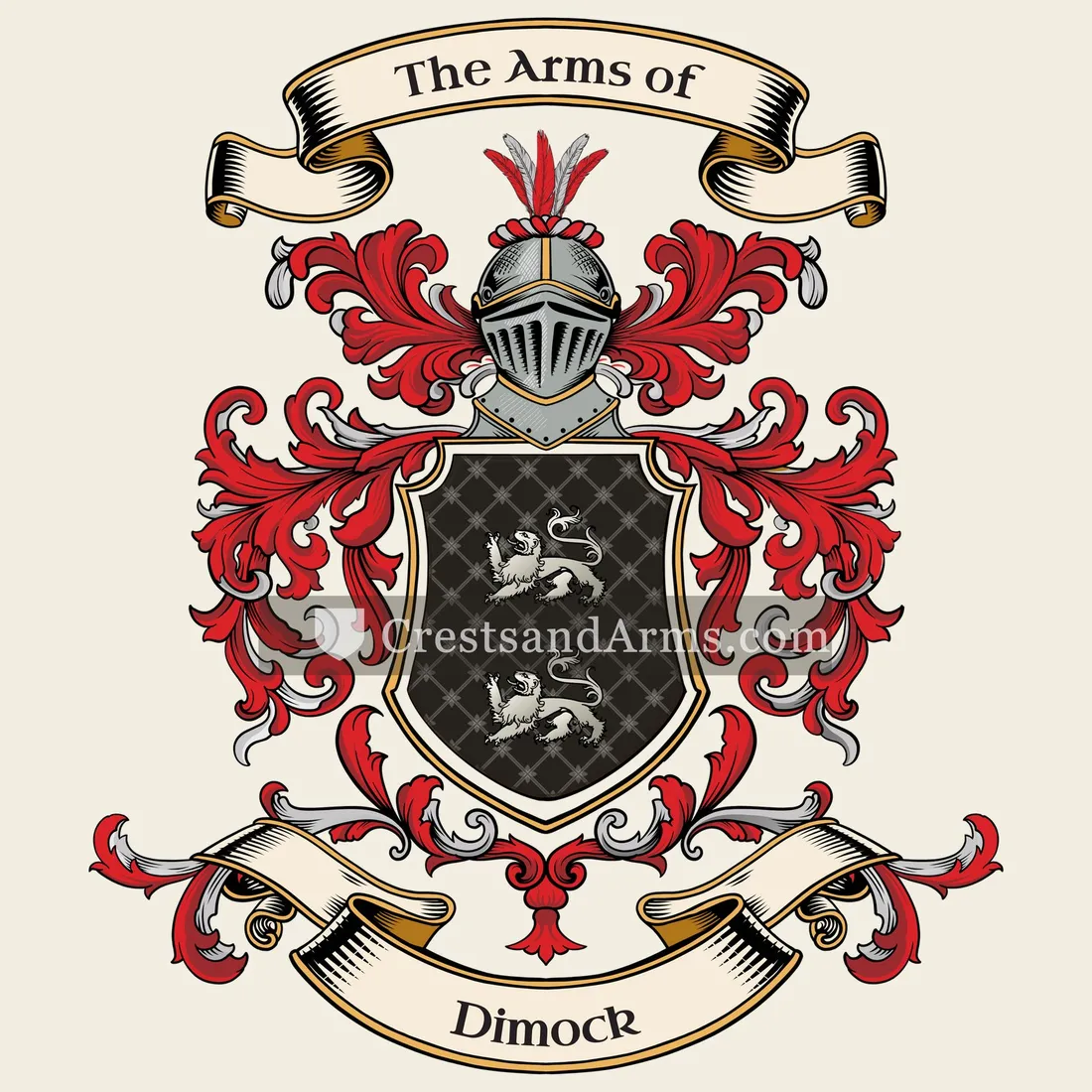
A record of documented arms, meaning and origin, researched for the Dimock family of Britain.
Reg. 1975 · Britain, D–F
Meaning of the Dimock family crest colors & symbols
Symbols on this shield
lionCourage, strength and royalty
Colours
Black (Sable)Means: Constancy
Silver (Argent)Means: Peace and sincerity
Historical info
Source
J. B. Rietstap, Armorial Général, Gouda: G. B. van Goor Zonen, 1884–87
Blazon (the actual original written record)
“De sa. à deux lions léopardés d'arg., cour. d'or, l'un sur l'autre. C.: 1º une épée d'arg., garnie d'or, posée en pal; 2º un lion de l'écu; 3º un rencontre de lièvre, au nat. D.: PRO REGE DIMICO.”
LincolnshireLincolnshire, c. 1700
Digital archive packCoat of arms PNG, gold border print PDF, vector SVG and the certificate of authenticity. Sent to your email in minutes.
Map of Britain showing where the Dimock arms are recorded
The Dimock arms were recorded in Lincolnshire, c. 1700.
This is where the arms were entered in the register. Families often moved to other parts of the country, so the same name can turn up in more than one region.
The body that granted and recorded arms in Britain in this period.
William III of England
Sovereign of the period
William III of England
1694–1702
Reigning in Britain when the Dimock arms are first recorded.
How Arms Worked in Britain
English heraldry allowed arms to be shared by all legitimate descendants of the original owner. These symbols were treated as personal property that moved through the generations to all children. While the eldest son kept the original design, other family members could use the same shield without needing to change it or register their own unique versions.
Granting authority
The College of Arms in London has regulated the use of coats of arms throughout England and Wales since 1484.
How they got arms
Families typically obtained their coats of arms through a formal grant from the Crown or by proving their ancient right to them.
Where arms were recorded
All official coats of arms are recorded in the registers kept at the College of Arms, which date back to the fifteenth century.
The family's standing
Recorded among the armigerous families of Lincolnshire.
Origin & History of the Dimock Family in Britain
The surname Dimock is a locational name that originated in England, specifically tied to the village of Dymock in Gloucestershire. During the medieval period, people often took the name of their home village as a way to identify themselves when they moved to new areas. By the year 1700, the family had established a notable presence in Lincolnshire, where they lived as part of the local community. The name itself is thought to come from ancient Welsh roots, likely meaning a place where pigs are kept or a clearing in the woods. Over several centuries, the spelling shifted from Dymock to Dimock as families settled in different regions and adapted to local writing styles. This transition reflects the broader history of English surnames, which often changed based on how they were spoken and recorded by local clerks.
Dimock Meaning & Related Branches
Root word
Dymoch
A Welsh place name derived from the word for a ridge.
This name
DimockA habitational surname referring to someone who originated from the town of Dymock in Gloucestershire.
also spelled
Dimock
Dymock
Dymoke
Dimoke de Scrivelsby
Documented Sources
J. B. Rietstap, Armorial Général, Gouda: G. B. van Goor Zonen, 1884–87
Reaney, P.H. and Wilson, R.M., A Dictionary of English Surnames, 1997
Mills, A.D., A Dictionary of British Place-Names, 2011
Lincolnshire Archives, Bishop’s Transcripts of Parish Registers, 1700
Digital archive packCoat of arms PNG, gold border print PDF, vector SVG and the certificate of authenticity. Sent to your email in minutes.


 lionCourage, strength and royalty
 lionCourage, strength and royalty