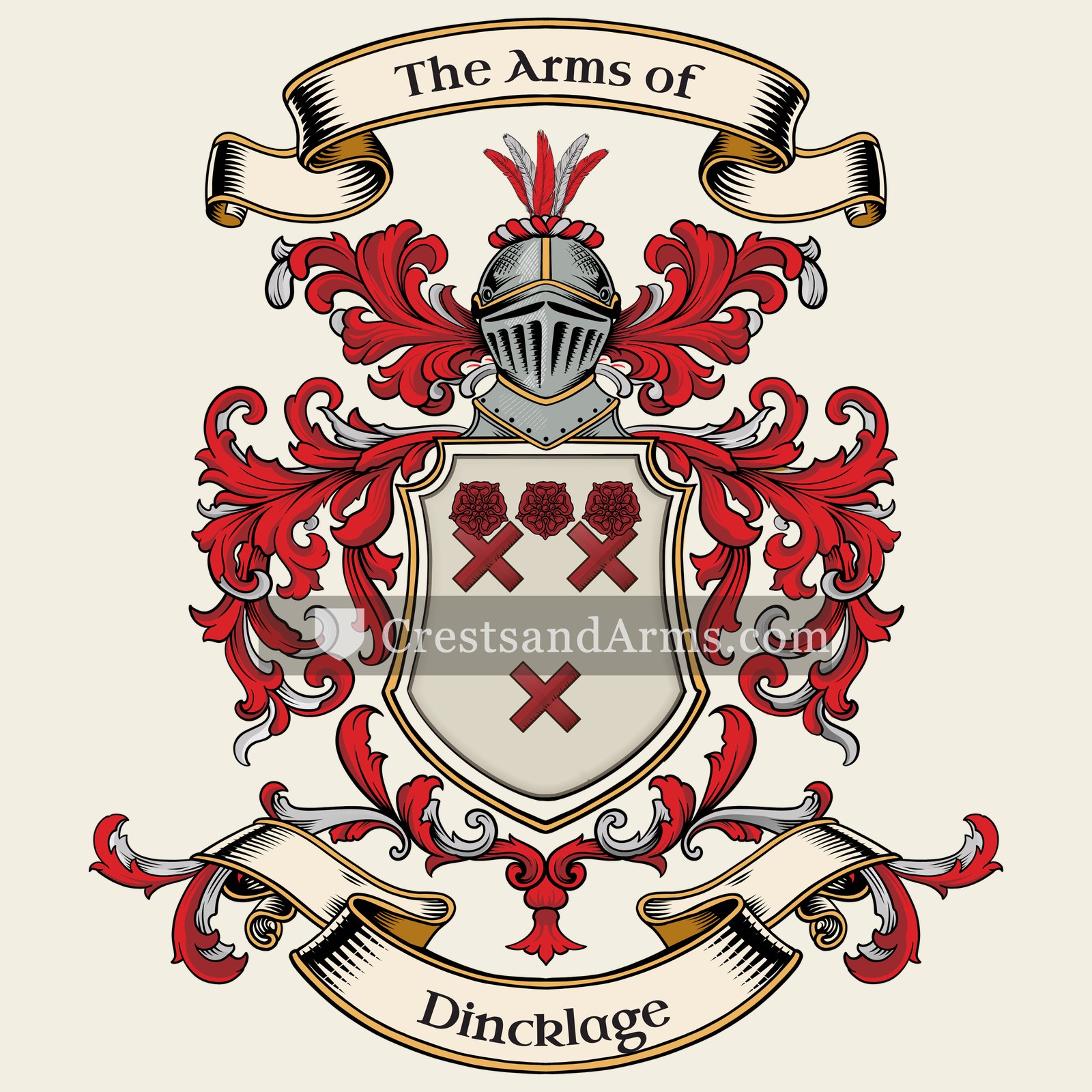
A record of documented arms, meaning and origin, researched for the Dincklage family of Germany.
Reg. 4546 · German, D–F
Coat of Arms & Family Crest Details
Symbols on this shield
saltire coupedResolution, and the cross of St Andrew
roseThe seventh son, and beauty with grace
Colours
Silver (Argent)Means: Peace and sincerity
Red (Gules)Means: Military strength
Historical info
Source
J. B. Rietstap, Armorial Général, Gouda: G. B. van Goor Zonen, 1884–87
Blazon (the actual original written record)
“D'arg. à trois flanchis de gu., 2 et 1, acc. de trois roses du même, rangées en chef. C.: un rang de trois roses de gu. et de trois flanchis du même, posés alt.; et trois drapeaux d'arg., ch. chacun d'une rose de gu. accostée d'un flanchis du même. S.: deux lions d'or.”
GermanyHan, c. 1844
Digital archive packCoat of arms PNG, gold border print PDF, vector SVG and the certificate of authenticity. Sent to your email in minutes.
Map of Germany showing where the Dincklage arms are recorded
The Dincklage arms were recorded in Han, c. 1844.
This is where the arms were entered in the register. Families often moved to other parts of the country, so the same name can turn up in more than one region.
The body that granted and recorded arms in Germany in this period.
Frederick William IV of Prussia
Sovereign of the period
Frederick William IV of Prussia
1840–1861
Reigning in Germany when the Dincklage arms are first recorded.
How Arms Worked in Germany
Prussian heraldry was strictly tied to social rank and noble status rather than being a free choice for every citizen. These symbols were treated as permanent family property that moved through the generations to all legitimate heirs. If a family branch wanted to change their design to stand out, they had to apply for official permission to alter their specific version of the shield.
Granting authority
The Prussian Heroldsamt acted as the central state office that managed and strictly controlled all noble titles and coats of arms.
How they got arms
Families usually obtained their arms through formal royal grants or by proving their long-standing noble status to the state authorities.
Where arms were recorded
All official coats of arms were kept in the rolls of the Prussian Heroldsamt, which functioned from 1706 until 1918.
The family's standing
Recorded among the armigerous families of Germany.
Origin & History of the Dincklage Family in Germany
The family name Dincklage originates from the town of the same name located in the Oldenburg region of Lower Saxony, Germany. In medieval times, it was common for families to adopt the name of their home village or estate to establish their identity and social standing. By the mid-19th century, members of the family had established a presence in the town of Han, where they integrated into the local community and participated in the regional economy. This migration reflects the broader patterns of movement during the 1800s as families sought new opportunities while maintaining ties to their ancestral roots. The name itself serves as a lasting connection to the geography of northern Germany, marking the family as part of the long history of the region.
Dincklage Meaning & Related Branches
Root word
Dinglage
A settlement or clearing associated with a local judicial assembly site.
This name
DincklageRefers to a person originating from the town of Dinklage in Lower Saxony.
also spelled
Dincklag
Dincklagee
Dyncklage
Dinklage
Documented Sources
J. B. Rietstap, Armorial Général, Gouda: G. B. van Goor Zonen, 1884–87
Grotefend, Hermann. Zeitrechnung des deutschen Mittelalters und der Neuzeit. 1891
Schiller, Karl. Die Geschichte der Stadt und des Amtes Vechta. 1888
Digital archive packCoat of arms PNG, gold border print PDF, vector SVG and the certificate of authenticity. Sent to your email in minutes.


 saltire coupedResolution, and the cross of St Andrew
 roseThe seventh son, and beauty with grace
 saltire coupedResolution, and the cross of St Andrew
 roseThe seventh son, and beauty with grace