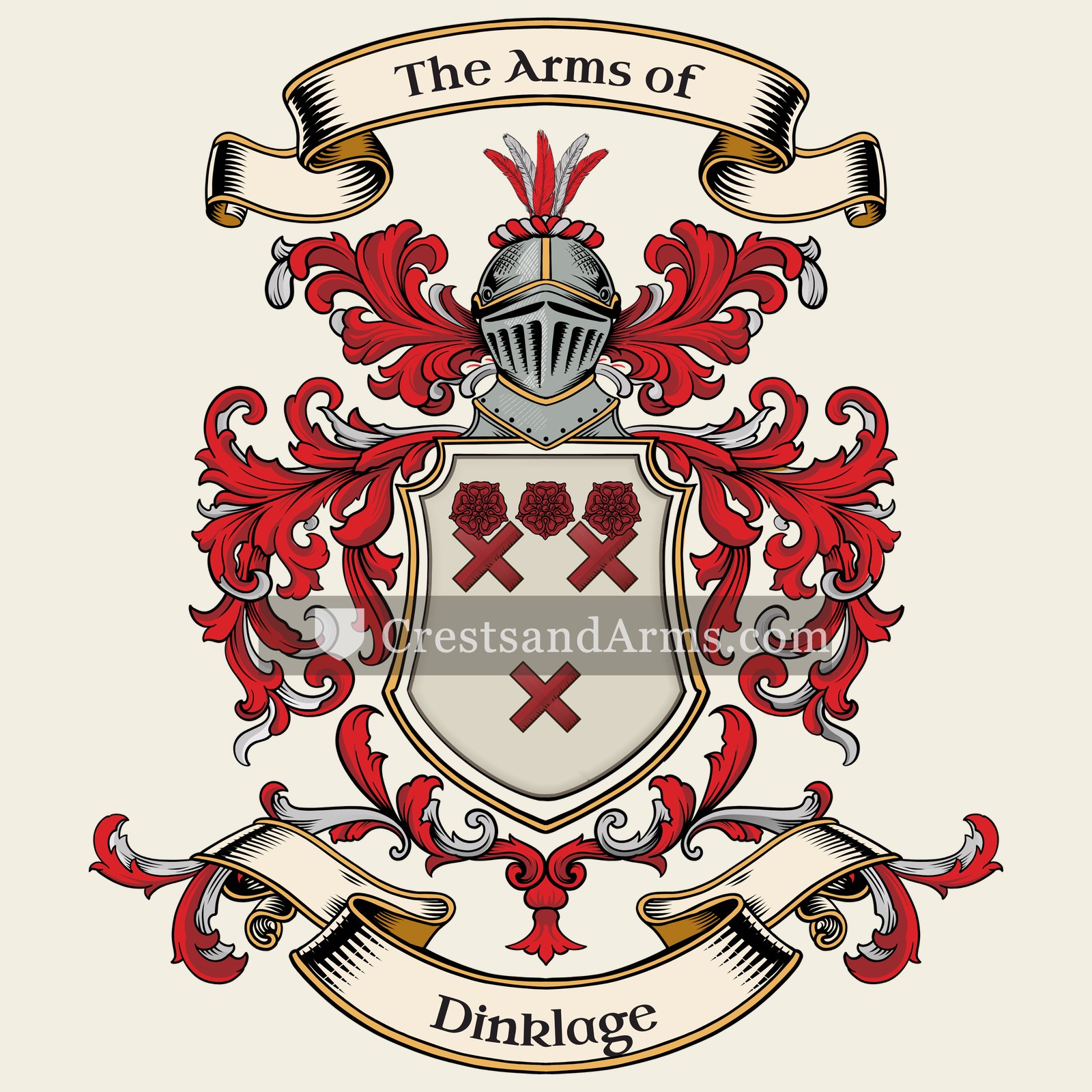
A record of documented arms, meaning and origin, researched for the Dinklage family of Germany.
Reg. 3994 · German, D–F
Coat of Arms & Family Crest Details
Symbols on this shield
saltireResolution, and St Andrew's cross
saltire coupedResolution, and the cross of St Andrew
roseThe seventh son, and beauty with grace
Colours
Silver (Argent)Means: Peace and sincerity
Red (Gules)Means: Military strength
Historical info
Source
J. B. Rietstap, Armorial Général, Gouda: G. B. van Goor Zonen, 1884–87
Blazon (the actual original written record)
“D'arg. à trois flanchis de gu., 2 et 1, acc. de trois roses du même, rangées en chef. C.: un rang de trois roses de gu. et de trois flanchis du même, posés alt.; et trois drapeaux d'arg., ch. chacun d'une rose de gu. accostée d'un flanchis du même. S.: deux lions d'or.”
GermanyHan, c. 1844
Digital archive packCoat of arms PNG, gold border print PDF, vector SVG and the certificate of authenticity. Sent to your email in minutes.
Map of Germany showing where the Dinklage arms are recorded
The Dinklage arms were recorded in Han, c. 1844.
This is where the arms were entered in the register. Families often moved to other parts of the country, so the same name can turn up in more than one region.
The body that granted and recorded arms in Germany in this period.
Frederick William IV of Prussia
Sovereign of the period
Frederick William IV of Prussia
1840–1861
Reigning in Germany when the Dinklage arms are first recorded.
How Arms Worked in Germany
Prussian heraldry was strictly tied to social rank and noble status rather than being a free choice for every citizen. These symbols were treated as permanent family property that moved through the generations to all legitimate heirs. If a family branch wanted to change their design to stand out, they had to apply for official permission to alter their specific version of the shield.
Granting authority
The Prussian Heroldsamt acted as the central state office that managed and strictly controlled all noble titles and coats of arms.
How they got arms
Families usually obtained their arms through formal royal grants or by proving their long-standing noble status to the state authorities.
Where arms were recorded
All official coats of arms were kept in the rolls of the Prussian Heroldsamt, which functioned from 1706 until 1918.
The family's standing
Recorded among the armigerous families of Germany.
Origin & History of the Dinklage Family in Germany
The surname Dinklage originates from a town of the same name located in the Lower Saxony region of Germany. Historically, the name is classified as a topographic or locative surname, meaning it was used to identify individuals based on the place where they lived or held land. By the mid-19th century, the family had established a notable presence in the area of Han, which was part of the broader administrative landscape of the Kingdom of Hanover. During this period, families in this region were often deeply connected to the local agricultural and civic life of their specific parishes. The movement of family members within these German territories was typically tied to local trade, land ownership, or the shifting borders of the various German states before the unification of the country. These early records from 1844 provide a glimpse into a time when the family was firmly rooted in the social and economic structures of their home province.
Related Branches & Arms
Root word
Ding
A Germanic term referring to a judicial assembly or court.
This name
DinklageA topographic name for someone living near a place where a public assembly was held.
also spelled
Dincklag
Dincklagee
Dyncklage
Dinklage
Documented Sources
J. B. Rietstap, Armorial Général, Gouda: G. B. van Goor Zonen, 1884–87
Gudde, Erwin G., German Place Names in the United States, 1980
Bahlow, Hans, Deutsches Namenlexikon: Familien- und Vornamen nach Ursprung und Sinn erklärt, 1967
Niedersächsisches Landesarchiv (Oldenburg), Bestand 261-10: Kirchenbücher der evangelisch-lutherischen Kirchengemeinden
Digital archive packCoat of arms PNG, gold border print PDF, vector SVG and the certificate of authenticity. Sent to your email in minutes.


 saltireResolution, and St Andrew's cross
 saltire coupedResolution, and the cross of St Andrew
 roseThe seventh son, and beauty with grace
 saltireResolution, and St Andrew's cross
 saltire coupedResolution, and the cross of St Andrew
 roseThe seventh son, and beauty with grace