A record of documented arms, meaning and origin, researched for the Ditmar family lines. Documented in 2 countries.
Reg. 4614 · French, D–F
Coat of Arms & Family Crest Details
Symbols on this shield
fleur de lisPurity, light, and the sixth son
Colours
Blue (Azure)Means: Loyalty and truth
Gold (Or)Means: Generosity
Historical info
Source
J. B. Rietstap, Armorial Général, Gouda: G. B. van Goor Zonen, 1884–87
Blazon (the actual original written record)
“d'azur, à deux demi-fleurs-de-lis d'or, mouv. du champ. Cq. cour. C.: un lion iss. d'azur; entre un vol, coupé alt. d'arg et d'azur. L.: à dextre d'or et d'azur, à sen. d'arg. et d'azur.”
Francec. 1663
Digital archive packCoat of arms PNG, gold border print PDF, vector SVG and the certificate of authenticity. Sent to your email in minutes.
Map of France showing where the Ditmar arms are recorded
The Ditmar arms were recorded in France, c. 1663.
Arms such as these were typically recorded in Bretagne.
More families held coats of arms in Bretagne than anywhere else in France. The land was divided into many small estates rather than a few large ones, so far more households counted as gentry, and each needed a shield of its own to be told apart.
This is where the arms were entered in the register. Families often moved to other parts of the country, so the same name can turn up in more than one region.
The body that granted and recorded arms in France in this period.
Louis XIV of France
Sovereign of the period
Louis XIV of France
1643–1715
Reigning in France when the Ditmar arms are first recorded.
How Arms Worked in France
In France, a coat of arms was a mark of honor that passed down through the male line to all legitimate descendants. Families often used the same shield without changes to show their shared heritage. If a branch wanted to stand out, they could add a small mark to their shield to show their specific place in the family tree.
Granting authority
The Juge d'armes de France acted as the official authority that regulated and verified coats of arms across the country.
How they got arms
Families typically inherited their arms from ancestors, though they could also receive them through royal grants or by proving their noble status.
Where arms were recorded
Coats of arms were officially recorded in the Armorial Général de France, which began its main collection in the year 1696.
The family's standing
Recorded among the armigerous families of France.
Origin & History of the Ditmar Family in France
The name Ditmar carries a rich history that traces back to Germanic roots before establishing a notable presence in France. By the year 1663, records confirm that members of the family were settled in the region of Bretagne. During this period, families in this coastal area were often involved in local trade, maritime activities, or the administration of rural estates. As the family integrated into French society, the spelling of the name occasionally shifted to reflect the phonetic patterns of the local Breton and French dialects. These early generations played a part in the social fabric of northwestern France, living through a time of significant cultural and political transition under the reign of Louis XIV. Their presence in Bretagne suggests they were part of a mobile population that moved across borders to find new opportunities in the seventeenth century.
Coat of Arms & Family Crest Details
Symbols on this shield
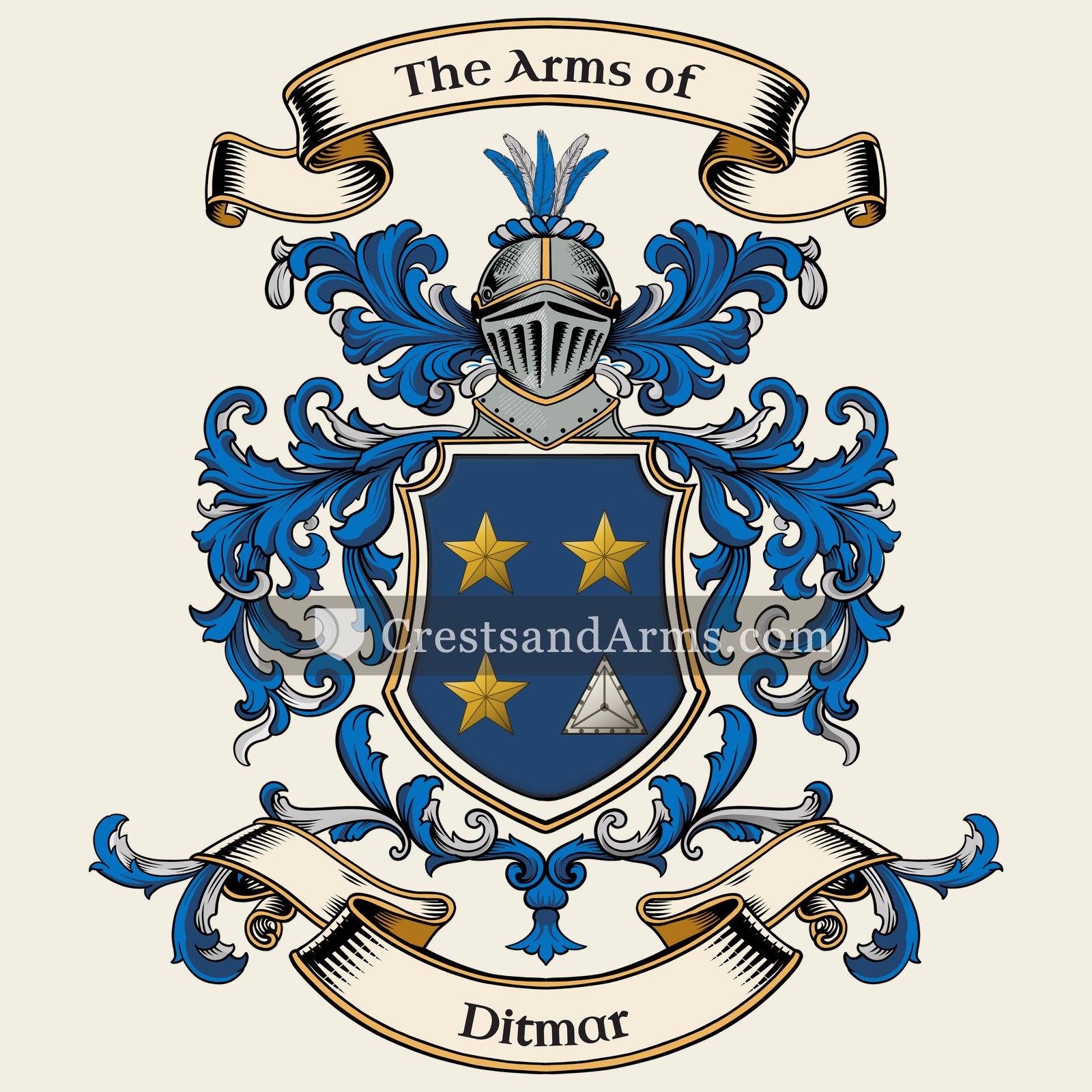
mulletThe third son, and a divine quality from above
triangleThe Trinity, and stability
Colours
Blue (Azure)Means: Loyalty and truth
Gold (Or)Means: Generosity
Silver (Argent)Means: Peace and sincerity
Historical info
Source
J. B. Rietstap, Armorial Général, Gouda: G. B. van Goor Zonen, 1884–87
Blazon (the actual original written record)
“D'azur au triangle vidé d'arg., chaque angle ch. d'une étoile d'or. C.: le triangle. L. d'arg. et d'azur.”
LivoniaEsthonie · Livonia, c. 1772
Digital archive packCoat of arms PNG, gold border print PDF, vector SVG and the certificate of authenticity. Sent to your email in minutes.
Map of Poland showing where the Ditmar arms are recorded
The Ditmar arms were recorded in Livonia, c. 1772.
Livonia was Baltic country held by a small number of landed families who kept their estates for centuries. Land there passed down whole rather than being divided, and long unbroken tenure is what fills a register.
This is where the arms were entered in the register. Families often moved to other parts of the country, so the same name can turn up in more than one region.
Region
Livonia
Town
Esthonie
First recorded
1772
Granting Authority for the Ditmar Arms
Ennoblement by the Sejm
Author: Olek Remesz · CC BY-SA 3.0
The body that granted and recorded arms in Poland in this period.
Stanisław August Poniatowski
Sovereign of the period
Stanisław August Poniatowski
1764–1795
Reigning in France when the Ditmar arms are first recorded.
How Arms Worked in Poland
Polish noble families shared a single coat of arms across many different surnames, creating large clans rather than individual designs. These symbols were held collectively by all members of the clan regardless of their specific family name. When a new family joined the nobility, they were adopted into an existing clan and began using that group's established shield.
Granting authority
The Sejm, which was the Polish parliament, held the power to grant noble status and the right to bear arms.
How they got arms
Families typically received their coat of arms through a formal act of ennoblement granted by the Sejm for distinguished service.
Where arms were recorded
These grants were officially recorded in the Crown Metrica, which served as the central archive for state documents starting in the sixteenth century.
The family's standing
Recorded among the armigerous families of Livonia.
Origin & History of the Ditmar Family in Poland
The family name Ditmar has deep roots in the Baltic region, where its members were well-established long before the late eighteenth century. By 1772, the family was documented as part of the influential landowning class in Livonia, a historical territory that spanned parts of modern-day Estonia and Latvia. During this era, the region was heavily influenced by the cultural and political shifts occurring within the Polish-Lithuanian Commonwealth. As trade routes expanded and borders fluctuated, individuals bearing the Ditmar name moved through these territories, often serving in administrative or military roles that connected them to the broader Polish sphere of influence. Their presence in Livonia reflects a time when families of German and Baltic origin integrated into the social fabric of the eastern Baltic lands, navigating the complex political landscape of an area caught between the interests of neighboring empires.
Ditmar Meaning & Related Branches
Root word
Dietmar
Derived from Germanic elements meaning people and famous or great.
This name
DitmarA name signifying a person who is famous among their people.
also spelled
Ditmarr
Ditmarre
Documented Sources
J. B. Rietstap, Armorial Général, Gouda: G. B. van Goor Zonen, 1884–87
Archives départementales d'Ille-et-Vilaine, Registres paroissiaux et d'état civil, 1663
Morvan, Françoise, Les Bretons, 2005
Pottier, Bernard, Histoire de la Bretagne, 1998
Digital archive packCoat of arms PNG, gold border print PDF, vector SVG and the certificate of authenticity. Sent to your email in minutes.


 fleur de lisPurity, light, and the sixth son
 fleur de lisPurity, light, and the sixth son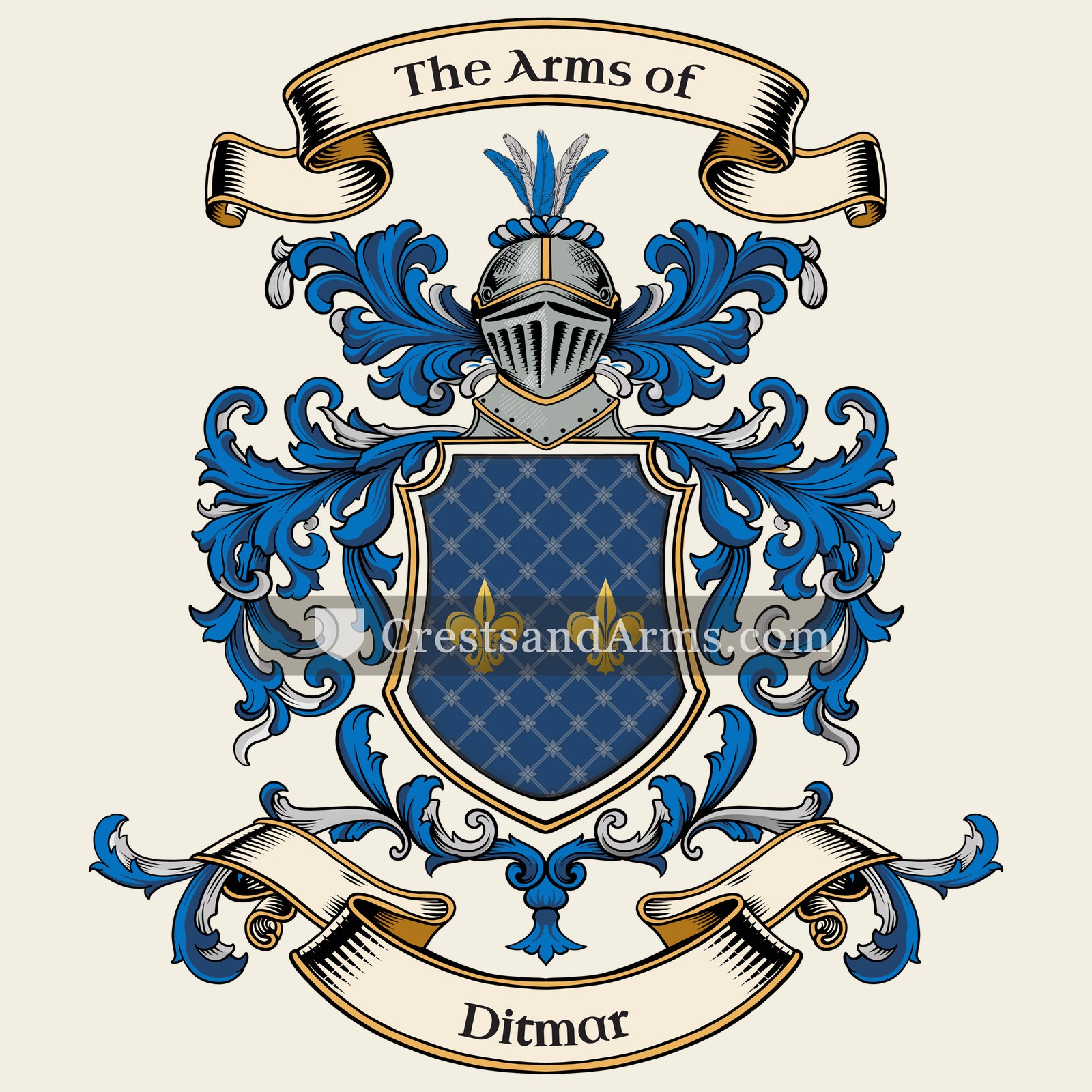


 mulletThe third son, and a divine quality from above
 triangleThe Trinity, and stability