Map of England showing where the Dixie arms are recorded
The Dixie arms were recorded in Huntingdon, c. 1620.
Huntingdonshire was small, flat fen-edge country. Drainage made new farmland and new fortunes, and families who gained by it bought manors and took arms to match.
This is where the arms were entered in the register. Families often moved to other parts of the country, so the same name can turn up in more than one region.
The body that granted and recorded arms in England in this period.
James VI and I
Sovereign of the period
James VI and I
1603–1625
Reigning in England when the Dixie arms are first recorded.
How Arms Worked in England
English heraldry allowed arms to be shared by all legitimate descendants of the original owner. These symbols were treated as personal property that moved through the generations to all children. While the eldest son kept the original design, other family members could use the same shield without needing to change it or register their own unique versions.
Granting authority
The College of Arms in London has regulated the use of coats of arms throughout England and Wales since 1484.
How they got arms
Families typically obtained their coats of arms through a formal grant from the Crown or by proving their ancient right to them.
Where arms were recorded
All official coats of arms are recorded in the registers kept at the College of Arms, which date back to the fifteenth century.
The family's standing
Recorded among the armigerous families of Huntingdon.
Origin & History of the Dixie Family in England
The family name Dixie has deep roots in the English county of Huntingdon, where records confirm the family was well-established by the year 1620. The name is believed to be a patronymic, which means it likely originated as a way to identify a person as the son of someone named Dick or Richard. During the seventeenth century, families in this region were often involved in local agriculture and trade, which helped them build a stable presence in the community. As the family grew, they became integrated into the social and administrative life of the area, serving in local roles that required literacy and land ownership. This early history reflects the typical development of English surnames during a time when families began to solidify their identities within specific towns and parishes.
Dixie Meaning & Related Branches
Root word
Dick
A diminutive form of the Germanic name Richard meaning brave ruler.
This name
DixieA patronymic surname meaning son of Dick or son of Richard.
also spelled
Dixy
Dyxie
Dyxy
Related arms
Dixyvariant spelling
Lovelrecorded with Dixie, same area
Mortonrecorded with Dixie, same area
Palmerrecorded with Dixie, same area
Documented Sources
Sir Bernard Burke, The General Armory of England, Scotland, Ireland and Wales, London: Harrison & Sons, 1884


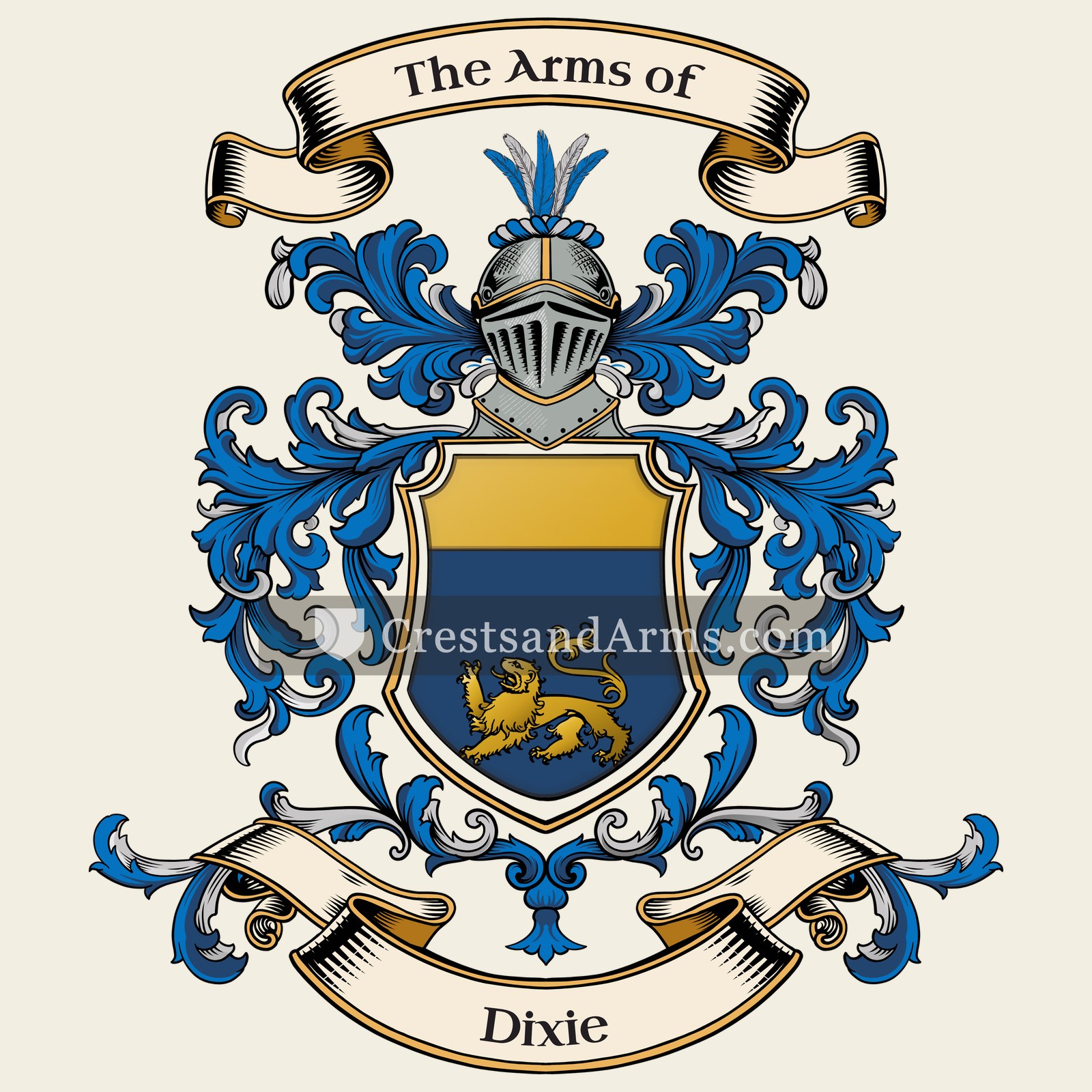
 chiefAuthority, wisdom and dominion
 lionCourage, strength and royalty
 chiefAuthority, wisdom and dominion
 lionCourage, strength and royalty