Map of England showing where the Dizon arms are recorded
The Dizon arms were recorded in Chester, c. 1620.
Cheshire was governed apart from the rest of England for much of its history, with its own courts and its own gentry. That separateness bred a strong local landed class, and landed families carried arms.
This is where the arms were entered in the register. Families often moved to other parts of the country, so the same name can turn up in more than one region.
The body that granted and recorded arms in England in this period.
James VI and I
Sovereign of the period
James VI and I
1603–1625
Reigning in England when the Dizon arms are first recorded.
How Arms Worked in England
English heraldry allowed arms to be shared by all legitimate descendants of the original owner. These symbols were treated as personal property that moved through the generations to all children. While the eldest son kept the original design, other family members could use the same shield without needing to change it or register their own unique versions.
Granting authority
The College of Arms in London has regulated the use of coats of arms throughout England and Wales since 1484.
How they got arms
Families typically obtained their coats of arms through a formal grant from the Crown or by proving their ancient right to them.
Where arms were recorded
All official coats of arms are recorded in the registers kept at the College of Arms, which date back to the fifteenth century.
The family's standing
Recorded among the armigerous families of Chester.
Origin & History of the Dizon Family in England
The history of the Dizon name in England is deeply rooted in the city of Chester, where records confirm the family’s presence as early as 1620. During the seventeenth century, Chester served as a bustling hub for trade and regional administration, placing the Dizon family within a significant urban center during a time of great social change. Families living in Chester at this time often participated in the local merchant guilds or contributed to the city’s role as a gateway for travel to Ireland and Wales. While the name may have evolved in spelling over time, its early appearance in local parish registers suggests that the Dizons were established members of the community who navigated the daily life of a historic English walled city. Their presence in these early documents provides a clear link to the demographic landscape of Northwest England long before the name spread to other regions.
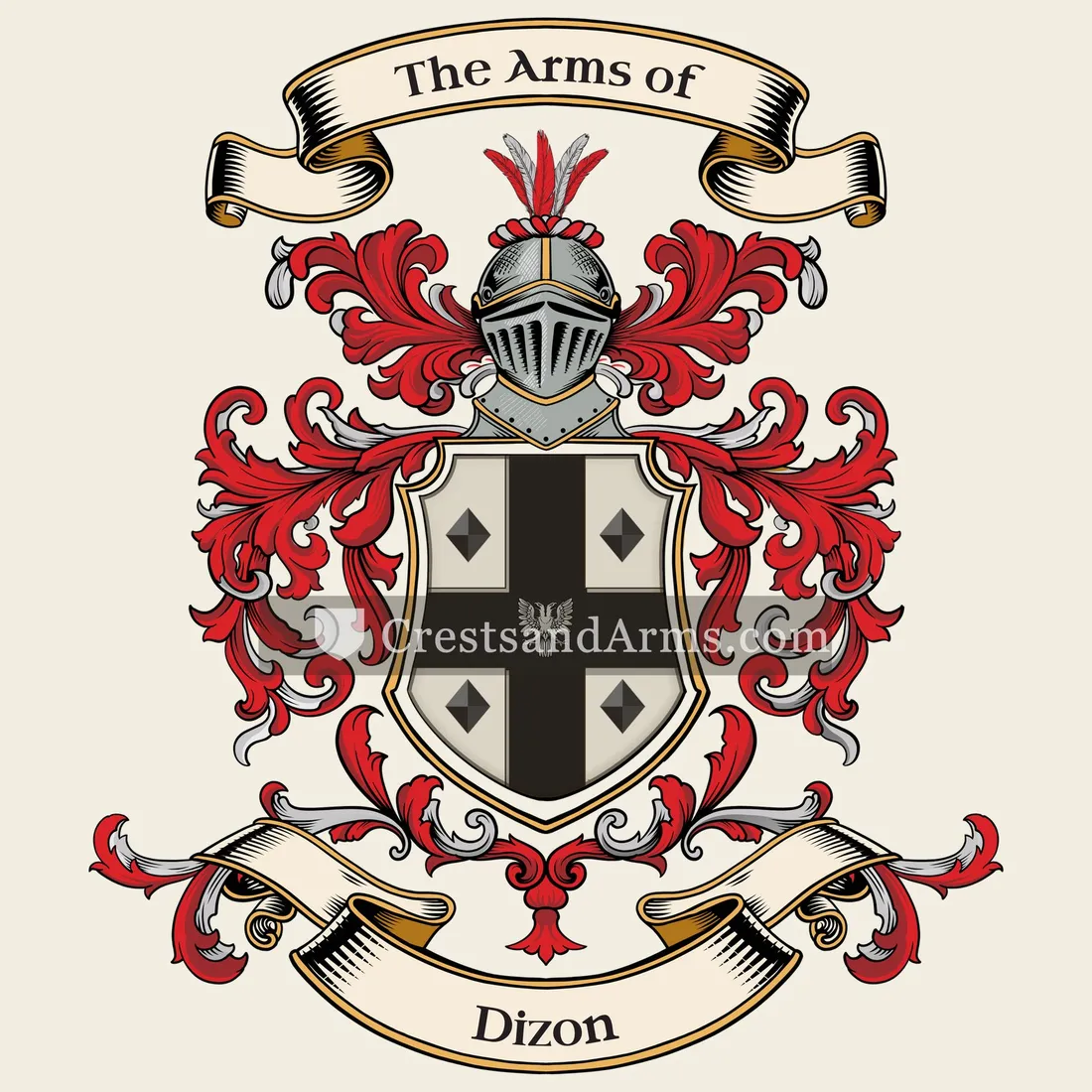
Meaning of the Dizon family crest colors & symbols
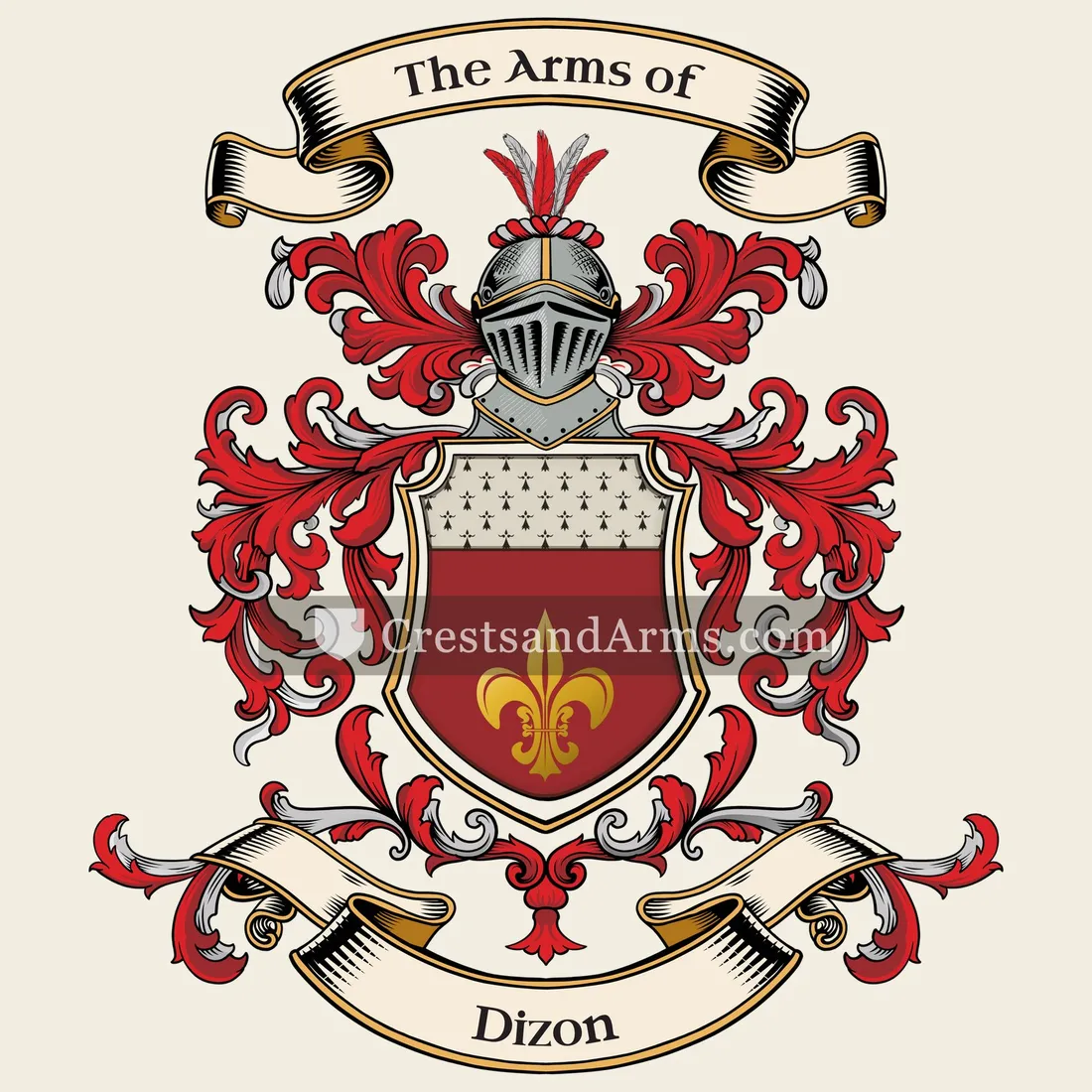
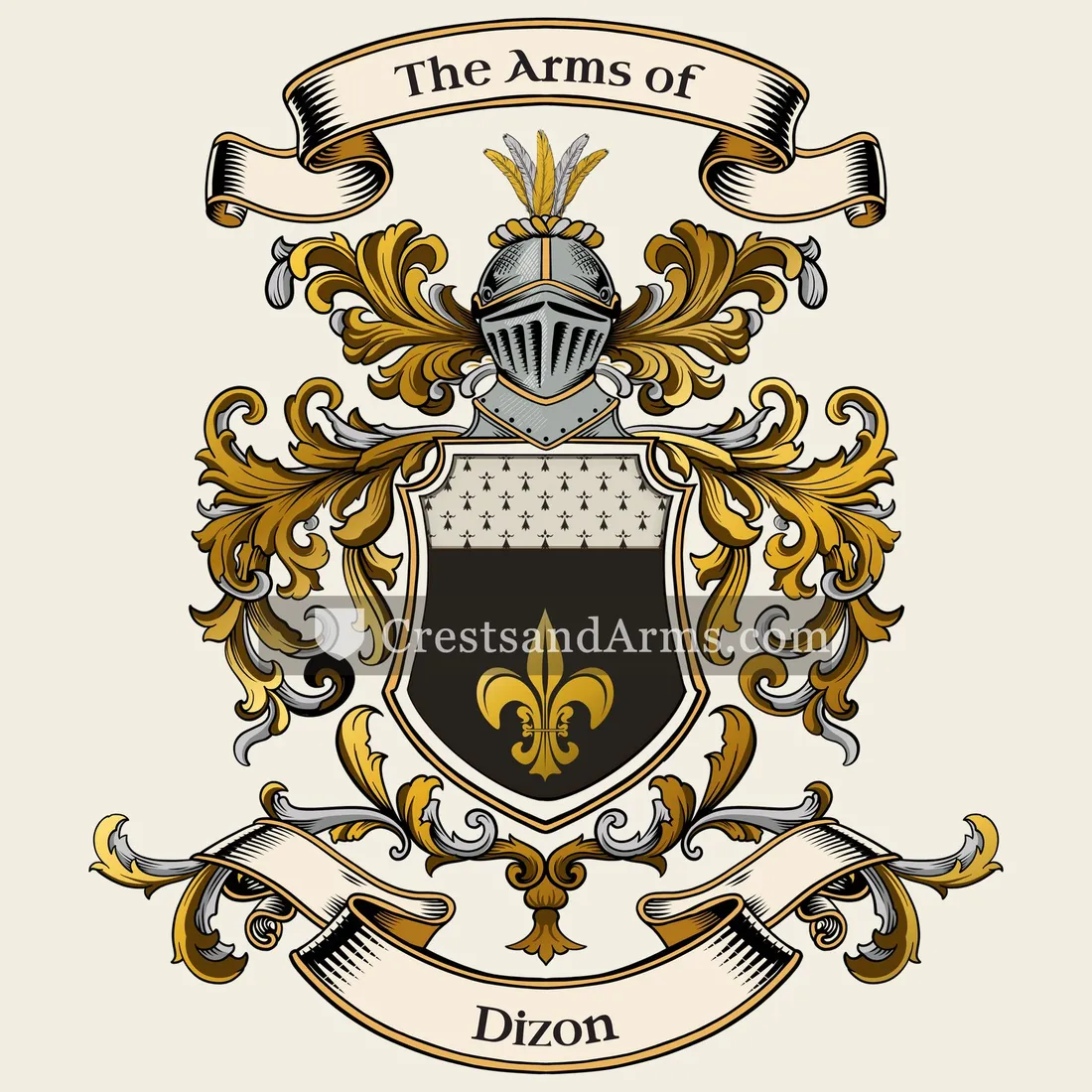
Symbols on this shield
chiefAuthority, wisdom and dominion
fleur de lisPurity, light, and the sixth son
Colours
Black (Sable)Means: Constancy
ErmineMeans: Dignity
Gold (Or)Means: Generosity
Historical info
Source
Sir Bernard Burke, The General Armory of England, Scotland, Ireland and Wales, London: Harrison & Sons, 1884
Blazon (the actual original written record)
“Sa. a fleur-de-lis or, a chief erm”
DublinDublin, c. 1634
Digital archive packCoat of arms PNG, gold border print PDF, vector SVG and the certificate of authenticity. Sent to your email in minutes.
Map of Ireland showing where the Dizon arms are recorded
The Dizon arms were recorded in Dublin, c. 1634.
Dublin was the seat of government in Ireland and the place where grants were sought and recorded. Families with business at the castle or the courts settled nearby, and settling there put their arms on record.
This is where the arms were entered in the register. Families often moved to other parts of the country, so the same name can turn up in more than one region.
The body that granted and recorded arms in Ireland in this period.
Charles I of England
Sovereign of the period
Charles I of England
1625–1649
Reigning in England when the Dizon arms are first recorded.
How Arms Worked in Ireland
The Ulster King of Arms granted coats of arms to individuals who proved their social standing and good character. These symbols were typically inherited by all legitimate descendants of the original holder. If a family branch wanted a unique look, they could apply for a specific change to their design through the office to ensure their identity remained distinct.
Granting authority
The Ulster King of Arms acted as the official body that regulated and issued all coats of arms throughout Ireland.
How they got arms
Families obtained their arms through formal grants issued by the office after proving their eligibility and paying the required fees.
Where arms were recorded
All official grants were recorded in the registers held by the Ulster King of Arms starting from the year 1552.
The family's standing
Recorded among the armigerous families of Dublin.
Origin & History of the Dizon Family in Ireland
The history of the Dizon name in Ireland begins with records of the family living in Dublin as early as 1634. During the seventeenth century, Dublin was a bustling center of trade and administration, attracting people from various backgrounds who sought new opportunities in the capital city. The presence of the Dizon family at this time suggests they were part of the growing urban population that helped shape the social and economic life of the city. While the name is often associated with other regions of the world today, its early appearance in Irish legal and parish documents highlights the diverse roots of families living in Dublin during the early modern period. These early settlers likely worked in the trades or local government, contributing to the development of a city that was rapidly expanding its influence across the island. By establishing themselves in Dublin during this era, the Dizon family became a small but notable part of the city's long and complex history.
Meaning of the Dizon family crest colors & symbols
Symbols on this shield
cross symbolChristian faith and service
lozengeHonour and nobility, and the arms of a woman
eagleNobility, strength and a keen mind
Colours
Silver (Argent)Means: Peace and sincerity
Black (Sable)Means: Constancy
Historical info
Source
Sir Bernard Burke, The General Armory of England, Scotland, Ireland and Wales, London: Harrison & Sons, 1884
Blazon (the actual original written record)
“Ar. on a cross betw. four lozenges sa. an eagle displ. of the field”
LanarkGovanhill · Lanark, c. 1748
Digital archive packCoat of arms PNG, gold border print PDF, vector SVG and the certificate of authenticity. Sent to your email in minutes.
Map of Scotland showing where the Dizon arms are recorded
The Dizon arms were recorded in Lanark, c. 1748.
Lanarkshire ran along the upper Clyde, farming country with coal beneath it. Its landed families were long-established, and long establishment is what brought them into the register.
This is where the arms were entered in the register. Families often moved to other parts of the country, so the same name can turn up in more than one region.
The body that granted and recorded arms in Scotland in this period.
George II of Great Britain
Sovereign of the period
George II of Great Britain
1727–1760
Reigning in England when the Dizon arms are first recorded.
How Arms Worked in Scotland
Scottish heraldry is unique because it treats a coat of arms as a piece of personal property protected by law. Only one person can own a specific design at any given time. When a family grows, the head keeps the original shield while other relatives must apply for their own distinct version with slight changes to prove their specific identity.
Granting authority
The Court of the Lord Lyon acts as the official body that regulates and controls all heraldic matters throughout Scotland.
How they got arms
Individuals obtain a legal right to their arms through a formal petition process that confirms their identity and family connection.
Where arms were recorded
All valid coats of arms are officially entered into the Public Register of All Arms and Bearings starting from 1672.
The family's standing
Recorded among the armigerous families of Lanark.
Origin & History of the Dizon Family in Scotland
The history of the Dizon family in Scotland is anchored by documented evidence of their presence in the royal burgh of Lanark by 1748. During this period, Lanark was a bustling center for trade and agriculture, providing a stable environment for families to establish deep roots. While the name Dizon is often associated with diverse origins, its appearance in the Scottish Lowlands suggests that these early members were likely integrated into the local merchant or artisan classes that defined the town’s economy. Life in mid-eighteenth-century Lanark was shaped by the influence of the nearby River Clyde and the town’s role as a regional administrative hub. By settling in this area, the Dizon family became part of a community that was transitioning through the early stages of the Industrial Revolution. Their presence in the official records of the time highlights a family that was active in the social and economic fabric of the Scottish countryside during a transformative era.
Dizon Meaning & Related Branches
Root word
Dionysius
Derived from the Greek god of wine and fertility.
This name
DizonA patronymic surname meaning son of Dion or son of Dennis.
also spelled
Dickson
Dyxon
Dyckson
Documented Sources
Sir Bernard Burke, The General Armory of England, Scotland, Ireland and Wales, London: Harrison & Sons, 1884
Cheshire Archives and Local Studies, Bishop's Transcripts of Chester St. Oswald, 1620
Cheshire Archives and Local Studies, Parish Register of St. Oswald, Chester, 1620
Digital archive packCoat of arms PNG, gold border print PDF, vector SVG and the certificate of authenticity. Sent to your email in minutes.


 chiefAuthority, wisdom and dominion
 fleur de lisPurity, light, and the sixth son
 chiefAuthority, wisdom and dominion
 fleur de lisPurity, light, and the sixth son




 cross symbolChristian faith and service
 lozengeHonour and nobility, and the arms of a woman
 eagleNobility, strength and a keen mind