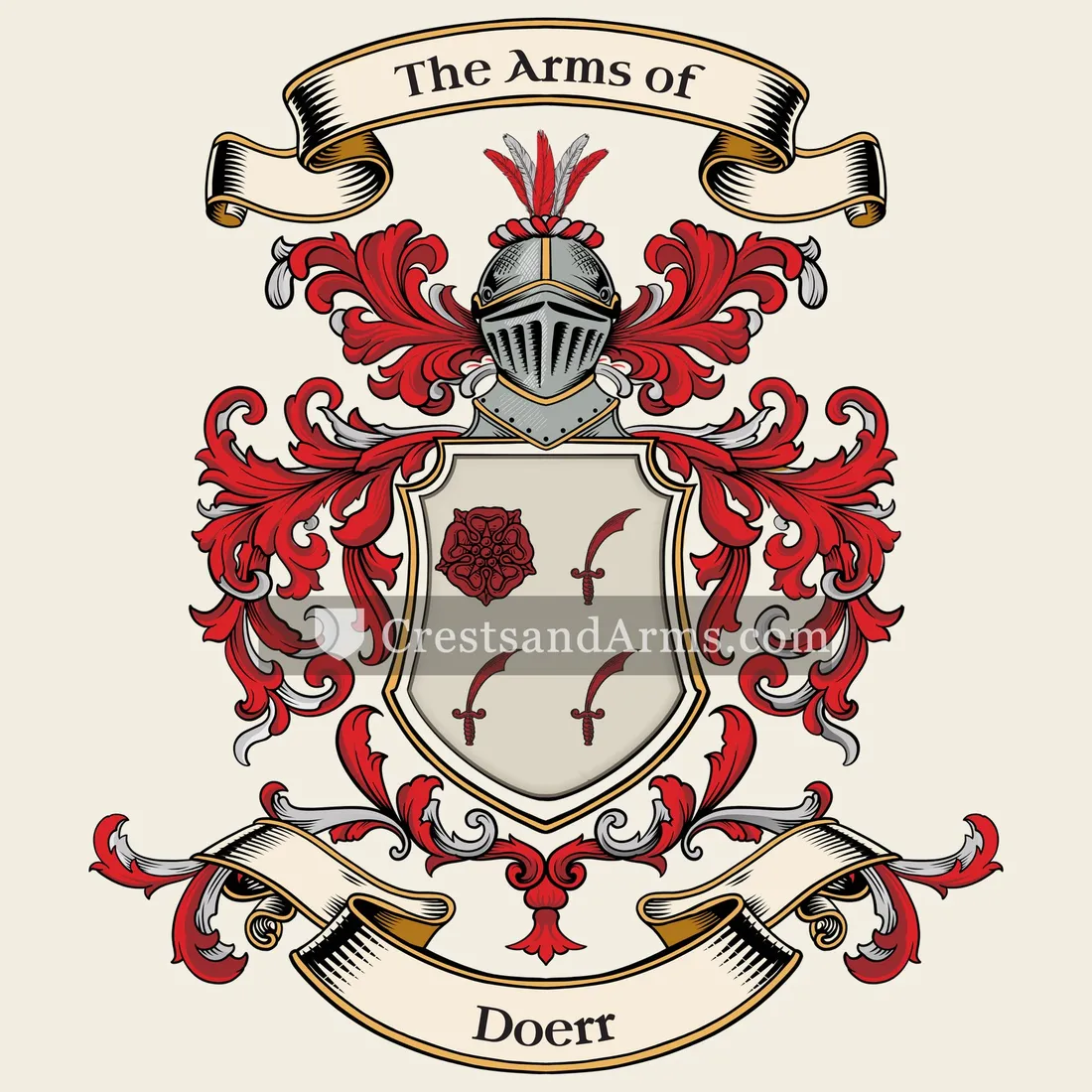
A record of documented arms, meaning and origin, researched for the Doerr family of Germany.
Reg. 2163 · German, D–F
Meaning of the Doerr family crest colors & symbols
Symbols on this shield
roseThe seventh son, and beauty with grace
swordJustice, and military honour
Colours
Silver (Argent)Means: Peace and sincerity
Red (Gules)Means: Military strength
Historical info
Source
J. B. Rietstap, Armorial Général, Gouda: G. B. van Goor Zonen, 1884–87
Blazon (the actual original written record)
“Coupé: au 1 d'arg. à une rose de gu.; au 2 de gu. à trois épées d'arg., garnies d'or, posées en éventail, les pointes en haut. C.: cinq pl. d'aut., alt. d'arg. et de gu.”
HesseHesse, c. 1873
Digital archive packCoat of arms PNG, gold border print PDF, vector SVG and the certificate of authenticity. Sent to your email in minutes.
Map of Germany showing where the Doerr arms are recorded
The Doerr arms were recorded in Hesse, c. 1873.
Hesse was central German country, divided among a large number of small landowners and prosperous towns. So many separate households held ground there that the region produced an unusual number of coats of arms.
This is where the arms were entered in the register. Families often moved to other parts of the country, so the same name can turn up in more than one region.
The body that granted and recorded arms in Germany in this period.
Wilhelm I
Sovereign of the period
Wilhelm I
1861–1888
Reigning in Germany when the Doerr arms are first recorded.
How Arms Worked in Germany
Prussian heraldry was strictly tied to social rank and noble status rather than being a free choice for every citizen. These symbols were treated as permanent family property that moved through the generations to all legitimate heirs. If a family branch wanted to change their design to stand out, they had to apply for official permission to alter their specific version of the shield.
Granting authority
The Prussian Heroldsamt acted as the central state office that managed and strictly controlled all noble titles and coats of arms.
How they got arms
Families usually obtained their arms through formal royal grants or by proving their long-standing noble status to the state authorities.
Where arms were recorded
All official coats of arms were kept in the rolls of the Prussian Heroldsamt, which functioned from 1706 until 1918.
The family's standing
Recorded among the armigerous families of Hesse.
Origin & History of the Doerr Family in Germany
The surname Doerr is a classic example of a name derived from a person’s trade or physical surroundings in medieval Germany. It is primarily associated with the region of Hesse, where families bearing this name were well-established by the mid-19th century. Linguists believe the name stems from the Middle High German word "tor," which refers to a gate or a door. It likely served as a descriptive nickname for someone who lived near the village gate or perhaps for a person who worked as a gatekeeper. Because surnames were often adopted based on local landmarks, the name spread throughout the Hessian countryside as families settled into specific communities. By 1873, the Doerr name was a recognized part of the local social fabric in Hesse, reflecting a long history of families who were deeply rooted in the agricultural and village life of the German states.
Doerr Meaning & Related Branches
Root word
Tor
A gate or a doorway.
This name
DoerrAn occupational name for a gatekeeper or someone who lived near a gate.
also spelled
Doer
Derr
Door
Documented Sources
J. B. Rietstap, Armorial Général, Gouda: G. B. van Goor Zonen, 1884–87
Bahlow, Hans, Deutsches Namenlexikon: Familien- und Vornamen nach Ursprung und Sinn erklärt, 1967
Hessisches Landesarchiv, Personenstandsregister der hessischen Gemeinden, 1873
Kohlheim, Rosa and Volker Kohlheim, Duden: Das große Vornamenlexikon, 2007
Digital archive packCoat of arms PNG, gold border print PDF, vector SVG and the certificate of authenticity. Sent to your email in minutes.


 roseThe seventh son, and beauty with grace
 swordJustice, and military honour
 roseThe seventh son, and beauty with grace
 swordJustice, and military honour