A record of documented arms, meaning and origin, researched for the Doff family lines. Documented in 3 countries.
Reg. 0367 · French, D–F
Meaning of the Doff family crest colors & symbols
Symbols on this shield
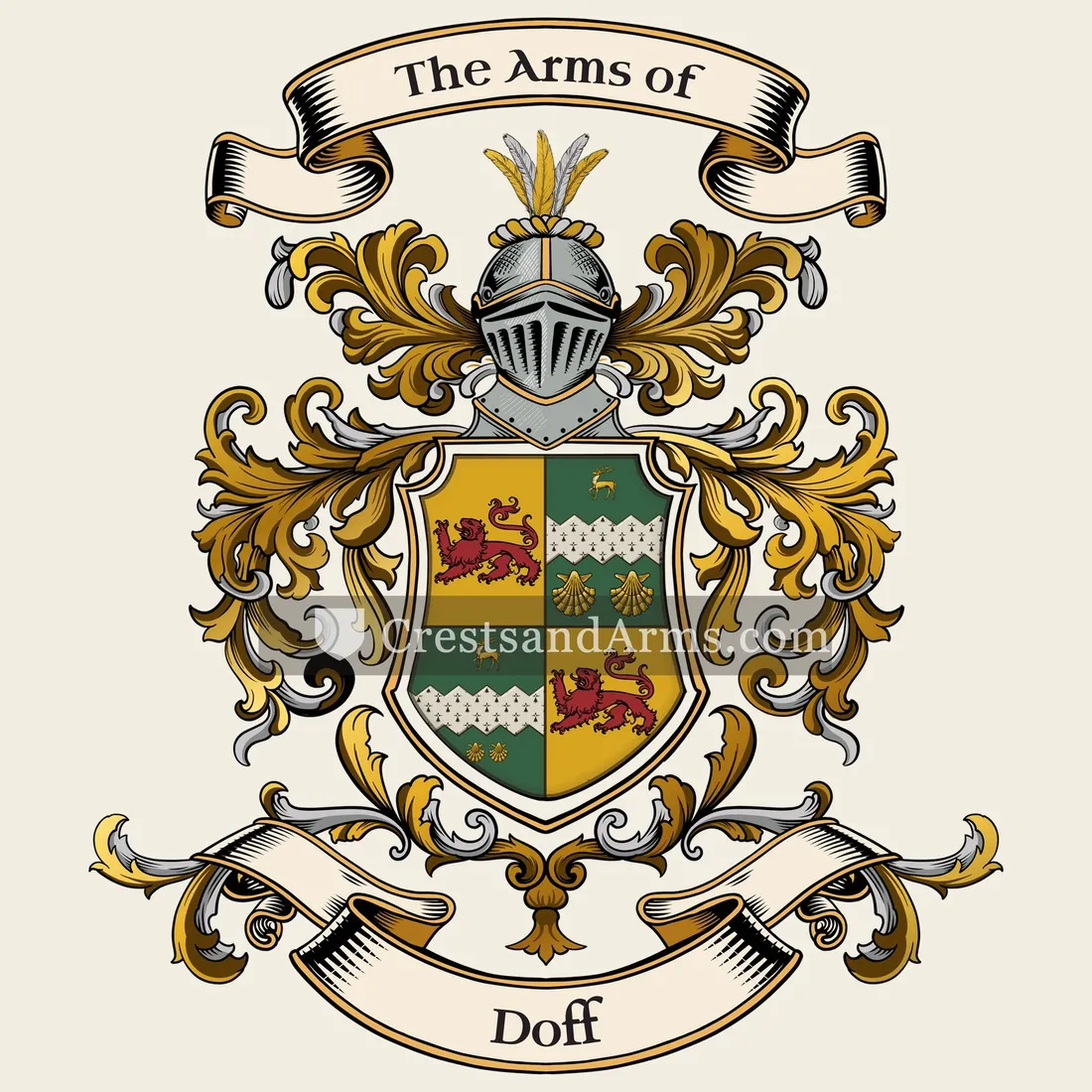
fessThe military belt, and readiness to serve
lionCourage, strength and royalty
stagPeace and harmony, and one who will not fight unprovoked
escallopThe pilgrim's shell, and a long journey made
Colours
Gold (Or)Means: Generosity
Green (Vert)Means: Hope
ErmineMeans: Dignity
Red (Gules)Means: Military strength
Historical info
Source
J. B. Rietstap, Armorial Général, Gouda: G. B. van Goor Zonen, 1884–87
Blazon (the actual original written record)
“Ec.: aux 1 et 4 d'or au lion de gu. (Macduff); aux 2 et 3 de sin. à la fasce vivrée d'herm., acc. en chef d'un rencontre de cerf d'or et en p. de deux coquilles du même (Duff). C.: 1° un cheval galopant d'arg., la housse de gu. semée d'écussons d'or ch. chacun d'un lion de gu.; le cheval monté par un chevalier, arm. de toutes pièces, tenant de sa main dextre une épée haute et de sa sen. un bouclier de gu. semé d'écussons pareils”
Francec. 1735
Digital archive packCoat of arms PNG, gold border print PDF, vector SVG and the certificate of authenticity. Sent to your email in minutes.
Map of France showing where the Doff arms are recorded
The Doff arms were recorded in France, c. 1735.
Arms such as these were typically recorded in Bretagne.
More families held coats of arms in Bretagne than anywhere else in France. The land was divided into many small estates rather than a few large ones, so far more households counted as gentry, and each needed a shield of its own to be told apart.
This is where the arms were entered in the register. Families often moved to other parts of the country, so the same name can turn up in more than one region.
The body that granted and recorded arms in France in this period.
Louis XV of France
Sovereign of the period
Louis XV of France
1715–1774
Reigning in France when the Doff arms are first recorded.
How Arms Worked in France
In France, a coat of arms was a mark of honor that passed down through the male line to all legitimate descendants. Families often used the same shield without changes to show their shared heritage. If a branch wanted to stand out, they could add a small mark to their shield to show their specific place in the family tree.
Granting authority
The Juge d'armes de France acted as the official authority that regulated and verified coats of arms across the country.
How they got arms
Families typically inherited their arms from ancestors, though they could also receive them through royal grants or by proving their noble status.
Where arms were recorded
Coats of arms were officially recorded in the Armorial Général de France, which began its main collection in the year 1696.
The family's standing
Recorded among the armigerous families of France.
Origin & History of the Doff Family in France
The history of the Doff family in France is deeply rooted in the rugged landscape of Bretagne, where records confirm their presence by at least 1735. During this period, the region was characterized by a strong sense of local identity and a traditional agrarian economy. Families like the Doffs often lived in small, tight-knit rural communities where they were closely tied to the local parish church and the seasonal cycles of farming. Because the name is relatively rare in French records, it likely originated as a descriptive nickname or a localized reference to a specific place or occupation within the Brittany peninsula. As the family established themselves in the region throughout the eighteenth century, they participated in the daily life of a province that maintained its own distinct customs and language, separate from the central authority in Paris. This early history reflects the broader experience of many families in western France who built their lives through generations of work on the land and involvement in their local villages.
Meaning of the Doff family crest colors & symbols
Symbols on this shield
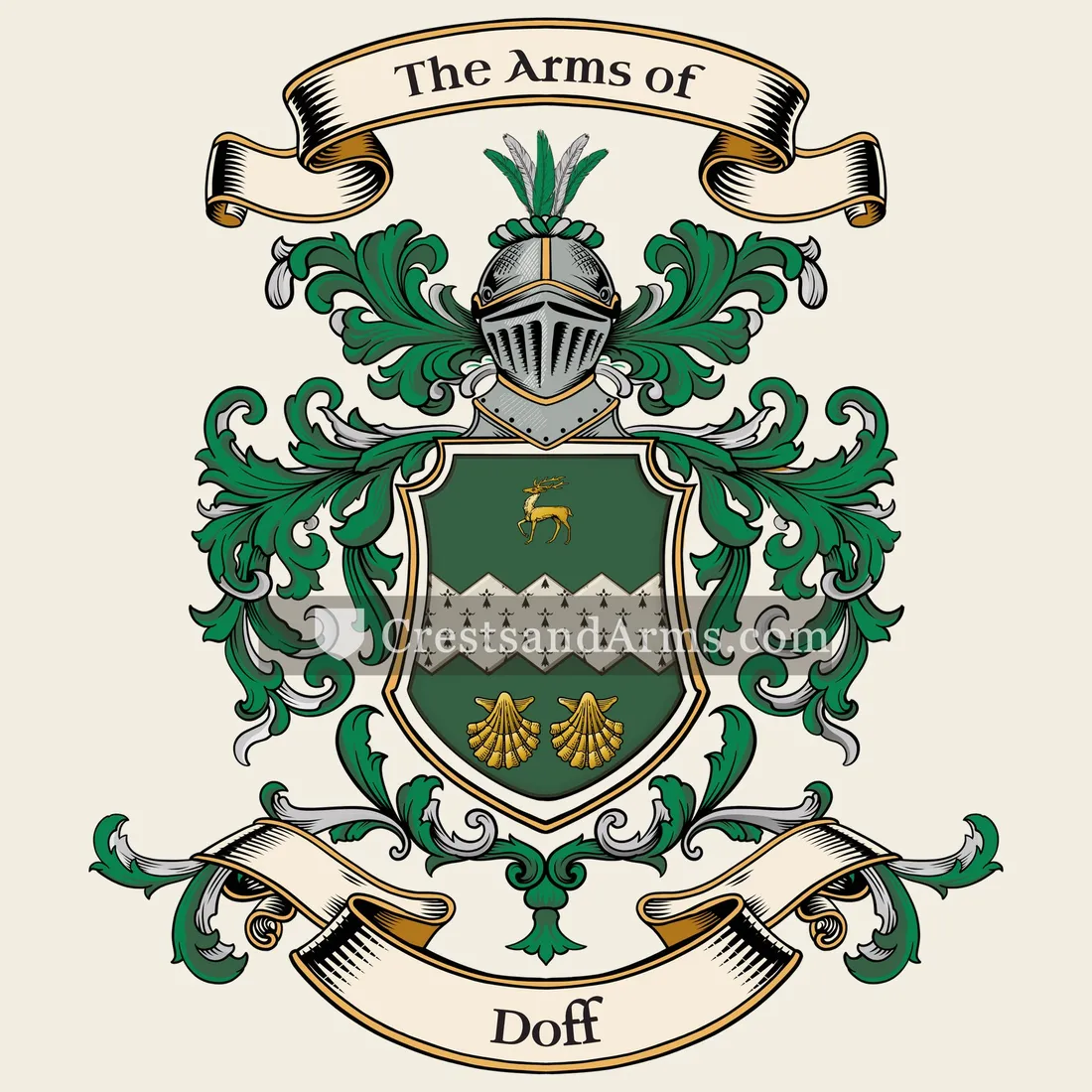
fessThe military belt, and readiness to serve
stagPeace and harmony, and one who will not fight unprovoked
escallopThe pilgrim's shell, and a long journey made
Colours
Green (Vert)Means: Hope
ErmineMeans: Dignity
Gold (Or)Means: Generosity
Historical info
Source
Sir Bernard Burke, The General Armory of England, Scotland, Ireland and Wales, London: Harrison & Sons, 1884
Blazon (the actual original written record)
“Vert a fess dancettée erm. betw. a buck's head cabossed in chief and two escallops in base or”
BanffKeithmore · Banff, c. 1748
Digital archive packCoat of arms PNG, gold border print PDF, vector SVG and the certificate of authenticity. Sent to your email in minutes.
Map of Scotland showing where the Doff arms are recorded
The Doff arms were recorded in Banff, c. 1748.
Banffshire was farming and fishing country on Scotland's north-east coast. Its landed families were long-settled and closely related, and each line recorded arms to be told apart from the rest.
This is where the arms were entered in the register. Families often moved to other parts of the country, so the same name can turn up in more than one region.
The body that granted and recorded arms in Scotland in this period.
George II of Great Britain
Sovereign of the period
George II of Great Britain
1727–1760
Reigning in France when the Doff arms are first recorded.
How Arms Worked in Scotland
Scottish heraldry is unique because it treats a coat of arms as a piece of personal property protected by law. Only one person can own a specific design at any given time. When a family grows, the head keeps the original shield while other relatives must apply for their own distinct version with slight changes to prove their specific identity.
Granting authority
The Court of the Lord Lyon acts as the official body that regulates and controls all heraldic matters throughout Scotland.
How they got arms
Individuals obtain a legal right to their arms through a formal petition process that confirms their identity and family connection.
Where arms were recorded
All valid coats of arms are officially entered into the Public Register of All Arms and Bearings starting from 1672.
The family's standing
Recorded among the armigerous families of Banff.
Origin & History of the Doff Family in Scotland
The history of the Doff family in Scotland is deeply rooted in the coastal landscape of Banff, where records confirm their presence by the middle of the eighteenth century. During this period, Banff served as a bustling center for maritime trade and local industry, providing a stable environment for families to establish their livelihoods. The name likely emerged as a localized variation of older surnames or occupational descriptors common to the northeastern regions of Scotland. By 1748, the Doff family was already integrated into the social fabric of the town, participating in the daily life and economic activities that defined this historic royal burgh. Their early residence in such a prominent port suggests that they were likely involved in the regional commerce or the skilled trades that supported the town’s growth during the mid-1700s. Through these early generations, the family helped shape the quiet but persistent history of the Banff community.
Meaning of the Doff family crest colors & symbols
Symbols on this shield
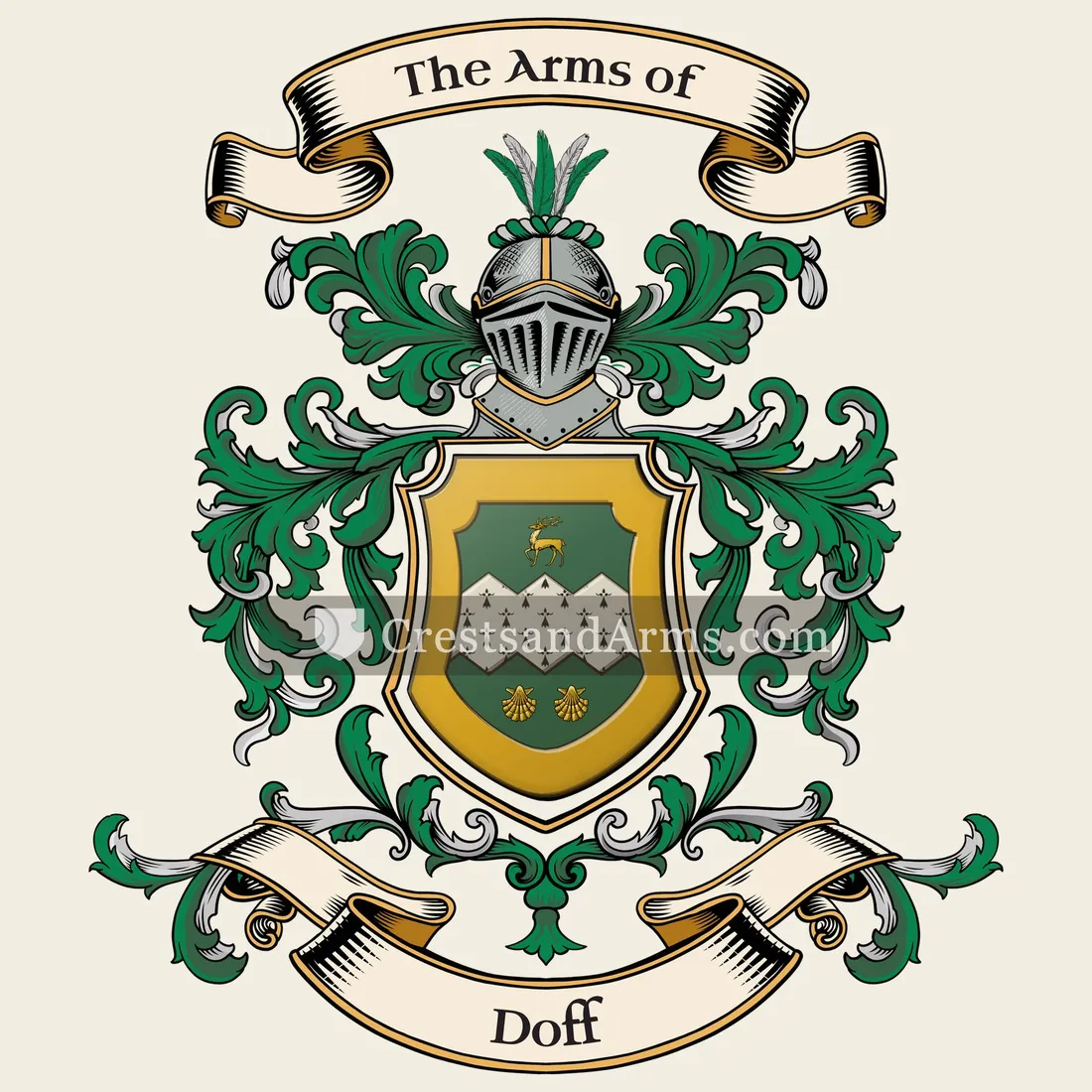
fessThe military belt, and readiness to serve
bordureA difference between branches of one family
stagPeace and harmony, and one who will not fight unprovoked
escallopThe pilgrim's shell, and a long journey made
Colours
Green (Vert)Means: Hope
ErmineMeans: Dignity
Gold (Or)Means: Generosity
Historical info
Source
Sir Bernard Burke, The General Armory of England, Scotland, Ireland and Wales, London: Harrison & Sons, 1884
Blazon (the actual original written record)
“Vert a fesse dancettée erm. betw. a buck's head cabossed in chief and two escallops in base or, all within a bordure of the last”
Englandc. 1781
Digital archive packCoat of arms PNG, gold border print PDF, vector SVG and the certificate of authenticity. Sent to your email in minutes.
Map of England showing where the Doff arms are recorded
The Doff arms were recorded in England, c. 1781.
Arms such as these were typically recorded in York.
Yorkshire is the largest of the English counties, and it held more gentry families than any other. Land there was split among a great many households rather than a few, so a great many of them carried arms.
This is where the arms were entered in the register. Families often moved to other parts of the country, so the same name can turn up in more than one region.
The body that granted and recorded arms in England in this period.
George III of Great Britain
Sovereign of the period
George III of Great Britain
1760–1801
Reigning in France when the Doff arms are first recorded.
How Arms Worked in England
English heraldry allowed arms to be shared by all legitimate descendants of the original owner. These symbols were treated as personal property that moved through the generations to all children. While the eldest son kept the original design, other family members could use the same shield without needing to change it or register their own unique versions.
Granting authority
The College of Arms in London has regulated the use of coats of arms throughout England and Wales since 1484.
How they got arms
Families typically obtained their coats of arms through a formal grant from the Crown or by proving their ancient right to them.
Where arms were recorded
All official coats of arms are recorded in the registers kept at the College of Arms, which date back to the fifteenth century.
The family's standing
Recorded among the armigerous families of England.
Origin & History of the Doff Family in England
The surname Doff is a rare and distinct name that first appears in historical records within the northern English city of York during the late eighteenth century. By 1781, members of the Doff family were already established residents of this historic walled city, which served as a major hub for trade and industry in the north of England. The name likely evolved as a localized variation of older occupational or descriptive surnames, potentially linked to the textile industry that defined the region at the time. As the Industrial Revolution began to reshape the landscape of Yorkshire, families like the Doffs were part of a growing urban population that transitioned from traditional rural life into the bustling commerce of the city. While the name remains uncommon today, its presence in York archives provides a clear starting point for tracing the family’s roots within the social and economic fabric of Georgian England.
Doff Meaning & Related Branches
Root word
Dauphin
Derived from the Latin word delphinus meaning dolphin.
This name
DoffA topographic name for someone living near a dolphin-shaped landmark or a nickname for a person of noble status.
also spelled
Duffe
Dufff
Duf
Documented Sources
J. B. Rietstap, Armorial Général, Gouda: G. B. van Goor Zonen, 1884–87
Archives Départementales du Finistère, Registres paroissiaux et d'état civil, 1735
Le Moyne de La Borderie, Arthur, Histoire de Bretagne, 1896
Ploix, Charles, La vie rurale en Bretagne au XVIIIe siècle, 1905
Digital archive packCoat of arms PNG, gold border print PDF, vector SVG and the certificate of authenticity. Sent to your email in minutes.


 fessThe military belt, and readiness to serve
 lionCourage, strength and royalty
 stagPeace and harmony, and one who will not fight unprovoked
 escallopThe pilgrim's shell, and a long journey made
 fessThe military belt, and readiness to serve
 lionCourage, strength and royalty
 stagPeace and harmony, and one who will not fight unprovoked
 escallopThe pilgrim's shell, and a long journey made




 bordureA difference between branches of one family