Map of Switzerland showing where the Dohrman arms are recorded
The Dohrman arms were recorded in Rappersweil, c. 1725.
This is where the arms were entered in the register. Families often moved to other parts of the country, so the same name can turn up in more than one region.
The body that granted and recorded arms in Switzerland in this period.
How Arms Worked in Switzerland
In Switzerland, coats of arms were not restricted to the nobility and were often adopted by common citizens and families. These symbols were passed down through generations to show family identity. When branches of a family grew, they often changed small details of the design to distinguish their own line from the original group.
Granting authority
Cantonal and civic authorities managed the use of coats of arms within their specific regions and local jurisdictions.
How they got arms
Families typically assumed their own coats of arms based on local custom rather than receiving them from a central monarch.
Where arms were recorded
Arms were recorded in various cantonal and civic registers starting from the fourteenth century throughout the Swiss region.
The family's standing
Recorded among the armigerous families of Switzerland.
Origin & History of the Dohrman Family in Switzerland
The Dohrman family name finds its historical roots in the lakeside town of Rapperswil, Switzerland, where records confirm the presence of family members as early as 1725. During this period, Rapperswil served as a vital hub for trade and transportation along the upper reaches of Lake Zurich. Families living in this region were often deeply integrated into the local guild systems, which governed the professional lives of craftsmen and merchants. The name likely evolved from regional dialects spoken in the German-speaking cantons, reflecting the linguistic shifts common in the Swiss plateau during the eighteenth century. Living in a town known for its strategic fortifications and religious significance, the early Dohrmans were part of a stable society that valued civic participation and local community ties. This environment allowed the family to establish deep roots within the social fabric of the St. Gallen region before many individuals began to migrate further across Europe and eventually to the Americas.
Coat of Arms & Family Crest Details
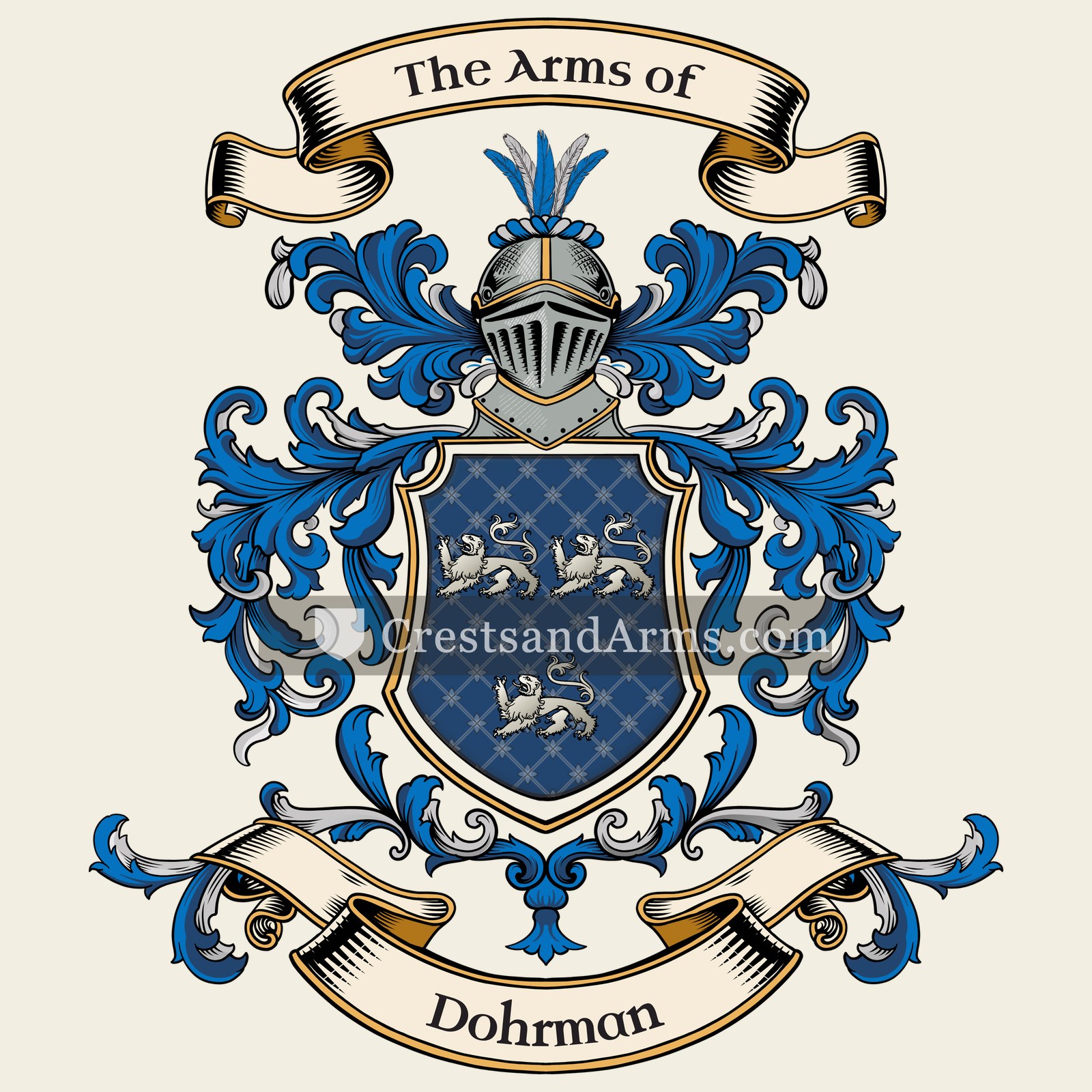
Symbols on this shield
lionCourage, strength and royalty
Colours
Blue (Azure)Means: Loyalty and truth
Silver (Argent)Means: Peace and sincerity
Historical info
Source
Sir Bernard Burke, The General Armory of England, Scotland, Ireland and Wales, London: Harrison & Sons, 1884
Blazon (the actual original written record)
“Az. three leopards' faces ar”
Englandc. 1620
Digital archive packCoat of arms PNG, gold border print PDF, vector SVG and the certificate of authenticity. Sent to your email in minutes.
Map of England showing where the Dohrman arms are recorded
The Dohrman arms were recorded in England, c. 1620.
Arms such as these were typically recorded in York.
Yorkshire is the largest of the English counties, and it held more gentry families than any other. Land there was split among a great many households rather than a few, so a great many of them carried arms.
This is where the arms were entered in the register. Families often moved to other parts of the country, so the same name can turn up in more than one region.
The body that granted and recorded arms in England in this period.
James VI and I
Sovereign of the period
James VI and I
1603–1625
Reigning in Switzerland when the Dohrman arms are first recorded.
How Arms Worked in England
English heraldry allowed arms to be shared by all legitimate descendants of the original owner. These symbols were treated as personal property that moved through the generations to all children. While the eldest son kept the original design, other family members could use the same shield without needing to change it or register their own unique versions.
Granting authority
The College of Arms in London has regulated the use of coats of arms throughout England and Wales since 1484.
How they got arms
Families typically obtained their coats of arms through a formal grant from the Crown or by proving their ancient right to them.
Where arms were recorded
All official coats of arms are recorded in the registers kept at the College of Arms, which date back to the fifteenth century.
The family's standing
Recorded among the armigerous families of England.
Origin & History of the Dohrman Family in England
The family name Dohrman first appears in the historical landscape of England during the early 17th century, with documented roots in the city of York by 1620. During this period, York was a bustling northern hub where families often settled due to the growth of regional trade and the influence of the local merchant guilds. The name likely reflects a migration pattern common among families moving across the North Sea, as the linguistic structure suggests origins linked to Germanic or Low German naming traditions. By establishing themselves in York, early members of the family became part of a society defined by religious change and the shifting economic policies of the Stuart era. These early settlers lived through a time when record-keeping in parish registers became more consistent, allowing historians to trace their presence in the city’s dense urban neighborhoods. Their early history in England is defined by this integration into a provincial center that served as a gateway for both commerce and cultural exchange during the early modern period.
Related Branches & Arms
Root word
Dorn-mann
A person living near a thorn bush or thicket.
This name
DohrmanDerived from Middle High German terms for a man residing by a thorny area.
also spelled
Dormann
Dormane
Dormans
Dormand
Dormant
Documented Sources
J. B. Rietstap, Armorial Général, Gouda: G. B. van Goor Zonen, 1884–87
Stadtarchiv Rapperswil-Jona, Bürgerrodel der Stadt Rapperswil, 1725
Zürcher, U., Die Geschichte der Stadt Rapperswil, 1998
Digital archive packCoat of arms PNG, gold border print PDF, vector SVG and the certificate of authenticity. Sent to your email in minutes.


 mountThe ground held, and steadfastness upon it
 mountThe ground held, and steadfastness upon it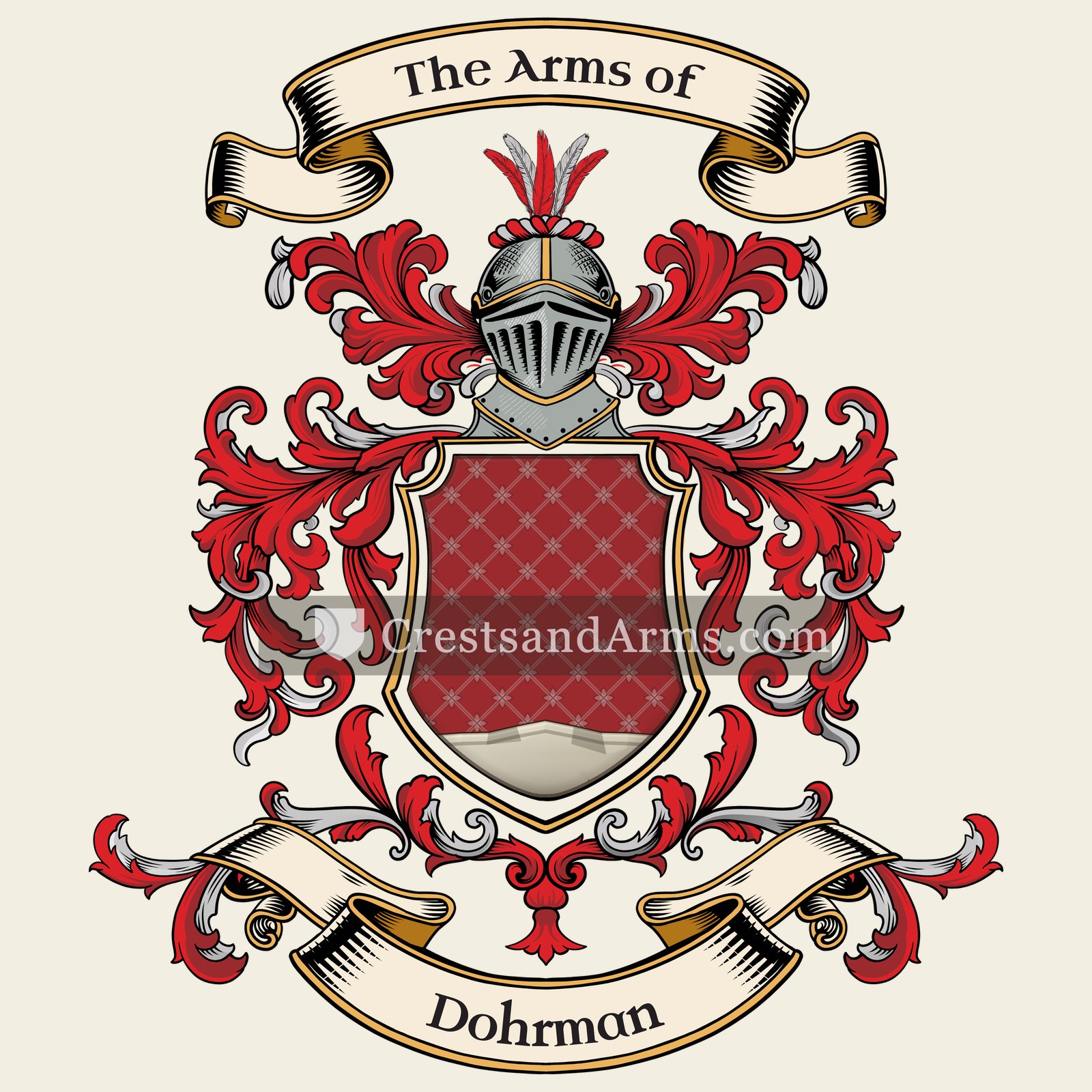

 lionCourage, strength and royalty