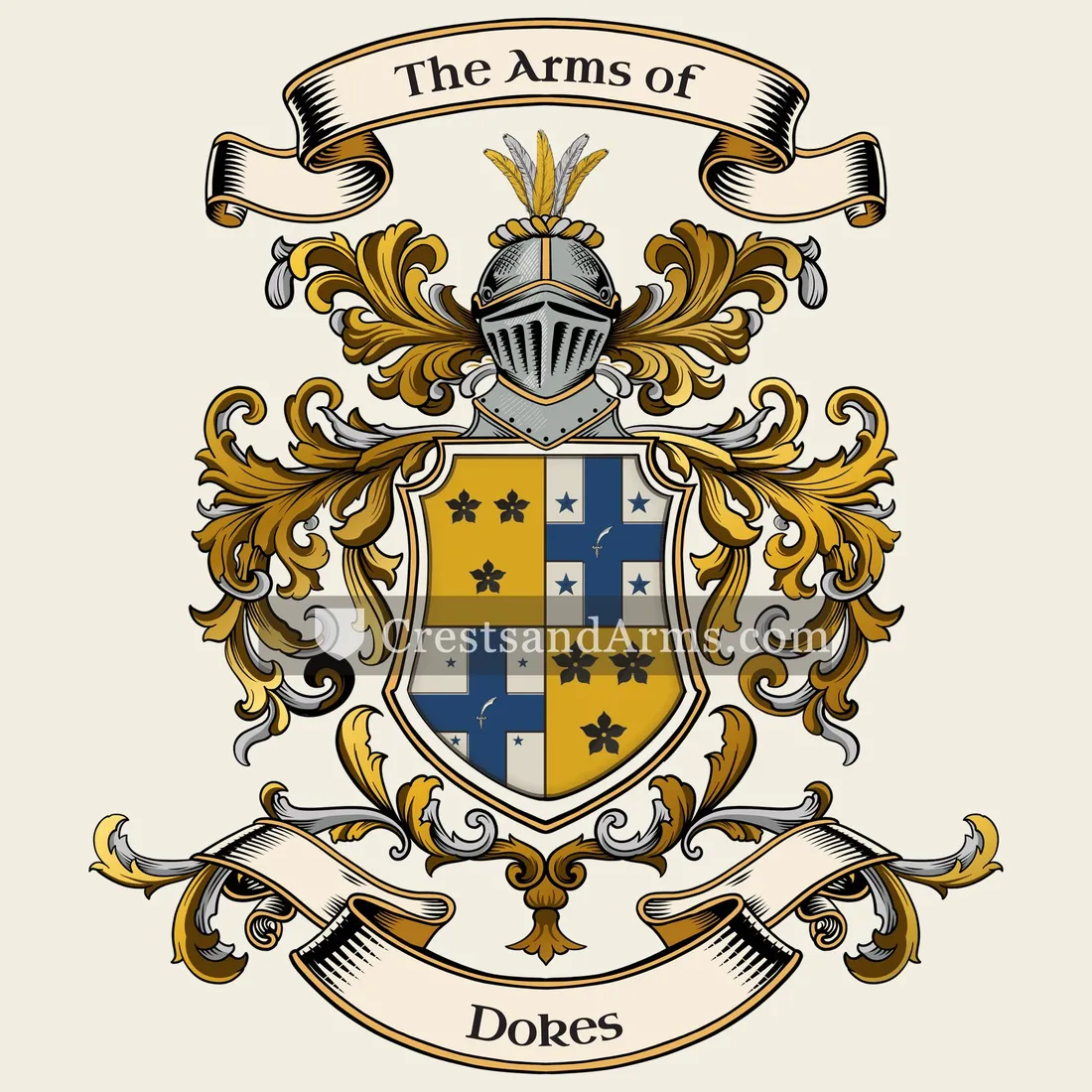
A record of documented arms, meaning and origin, researched for the Dokes family of England.
Reg. 6570 · English, D–F
Meaning of the Dokes family crest colors & symbols
Symbols on this shield
cross symbolChristian faith and service
cinquefoilHope and joy
mulletThe third son, and a divine quality from above
swordJustice, and military honour
Colours
Gold (Or)Means: Generosity
Silver (Argent)Means: Peace and sincerity
Blue (Azure)Means: Loyalty and truth
Black (Sable)Means: Constancy
Historical info
Source
Sir Bernard Burke, The General Armory of England, Scotland, Ireland and Wales, London: Harrison & Sons, 1884
Blazon (the actual original written record)
“Quarterly, 1st and 4th, or, three cinquefoils sa., for DYKES; 2nd and 2rd, ar. on a cross betw. four mullets az. a sword ppr. pommelled and hilted or, for BALLANTINE”
CumberlandDovenby Hall · Cumberland, c. 1620
Digital archive packCoat of arms PNG, gold border print PDF, vector SVG and the certificate of authenticity. Sent to your email in minutes.
Map of England showing where the Dokes arms are recorded
The Dokes arms were recorded in Cumberland, c. 1620.
Cumberland was rough border country in the north-west, facing Scotland across a disputed line. Its families held land in return for keeping it defended, and men who fought carried shields of their own.
This is where the arms were entered in the register. Families often moved to other parts of the country, so the same name can turn up in more than one region.
The body that granted and recorded arms in England in this period.
James VI and I
Sovereign of the period
James VI and I
1603–1625
Reigning in England when the Dokes arms are first recorded.
How Arms Worked in England
English heraldry allowed arms to be shared by all legitimate descendants of the original owner. These symbols were treated as personal property that moved through the generations to all children. While the eldest son kept the original design, other family members could use the same shield without needing to change it or register their own unique versions.
Granting authority
The College of Arms in London has regulated the use of coats of arms throughout England and Wales since 1484.
How they got arms
Families typically obtained their coats of arms through a formal grant from the Crown or by proving their ancient right to them.
Where arms were recorded
All official coats of arms are recorded in the registers kept at the College of Arms, which date back to the fifteenth century.
The family's standing
Recorded among the armigerous families of Cumberland.
Origin & History of the Dokes Family in England
The family name Dokes has roots that trace back to the rugged landscapes of northern England. Historical records confirm that members of the family were established in the county of Cumberland by the year 1620. During this period, the region was defined by its proximity to the Scottish border and its reliance on agriculture and sheep farming. Families living in this area often adopted surnames based on their local occupations, nicknames, or specific geographic landmarks. The name likely evolved as a variation of older regional terms used to describe people who lived near a specific brook or a small woodland clearing. As the family grew, they became part of the local fabric of Cumberland society, living through a time of significant social change and regional development in the early seventeenth century.
Dokes Meaning & Related Branches
Root word
Doke
Derived from the Middle English personal name Doke or Dok.
This name
DokesA patronymic surname indicating descent from a person originally nicknamed or named Doke.
also spelled
Dikes
Documented Sources
Sir Bernard Burke, The General Armory of England, Scotland, Ireland and Wales, London: Harrison & Sons, 1884


 cross symbolChristian faith and service
 cinquefoilHope and joy
 mulletThe third son, and a divine quality from above
 swordJustice, and military honour
 cross symbolChristian faith and service
 cinquefoilHope and joy
 mulletThe third son, and a divine quality from above
 swordJustice, and military honour