Map of France showing where the Domke arms are recorded
The Domke arms were recorded in Guyenne, c. 1663.
Guyenne was the great wine country of south-western France, shipping claret to England for centuries. The trade made merchant families rich, they bought vineyards and estates with the money, and land of that kind brought arms with it.
This is where the arms were entered in the register. Families often moved to other parts of the country, so the same name can turn up in more than one region.
The body that granted and recorded arms in France in this period.
Louis XIV of France
Sovereign of the period
Louis XIV of France
1643–1715
Reigning in France when the Domke arms are first recorded.
How Arms Worked in France
In France, a coat of arms was a mark of honor that passed down through the male line to all legitimate descendants. Families often used the same shield without changes to show their shared heritage. If a branch wanted to stand out, they could add a small mark to their shield to show their specific place in the family tree.
Granting authority
The Juge d'armes de France acted as the official authority that regulated and verified coats of arms across the country.
How they got arms
Families typically inherited their arms from ancestors, though they could also receive them through royal grants or by proving their noble status.
Where arms were recorded
Coats of arms were officially recorded in the Armorial Général de France, which began its main collection in the year 1696.
The family's standing
Recorded among the armigerous families of Guyenne.
Origin & History of the Domke Family in France
The surname Domke is rooted in the linguistic traditions of Central and Eastern Europe, where it often functioned as a diminutive form of names derived from the Slavic word for home or house. While the name is most commonly associated with regions in modern-day Germany and Poland, historical records place members of the family in the province of Guyenne in southwestern France as early as 1663. During the seventeenth century, Guyenne was a region defined by complex religious and social shifts, and the presence of the family there suggests they may have been part of the mobile populations moving across European borders for trade or military service. Over time, the name evolved through various spellings as families migrated, reflecting the linguistic influences of the different regions they inhabited. By maintaining their identity while adapting to new environments, the early Domke family became part of the broader history of European migration and cultural integration.
Domke Meaning & Related Branches
Root word
Dominicus
Latin term meaning belonging to the Lord or master.
This name
DomkeA diminutive form indicating a descendant of someone named Dominic.
also spelled
Domeck
Domece
Domecc
Domek
Documented Sources
J. B. Rietstap, Armorial Général, Gouda: G. B. van Goor Zonen, 1884–87
Archives départementales de la Gironde, Registres paroissiaux et d'état civil, 1663
Bahlow, Hans, Deutsches Namenlexikon: Familien- und Vornamen nach Ursprung und Sinn erklärt, 1967
Kohlheim, Rosa and Volker Kohlheim, Duden Familiennamen: Herkunft und Bedeutung von 20.000 Nachnamen, 2005
Digital archive packCoat of arms PNG, gold border print PDF, vector SVG and the certificate of authenticity. Sent to your email in minutes.


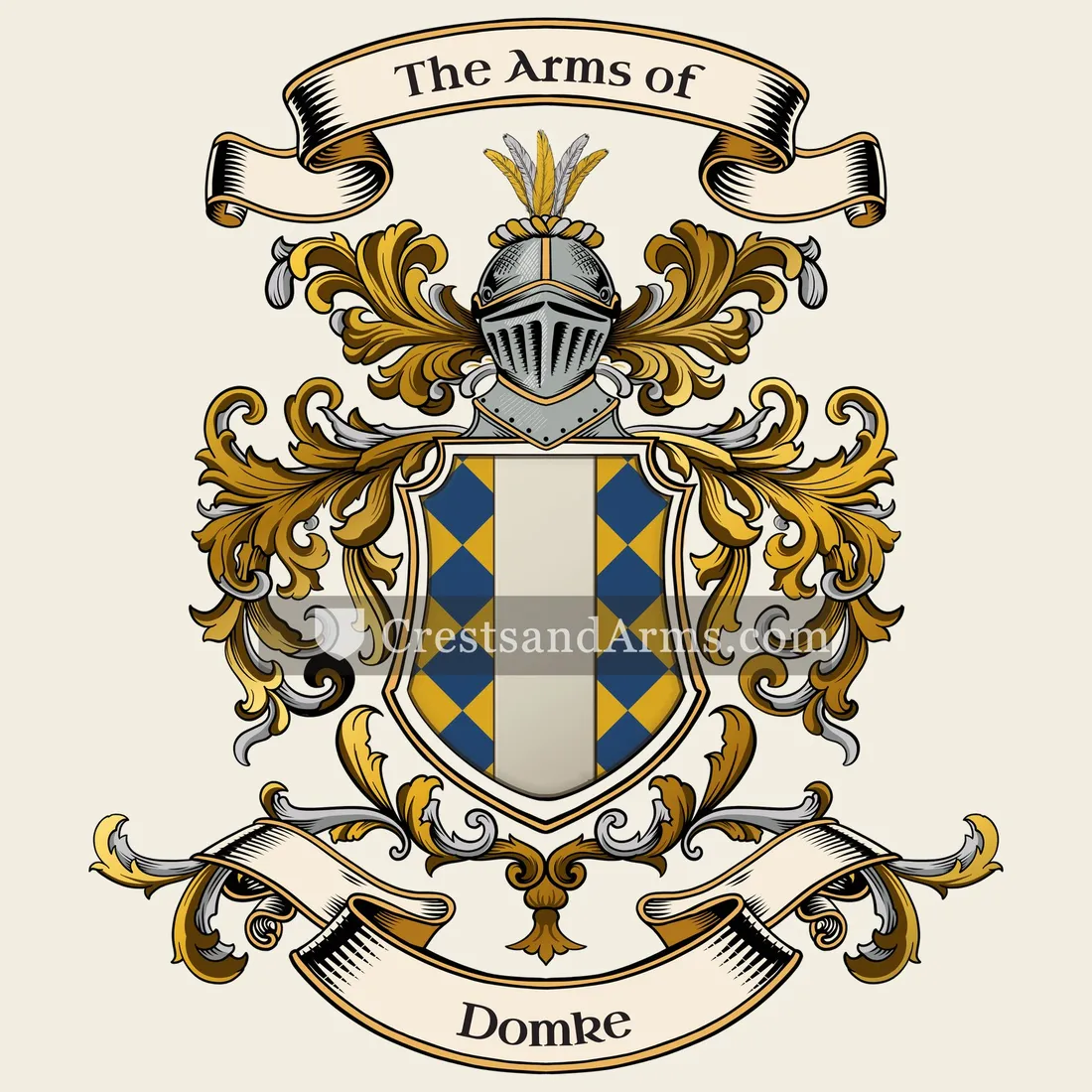
 paleMilitary strength, and a fortified defence
 paleMilitary strength, and a fortified defence