A record of documented arms, meaning and origin, researched for the Donald family lines. Documented in 2 countries.
Reg. 0282 · Austrian, D–F
Coat of Arms & Family Crest Details
Symbols on this shield
paleMilitary strength, and a fortified defence
lionCourage, strength and royalty
Colours
Red (Gules)Means: Military strength
Gold (Or)Means: Generosity
Black (Sable)Means: Constancy
Historical info
Source
J. B. Rietstap, Armorial Général, Gouda: G. B. van Goor Zonen, 1884–87
Blazon (the actual original written record)
“Coupé: au 1 palé de gu., de sa., d'or, de sa., de gu., de sa. et d'or; au 2 d'azur au lion léopardé d'or, cour. du même. Cq. cour. C.: le lion, iss. L.: à dextre de sa. et de gu., à sen. d'or et d'azur.”
Austriac. 1772
Digital archive packCoat of arms PNG, gold border print PDF, vector SVG and the certificate of authenticity. Sent to your email in minutes.
Map of Austria showing where the Donald arms are recorded
The Donald arms were recorded in Austria, c. 1772.
Arms such as these were typically recorded in Tyrol.
Tyrol was mountain country in western Austria, where the valleys were held by families who had been there a very long time. Old tenure counted for more than money, and old families carried arms.
This is where the arms were entered in the register. Families often moved to other parts of the country, so the same name can turn up in more than one region.
Region
Tyrol
First recorded
1772
Granting Authority for the Donald Arms
Imperial and Royal chancery
Sodacan · CC BY-SA 3.0
The body that granted and recorded arms in Austria in this period.
Joseph II, Holy Roman Emperor
Sovereign of the period
Joseph II, Holy Roman Emperor
1765–1790
Reigning in Austria when the Donald arms are first recorded.
How Arms Worked in Austria
Austrian coats of arms were often linked directly to noble titles granted by the Emperor. These symbols belonged to the entire family line rather than just one individual. When a family grew, new branches kept the original design without needing to change it. This system allowed all members of a noble house to share the same identity across many generations.
Granting authority
The Imperial and Royal chancery managed all heraldic matters and controlled the official granting of arms throughout the Austrian lands.
How they got arms
Families typically received their arms through a formal imperial decree that often accompanied the elevation of a person to noble status.
Where arms were recorded
Official records of these grants were kept in the Imperial Register of Nobility which began its formal documentation process in 1453.
The family's standing
Recorded among the armigerous families of Austria.
Origin & History of the Donald Family in Austria
The history of the Donald family in Austria is deeply tied to the rugged landscape of the Tyrol region. By 1772, records confirm that members of the family were firmly established within this mountainous territory, likely working as skilled laborers or farmers in the isolated alpine valleys. During this era, the Tyrol was a vital crossroads for trade and migration between the German lands and northern Italy. The family name likely evolved from local linguistic roots as people moved through these mountain passes. Because the region was under the strict administration of the Habsburg monarchy, the family would have been subject to careful census tracking and church registrations. These early ancestors lived through a time of significant cultural transition, as the influence of the Enlightenment began to reach even the most remote villages of the Austrian Alps. Their presence in the 1772 records suggests they were part of a stable, tax-paying population that helped shape the social fabric of the province during the reign of Empress Maria Theresa.
Coat of Arms & Family Crest Details
Symbols on this shield
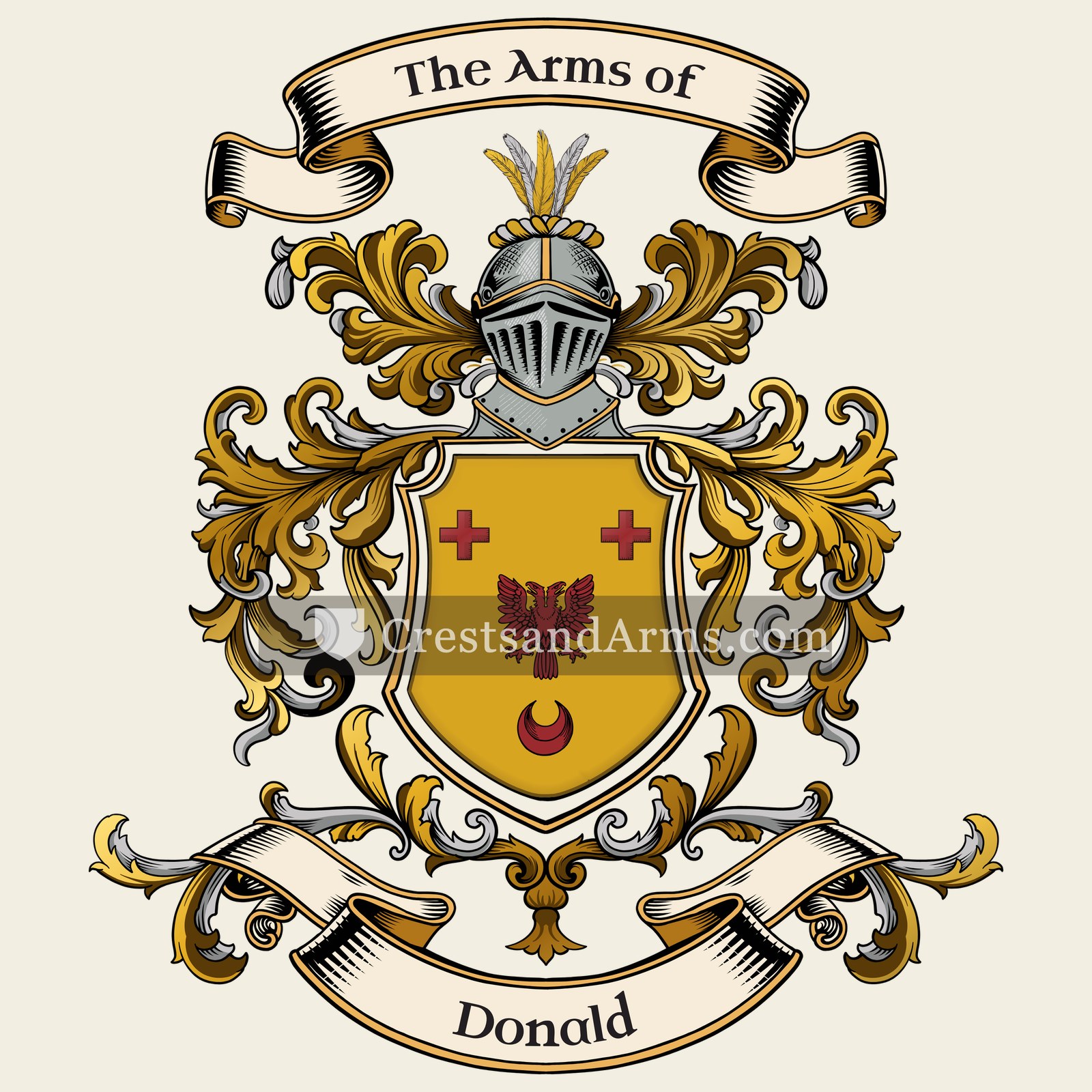
cross symbolChristian faith and service
eagleNobility, strength and a keen mind
crescentHonour by the sovereign, and the second son
Colours
Gold (Or)Means: Generosity
Red (Gules)Means: Military strength
Historical info
Source
Sir Bernard Burke, The General Armory of England, Scotland, Ireland and Wales, London: Harrison & Sons, 1884
Blazon (the actual original written record)
“Or, an eagle displ. gu. armed and membered sa. charged on the breast with a star ar. betw. two cross crosslets fitchée in chief and a crescent in base of the third”
DumfriesConheath · Dumfries, c. 1748
Digital archive packCoat of arms PNG, gold border print PDF, vector SVG and the certificate of authenticity. Sent to your email in minutes.
Map of Scotland showing where the Donald arms are recorded
The Donald arms were recorded in Dumfries, c. 1748.
Dumfriesshire was Scottish border country facing England across a disputed line. Families held their land in return for defending it, and a defending household carried a shield.
This is where the arms were entered in the register. Families often moved to other parts of the country, so the same name can turn up in more than one region.
The body that granted and recorded arms in Scotland in this period.
George II of Great Britain
Sovereign of the period
George II of Great Britain
1727–1760
Reigning in Austria when the Donald arms are first recorded.
How Arms Worked in Scotland
Scottish heraldry is unique because it treats a coat of arms as a piece of personal property protected by law. Only one person can own a specific design at any given time. When a family grows, the head keeps the original shield while other relatives must apply for their own distinct version with slight changes to prove their specific identity.
Granting authority
The Court of the Lord Lyon acts as the official body that regulates and controls all heraldic matters throughout Scotland.
How they got arms
Individuals obtain a legal right to their arms through a formal petition process that confirms their identity and family connection.
Where arms were recorded
All valid coats of arms are officially entered into the Public Register of All Arms and Bearings starting from 1672.
The family's standing
Recorded among the armigerous families of Dumfries.
Origin & History of the Donald Family in Scotland
The name Donald is deeply rooted in the Gaelic language, originating from the personal name Domhnall, which translates to world ruler. In the context of Scottish history, the name gained prominence through the powerful Clan Donald, also known as the Lords of the Isles, who held vast influence across the western Highlands and islands for centuries. While the name began as a title of leadership, it gradually spread throughout the country as families adopted it as a hereditary surname. By the time members of the family were documented in Dumfries in 1748, the name had become well-established across the Scottish Lowlands. During this period, families in the southern regions often worked as skilled tradespeople or tenant farmers, contributing to the local economy of the borderlands. These early ancestors were part of a wider movement of people who carried their Gaelic heritage into new regions, helping the name evolve from its ancient tribal origins into a common fixture of Scottish life.
Donald Meaning & Related Branches
Root word
Dubhghall
Derived from Gaelic elements meaning dark or black stranger.
This name
DonaldA Scottish Gaelic name meaning world ruler or mighty chief.
also spelled
Donal
Donnald
MacDonald
Documented Sources
J. B. Rietstap, Armorial Général, Gouda: G. B. van Goor Zonen, 1884–87
Tiroler Landesarchiv, Tiroler Steuerkataster 1772
Huter, Franz, Tiroler Urkundenbuch, 1937
Obermair, Hannes, Tirolensia im Haus-, Hof- und Staatsarchiv, 1996
Digital archive packCoat of arms PNG, gold border print PDF, vector SVG and the certificate of authenticity. Sent to your email in minutes.


 paleMilitary strength, and a fortified defence
 lionCourage, strength and royalty
 paleMilitary strength, and a fortified defence
 lionCourage, strength and royalty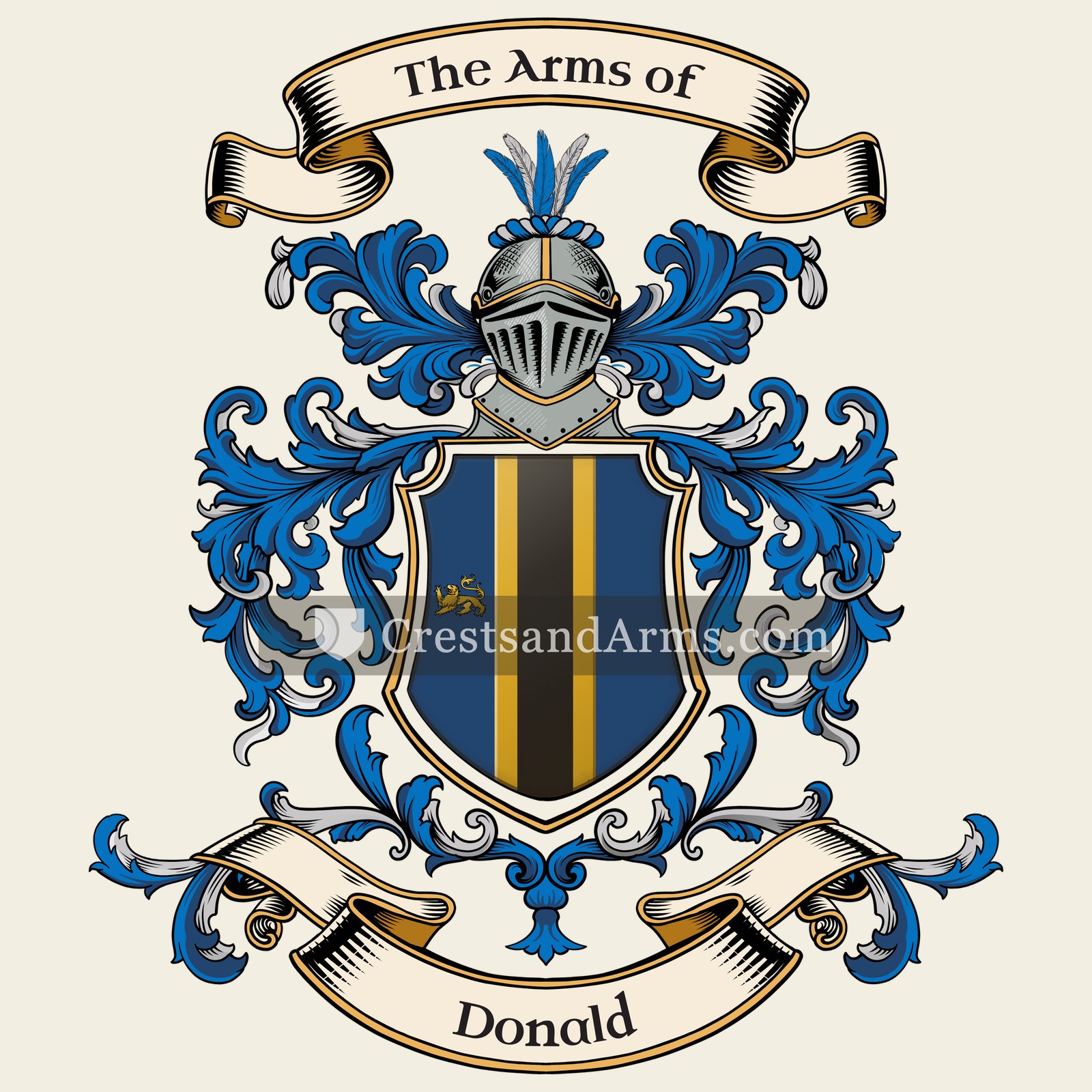


 cross symbolChristian faith and service
 eagleNobility, strength and a keen mind
 crescentHonour by the sovereign, and the second son