A record of documented arms, meaning and origin, researched for the Donat family lines. Documented in 2 countries.
Reg. 3369 · German, D–F
Coat of Arms & Family Crest Details
Symbols on this shield
armA person of action, industrious and laborious
Colours
Silver (Argent)Means: Peace and sincerity
Gold (Or)Means: Generosity
Black (Sable)Means: Constancy
Historical info
Source
J. B. Rietstap, Armorial Général, Gouda: G. B. van Goor Zonen, 1884–87
Blazon (the actual original written record)
“D'arg. à un dextrochère, arm. de sa., sortant d'une nuée d'azur, mouv. du canton dextre du chef, la main de carn. supp. un coeur de gu., l'écu bordé d'or. Cq. cour. C.: un sauvage iss. de carn., ceint et cour. de lierre, tenant de sa main dextre une massue, la sen. appuyée sur sa hanche; entre un vol de gu. et d'azur. L.: à dextre d'arg. et d'azur, à sen. d'arg. et de gu.”
Germanyc. 1769
Digital archive packCoat of arms PNG, gold border print PDF, vector SVG and the certificate of authenticity. Sent to your email in minutes.
Map of Germany showing where the Donat arms are recorded
The Donat arms were recorded in Germany, c. 1769.
Arms such as these were typically recorded in Bavaria.
Bavaria was a country of old landed families and walled market towns. Estates passed down the same line for centuries, and both the landowners and the leading townsmen kept arms, which is why so many Bavarian names sit in the registers.
This is where the arms were entered in the register. Families often moved to other parts of the country, so the same name can turn up in more than one region.
The body that granted and recorded arms in Germany in this period.
Joseph II, Holy Roman Emperor
Sovereign of the period
Joseph II, Holy Roman Emperor
1765–1790
Reigning in Germany when the Donat arms are first recorded.
How Arms Worked in Germany
In the Holy Roman Empire, coats of arms were often granted to individuals by the Emperor or his representatives. These arms were then passed down through the generations to all legitimate descendants of the original holder. Younger branches of a family usually kept the same shield design without needing to change it, as the arms belonged to the entire lineage.
Granting authority
The Holy Roman Emperor held the sole power to grant new coats of arms throughout his vast imperial territories.
How they got arms
Families typically obtained their coats of arms through a formal imperial grant or by proving their noble status to the authorities.
Where arms were recorded
These grants were officially recorded in the Imperial Chancery registers, which began keeping formal records of such honors during the Middle Ages.
The family's standing
Recorded among the armigerous families of Germany.
Origin & History of the Donat Family in Germany
The name Donat traces its roots back to the Latin name Donatus, which means given or gifted by God. In the context of German history, the name gained popularity through its association with Saint Donatus, a figure whose veneration spread across Europe during the Middle Ages. By the time the family was firmly established in Bavaria in 1769, the name had evolved from a religious descriptor into a stable surname used to identify specific lineages within the region. During this era, families like the Donats were often tied to the local agricultural and social structures of the Bavarian countryside. As the population grew and record-keeping became more standardized by local parish and civil authorities, the Donat name became a permanent fixture in the regional identity of southern Germany. This transition from a personal name to a hereditary family name reflects the broader shift in how individuals were identified and documented within the German states during the eighteenth century.
Coat of Arms & Family Crest Details
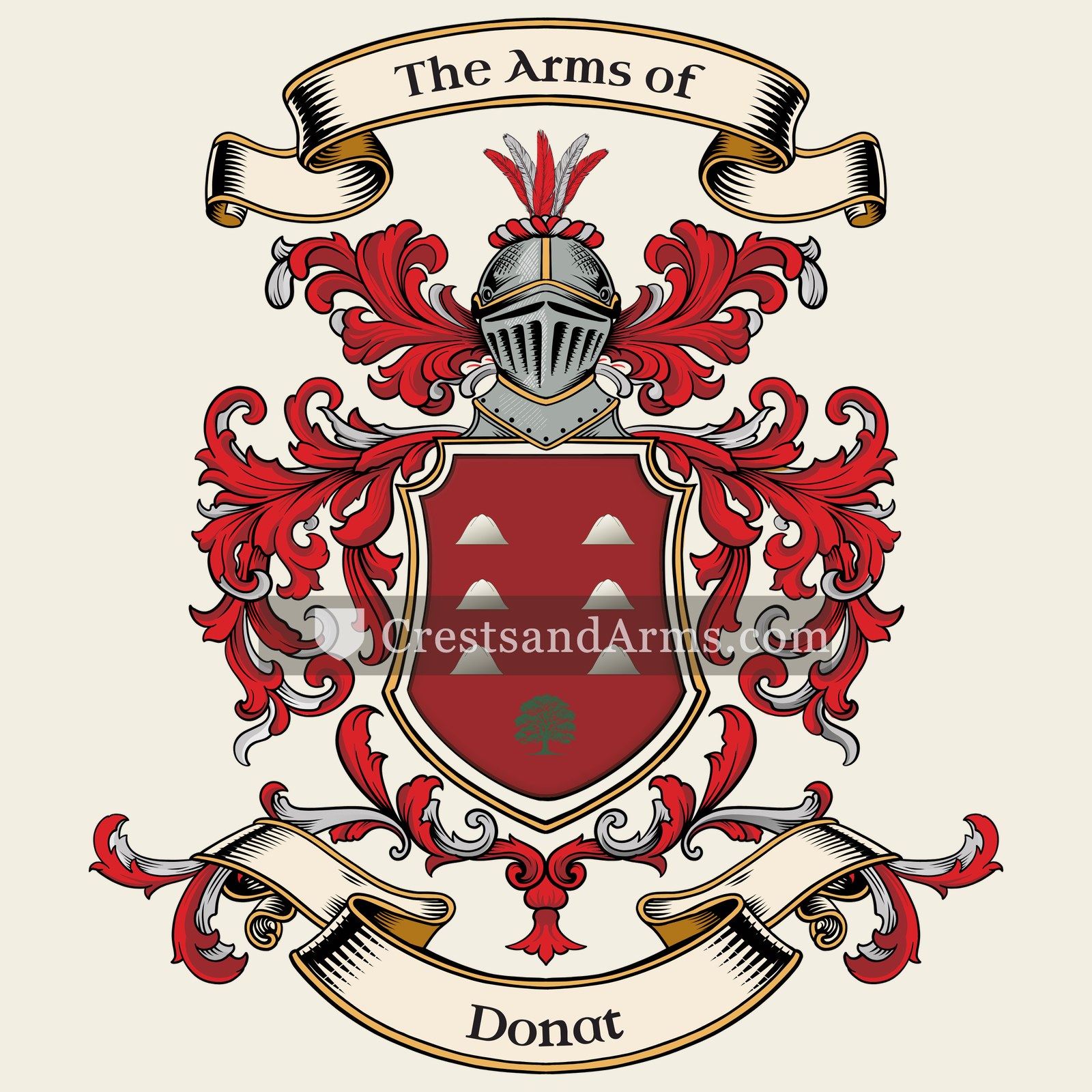
Symbols on this shield
mountThe ground held, and steadfastness upon it
treeLife, endurance and deep roots
Colours
Red (Gules)Means: Military strength
Silver (Argent)Means: Peace and sincerity
Historical info
Source
J. B. Rietstap, Armorial Général, Gouda: G. B. van Goor Zonen, 1884–87
Blazon (the actual original written record)
“De gu. à un mont de six coupeaux d'arg., mouv. de la p., sommé d'un arbre de sin.”
ItalyRome, c. 1775
Digital archive packCoat of arms PNG, gold border print PDF, vector SVG and the certificate of authenticity. Sent to your email in minutes.
Map of Italy showing where the Donat arms are recorded
The Donat arms were recorded in Rome, c. 1775.
This is where the arms were entered in the register. Families often moved to other parts of the country, so the same name can turn up in more than one region.
The body that granted and recorded arms in Italy in this period.
Alvise Giovanni Mocenigo
Sovereign of the period
Alvise Giovanni Mocenigo
1763–1778
Reigning in Germany when the Donat arms are first recorded.
How Arms Worked in Italy
In the Italian states, coats of arms were often used by noble families to show their status and history. These symbols were passed down through the generations to all legitimate male descendants. Younger branches of a family usually kept the original design but sometimes added small changes to distinguish their specific line from the main branch.
Granting authority
Various local rulers and city governments controlled the use of coats of arms across the different Italian states.
How they got arms
Families often assumed their own arms or received them as official grants from local lords, popes, or city councils.
Where arms were recorded
Arms were recorded in local city archives or private family books rather than in one single national register.
The family's standing
Recorded among the armigerous families of Italy.
Origin & History of the Donat Family in Italy
The family name Donat traces its roots to the Latin word donatus, which means given or gifted. In the context of Italian history, this name often reflected a family’s connection to religious devotion or a status as a gift from God. By the year 1775, records confirm that members of the Donat family were well-established residents of Rome. During this period, Rome was a center of immense cultural and administrative activity under the Papal States. Families living in the city at that time were frequently involved in the artisanal guilds, trade networks, or the complex bureaucracy that supported the Vatican. Living in Rome during the late eighteenth century meant that the Donat family was part of a vibrant urban society that was just beginning to experience the shifts of the Enlightenment and the changing political landscape of Europe. Their presence in the capital city suggests they were integrated into the social fabric of a region defined by its deep historical ties to the Roman Empire and the Catholic Church.
Donat Meaning & Related Branches
Root word
Donatus
Latin word meaning given or gifted by God.
This name
DonatA surname derived from a personal name signifying a gift or blessing.
also spelled
Donad
Documented Sources
J. B. Rietstap, Armorial Général, Gouda: G. B. van Goor Zonen, 1884–87
Bahlow, Hans, Deutsches Namenlexikon: Familien- und Vornamen nach Ursprung und Sinn erklärt, 1967


 armA person of action, industrious and laborious
 armA person of action, industrious and laborious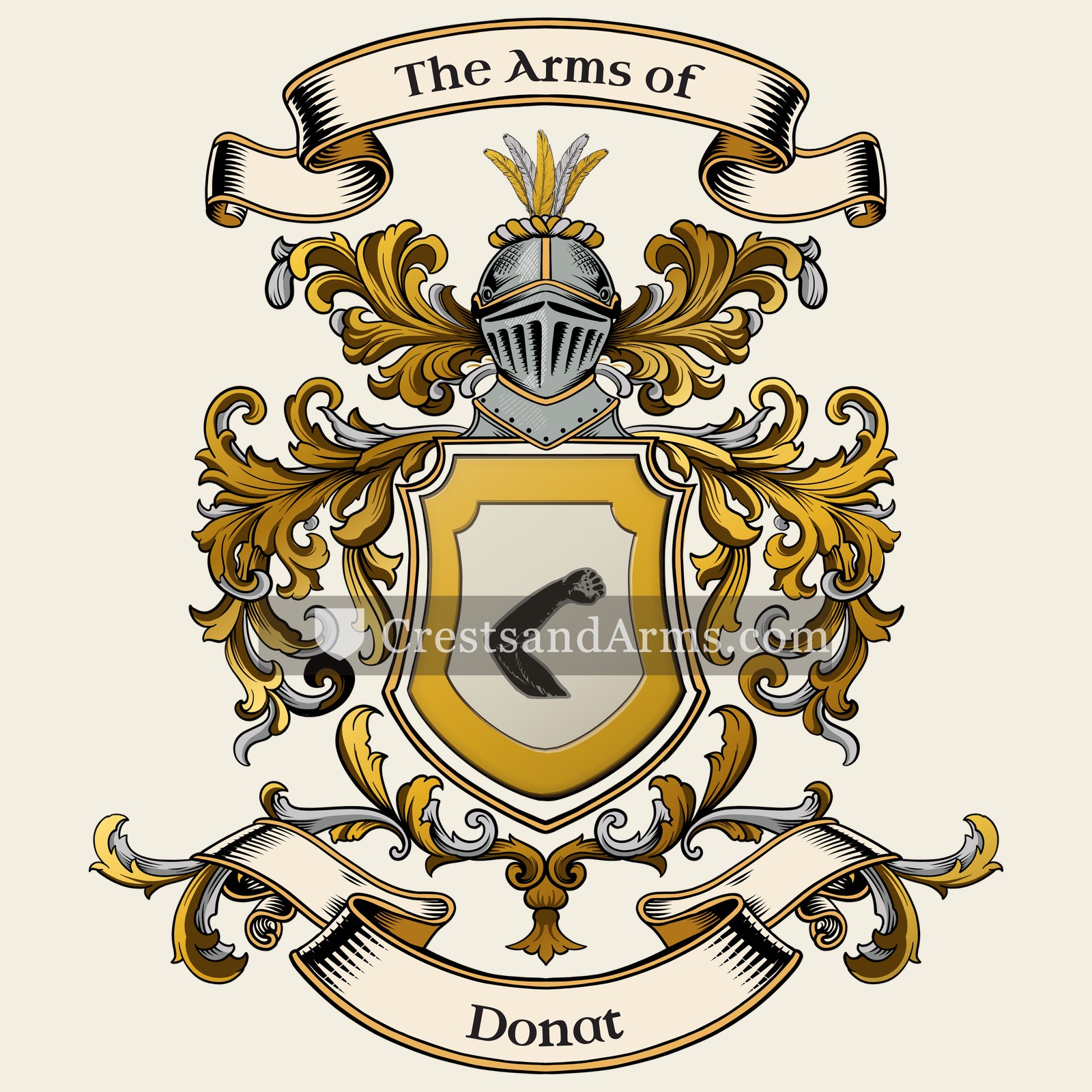


 mountThe ground held, and steadfastness upon it
 treeLife, endurance and deep roots