A record of documented arms, meaning and origin, researched for the Donath family lines. Documented in 2 countries.
Reg. 5762 · German, D–F
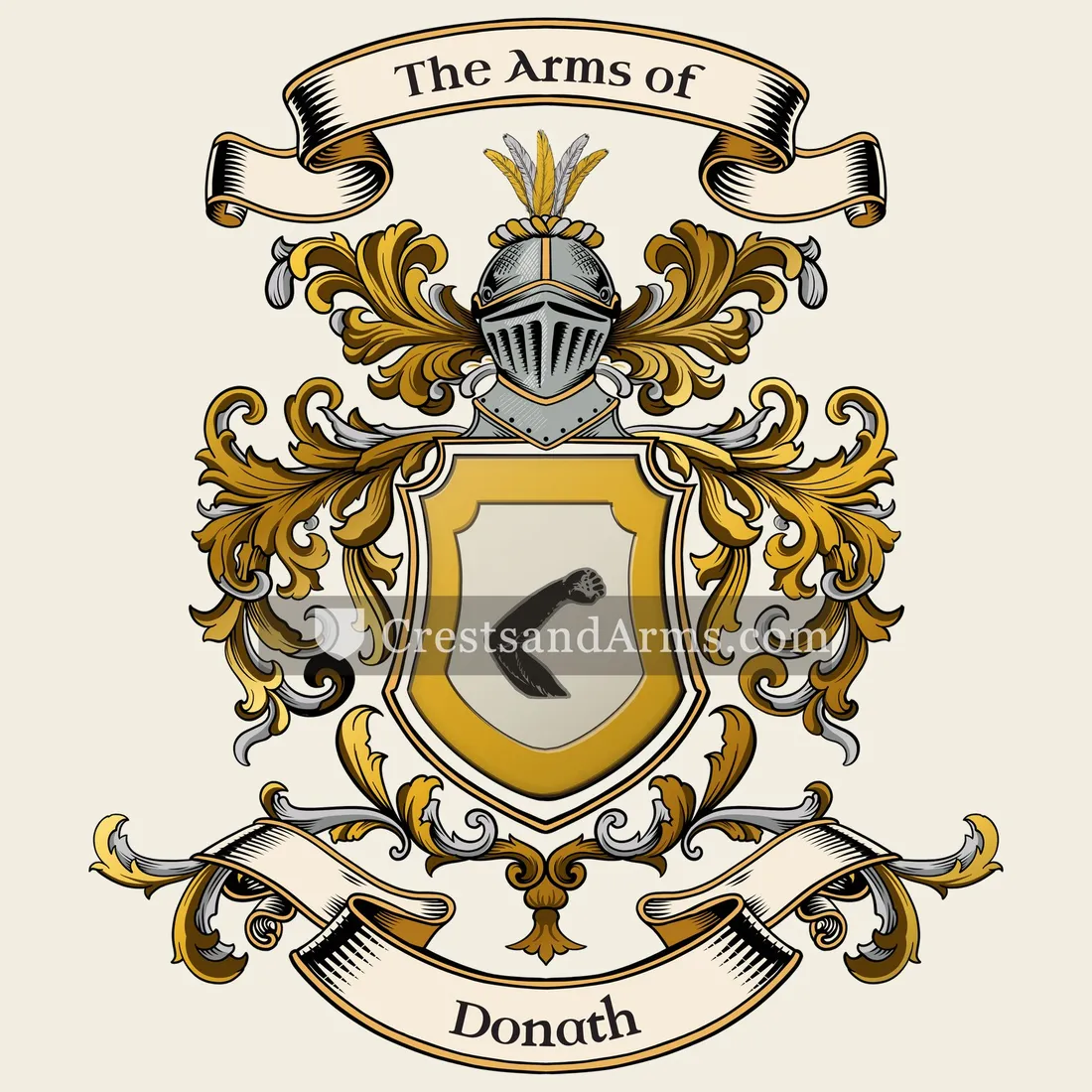
Meaning of the Donath family crest colors & symbols
Symbols on this shield
armA person of action, industrious and laborious
Colours
Silver (Argent)Means: Peace and sincerity
Gold (Or)Means: Generosity
Black (Sable)Means: Constancy
Historical info
Source
J. B. Rietstap, Armorial Général, Gouda: G. B. van Goor Zonen, 1884–87
Blazon (the actual original written record)
“D'arg. à un dextrochère, arm. de sa., sortant d'une nuée d'azur, mouv. du canton dextre du chef, la main de carn. supp. un coeur de gu., l'écu bordé d'or. Cq. cour. C.: un sauvage iss. de carn., ceint et cour. de lierre, tenant de sa main dextre une massue, la sen. appuyée sur sa hanche; entre un vol de gu. et d'azur. L.: à dextre d'arg. et d'azur, à sen. d'arg. et de gu.”
Germanyc. 1769
Digital archive packCoat of arms PNG, gold border print PDF, vector SVG and the certificate of authenticity. Sent to your email in minutes.
Map of Germany showing where the Donath arms are recorded
The Donath arms were recorded in Germany, c. 1769.
Arms such as these were typically recorded in Bavaria.
Bavaria was a country of old landed families and walled market towns. Estates passed down the same line for centuries, and both the landowners and the leading townsmen kept arms, which is why so many Bavarian names sit in the registers.
This is where the arms were entered in the register. Families often moved to other parts of the country, so the same name can turn up in more than one region.
The body that granted and recorded arms in Germany in this period.
Joseph II, Holy Roman Emperor
Sovereign of the period
Joseph II, Holy Roman Emperor
1765–1790
Reigning in Germany when the Donath arms are first recorded.
How Arms Worked in Germany
In the Holy Roman Empire, coats of arms were often granted to individuals by the Emperor or his representatives. These arms were then passed down through the generations to all legitimate descendants of the original holder. Younger branches of a family usually kept the same shield design without needing to change it, as the arms belonged to the entire lineage.
Granting authority
The Holy Roman Emperor held the sole power to grant new coats of arms throughout his vast imperial territories.
How they got arms
Families typically obtained their coats of arms through a formal imperial grant or by proving their noble status to the authorities.
Where arms were recorded
These grants were officially recorded in the Imperial Chancery registers, which began keeping formal records of such honors during the Middle Ages.
The family's standing
Recorded among the armigerous families of Germany.
Origin & History of the Donath Family in Germany
The surname Donath is a German variation of the name Daniel, which originated from the Hebrew language and means "God is my judge." During the Middle Ages, it became common for people to adopt the names of saints or biblical figures as surnames as populations grew and record-keeping became more formal. By the time ancestors of the Donath family were recorded in Bavaria in 1769, the name had already been established in various regions of Germany for several generations. Families with this name were often part of the hardworking middle class, frequently working as farmers, craftsmen, or tradespeople who helped build the local economy of the Bavarian countryside. Because the name was tied to a popular biblical figure, it spread naturally across different German-speaking lands as families moved to find new work or land. This history reflects the broader movement of people in central Europe who were defined by their local community roles and their religious heritage.
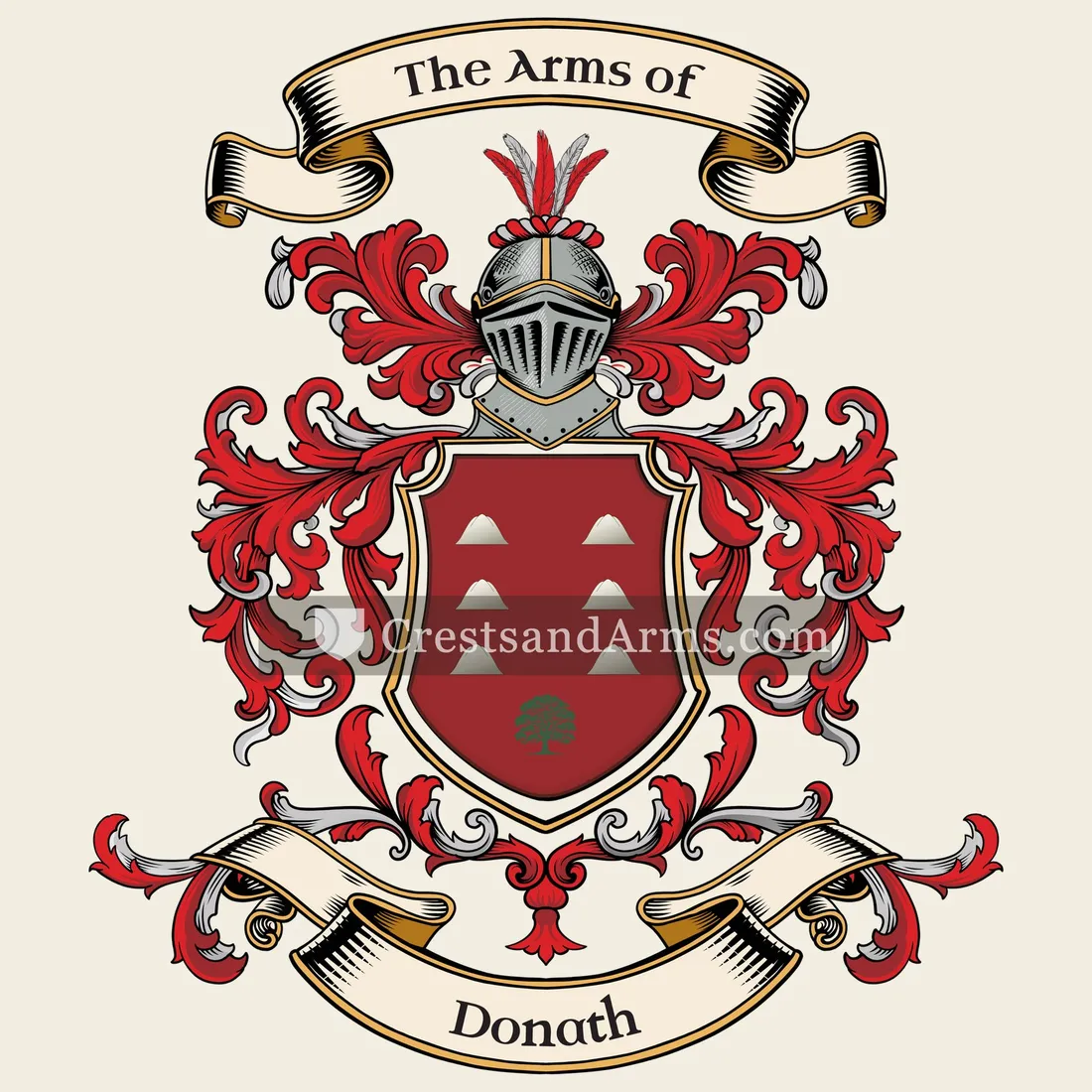
Meaning of the Donath family crest colors & symbols
Symbols on this shield
mountThe ground held, and steadfastness upon it
treeLife, endurance and deep roots
Colours
Red (Gules)Means: Military strength
Silver (Argent)Means: Peace and sincerity
Historical info
Source
J. B. Rietstap, Armorial Général, Gouda: G. B. van Goor Zonen, 1884–87
Blazon (the actual original written record)
“De gu. à un mont de six coupeaux d'arg., mouv. de la p., sommé d'un arbre de sin.”
ItalyRome, c. 1775
Digital archive packCoat of arms PNG, gold border print PDF, vector SVG and the certificate of authenticity. Sent to your email in minutes.
Map of Italy showing where the Donath arms are recorded
The Donath arms were recorded in Rome, c. 1775.
This is where the arms were entered in the register. Families often moved to other parts of the country, so the same name can turn up in more than one region.
The body that granted and recorded arms in Italy in this period.
Alvise Giovanni Mocenigo
Sovereign of the period
Alvise Giovanni Mocenigo
1763–1778
Reigning in Germany when the Donath arms are first recorded.
How Arms Worked in Italy
In the Italian states, coats of arms were often used by noble families to show their status and history. These symbols were passed down through the generations to all legitimate male descendants. Younger branches of a family usually kept the original design but sometimes added small changes to distinguish their specific line from the main branch.
Granting authority
Various local rulers and city governments controlled the use of coats of arms across the different Italian states.
How they got arms
Families often assumed their own arms or received them as official grants from local lords, popes, or city councils.
Where arms were recorded
Arms were recorded in local city archives or private family books rather than in one single national register.
The family's standing
Recorded among the armigerous families of Italy.
Origin & History of the Donath Family in Italy
The surname Donath carries a rich history that reflects the movement of people across Europe and into the heart of Italy. While the name itself has roots in Germanic and Central European naming traditions, records confirm that members of the family were well-established in Rome by 1775. During this period, Rome was a vibrant center for international trade, religious pilgrimage, and the arts, drawing families from across the continent to settle within its historic walls. The presence of the Donath family in the city during the late eighteenth century suggests they were likely part of a professional or merchant class that navigated the complex social structures of the Papal States. By integrating into the local Roman community, these early family members contributed to the diverse cultural landscape of the city during a time of significant political and social transition. Their transition into Italian life highlights how names often traveled alongside families as they sought new opportunities in major European capitals.
Donath Meaning & Related Branches
Root word
Donatus
Latin for given or gifted by God.
This name
DonathA German patronymic surname derived from a saint's name meaning gift of God.
also spelled
Donad
Documented Sources
J. B. Rietstap, Armorial Général, Gouda: G. B. van Goor Zonen, 1884–87
Bahlow, Hans, Deutsches Namenlexikon: Familien- und Vornamen nach Ursprung und Sinn erklärt, 1967
Heintze, Albert, Die deutschen Familien-Namen: geschichtlich, geographisch, sprachlich, 1903


 armA person of action, industrious and laborious
 armA person of action, industrious and laborious


 mountThe ground held, and steadfastness upon it
 treeLife, endurance and deep roots