Map of Italy showing where the Donati arms are recorded
The Donati arms were recorded in Florence, c. 1775.
This is where the arms were entered in the register. Families often moved to other parts of the country, so the same name can turn up in more than one region.
The body that granted and recorded arms in Italy in this period.
Alvise Giovanni Mocenigo
Sovereign of the period
Alvise Giovanni Mocenigo
1763–1778
Reigning in Italy when the Donati arms are first recorded.
How Arms Worked in Italy
In the Italian states, coats of arms were often used by noble families to show their status and history. These symbols were passed down through the generations to all legitimate male descendants. Younger branches of a family usually kept the original design but sometimes added small changes to distinguish their specific line from the main branch.
Granting authority
Various local rulers and city governments controlled the use of coats of arms across the different Italian states.
How they got arms
Families often assumed their own arms or received them as official grants from local lords, popes, or city councils.
Where arms were recorded
Arms were recorded in local city archives or private family books rather than in one single national register.
The family's standing
Recorded among the armigerous families of Italy.
Origin & History of the Donati Family in Italy
The Donati family name is deeply rooted in the history of Florence, where it emerged as a prominent force during the Middle Ages. The name itself is derived from the Italian word *donato*, which translates to "given" or "gift of God," reflecting a common naming tradition that signified a child as a blessing. By the time the family was firmly established in Florentine records in the late 18th century, they were already part of a long-standing legacy that had influenced the city’s political and social landscape for generations. The Donati were known for their active participation in the complex power struggles of the Tuscan region, often finding themselves at the center of civic life. Their presence in 1775 represents a continuation of this historical trajectory, as the family maintained their status as influential citizens within the shifting administrative structures of Italy. Through their involvement in local governance and trade, the Donati helped shape the identity of Florence, leaving a mark that persisted long after their early rise to prominence.
Coat of Arms & Family Crest Details
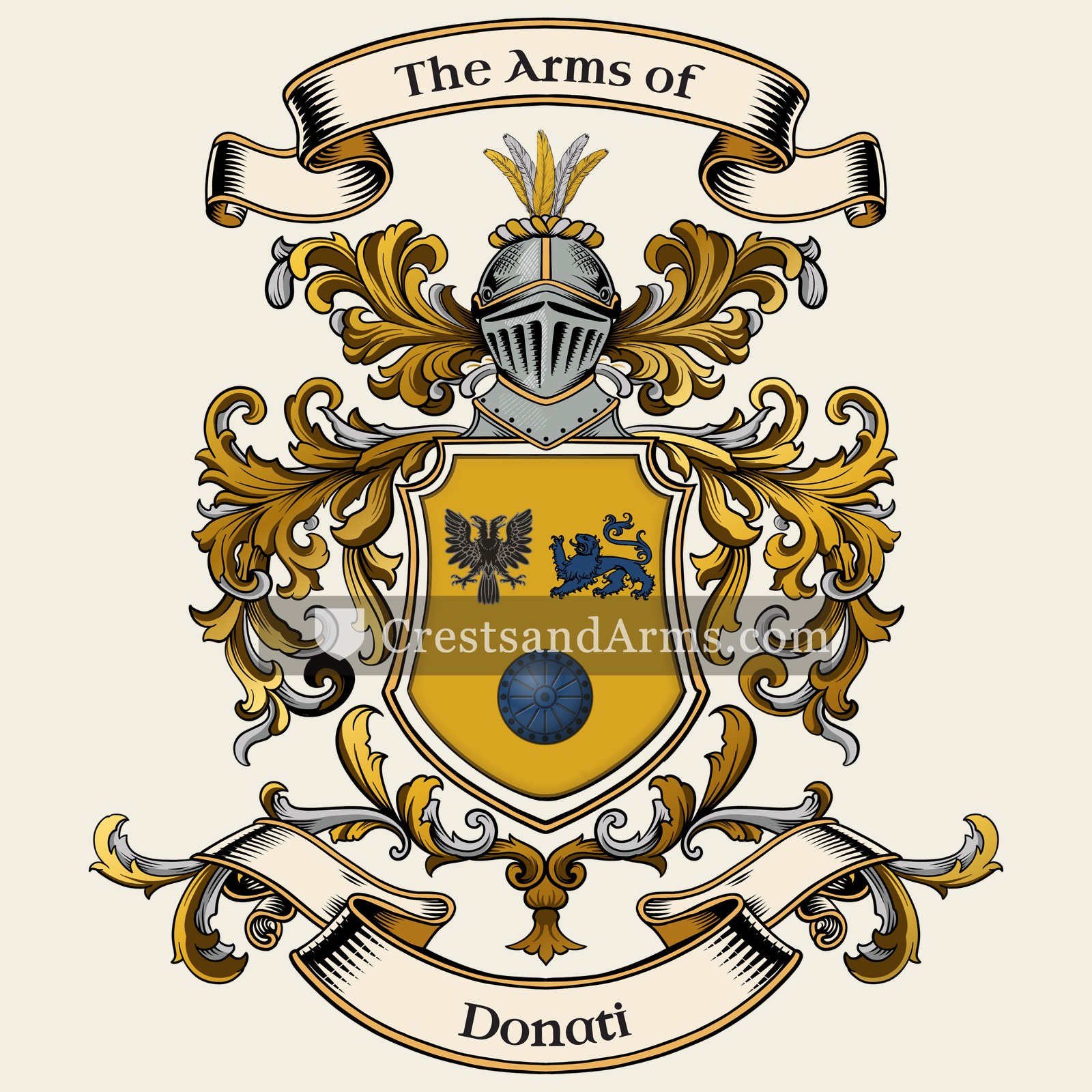
Symbols on this shield
eagleNobility, strength and a keen mind
lionCourage, strength and royalty
roundelA coin, and one who has been to the crusades
Colours
Gold (Or)Means: Generosity
Blue (Azure)Means: Loyalty and truth
Black (Sable)Means: Constancy
Historical info
Source
J. B. Rietstap, Armorial Général, Gouda: G. B. van Goor Zonen, 1884–87
Blazon (the actual original written record)
“Coupé: au 1 d'or à l'aigle de sa.; au 2 d'azur au lion d'or, supp. de sa patte dextre un monde du même. Cq. cour. C.: une femme iss. de carn., tenant de sa main sen. une voile d'antenne au-dessus de sa tête. L.: d'or et d'azur.”
SwitzerlandTessin Suisse, c. 1745
Digital archive packCoat of arms PNG, gold border print PDF, vector SVG and the certificate of authenticity. Sent to your email in minutes.
Map of Switzerland showing where the Donati arms are recorded
The Donati arms were recorded in Tessin Suisse, c. 1745.
Arms such as these were typically recorded in Bern.
Bern was the largest of the Swiss cantons and ran itself, with its own council and its own courts. Its governing families held office for generations, and office of that kind carried a shield with it.
This is where the arms were entered in the register. Families often moved to other parts of the country, so the same name can turn up in more than one region.
The body that granted and recorded arms in Switzerland in this period.
How Arms Worked in Switzerland
In Switzerland, coats of arms were not restricted to the nobility and were often adopted by common citizens and families. These symbols were passed down through generations to show family identity. When branches of a family grew, they often changed small details of the design to distinguish their own line from the original group.
Granting authority
Cantonal and civic authorities managed the use of coats of arms within their specific regions and local jurisdictions.
How they got arms
Families typically assumed their own coats of arms based on local custom rather than receiving them from a central monarch.
Where arms were recorded
Arms were recorded in various cantonal and civic registers starting from the fourteenth century throughout the Swiss region.
The family's standing
Recorded among the armigerous families of Switzerland.
Origin & History of the Donati Family in Switzerland
The Donati family name carries a history rooted in the movement of people across European borders during the eighteenth century. While the name is famously associated with Italian origins, its presence in Switzerland became officially documented by the middle of the 1700s. In 1745, records confirm that members of the Donati family were established residents of Bern. During this period, Bern was a center of trade and political influence, attracting skilled individuals and families from various regions. The Donati family likely integrated into the local society by participating in the city's commercial or civic life, which was common for families settling in the Swiss cantons at that time. By establishing themselves in Bern, the family became part of the diverse social fabric that defined the city during the Enlightenment, marking the beginning of their long-standing connection to Swiss history.
Donati Meaning & Related Branches
Root word
Donatus
Latin for given or gifted by God.
This name
DonatiDerived from the past participle of the verb donare, signifying one who is a gift.
also spelled
Donatti
Donaty
Donatee
Documented Sources
J. B. Rietstap, Armorial Général, Gouda: G. B. van Goor Zonen, 1884–87
Dante Alighieri, La Divina Commedia, 1320
John M. Najemy, A History of Florence 1200–1575, 2006
Archivio di Stato di Firenze, Catasto, 1427
Digital archive packCoat of arms PNG, gold border print PDF, vector SVG and the certificate of authenticity. Sent to your email in minutes.




 eagleNobility, strength and a keen mind
 lionCourage, strength and royalty
 roundelA coin, and one who has been to the crusades