Map of England showing where the Donovan arms are recorded
The Donovan arms were recorded in Sussex, c. 1620.
Sussex had ironworks in its woods and good farmland on its downs. Both made money, and families who made it bought manors, which is what put their names in the heraldic records.
This is where the arms were entered in the register. Families often moved to other parts of the country, so the same name can turn up in more than one region.
The body that granted and recorded arms in England in this period.
James VI and I
Sovereign of the period
James VI and I
1603–1625
Reigning in England when the Donovan arms are first recorded.
How Arms Worked in England
English heraldry allowed arms to be shared by all legitimate descendants of the original owner. These symbols were treated as personal property that moved through the generations to all children. While the eldest son kept the original design, other family members could use the same shield without needing to change it or register their own unique versions.
Granting authority
The College of Arms in London has regulated the use of coats of arms throughout England and Wales since 1484.
How they got arms
Families typically obtained their coats of arms through a formal grant from the Crown or by proving their ancient right to them.
Where arms were recorded
All official coats of arms are recorded in the registers kept at the College of Arms, which date back to the fifteenth century.
The family's standing
Recorded among the armigerous families of Sussex.
Origin & History of the Donovan Family in England
The family name Donovan has deep roots that stretch back to the early seventeenth century in the county of Sussex. By the year 1620, records indicate that members of the family were already established as part of the local community in this region of England. During this period, the name was often recorded in parish registers as families interacted with their local churches for baptisms, marriages, and burials. These early settlers were likely part of the growing population that helped shape the rural landscape of southern England during the reign of King James I. While the name is often associated with Irish origins, its presence in Sussex shows how families moved and settled across different regions to build new lives. These early Donovan ancestors lived through a time of significant social change, contributing to the local history of their parishes through their daily work and community ties.
Coat of Arms & Family Crest Details
Symbols on this shield
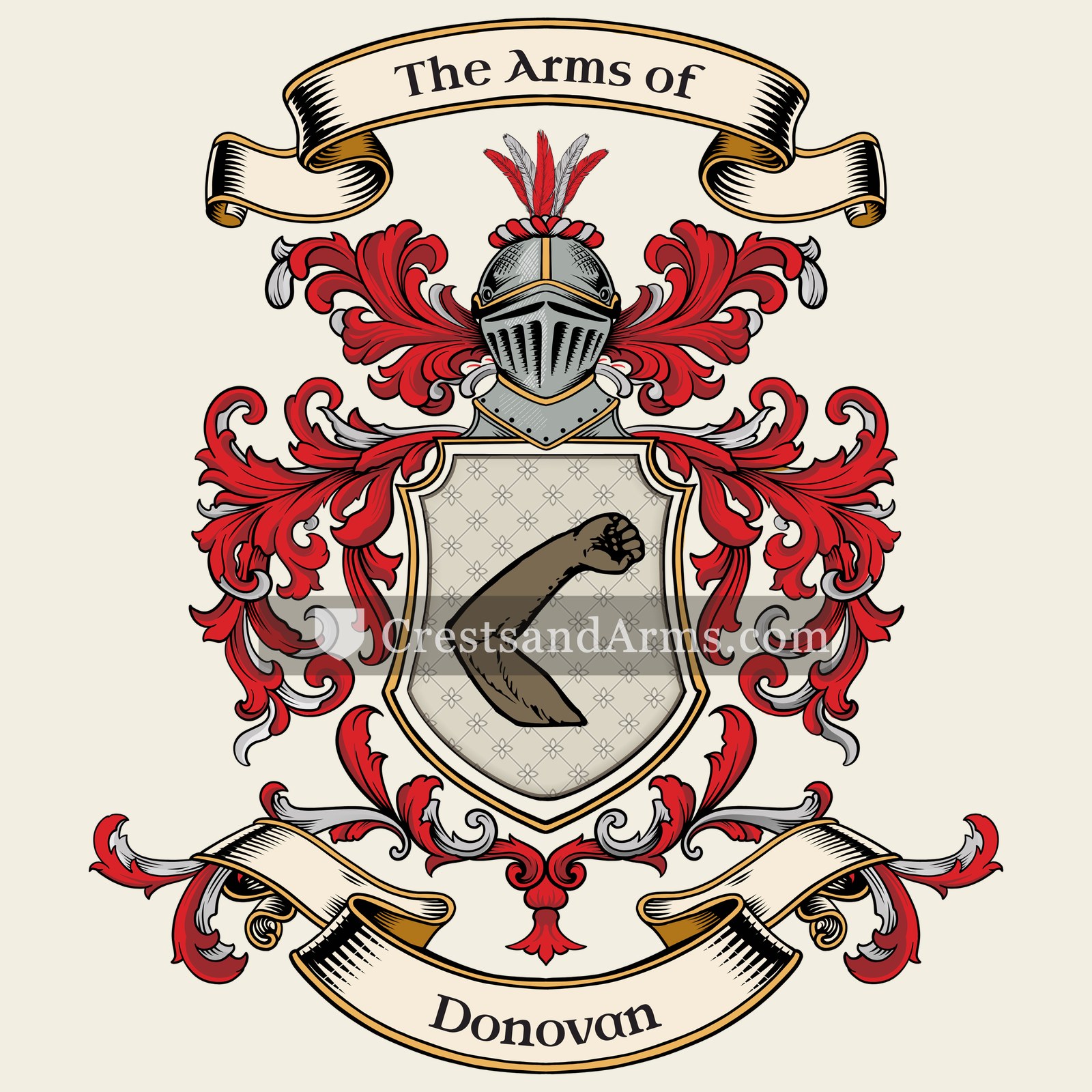
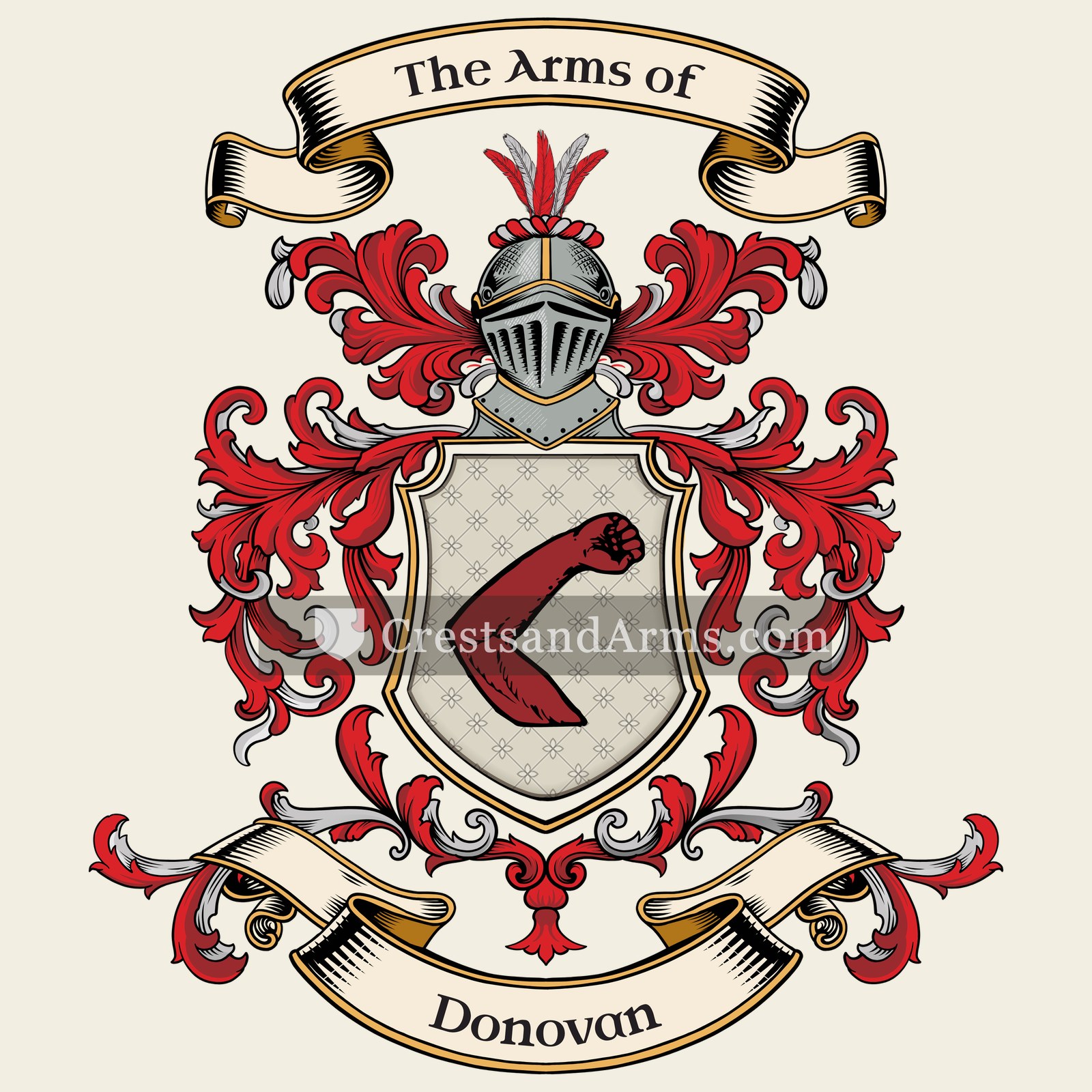
armA person of action, industrious and laborious
Colours
Silver (Argent)Means: Peace and sincerity
Red (Gules)Means: Military strength
Historical info
Source
Sir Bernard Burke, The General Armory of England, Scotland, Ireland and Wales, London: Harrison & Sons, 1884
Blazon (the actual original written record)
“Ar. issuing from the sinister side of the shield a cubit dexter arm vested gu. cuffed of the first, the hand grasping an old Irish sword, the blade entwined with a serpent all ppr”
WexfordBallymore · Wexford, c. 1645
Digital archive packCoat of arms PNG, gold border print PDF, vector SVG and the certificate of authenticity. Sent to your email in minutes.
Map of Ireland showing where the Donovan arms are recorded
The Donovan arms were recorded in Wexford, c. 1645.
Wexford was the corner of Ireland closest to Wales, settled early by Norman families. They held their land under arms and kept it for generations, which is why so many Wexford names carry recorded shields.
This is where the arms were entered in the register. Families often moved to other parts of the country, so the same name can turn up in more than one region.
The body that granted and recorded arms in Ireland in this period.
Charles I of England
Sovereign of the period
Charles I of England
1625–1649
Reigning in England when the Donovan arms are first recorded.
How Arms Worked in Ireland
The Ulster King of Arms granted coats of arms to individuals who proved their social standing and good character. These symbols were typically inherited by all legitimate descendants of the original holder. If a family branch wanted a unique look, they could apply for a specific change to their design through the office to ensure their identity remained distinct.
Granting authority
The Ulster King of Arms acted as the official body that regulated and issued all coats of arms throughout Ireland.
How they got arms
Families obtained their arms through formal grants issued by the office after proving their eligibility and paying the required fees.
Where arms were recorded
All official grants were recorded in the registers held by the Ulster King of Arms starting from the year 1552.
The family's standing
Recorded among the armigerous families of Wexford.
Origin & History of the Donovan Family in Ireland
The surname Donovan, or Ó Donnabháin in its original Irish form, traces its roots back to the ancient kingdoms of Munster, specifically within the Eóganachta dynasty. While the name is famously associated with the southwest of Ireland, historical records confirm that members of the family were established in County Wexford by 1645. During this period, Ireland faced intense political upheaval and land displacement, which often forced families to migrate from their ancestral territories to different provinces. The name itself is derived from the Gaelic words for dark and brown, likely referring to the physical appearance of an early ancestor. As the family settled in Wexford, they became part of the complex social fabric of the seventeenth century, living through a time when the traditional Gaelic way of life was rapidly changing under new governance. By maintaining their presence in the region, the Donovan family contributed to the long history of migration and survival that defines many Irish lineages from that era.
Donovan Meaning & Related Branches
Root word
Donnchadh
Derived from the Gaelic words for brown and warrior or chief.
This name
DonovanA surname of Irish origin meaning dark-haired chieftain or brown-haired warrior.
also spelled
Donevan
Donnavan
Related arms
Burgesrecorded with Donovan, same area
Documented Sources
Sir Bernard Burke, The General Armory of England, Scotland, Ireland and Wales, London: Harrison & Sons, 1884
Sussex Family History Group, Sussex Parish Registers, 1620
The National Archives, Parish registers for the county of Sussex, series ref: RG 4
Digital archive packCoat of arms PNG, gold border print PDF, vector SVG and the certificate of authenticity. Sent to your email in minutes.


 armA person of action, industrious and laborious
 armA person of action, industrious and laborious