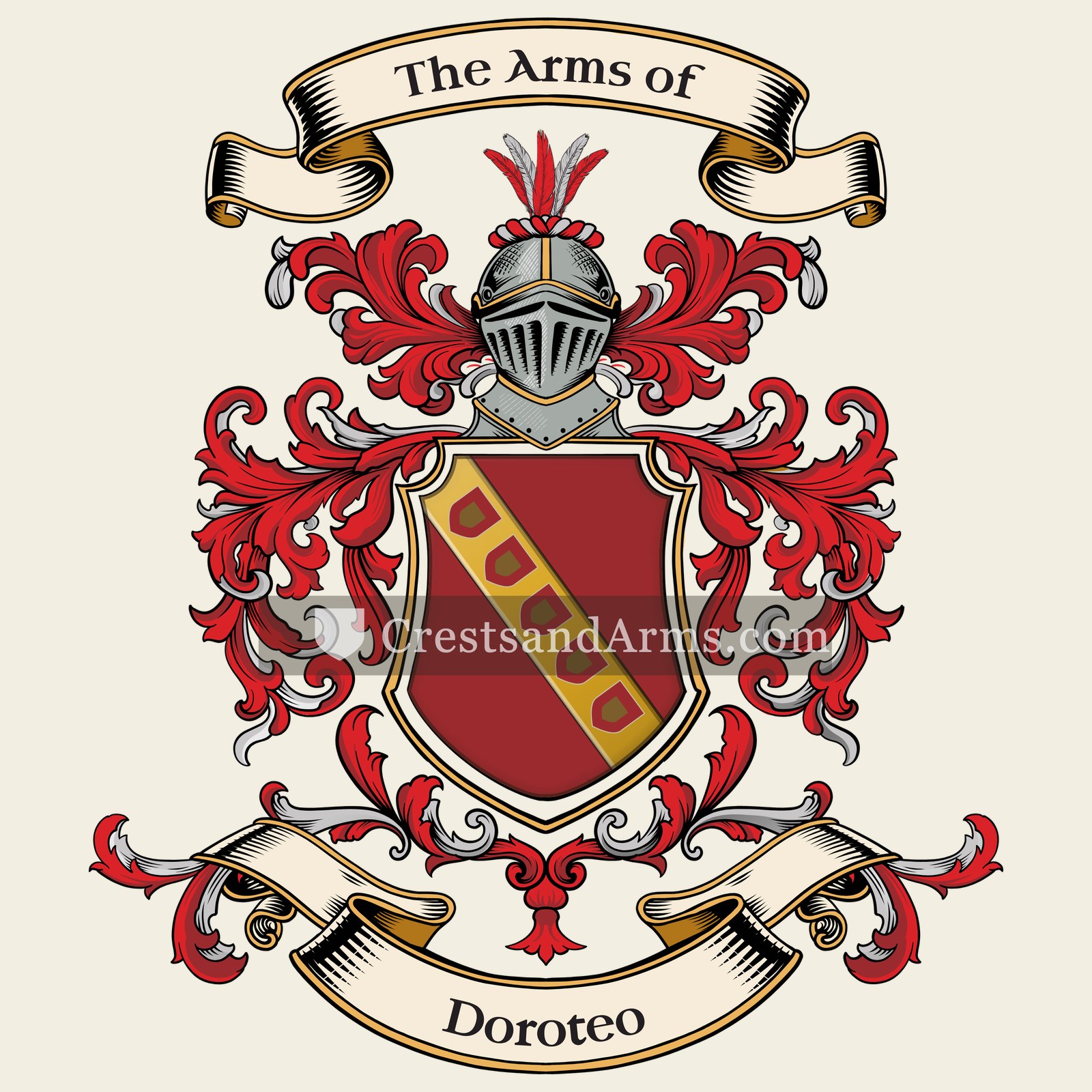
A record of documented arms, meaning and origin, researched for the Doroteo family of Italy.
Reg. 9850 · Italian, D–F
Coat of Arms & Family Crest Details
Symbols on this shield
bendDefence, and the scarf of a commander
escutcheonA shield within a shield, and a claim inherited
Colours
Red (Gules)Means: Military strength
Gold (Or)Means: Generosity
Historical info
Source
J. B. Rietstap, Armorial Général, Gouda: G. B. van Goor Zonen, 1884–87
Blazon (the actual original written record)
“De gu. à la bande d'or, ch. de cinq écussons du champ, posés dans le sens de la bande. Cq. cour. C.: cinq pl. d'aut., alt. de gu. et d'or [V. Celio-Doroteo.]”
DalmatiaDalmatia, c. 1775
Digital archive packCoat of arms PNG, gold border print PDF, vector SVG and the certificate of authenticity. Sent to your email in minutes.
Map of Italy showing where the Doroteo arms are recorded
The Doroteo arms were recorded in Dalmatia, c. 1775.
Dalmatia was a string of walled towns along the Adriatic coast, each with its own leading families. Sea trade made them wealthy, and the towns kept lists of the houses entitled to arms.
This is where the arms were entered in the register. Families often moved to other parts of the country, so the same name can turn up in more than one region.
The body that granted and recorded arms in Italy in this period.
Alvise Giovanni Mocenigo
Sovereign of the period
Alvise Giovanni Mocenigo
1763–1778
Reigning in Italy when the Doroteo arms are first recorded.
How Arms Worked in Italy
In the Italian states, coats of arms were often used by noble families to show their status and history. These symbols were passed down through the generations to all legitimate male descendants. Younger branches of a family usually kept the original design but sometimes added small changes to distinguish their specific line from the main branch.
Granting authority
Various local rulers and city governments controlled the use of coats of arms across the different Italian states.
How they got arms
Families often assumed their own arms or received them as official grants from local lords, popes, or city councils.
Where arms were recorded
Arms were recorded in local city archives or private family books rather than in one single national register.
The family's standing
Recorded among the armigerous families of Dalmatia.
Origin & History of the Doroteo Family in Italy
The name Doroteo traces its roots to the Greek name Dorotheos, which translates to a gift of God. While the name was common throughout the Mediterranean due to its religious significance, the family established a documented presence in the coastal region of Dalmatia by 1775. During this period, Dalmatia was a vibrant crossroads of culture under the influence of the Venetian Republic. Families living in this area often served as vital links between the maritime trade networks of the Adriatic Sea and the inland territories of the Balkans. As members of a community shaped by both Roman and Slavic traditions, the early Doroteo family likely navigated a society that valued seafaring, craftsmanship, and local governance. Their presence in the region during the late eighteenth century suggests they were part of the stable, established population that contributed to the unique social fabric of the Dalmatian coast before the major political shifts of the nineteenth century.
Doroteo Meaning & Related Branches
Root word
Dorotheos
Derived from the Greek words for gift and god.
This name
DoroteoA name signifying a gift from God, reflecting divine blessing and favor.
also spelled
Dorote
Documented Sources
J. B. Rietstap, Armorial Général, Gouda: G. B. van Goor Zonen, 1884–87
State Archives in Zadar (Državni arhiv u Zadru), Matice krštenih (Baptismal Registers), 1775
State Archives in Split (Državni arhiv u Splitu), Katastarski spisi (Cadastral Records), 18th century
Fisković, Cvito. Dalmatinski gradovi i ljudi (Dalmatian Cities and People), 1965
Novak, Grga. Prošlost Dalmacije (The Past of Dalmatia), 1944
Digital archive packCoat of arms PNG, gold border print PDF, vector SVG and the certificate of authenticity. Sent to your email in minutes.


 bendDefence, and the scarf of a commander
 escutcheonA shield within a shield, and a claim inherited
 bendDefence, and the scarf of a commander
 escutcheonA shield within a shield, and a claim inherited