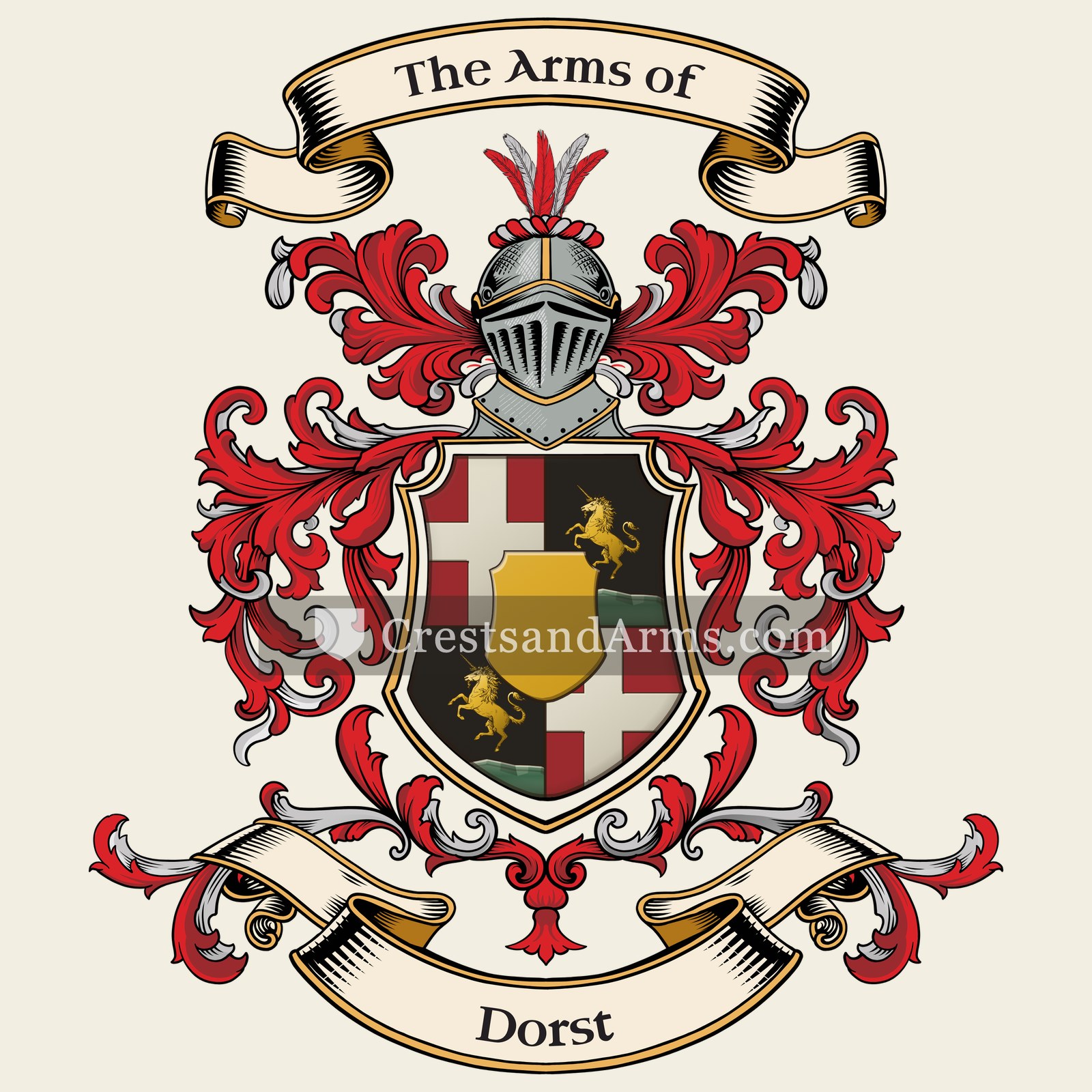
A record of documented arms, meaning and origin, researched for the Dorst family of Germany.
Reg. 8991 · German, D–F
Coat of Arms & Family Crest Details
Symbols on this shield
cross symbolChristian faith and service
mountThe ground held, and steadfastness upon it
cantonA mark of honour granted by the sovereign
unicornPurity, and extreme courage in defence of honour
heartSincerity, charity and true affection
crownSovereignty, authority and just reward
Colours
Red (Gules)Means: Military strength
Black (Sable)Means: Constancy
Gold (Or)Means: Generosity
Silver (Argent)Means: Peace and sincerity
Green (Vert)Means: Hope
Blue (Azure)Means: Loyalty and truth
Historical info
Source
J. B. Rietstap, Armorial Général, Gouda: G. B. van Goor Zonen, 1884–87
Blazon (the actual original written record)
“Ec.: aux 1 et 4 de gu. à la croix d'arg.; aux 2 et 3 de sa. à une licorne ramp. d'or, soutenue d'un tertre de sin. Sur le tout de Dorst, qui est éc. d'or et de gu., le 4e quartier ch. d'un canton d'azur surch. d'un coeur d'or surm. d'une couronne princière. Deux cq., le 2 cour. C.: 1° un écusson aux armes du canton du surtout; entre deux prob., coupées alt. d'or et de gu.; 1. d'or et de gu.; 2° un demi-vol aux armes du”
SilesiaSilesia, c. 1850
Digital archive packCoat of arms PNG, gold border print PDF, vector SVG and the certificate of authenticity. Sent to your email in minutes.
Map of Germany showing where the Dorst arms are recorded
The Dorst arms were recorded in Silesia, c. 1850.
Silesia was farming country in the east of the German lands, held in large estates by families who stayed put for generations. Owning land was what entitled a family to arms, so the region fills a good deal of the register.
This is where the arms were entered in the register. Families often moved to other parts of the country, so the same name can turn up in more than one region.
The body that granted and recorded arms in Germany in this period.
Frederick William IV of Prussia
Sovereign of the period
Frederick William IV of Prussia
1840–1861
Reigning in Germany when the Dorst arms are first recorded.
How Arms Worked in Germany
Prussian heraldry was strictly tied to social rank and noble status rather than being a free choice for every citizen. These symbols were treated as permanent family property that moved through the generations to all legitimate heirs. If a family branch wanted to change their design to stand out, they had to apply for official permission to alter their specific version of the shield.
Granting authority
The Prussian Heroldsamt acted as the central state office that managed and strictly controlled all noble titles and coats of arms.
How they got arms
Families usually obtained their arms through formal royal grants or by proving their long-standing noble status to the state authorities.
Where arms were recorded
All official coats of arms were kept in the rolls of the Prussian Heroldsamt, which functioned from 1706 until 1918.
The family's standing
Recorded among the armigerous families of Silesia.
Origin & History of the Dorst Family in Germany
The family name Dorst is rooted in the German language and likely originated as a descriptive nickname for a person who was particularly bold or sturdy. In the Middle Ages, names often evolved from personal traits or occupations, and the root word suggests a sense of firmness or endurance. By the mid-19th century, records confirm that families bearing this name were well-established in the region of Silesia. This area, which was then part of the Prussian Kingdom, served as a cultural crossroads where families often worked in agriculture, trade, or local craftsmanship. As these individuals moved through the changing political landscapes of Central Europe, the name remained a consistent marker of their heritage and their deep connection to the lands of Silesia.
Dorst Meaning & Related Branches
Root word
Durst
Middle High German term for thirst or a craving for drink.
This name
DorstA nickname for a person who was known for being a heavy drinker or thirsty.
also spelled
Dorst
Schatzberg
Dorst de Shatsberg
Documented Sources
J. B. Rietstap, Armorial Général, Gouda: G. B. van Goor Zonen, 1884–87
Bahlow, Hans, Deutsches Namenlexikon: Familien- und Vornamen nach Ursprung und Sinn erklärt, 1967
Heintze, Albert, Die deutschen Familien-Namen: geschichtlich, geographisch, sprachlich, 1903
Archiwum Państwowe we Wrocławiu (State Archives in Wrocław), Standesamtregister (Civil Registry Records), 1850
Digital archive packCoat of arms PNG, gold border print PDF, vector SVG and the certificate of authenticity. Sent to your email in minutes.


 cross symbolChristian faith and service
 mountThe ground held, and steadfastness upon it
 cantonA mark of honour granted by the sovereign
 unicornPurity, and extreme courage in defence of honour
 heartSincerity, charity and true affection
 crownSovereignty, authority and just reward
 cross symbolChristian faith and service
 mountThe ground held, and steadfastness upon it
 cantonA mark of honour granted by the sovereign
 unicornPurity, and extreme courage in defence of honour
 heartSincerity, charity and true affection
 crownSovereignty, authority and just reward