Map of Switzerland showing where the Doscher arms are recorded
The Doscher arms were recorded in Soleure, c. 1745.
This is where the arms were entered in the register. Families often moved to other parts of the country, so the same name can turn up in more than one region.
The body that granted and recorded arms in Switzerland in this period.
How Arms Worked in Switzerland
In Switzerland, coats of arms were not restricted to the nobility and were often adopted by common citizens and families. These symbols were passed down through generations to show family identity. When branches of a family grew, they often changed small details of the design to distinguish their own line from the original group.
Granting authority
Cantonal and civic authorities managed the use of coats of arms within their specific regions and local jurisdictions.
How they got arms
Families typically assumed their own coats of arms based on local custom rather than receiving them from a central monarch.
Where arms were recorded
Arms were recorded in various cantonal and civic registers starting from the fourteenth century throughout the Swiss region.
The family's standing
Recorded among the armigerous families of Switzerland.
Origin & History of the Doscher Family in Switzerland
The family name Doscher has deep roots in the German-speaking regions of Europe, where it likely originated as a descriptive surname. In the local dialects of Northern Germany, the name is often associated with the word "Dose," which historically referred to a small container or a box. It is possible that an early ancestor was a skilled craftsman who made these items, leading neighbors to identify the family by their trade. By the mid-eighteenth century, the family had established a presence in the Swiss city of Soleure. Records from 1745 confirm that members of the Doscher family were living in this region during a time of significant social and economic change. As they settled in Soleure, they integrated into the local community while maintaining the unique identity tied to their ancestral name. This migration highlights how families moved across European borders to seek new opportunities while preserving their heritage through their surnames.
Doscher Meaning & Related Branches
Root word
Toscher
A person who works with or makes cups or bowls.
This name
DoscherAn occupational surname derived from the Middle High German word for a cup maker or tavern keeper.
also spelled
Discherre
Discheri
Disher
Documented Sources
J. B. Rietstap, Armorial Général, Gouda: G. B. van Goor Zonen, 1884–87
Bahlow, Hans, Deutsches Namenlexikon: Familien- und Vornamen nach Ursprung und Sinn erklärt, 1967
Staatsarchiv des Kantons Solothurn, Kirchenbücher der Stadt Solothurn (Tauf-, Ehe- und Totenrodel), 1745
Digital archive packCoat of arms PNG, gold border print PDF, vector SVG and the certificate of authenticity. Sent to your email in minutes.


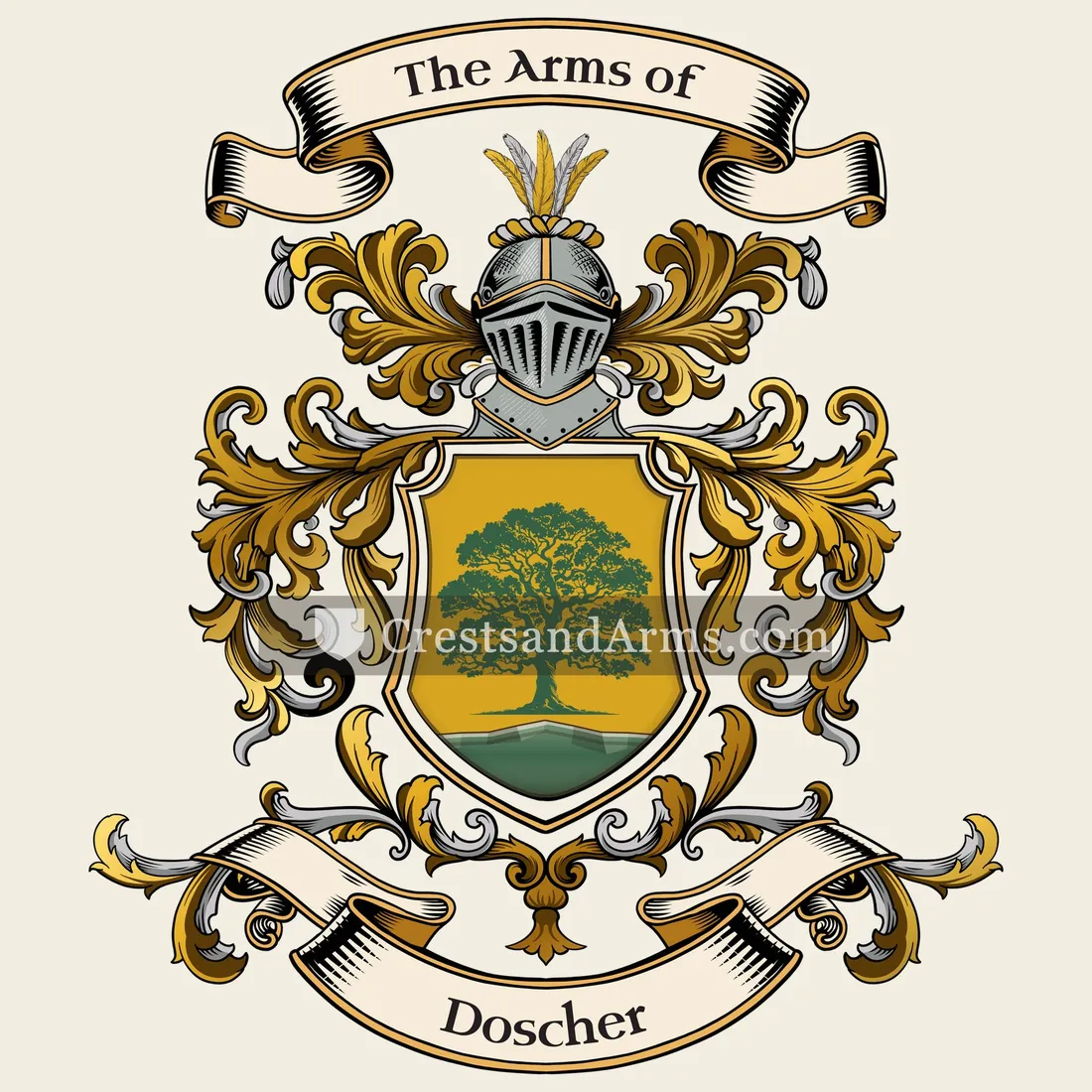
 mountThe ground held, and steadfastness upon it
 treeLife, endurance and deep roots
 mountThe ground held, and steadfastness upon it
 treeLife, endurance and deep roots